by Jeffrey Insko | Mar 6, 2014 |
Today is a big day up in Canada. As we noted earlier this morning, the National Energy Board will announce its decision on the Line 9 reversal project this afternoon. To mark this occasion, we are pleased to bring you these reflections form our friend Emily Ferguson, keeper of the marvelous Line 9 Communities blog and resource, where this is cross-posted.
Reflections on Line 9
by Emily Ferguson
In anticipation of the Line 9 decision to be released March 6th, 2014, I can’t help but reflect about the year that has passed. It would have been about this time last year that my journey began.
The night I requested a Line 9 info package from Enbridge representatives at a public meeting – and was denied – was the night that started this incredible journey. As a student of environmental politics at McMaster University in Hamilton, Ontario, I was interested to understand where the pipeline was located and what the local issues were. I finished class, jumped on a bus, and grabbed a $40 cab to the remote meeting location – remember, I was a student.
The meeting consisted of a brief presentation by Enbridge and then questions from Conservation Halton Board members. After the meeting, I approached the five or so company representatives in the lobby. Although attempting to be outgoing, I was still a very much soft-spoken introvert. My hands were trembling as I approached Enbridge and requested a copy of the extra info packages they held in their hands – which had just been provided to Conservation Halton Board members.
After a very brief discussion where I was interrogated about my name, address, and “who I was working for”, I walked away empty handed. FYI – I got the info package anyways the next day from a contact on the Conservation Board. Hardly an “abrupt and confrontational approach” as described by Graham White of Enbridge in the January 2014 Toronto Star special report (who by the way I have never met and who was not present at that meeting).
After that exchange, I instantly felt a need to know more and the responsibility to ensure others had the information as well. If I was going to discuss the info with affected communities, I needed to know who those affected communities were! So I went home and started mapping the pipeline …
To be honest, I could not be more grateful for the individuals at Enbridge – you know who you are – for denying a young, timid student access to public information. You gave me the motivation to dig for the answers and to connect with communities through the sharing of information. It was at this point I found the strength to continue the journey. I was ready for the challenge.
I quickly discovered that Line 9 travelled straight through the small community I grew up in – Glenburnie, Ontario. I was shocked! Having lived in that community for over 17 years, my family and friends had no idea there was an oil pipeline running next to my beloved country public school. I started a website with the intention to educate the Glenburnie community. You can actually still see my original website at www.line9glenburnie.wordpress.com.
However, within 5 minutes of its creation, I was already thinking much bigger. If my community didn’t know about the pipeline, how many other communities were in the dark? Line 9 Glenburnie rapidly developed into Line 9 Communities. The success of www.line9communities.com has been overwhelming! I poured my heart into writing factual articles about the project application and entire history of Line 9, but the main attraction was – and continues to be – the pipeline maps.
Line 9 Communities was launched March 17th, 2013. By that time, it became very apparent that my Grandma was beginning to lose her courageous battle with cancer. She keenly followed my journey with enthusiasm, and supported my ambition to learn and teach others. By April 18th, she was hospitalized. She asked me what I was going to do about the pipeline. She didn’t agree with the secrecy and the lack of information around the Line 9 project. She pushed me to do more. On April 19th, I sat by her bed side and applied to be an Intervenor in the Canadian National Energy Board hearing on the project. Once the application was submitted, she said “Good! You’re going to get in!” At sunrise on April 22nd– Earth Day – she was gone.
People say things happen for a reason. I firmly believe that. As she peacefully took her last breath, she held my hand and repeated my name over and over. The following week, we held a small memorial at her final resting place – less than 600m from the pipeline. My participation in the NEB Line 9 hearing became so much more. I was now working in her memory.
In the January 2014 Toronto Star report, Mr. White (Enbridge) labelled me as a “stringent opponent of the project and an activist”. Although I do not label myself as an “activist”, I do believe in having your voice heard about a social cause. And if by “stringent” Mr. White means “not allowing for any exceptions or loosening of standards” as defined by the Merriam-Webster dictionary, then I whole heartedly agree. Why would Mr. White expect anything less than communities along the line to demand Enbridge meet existing standards of operating a pipeline in Canada?
Through the summer of 2013, I was immersed in reading regulatory documents, submitting information requests to Enbridge, keeping up with media coverage and building the Line 9 Communities website. In October 2013, final oral arguments were given in Toronto, Ontario. As I wore my Grandma’s gold angel pin, I delivered what will always be one of the most powerful speeches of my life.
The final hearings were incredibly inspiring. There were so many groups standing united and highlighting the poor consultation and questionable safety of the project. First Nations, Métis, neighbourhood organizations, government and individual citizens brought their concerns to the NEB.
After the NEB process was complete, I continued to network with all the incredible people I had met along the way. One word could describe the whole journey – community. Enbridge Line 9 has re-connected me with my childhood community and the pipeline route has provided me a path to connect with other communities and hear their stories.
Reflecting on my journey, I have realized how much I have grown as a person in the last year. I am no longer timid in approaching large players and asking the tough questions. I have a strong interest in encouraging active engagement in social and environmental causes. Through the support of others along the ride, I now personally understand what it means to be empowered. Moving forward, my goal is to take the valuable lessons learned over the past year and use my experience to help encourage others to find their voice and make a difference.
Regardless of the NEB decision to be released March 6th, 2014, www.line9communities.com will continue to unite and be a forum for communities to raise awareness and promote discussion.
Some things really matter, and Line 9 is definitely one of them!
by Jeffrey Insko | Mar 6, 2014 |
Good news from Ingham County, the three Michigan CATS who have been in jail, remanded needlessly and gratuitously by a chest-thumpin judge, have been released. At their sentencing yesterday, they were given probation for a year. We’re glad that these committed individuals can finally return home to their family and friends and continue their good work.
In other news this week, the AP’s John Flesher has an excellent story about Line 5 under the straits of Mackinac. The story has been getting lots of national play, attention that is much deserved (and, we should add, a credit to our friend Beth Wallace, who has done so much to get this story in the public eye).
In other Enbridge news, the company just announced plans to embark upon yet another “replacement” project. This one would “replace”– by which Enbridge means installing new pipe– Line 3, which runs for more than 1.,000 miles between Alberta and Superior, Wisconsin. It’s not entirely clear whether this project will trigger the presidential permit process, since it crosses an international border. Enbridge, we’re sure, will call it an “integrity driven” project in hopes of avoiding that– just as they did with Line 6b. We’ll post more about this later today. In the meantime, you can read more at DeSmog Canada and SURF Great Lakes.
One other notable Enbridge item: the National Energy Board in Canada will announce its decision today on the Line 9 reversal. In anticipation of this decision, we’ve got something special coming today from our Canadian friend Emily Ferguson. Stay tuned later this morning for that!
Lastly, the New York Times this week ran a deeply disturbing cautionary tale about the failures of our regulatory systems. Although the story is about the handling of coal ash in North Carolina, we see in it so much of the short-sighted, weak-willed, corporate-driven mindset that typifies pipeline safety regulations and regulators, betraying the public interest. If you want to know why we’ve spent so much of our time writing and thinking about seemingly dull regulatory matters– like the MPSC and PHMSA– this story is why.
Finally, the Line 6B Citizens’ Blog now has its very own Facebook page. Please head over there and “like” us!
by Jeffrey Insko | Feb 25, 2014 |
On Saturday, a Canadian television report on Enbridge’s proposed Line 9 reversal in Canada got us thinking (yet again!) about Enbridge’s habit of alienating landowners and municipalities by failing to do what one would think is the easiest thing in the world: just being honest, straightforward, and forthright. But for some reason, that is something that is extremely difficult for them.
We were also reminded of that fact a couple of weeks ago, when we read the latest on Enbridge’s quest to secure a dredge pad site for their work on Morrow Lake. On Monday, the Comstock Township Planning Commission finally gave Enbridge approval, with conditions, for a new site. We don’t know the first thing about the new location and are therefore in no position to comment on its suitability. We are inclined, however, to give the Planning Commission and Comstock Township Supervisor Ann Nieuwenhuis the benefit of the doubt on this one.
In order to secure the site, however, Enbridge evidently decided they needed to bring in the big guns, so they sent Vice President of Operations Rich Adams to speak with some Comstock Township residents the week before the Planning Commission meeting. The circumstances of that meeting (as reported by MLive), and Adams’s comments to the press, struck us as absolutely emblematic of the way Enbridge “communicates” with the public. Let’s see how Adams operates according to the Enbridge communications playbook:
1. Carefully control and manage the setting. One of the first things we ever learned about Enbridge was just how reluctant they are to engage the public when they can’t dictate the precise terms and conditions under which that engagement takes place. VP Mark Sitek more or less conceded as much when he told us they worry about being “ambushed” at public meetings. That fear is also why Enbridge reps once told us they were trying to find “the right person” for us to talk to. And it’s surely why Enbridge spokesperson Graham White fabricated a story about Emily Ferguson as some kind of “combative” “activist” raising cain at a public meeting– because like an elephant cowering before a mouse, Enbridge, despite its overwhelming wealth, power, and influence, seems to live in fear of anyone who might confront them with even the mildest word of criticism.
This need to control the setting in which communication takes place is also surely why, as MLive reports, the “informational session” at Comstock Township was “invite-only.” We suspect that that the invitation only idea was Enbridge’s and that, going into the meeting, they were very careful to make sure that they created a situation that would protect Rich Adams as much as possible from any of those scary angry citizens.
2. Never listen; always condescend and dismiss. We also learned quite early on that Enbridge’s style of communication consists almost entirely of attempts to explain itself, not to listen or solicit feedback or cultivate dialogue or consider other points of view than their own and certainly not to engage in any kind of honest self-reflection. We’ve seen this over and over, both in our conversations with Enbridge reps and in their dealings with various municipalities, particularly with Brandon Township. This tendency is part and parcel with Enbridge’s generally dismissive attitude toward anyone who criticizes them.
Adams applies this principle when he explains what went wrong the last time Enbridge tried (and failed) to secure a dredge pad site. He says, “I think that’s what happened the first time around — in terms of us not getting approval — I don’t think we provided the education.” This is a rather extraordinary account of what happened last time. According to Adams, it’s not that Larry Bell and other Comstock residents had legitimate and reasonable concerns about the other dredge pad site; it’s not that Enbridge tried to circumvent the approval process; it’s not that Enbridge failed to consult with Comstock Township authorities. Adams dismisses (by failing to acknowledge) all of those concerns. By his account, the problem “the first time around” was all because Enbridge just didn’t provide the proper education– which is really just his condescending way of saying that all of those people– Larry Bell, Comstock residents, Township officials– just didn’t (or don’t) understand. We can’t help but wonder: does he really believe that? Which leads us to one final principle of Enbridge communication with the public:
3. When in doubt, dissemble. This one is generally the province of Enbridge’s spokespersons and its marketing team; we’ve noted numerous examples over the past couple of years. But even those at the very top at Enbridge are prone to unfair or distorted characterizations of people and situations. Adams himself tried to peddle a pretty distorted account of the dredge pad situation to the EPA late last year.
So what is Adams saying now? Well, this is what he said at the recent Comstock informational meeting: “We were in a real tight timeline and were trying to push it through a little fast and this time we were kind of afforded the opportunity to do it right and kind of present that information.” That is one way to put it, we suppose, if you don’t want to face the realities of the situation or take responsibility for what brought you to this point. We’re especially fond of the part where he says that Enbridge was “kind of afforded the opportunity to do it right”– as if circumstances, rather than their own actions and decisions, prevented them from doing it right the first time; as if an already broken EPA deadline and an order to keep working is just “an opportunity,” as opposed to a responsibility or an obligation; and as if they’ll only do things right when given the opportunity, not as a matter of routine or regular practice.
by Jeffrey Insko | Feb 23, 2014 |
On more than one occasion over the past couple of years, Enbridge officials have told us that the Line 6B situation in Michigan is anomalous– presumably meaning that the contention, the poor communication, the acrimony, and the miscues (on their part) are out of the ordinary. Elsewhere and in the past, they would have us believe, Enbridge does not and has not conducted itself the way it has conducted itself here.
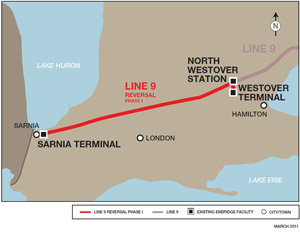
Unfortunately, too much evidence suggests otherwise. The latest glaring example of this has to do with Line 9 in Canada. Line 9, you will recall, runs across Ontario to Sarnia (where Line 6B terminates). Enbridge is currently seeking to reverse the flow of that pipeline, raising serious concerns on the part of residents all along that route.
Just this week, a Canadian television program, CTV’s W5, ran a major story on the project, uncovering some troubling facts about the integrity of Line 9, which is 38 years old. (The video is currently unavailable in the U.S., but we’ll link to it once it is viewable); they even came to Michigan to speak with residents here, like our friend David Gallagher. Among other things, the report discovered far more incidents on the line, including at Enbridge facilities, than previously reported publicly.
Most striking to us about the report– and in a follow-up story at the Toronto Star— is the reaction to this news by local officials. Their refrain is one that we and many others all across Michigan have been singing for a very long time: Enbridge does not, despite all of their claims to the contrary, communicate openly, honestly, and straightforwardly. For instance:
Landowners like Walker living along Enbridge’s Line 9 pipeline say that when problems arise on the pipelines running through their land they struggle with getting answers and help from the company.
“I didn’t believe that a pipeline or anybody would kind of leave you holding the bag the way that they’ve left me holding the bag on this one,” says Walker.
And this:
W5 called the municipalities where these spills occurred and the majority of them were not notified. The Mayor of Sarnia, Mike Bradley, where thousands of litres of product released at an Enbridge terminal, said he wasn’t informed of the nine incidents there since 2006 and believed that regardless of the fact that they were on Enbridge property, he thought the city should be informed.
“If you want to have a good relationship with your community, and you want to get rid of the distrust that is out there for the pipeline industry you disclose everything,” said Bradley.
And in the Toronto Star:
“It’s quite alarming,” said Brian McHattie, a city councillor in Hamilton, where seven leaks over the years have released nearly 3,000 litres of crude oil at company facilities northwest of the city. “This is new information for me.”
McHattie said the information raises concern about what is shared with municipalities. Hamilton staff met regularly with Enbridge officials since the company submitted its application, but none, to McHattie’s knowledge, were ever informed of the spills.
“They just haven’t been very forthcoming with us,” said McHattie. “It just makes you less confident in their integrity as a company and their willingness to share information and be above-board.”
And this:
Cramahe Mayor Marc Coombs said he first learned of five spills that together leached 1,824 litres of oil when he was contacted by a W5 reporter.
“We were not notified of any of them,” said Coombs. “It does (raise concerns), from the point of view of transparency.”
And this:
Sarnia Mayor Mike Bradley said the city isn’t usually notified when spills are contained within facilities and don’t require municipal staff to be involved in containment or cleanup. He said the city hadn’t heard about the nine spills linked with Line 9 facilities in the past decade — but it should.
“It’s just a good practice to notify, and then we can make our own judgment whether we need to do anything further,” said Bradley. “Just tell us. That’s all we want — to know.”
In both reports, Enbridge spokesperson Graham White– he’s the guy who not long ago out-Springered Larry Springer by fabricating a story about one citizen seeking more information about Line 9–is on hand with all of the standard excuses and platitudes. In fact, it appears that he and his team of spin doctors even tried a preemptive strike, sending out a letter to local officials criticizing the report before it had even aired.
Of course, to those of us in Michigan, there’s nothing new about any of this. Enbridge’s failure to communicate honestly with landowners, municipalities, and the public and its desperate attempt to try and solve all of its problems via its vast (and inept) public relations apparatus has been the predominant theme of this blog for a very long time; just see, for example, this and this and this and this. Perhaps Canadians will have more success convincing elected officials and regulators to step up and protect the public than we have in Michigan.
—-
Speaking of the remarkable similarities between the experiences of people along Line 9 and along Line 6B, the latest entry by our Canadian friend Emily Ferguson over at the Line 9 Communities blog is well worth your time. It tells the story of a landowner frustrated by an Enbridge integrity dig. His experience, unfortunately, mirrors the kinds of maddening experiences we have documented here so extensively. Check it out.
by Jeffrey Insko | Feb 16, 2014 |
We have some good news to report on the Michigan legislative front– of a minor sort. You might recall that at the end of last month, we had ourselves pretty worked up about some seemingly minor changes proposed by state lawmakers to the Crude Oil and Petroleum Act. The bill that had us most concerned was a companion to another bill that will reduce the oil and gas severance tax in the state. HB 5254, as it was originally introduced, would have changed the word “landowner” to “owner of agricultural property,” thereby eroding the already scant protections afforded to property owners affected by eminent domain. Needless to say, this is for us a rather sensitive topic.
So we wrote to our House Representative Joseph Graves as well as the House Energy and Technology Committee, multiple times to express our concerns. Promisingly, we then saw those concerns expressed in the Committee’s deliberations on the bill. Yet we weren’t certain as to whether those discussions bore any sort of fruit. Then last week we spoke on the phone with Representative Graves, who reported to us the good news that the Committee removed the offending change from HB 5254, leaving its original language intact (here is the bill as passed by the House).
Score one for landowners!
Admittedly, this is an exceedingly small victory, but at the very least it shows that Michigan legislators do recognize the need to protect property owners and are capable of listening to their constituents. We are grateful to Rep. Graves and other members of the committee, Marilyn Lane in particular, for their responsiveness on this question. We also spoke with Rep. Graves about pursuing further discussions regarding the treatment of landowners by Enbridge. If something comes of that– and we plan to follow up– we will of course let you know.
by Jeffrey Insko | Feb 11, 2014 |
We’re assuming that by now, all Line 6B landowners have received their completely incorrect 1099 tax forms. Since we first mentioned this extraordinary error— strong and disturbing evidence for theory #3 as an explanation for why Enbridge can’t do better— we have heard from a number of you confirming completely mistaken forms. We have also received confirmation from some who were able to contact land agents that Enbridge does plan to re-issue them. Unfortunately, that means we should probably all hold off on filing our taxes. Yep, apparently Enbridge now gets to dictate that part of your life too.
Worst of all? As far as we know, Enbridge has taken NO proactive steps whatsoever to notify landowners of this mistake. How’s that for “doing the right thing,” “taking accountability,” “following through on commitments,” and “treating everyone with unfailing dignity”?
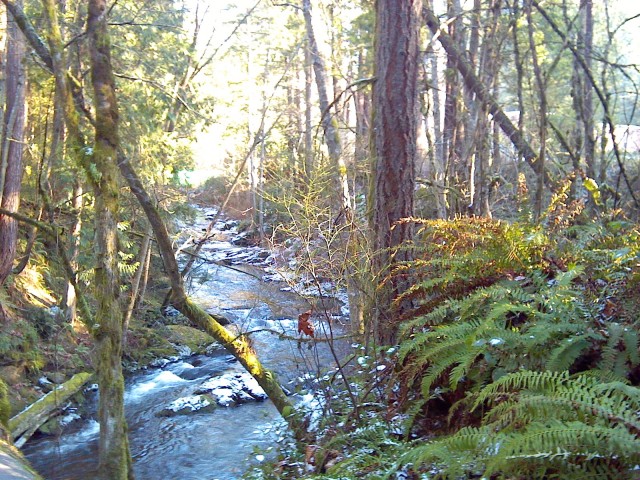
Whatcom Creek, Bellingham, Washington
In better news, we just returned from a trip to Bellingham, Washington, where we attended our first-ever Board of Directors meeting for the Pipeline Safety Trust. We were just recently appointed to the Board and our humbled to get to work with such good and remarkable people. You’ve heard us talk about the PS Trust a lot around here in the past. Our debt to them is truly enormous and we are eager for the opportunity to get to pay that back in some small way by working for and with them and with so many other wonderful people, like our friends in the New Voices project. Michiganders will be especially pleased to know that there are now three of us on the Board: the brilliant environmental law professor Sara Gosman and Michigan’s own hero Beth Wallace are the other two. We’re lucky to be in their company. We will of course keep you updated here on much of the Trust’s important work on behalf of the public interest.
Lastly, as we mentioned a week or so ago, the Michigan CATS activists were convicted and remanded to jail pending sentencing (the remand was completely unnecessary and, in our view, another example of this Judge’s disproportionately churlish and mean-spirited treatment of these three by a Judge oddly prone to chest-thumping displays of his power). At any rate, we want to once again state our support for these three committed individuals and we hope you’ll do the same. They’re receiving support of all kinds from all over the country. To find out what you can do for them, please head over to their website.
by Jeffrey Insko | Jan 29, 2014 |
As we said yesterday, we learned some things– not all of them very helpful or comforting– by watching the morning’s House Energy and Technology Committee hearing on House Bills 4885, 5254, and 5255. One thing that became very clear is that the legislation is not, as we at first supposed, aimed principally at encouraging fracking (although it certainly doesn’t rule it out). Rather, the bill is primarily driven by Enhanced Oil Recovery, a process of extracting more oil from existing wells by injecting CO2 to help carry it to the surface. Relative to other kinds of oil and gas development, as we understand it, EOR isn’t so bad.
This bit of clarification came, in part, courtesy of the testimony of an executive at Core Energy. Who, you might ask, is Core Energy? Well, according to their website:
Core Energy, LLC is actively involved in innovative oil production technologies and is the only company in Michigan currently performing CO2 Enhanced Oil Recovery (EOR) operations, which is making Michigan’s economy stronger and more energy independent while sequestering CO2. In addition to CO2 EOR, Core Energy is leading the way for Geologic CO2 Sequestration in Michigan by hosting a public/private partnership to research the storage potential of Michigan’s geology. Geologic CO2 Sequestration is a world changing technique that could help clean the atmosphere by removing CO2 and permanently storing it deep underground.
Now, the fact that we are talking about a bill more or less specifically designed, evidently, to help advance Core Energy’s interests is plenty troubling– but in an unsurprising sort of way. Far more troubling, however, is that the guy from Core Energy seemed to be the only one in the room who knew much about the particular bill in this grouping that has us most upset: HB 5254. That’s the one that would change some language in Act 16 from “landowner” to “owner of agricultural property.”
A few of the Committee members, notably Collene Lamonte and Marylyn Lane asked about this change specifically. The main sponsors of the legislation, Aric Nesbitt and Rick Outman, didn’t have a clue. They were clearly just following orders (which is pretty appalling; is it too naive to expect that sponsors of legislation understand the legislation they are sponsoring?!). The closest anyone came to providing a clear answer came from the guy from Core Energy and the representative of the MPSC.
Their claim is that the change is just a “technical change.” They insist that the original intent of the section of Act 16 in question was only to provide provisions for agriculture. Therefore, changing “landowner” to “owner of agricultural property” is merely to clarify the original intent of the law. We suspect that quasi-explanation satisfied some of the members of the committee. However, there are serious problems with this “explanation”:
First, it may very well be true that the legislators who passed the law in 1929 were thinking mainly of farm land. That certainly seems plausible. But then again, it might not be true. After all, the line with the proposed change is not the only place in that section of Act 16 where the word “landowner” is used. For example, here is the change we’re talking about:
3) Any offer to a landowner an owner of agricultural property for an easement for the purpose of locating, constructing, maintaining, operating, and transporting crude oil or petroleum pipelines on agricultural property in this state shall include all of the following information:
In fairness, it may well be that the change indicated above does clarify that sentence somewhat. However, in the context of the rest of the section, it’s not all that helpful. For instance, this is what it says just below (3):
(a) The anticipated physical impact of pipeline construction on the landowner’s property.
Does landowner here mean “an owner of agricultural property”? Or what about a little later in the section, where it says this:
(g) That the landowner has rights under the uniform condemnation procedures act, 1980 PA 87, MCL 213.51 to 213.77, and a copy of the act to the landowner.
Does the word landowner here also only mean “owner of agricultural property”? Or is the use of the term this time describing any landowner? The point is this: if the original intent of the law was to apply only to agricultural property owners, why did the original law sometimes use that term and other times use the term “landowner”? Or, if those terms are supposed to be interchangeable, why doesn’t the newly proposed law change the word landowner throughout? Better yet, why doesn’t it just clarify this in the “definitions” at the top of the section and be done with it?
So there are two problems here: first, the intent of the original law is not at all as clear as Nesbitt and others want to convince us it is. Secondly, the attempt to clarify that matter by the drafters of the new bill (whoever they are; clearly it’s not Nesbitt) is also not clear. In fact, it is a really awful attempt at clarification. Maybe that’s why Aric Nesbitt is so willing to make it clear that he did not draft it. We don’t blame him.
But that’s not all. So secondly, even if one wants to accept that the “intent” of this part of the law pertains only to agricultural property, the law as written appears to cover non-agricultural landowners as well. Given that fact– though this is a matter of legal interpretation of the sort that we’ve discussed before— why would lawmakers not simply want to err on the side of more landowners being protected rather than fewer? What do the citizens of Michigan have to gain by limiting the people to whom these very minimal protections apply?
Thirdly, even the clarifying term “agricultural property” isn’t especially clear. What is the definition of agricultural property? For instance, we have a very large garden here and fruit trees. Does that make ours an agricultural property? We also have friends who raise goats and chickens for their own use. Does that property count as agricultural?
Fourthly, once again contrary to what Nesbitt & co. would have us believe, there are very good reasons why the protections in the section of the act in question should apply to all landowners. Here, for example, are some of those protections:
(b) Written assurance that any agricultural drainage tile that is damaged or removed during the construction or repair of a pipeline will be repaired or replaced to preconstruction working condition. As used in this subdivision, “drainage tile” includes any surface or subsurface system by which the movement of water is redirected.
(c) Written assurance that topsoil that is disturbed due to construction or repair of a pipeline is properly separated and replaced. As used in this subdivision, “topsoil” means surface soil that is presumed to be fertile as distinguished from subsoil.
(d) The method by which property will be appraised.
Let’s take these each, briefly, in turn: (a) there are plenty of properties, like ours, that used to be farmland. And many of those properties have drainage tile on them. Why would that drainage tile be exempt from these rules? (b) the mixing of topsoil has been a serious problem on the Line 6B project, even on our very property. Why shouldn’t the separation of topsoil issue apply to everyone’s property? After all, it’s not just crops that need good topsoil; trees do too. And (c) lots of us have concerns about how our property was appraised by Enbridge. Those appraisals were the source of a great deal of contention during compensation negotiations. Why wouldn’t the legislature want all landowners to know how their property is being appraised?
Lastly, the final provision in this part of the Act is as follows:
(g) That the landowner has rights under the uniform condemnation procedures act, 1980 PA 87, MCL 213.51 to 213.77, and a copy of the act to the landowner.
According to the sponsors of the bill, “landowner” here means “an owner of agricultural property” (even though, as we noted above, they’re not changing this language). Why in the world would legislators not want ALL landowners, agricultural or not, to be notified of their rights under the uniform condemnation procedures act? What could possibly be gained by NOT requiring that a copy of that act be given to all landowners?
The bottom line is this: there is absolutely NOTHING to be gained by the public if the changes proposed in HB 5254 are passed. Nothing. The only benefits bestowed by the changes would go to oil and gas companies, who would have to be somewhat less careful with regard to their dealings with non-agricultural landowners. Furthermore, what the Act presently requires is so very minimal that it in no way harms those same oil and gas companies in the slightest. In other words, HB 5254 is completely inessential to this legislation as a whole. The ONLY thing it does is removes protections for landowners. That is its only effect. Why would a single legislator, Republican or Democrat, possibly vote for such a thing?
by Jeffrey Insko | Jan 28, 2014 |
Wow! This morning, we spent some time watching the House Energy and Technology Committee hearings on the three bills we’ve been squawking about over the past few days. It was both interesting and very disturbing. We learned a lot, some of it clarifying and some of it just plain maddening. As soon as we can, we’ll try and give a full account of the hearings and a better discussion of the questions at stake in the legislation. Needless to say, our concerns have not been alleviated. For now, here’s a quick teaser list of some of what we learned:
- Our original assessment that the legislation is mainly about fracking isn’t exactly correct. As we explained in our follow-up post, it appears to have more to do with “Enhanced Oil Recovery”– which isn’t, however, to remove fracking from the equation entirely.
- The main sponsor of the legislation, Committee Chairman Aric Nesbitt, doesn’t appear to understand the bill very clearly at all. He spent a lot of his time saying things like “what I’m told” and “from what I understand.” Needless to say, that does not provide much comfort.
- Which means that Nesbitt obviously didn’t write the legislation. He’s just doing someone else’s bidding. Whose bidding? We aren’t entirely sure.
- But here’s one possibility: during his testimony, the executive from Core Energy (we didn’t catch his name, but check out what it is they do!) spoke about Act 16 as if he were some kind of expert on it. He seemed to know more about the reason for HB 5254 than anybody else in the room. Yes, that’s right, the one person who has more to gain from this legislation than anybody else on the planet was explaining it to the legislators.
- The MPSC, indifferent to the interests of the citizens it is supposed to protect, is not the least bit bothered by the change proposed in HB 5254. Even worse, the MPSC representative went out of his way to describe the MPSC’s charge in precisely the terms created by Enbridge’s lawyers. So just as we’ve said in the past, Enbridge has successfully re-created the MPSC in its very own image.
- Our own representative, Joseph Graves, did ask a question about landowner rights–but rather half-heartedly, we thought. His colleagues Reps. Marilyn Lane and Collene Lamonte, on the other hand, were tenacious and proved themselves true champions of Michigan citizens. We applaud their efforts.
- Finally, we’ve been a little baffled by the lack of interest in this matter by various environmental groups. The Sierra Club, however, has stepped up and articulated clearly and forcefully their opposition to this legislation.
Much more– including more on why the feeble attempts by those at the hearing attempting to dismiss concerns about HB 5254 were completely unpersuasive– as time allows.
by Jeffrey Insko | Jan 26, 2014 |
On Friday, we brought you the disturbing news of some new legislation introduced in the Michigan House of Representatives by Rick Outman. HB 5254 makes a very subtle and seemingly small change to Act 16, the Crude Oil and Petroleum Act, removing the word “landowner”and replacing it with “owner of agricultural property” from the section of the bill describing the rights of those whose property will be acquired through eminent domain.
This, in our view, is a proposal that should trouble everyone. Whatever your view of the use of fracking or oil and gas development or state energy policy or climate change, it’s hard to imagine anyone– with the exception, it appears of Rick Outman and his compatriots in Congress– who thinks that pipeline companies should get to do whatever they want, without any rules or restrictions, with your private property. Trust us, when some company comes knocking on your door, backed by the state, to dig up your back yard (and you can’t stop it), you will hope that there are as many rules and regulations in place to make sure they behave and treat you and your property respectfully as possible. Just ask these people. As it stands right now, there are precious few such rules. After this bill, there will be even fewer.
Which is why we believe this is an issue that should create bipartisan coalitions. EVERYONE should be troubled by it, from conservative anti-government champions of private property rights to liberal environmental groups looking to halt or at least slow oil and gas development. We’ll be interested to see if such groups, whether alone or together make any noise about this bill. We certainly plan to and we have already written our state representative Joseph Graves. We’ll be sure to update you on his response.
In the meantime, there’s a bit more to this story that we need to share. As it turns out, this legislation is not solely about fracking, although that is certainly an element of it. It is actually part of a suite of interrelated bills designed to promote gas and oil development (an effort that, according to an MiLive story this morning, has yet to pay off). In fact, the two bills we mentioned on Friday (HB 5254 and 5255) will only take effect with the passage of another bill HB 4885. That bill, sponsored by 16 House Republicans, including Joseph Graves would give tax breaks to oil and gas developers by significantly reducing the severance tax those companies currently have to pay to the state for the oil and gas they extract.
In fact, something else we learned after looking in to this is that CO2 is not just used for fracking. It is also commonly used for oil extraction as part of what is called “Enhanced Oil Recovery.” So this suite of bills is not only promoting fracking, but further oil development as well.
But, again, you don’t have to oppose HB 4885 and the encouragement of more oil and gas exploration– personally, we do oppose it; we think it’s the wrong path for Michigan and poses too many dangers to our precious natural resources–to oppose its companion legislation. Indeed, it’s astonishing to us that the sponsors of the tax break bill aren’t proposing exactly the opposite sort of companion legislation: a bill that would give landowners MORE, not fewer, protections. That would seem to be a way to make the prospect of more development and more pipelines more palatable to those who might otherwise oppose it.
Instead, for reasons we simply can’t fathom our state elected officials– too timid and cowardly even to require energy companies simply to behave themselves on the properties of those constituents the official have been elected to serve– seem to want even more Michigan citizens to endure the pain and misery experienced by Line 6B landowners.
Please call or write your state representative and urger her or him to stand up for private property rights, and for the protection of the interests of you and your fellow citizens, not those of the oil and gas industry.
Note (Jan. 28, 2014): the House Committee on Energy and Technology held a hearing on this legislation this morning. Here is a brief overview of what happened. More to come.
by Jeffrey Insko | Jan 24, 2014 |
In the midst of the property rights nightmare and landowner abuse that has been the Line 6B replacement, evidently the Michigan legislature has decided to make things even worse for Michigan property owners. Just yesterday, Representative Rick Outman introduced legislation that would further erode the already weak rights of property owners in the path of oil and gas pipelines.
Bear with us while we explain:
Remember Michigan Act 16 of 1929? We’ve talked about it a lot here over the past year or more. It’s the law that governs the transportation of crude oil or petroleum through the state of Michigan and grants carriers of those substances the power of eminent domain. It’s the law that our first land agent pulled out of his pocket the first day we met him– and that was before Enbridge had been granted the right of eminent domain by the MPSC. Of course, it didn’t matter, since Enbridge all but owned the MPSC; in fact, the MPSC helped Enbridge to more or less re-write Act 16 of 1929 to suit their own and their industry peers’ interests.
Well, two bills have just been introduced in the Michigan House of Representatives seeking to amend Act 16. The reason for these amendments can be stated in one word: fracking.
Now, we haven’t spent much time discussing fracking here at the Line 6B blog. Generally speaking, we try to keep ourselves focused. Also, unlike some places in the country, like Pennsylvania, where our friends like Emily Krafjack and Lynda Farrell (among others) are working hard to protect landowners and natural resources, fracking– or at least the kind of hydraulic fracking that has become so controversial nationally–hasn’t been a major problem in most parts of Michigan. As we understand it, this has mainly to do with geology.
Which isn’t to say fracking is not something we should be worried about. It is and we very much are. There are plenty of reasons to be wary and vigilant, not the least of which, as some of our very best friends will tell you, is the possibility of oil and gas development in some very beautiful and sensitive recreational areas in our state. Plus, there’s the water– which is where the proposed legislation comes in.
You see, high pressure hydraulic fracking typically requires water– lots and lots of water. And water, of course, is a precious natural resource, not something to be squandered, especially in a state like ours that with a culture so deeply rooted in outdoor sports and recreation. However, there are apparently other fracking methods that don’t need to use all that water. Those methods use, instead, carbon dioxide. CO2 fracking, although it has its downsides– cost being one of them– might well be better for the environment. So– and we are still learning about this ourselves and are therefore not prepared to make any firm pronouncements about it– if there’s going to be more fracking in Michigan, this may be the desirable kind.
Which explains why HB 5255 is seeking to amend Act 16 to include the following language to the section of the Act addressing “condemnation for acquisition of right of ways”:
(B) AFTER RECEIVING APPROVAL UNDER THIS ACT AS REQUIRED FOR CRUDE OIL OR PETROLEUM, TO TRANSPORT BY PIPELINE GASEOUS OR LIQUID SUBSTANCES, CONSISTING PRIMARILY OF CARBON DIOXIDE, THAT WILL BE PUT IN STORAGE OR THAT HAVE BEEN OR WILL BE USED TO PRODUCE HYDROCARBONS IN SECONDARY OR ENHANCED RECOVERY OPERATIONS.
It’s the “gaseous or liquid substances, consisting primarily of carbon dioxide” part that is new. As it is written now, the Act only mentions oil. The reason for this change is obvious: if we’re going to frack with CO2, we’re going to need lots of it and it’s going to need to get moved around. Apparently, this is exactly what our legislators foresee: the need for the transportation of lots of CO2 gas. That gas is probably going to get transported by pipeline– which means building more pipelines. Through people’s property.
So that’s mixed news at best–although there may well be more to the story than we understand yet. It’s (possibly) mixed because CO2 fracking might not be such a bad thing (in relative terms, that is), even though building lots of new infrastructure presents all kinds of potential problems– problems of precisely the kind that those of us on the Enbridge pipeline route have had to endure. But it’s here where the news is not mixed at all, but very, very bad.
You see, there’s a companion bill to HB 5255. It’s HB 5254 and it also seeks to amend Act 16, but a different section. Here’s what HB 5254 would do: it would change the language of the bill so as to redefine who the protections of the act apply to. Specifically, it would remove the word “landowner” and replace it with “owner of agricultural property.” What that means, then, is that the protections included in the bill (and granted, there aren’t a lot of them, though there are some) would ONLY apply to “owners of agricultural property,” not to “landowners.” Non-agricultural property owners– and presumably that means most people, like you and me–would therefore have even FEWER rights than they do now if and when a pipeline gets to run through their property. Oil and gas companies could just have their way on your property– even more so than they do now.
Needless to say, this is outrageous. As I think anyone who has lived through the Line 6B nightmare or anyone who has paid careful attention to it will attest, the state of Michigan needs to STRENGTHEN property rights, not further erode them.
This, we think, is an actionable matter, an urgent matter. Please take the time to write or call your legislators to oppose HB 5254 and its blatant assault on individual property rights in the name of fracking. In the meantime, we’ll learn more about this legislation and, as soon as we can, post a follow-up with more information.
__
Our follow-up with more information about this legislation has been posted. You can read it here.