by Jeffrey Insko | Jan 21, 2014 |
We wish we could start this little news roundup by telling you that Enbridge spokesperson Graham White has issued a public apology to Emily Ferguson for his apparently fictional account of her behavior at an informational meeting regarding Line 9. Unfortunately, we have yet to hear whether White has decided to abide by Enbridge corporate value of “Maintain[ing] truth in all interactions” (although it may be that “maintaining” truth is somehow different than just telling it).
But there’s other news to pass on. Inside Climate News has run its own story regarding the fallen pipe on Dave Gallagher’s property. Needless to say, reporter Maria Gallucci practices the same sort of quality journalism as her ICN colleagues. We only wish the article were a bit longer, as it raises some important questions that could be further explored, such as the lack of regulations (at either the state or federal levels) about pipeline proximity to dwellings, the shoddy work of the MPSC when approving this project, and, of course, the fact that what has gone on out at the Gallagher property is just an extreme version of the troubles endured by countless landowners along the Line 6B route. The article also, unfortunately, doesn’t shed any light on the question of whether the Smith-Manshum account of immediate on site inspection of the dropped pipe really did occur.
Speaking of construction accidents, news from Griffith, Indiana is that Enbridge crews accidentally busted a water main, draining the entire contents of one of the city’s water towers. Thinking back on some other accidents– the tree they dropped on that power line over the holidays, the sewer line they broke at an intersection in Howell a while back– we’re wondering just how common these sorts of accidents are on large-scale projects like this. It’s no clear whether this is routine or whether Enbridge’s contractors are especially accident prone. But even if they’re not particularly unusual, the messy realities of pipeline construction are clearly a far cry from the smooth, hassle-free portrait of the process that Enbridge painted for landowners and municipalities before it all began.
Finally, on the national scene, the Wall Street Journal this morning is reporting that the vast majority of pipeline leaks are not discovered by operators and all their fancy gadgets and doodads, all those high-tech devices they love to talk about, but by individuals on-site. We’re glad the WSJ has done the story, but they’re pretty late to the party. We’ve been talking about this for a long while, as have some of our very favorite reporters. The splendid Elana Schor, for example, was on it way back in August of last year. (Incidentally, Schor’s been getting a fair amount of television face-time lately (and more). We’re glad her voice is reaching national ears, as it should, but we’re also a little worried she’s moving over toward the dark side. We’ve all seen what the tv does to people…)
by Jeffrey Insko | Jan 19, 2014 |
Yesterday, we wrote about Graham White’s gratuitous comments about our Canadian friend Emily Ferguson in Jessica McDiarmid’s outstanding Toronto Star series “All Along the Pipeline”. As far as we know, he has yet to write to Emily with the apology he obviously owes her, and it might not be coming very soon, since he’s probably quite busy fielding phone calls about the latest Enbridge oil spill. But while we wait, we thought we’d add just a few more comments on the matter, which while seemingly small, illustrates some much larger problems with the way that Enbridge deals with the public. The contempt that White displays toward Emily Ferguson is not just some isolated incident; it’s an attitude that seems to be endemic to Enbridge.
In this follow-up, we’d just like to highlight a couple of points about this matter. Yesterday, we asked a series of rhetorical questions about White’s remark, asking among other things, whether and how Graham White could possibly have known anything about Emily’s demeanor or behavior at the informational meeting in question, which was held in Conservation Halton back in March of last year. The answer to that question, just to be clear, is that he couldn’t. He doesn’t. For one thing, Graham White wasn’t even at the meeting (at least not according to the official minutes from the meeting, which list the Enbridge representatives in attendance). For another thing, Emily never gave her name to any Enbridge representatives at that meeting. There is no way anybody from Enbridge could possibly know whether she was “abrupt and confrontational” at the meeting because there is no way for anybody from Enbridge to have even known she was there in the first place. Therefore, this can only lead to one conclusion:
Graham White is simply making things up.
Or if he’s not, we’d sure like to hear his explanation of how he knows that Emily was at that meeting acting all abrupt and confrontational-like. Perhaps he’s psychic.
Now, that’s pretty bad. What’s so very bizarre about it, however, is that it’s completely unnecessary. That is, we understand that Graham White has to say something when a reporter asks him a question; that’s his job. But he doesn’t have to make things up. And he certainly doesn’t have to try and portray Emily as some sort of unreasonable rabble-rouser. Frankly, we don’t really want to tell Graham White how to do his job, but this doesn’t seem particularly complicated. It’s not hard to imagine any number of other things he could have said in reply to a reporter’s question about Emily Ferguson. For example:
- He could have just been honest. Like this: “I wasn’t at the meeting in question and therefore I am in no position to comment on what happened there.”
- Or if straightforward honesty isn’t his cup of tea (and it appears not to be), he could have just been evasive. Like this: “It is not Enbridge corporate policy to ask for identification at informational meetings. We provide information freely to all members of the public.”
- Or, even better, he could have given an answer in keeping with Enbridge’s corporate values (“Maintain truth in all interactions,” “Do the right thing; do not take the easy way out,” “Take accountability for our actions, without passing blame to others.”) Like this: “We regret that Ms. Ferguson was asked by one of our representatives for identification. That is not our policy and it should not have happened. We regret our mistake and apologize to Ms. Ferguson.”
That last answer– the high road answer– would have cost Graham White and Enbridge nothing. And it would have made them look good (or at least better than they look right now). It would have made them look like they walk the walk, like they really do adhere to the values they profess guide their conduct. It might even have made Emily Ferguson feel slightly better about the whole unfortunate incident. Perhaps it would have opened the door to a more productive, less combative relationship with citizens who have serious concerns about the Line 9 reversal project.
But Enbridge doesn’t seem to want any of that. They don’t seem to want to be guided by those values. They don’t seem to want to walk the walk. They don’t seem to want to cultivate better relations with ordinary citizens and their critics. They don’t seem to want to be less combative. Of course, this is all ground we have covered before (again and again and again). Enbridge’s failure– or more precisely, its apparent inability– to live up to its own stated values runs deep. It’s almost as if those values aren’t there as guides to its employees’ conduct, but as things to be studiously avoided.

by Jeffrey Insko | Jan 18, 2014 |
Remember that time Enbridge spokesperson Larry Springer, in a ham-fisted attempt to dismiss legitimate questions about Enbridge’s practices, described landowners and other ordinary citizens expressing perfectly reasonable concerns as “special interest groups”? That remark had us so worked up that we devoted a whole series to it (part 2, part 3, part 4). The reason we spent so much time on it– and the reason we return to it every now and then– is because it is so emblematic of the way that Enbridge views landowners, responds to criticism, and communicates with the public. Dishonest, misleading, and offensive, Springer’s remark also appears to be deeply rooted in Enbridge’s corporate culture, and is part of a strategy (perhaps?) pioneered, but certainly deployed by Enbridge’s former CEO Patrick Daniel.
Well, Larry Springer can finally rest easy. He has at last been outdone. Meet Graham White.
If you’re paying attention to matters up in Canada– Northern Gateway, the Line 9 reversal– you may have encountered Graham White before. He’s one of Enbridge’s chief spokespersons up there (his official title has something to do with business communications and public affairs or something). He gets quoted a lot, much like Jason Manshum here in Michigan. So what is it that Graham White said that surpasses Larry Springer’s now-classically-infamous “special interest groups” comment? Well, let’s take a look:
This week, The Toronto Star ran a fantastic feature called “All Along the Pipeline,” that highlights the Line 9 reversal project and profiles a number of people, as they put it, “whose lives it passes.” It’s a really wonderful piece of journalism by The Star’s Jessica McDiarmid that nicely balances policy and humanity. We wish some reporter in Michigan (about a year ago!) would do the same for Line 6B (yet another opportunity for Jennifer Bowman!). We encourage everyone to read it.
Among those profiled is our friend Emily Ferguson, who maintains the excellent Line 9 Communities blog. The story explains Emily’s first experience with Enbridge:
Then a McMaster University student in geography and environmental studies, Ferguson went to several more. In Halton region, she asked Enbridge for an information package that had been provided to council, which included maps of Line 9’s passage through the area.
Ferguson says a company official asked her who she was working for, then agreed to send a copy — if she showed her driver’s license.
And that’s when Graham White enters the story:
Enbridge offers a different version of events: company spokesperson Graham White says “after an abrupt and confrontational approach from Ms. Ferguson,” an employee asked her who she was but did not request identification.
“We provide our information freely, there is no reason someone would have to show ID,” says White, who characterized Ferguson as “a stringent opponent of the project and an activist.”
There is so much that is wrong and deeply disturbing about this that we hardly know where to begin. But let’s start with the obvious:
Does Graham White really have any idea what Emily Ferguson’s demeanor was at an informational meeting that took place nearly a year ago? Has Graham White ever once met or spoken to Emily Ferguson, anywhere? Was he at that informational meeting to witness her conduct himself? Does he possess such a preternatural memory that he is able to recall every person who comes to every meeting that Enbridge holds all across Canada? Or does Enbridge keep some secret list of “abrupt and confrontational” people that they post somewhere on an internal server, a list that spokespersons are required to memorize so that they can instantly, on command, bring to mind the identities and actions of each and every individual on the list? Or would Graham White somehow have us believe that young Emily Ferguson, college student, was just so extremely abrupt, so extraordinarily confrontational that this incident became a permanent part of Enbridge Line 9 reversal project lore, inscribed indelibly into everyone’s memory, like the moon landing? Or could it be that Graham White is just making things up?
Or, let’s just say for the sake of argument (though we don’t believe it for a second) that Emily was “abrupt and confrontational” that day. What, then, would Graham White’s point be? That those who do not conduct themselves at informational meetings with appropriate deference are asked to identify themselves? Who makes that call and what exactly are the rules of propriety at these meetings? Are they explained before hand? Do you just have to be polite or is some particular form of obsequiousness required? Do you have to genuflect or will a simple curtsy do? Are citizens allowed to make direct eye contact with Enbridge representatives or would that be seen as too confrontational?
If those questions seem absurd, as they should, it’s to point out the absurdity of White’s attempt to mischaracterize Emily’s behavior. There is no good reason for Graham White to describe her as “abrupt and confrontational” other than a desire to cast her, needlessly and gratuitously, in a negative light. That’s clearly what he’s doing. It’s a ploy straight out of the Daniel-Springer playbook: if you can portray your critics in an unflattering way– as “special interest groups” or people who are “abrupt and confrontational”– it’s much easier to dismiss them. White does it again when he describes Emily as a “stringent opponent of the project and an activist.” What is the point of that characterization? Why does Graham White go out of his way to describe Emily in this way? Indeed, why does Graham White feel the need to characterize Emily at all? Again, the answer to that is simple: he thinks that calling her an “activist” is automatically to discredit her– in precisely the same way that Larry Springer thinks that calling people “special interest groups” automatically discredits them. It’s a cheap trick, shabby and lazy.
But if what we have here is just another specimen of what we’ve seen from other Enbridge reps, why dwell on Graham White’s snide comments? What makes White’s remarks so much worse than Larry Springer’s? Well, when Springer made his remarks, he was referring (to the extent that he was referring to anyone real, as opposed to the phantoms conjured by his own corporation’s distorted imagination) to a group of people. Springer might even say he was referring generally to everyone who has ever been critical of Enbridge in Michigan since 2010; heaven knows plenty of people have been, some of them even genuine “special interest groups.” So at least Springer has an out– not a very good one, but an out nevertheless.
Graham White, on the other hand? He is talking specifically about one single individual, one ordinary Canadian citizen. And while we are personally mighty impressed with young Emily Ferguson, who seems to us quite formidable, exceedingly smart, talented, enterprising, and with a very bright future ahead of her, it’s not as if she is, say, Neil Young.
By contrast, when Graham White speaks, he is speaking as and for one of the largest, wealthiest, and most powerful corporations in Canada, in all of North America, in fact. Yet despite all of its wealth and power and influence, it is also, evidently, a corporation that is so petty, so thin-skinned, so defensive, so stung by even the mildest of criticisms, so unwilling to take responsibility for even the slightest of missteps, so utterly lacking in grace and humility, so stubborn, so ungenerous, and so mean-spirited that it is willing, on the basis of almost nothing, to publicly disparage a single individual for nothing more than saying what happened when she attended a meeting?
That, friends, is just plain crazy.
[Okay. Believe it or not, we’ve got even more to say about this. But since it’s already gotten a bit longer than we planned, we’ll save it for a follow-up post. Congratulations, Graham White! You’ve earned your very own series!]
by Jeffrey Insko | Jan 16, 2014 |
We’re playing catch-up today; strangely, 2014 has started out rather eventfully. Earlier today, we made a few remarks about the construction accident and its aftermath that took place on David Gallagher’s property. Among other things, it has yielded a rather troubling he said/she said situation. Needless to say, we have grave doubts about what Enbridge says about the incident.
But there’s been plenty of news otherwise:
Jennifer Bowman over at the Battle Creek Enquirer– who more or less owns the Enbridge Line 6B “replacement” project story these days– wrote an excellent piece on ongoing landowner troubles that appeared over the weekend. Among other things, we were grateful for her recognition that Enbridge’s problems with landowners run far deeper than just the terrible Gallagher situation (which certainly deserves the attention it’s gotten). These are systemic problems, not isolated ones. We even have a few things to say ourselves in the article.
But by far the most, um, interesting comments in Jennifer’s piece come from Jason Manshum. Recently, we’ve had some productive exchanges with Jason and are hopeful that they are a step toward some better communications with Enbridge. We don’t want to jeopardize that. But we still have to tell the truth. And the truth is that Manshum’s comments are so inapt that it’s not really clear just what in the hell he is talking about:
Manshum said the company has been working with landowners since before construction began, going over details and negotiating compensation. Property owners are each assigned a land agent to work with on a regular basis, he said.
“Those conversations begin long before construction,” said Manshum. “They continue during construction and once we go through hydro testing and the final restoration, those conversations will still be ongoing. Because at the end of it, we will go through the list of everything we outlined in the beginning with each landowner and check off the list to ensure that we have actually everything to the homeowner’s satisfaction.”
We understand that journalistic protocol requires Jennifer Bowman, who is a real pro, to solicit some kind of statement from Enbridge, but it has to be as painful for her to type up that sort of thing as it is for us to read it. At this point in the project, after all that has gone on, after all that’s been discussed, demonstrated, and documented with regard to Enbridge’s dealings with landowners is there anybody on the planet who thinks such hollow boilerplate is even remotely helpful or even the slightest bit honest?
In other Line 6B news, remember the protests that took place over the summer? The dude that skateboarded his way into a stretch of pipe? the group that chained themselves to some Enbridge construction equipment? Last week, hearings were held in both cases. The results were mixed. In the case of Chris Wahmhoff, who spent a day inside an Enbridge pipe, a Calhoun County Circuit Court Judge dismissed the charges against him. Wahmhoff celebrated the good news by immediately announcing his candidacy for U.S. Senate. Yes, you heard that right: Wahmhoff is running for the U.S. Senate seat recently vacated by Carl Levin. Jennifer Bowman (who sure keeps busy!) has that story as well. And here’s more from the good folks at the DeSmog Blog. Unfortunately, Wahmhoff’s legal troubles may not be over. Evidently, Calhoun County Prosecutor David Gilbert is seeking to re-issue charges agains Wahmhoff, or so MiLive reports. What Gilbert thinks the citizens of Calhoun County or the state of Michigan could possibly gain from the prosecution of Wahmhoff is completely beyond us.
The news is not quite as good for the other four protestors. An Ingham County Judge has refused to dismiss charges against them. But apparently, simply allowing the prosecution to continue wasn’t enough for Judge William Collette. He also decided to take it upon himself to make some oddly petulant and legally irrelevant remarks. First, according to MiLive, there was this:
“I am tired of people coming in here seeking publicity for themselves,” he said and criticized the defendants and their supporters for organizing court protests. “I don’t like that.”
Then, as if that weren’t weren’t crotchety enough, he added this:
Collette said he is not unsympathetic to an environmental cause or environmental necessity. If someone were charged with trespassing for going out and stopping an oil leak, he would toss out such a charge.
If people think attaching themselves to machinery will change a corporate or government “mode of operation,” it is not going to happen, he said.
Now we’re not really sure why Judge Collette thinks anyone wants to hear his personal opinions about the effectiveness of various forms of protest and agitation for social change. Maybe he’s auditioning for a gig as a talk radio host. Or maybe there is an Ingham County law that we don’t know about prohibiting wrongheaded ideas about what will change corporate modes of operation. But if there is no such statute, then maybe Judge Collette should just keep his non-legal views to himself and focus on administering the law. In the meantime, we hope the protestors’ legal team can find a way to persuade the Court to let this matter drop.
Looking beyond Line 6B, you might also remember the recent letter that Senators Stabenow, Levin, and Dick Durbin of Illinois sent to PHMSA regarding concerns about Enbridge’s proposal to increase capacity on Line 5 running through the Straits of Mackinac. Well, PHMSA has written a letter to the senators in response. The letter reads, in its entirety:
Dear Senators.
It’s all good. Don’t you worry your pretty little heads about this.
Sincerely,
PHMSA
Okay, maybe that’s not really the letter. But it may as well be. If you want to read the thing yourself, it’s here. PHMSA has very little to say other than to try and pacify Stabenow, Levin, and Durbin. Needless to say, it’s cold comfort for anyone who has serious concerns about Line 5 and the protection of the Great Lakes. For more, SURF on over to Beth Wallace’s blog where she discusses the letter in a little more detail, calling it– with devastating accuracy– mostly “jibber jabber.”
Finally, word last week from the EPA is that they are now considering enforcement options against Enbridge for the company’s failure to meet its dredging deadline. You will recall that in a desperate, dishonest attempt to buy more time following its own ham-handed attempts to have its way in Comstock Township, the EPA denied Enbridge’s request for an extension to complete the work. As a result, they’ve missed their Dec. 31st deadline and will likely face fines. Stiff ones? That remains to be seen.

by Jeffrey Insko | Dec 18, 2013 |
Although there hasn’t been a whole lot of news directly related to the Line 6B replacement lately, we’ve been putting together a list of notable items worthy of your attention. We present them here, bulleted (in honor of Carl Weimer) and in no particular order:
- From Canada, Enbridge’s Line 9 reversal project– which has been somewhat contentious and has lots of landowners reasonably wary— took a step forward by earning the approval of a Quebec National Assembly committee. On the bright side, our friend Richard Kuprewicz is on hand to apply a little pressure to Enbridge’s rosy claims. Specifically, Rick suggests that Enbridge might want to do some hydrotesting on that line to ensure its safety. In response, Enbridge whines about how much that would cost them.
- Also from Canada, a Prince George paper reports this week on Enbridge vice-president of pipeline integrity Walter Kresic telling a Northern Gateway Community Advisory Board about all of the fancy new tools and gadgets (perhaps they’ll use these on Line 9) they use to check the integrity of their pipelines. Most striking about his remarks is this howler about the Marshall spill: “The [inspection] technology wasn’t as good as it should have been,” he said. “Any of the new tools would have seen [the problem]” Technically speaking, that is surely a true statement. What makes it outrageous, however, is that it implies that the older technology failed to detect problems on that line. But that, of course, is just plain untrue. The fact is, as we’ve noted many times– it’s all right there in the NTSB report– that OLD tools saw the problems on that line FIVE YEARS before it ruptured. But Enbridge chose not to act on those findings. The problem in Marshall– we all know it by now, which is why it’s astonishing to hear Enbridge executives still peddling this technology-will-save-us nonsense– wasn’t with the technology, it was with Enbridge’s callous, hapless safety culture.
- Back in the states, we were very interested in this story from South Portland, Maine. The City Council there voted to prohibit the shipment of tar sands oil through the city’s port. This is a story with all sorts of important and fascinating dimensions. For instance, it’s a pretty good illustration of how failures of leadership at the state and federal level are leaving municipalities to attend to these matters for themselves. It’s also interesting in terms of the role of local authority (there was a panel on this topic featuring the great Rebecca Craven at last month’s PS Trust conference) as these large corporations seek to expand tar sands production all over the country and beyond. Unsurprisingly, the American Petroleum Institute seems to want to limit that authority as much as possible. In response the Council’s decision, API shrieks and thumps its chest like a big gorilla putting on some threatening display.
- Over at the terrific DeSmog Blog, our new friend (we met at this year’s PS Trust conference) Julie Dermansky has an excellent report on the great landowners panel featuring our other friends Ann Jarrell, David Gallagher, and Jennifer Baker. Like those landowners did at the conference, Julie nails it.
- There’s been a little bit of Keystone XL news this week as well. Inside Climate News reports on a letter to President Obama signed by a number of U.S. and Canadian celebrities and notable figures urging the President to reject TransCanada’s permit. Our favorite names on the list? Rocker Joan Jett, whose I Love Rock ‘n Roll was the very first record album we ever bought, and Yann Martel, author of the excellent novel Life of Pi.
- And speaking of KXL and people we admire, Omaha.com has a story about a bunch of courageous, principled landowners in Nebraska who steadfastly refuse TransCanada’s ever-lucrative entreaties. Our friend Jane Kleeb of Bold Nebraska has the money quote: “Our landowners are stubborn and independent, which is good,” Jane says. Those landowners have our respect, admiration, and support.
- Closer to home, you may have seen the story this week about some large “tar balls” discovered in the Kalamazoo River (as reported on in two excellent Canadian outlets, The Tyee and the Vancouver Observer). Some concerned activists found the creepy-looking rocks in the river recently and were understandably alarmed. It turns out, however, that the rocks are actually natural formations. Of course, there are still plenty of unsettled questions about the effects of the spill and cleanup on the river and on people’s health. But it appears that there are not, in fact, giant tar balls in the river (whew!).
- Speaking of citizen activists, those tireless MICATS are urging people to turn out to support the “felonious 4” activists who were arrested earlier this year for their protests that stopped work at Enbridge construction sites. They’d like to see charges against the activists dropped. So would we. If you’d like to support them, the hearing is set for January 15 at the Ingham County Courthouse.
- Finally– and we hope you’re sitting down for this one– our friend Beth Wallace has apparently started her very own blog! Evidently, guest-blogging here just wasn’t enough for a hero like her (although she’s welcome to post here as often as she likes!), so she has struck out on her own. Her first post is a follow-up to the recent excellent news about the letter Michigan’s U.S. senators wrote to PHMSA about Enbridge’s Line 5 that runs through the Straits of Mackinac. Needless to say, what Beth has to say on the matter is crucially important and hits the bullseye.
by Jeffrey Insko | Dec 11, 2013 |
As longtime readers of this blog know, we think that the silence and inaction of Michigan’s elected officials at both the state and federal levels in the three years since the Marshall spill has been shameful. In fact, the seeming indifference of one prominent Michigan political figures was a large part of what caused us to start this blog in the first place. And the situation is even worse when one considers how other states and municipalities have responded to disasters like the one in Marshall. In Bellingham, Washington, they started the Pipeline Safety Trust. In San Bruno, California, the city filed suit against PHMSA and the state overhauled its Public Utilities Commission. In Mayflower, Arkansas a U.S. Representative has taken up the cause of affected residents. And in North Dakota, the governor is forming an advisory panel on pipeline safety. In Michigan after the Kalamazoo River spill? Nothing.
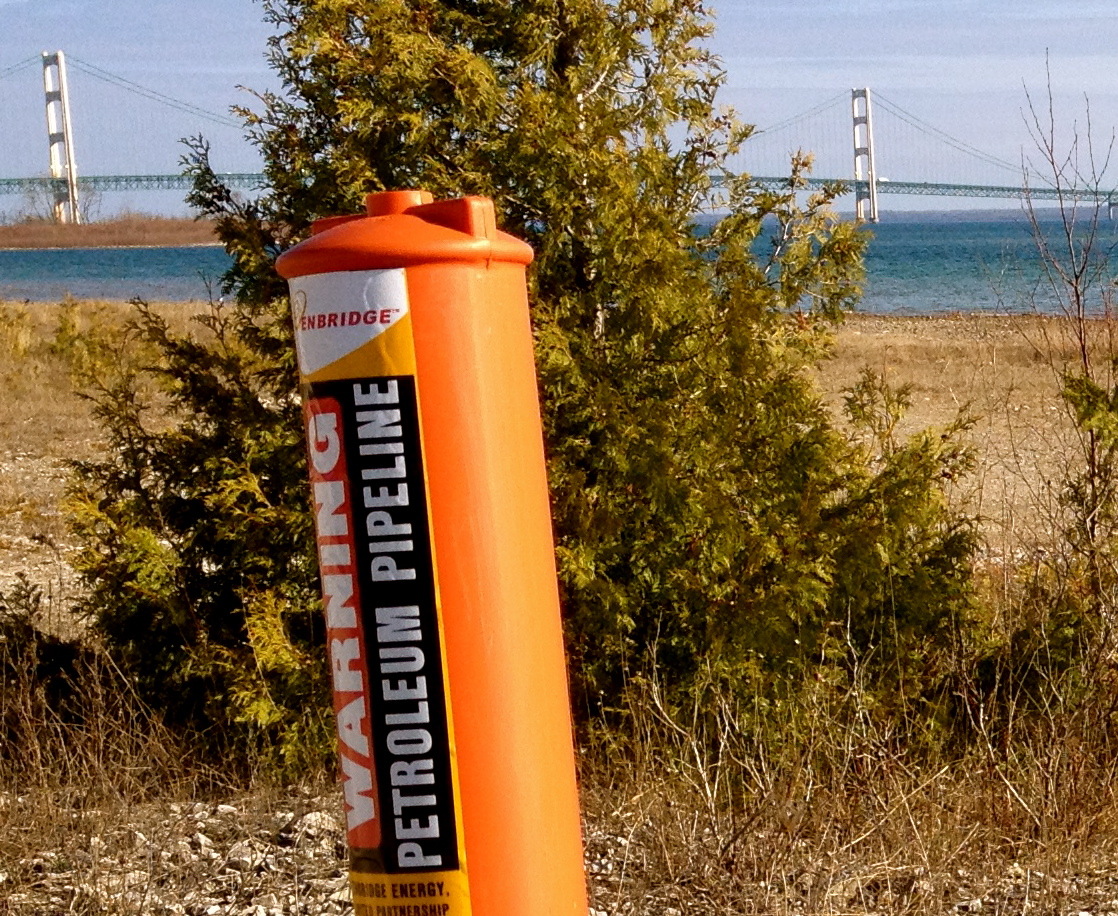
Sadly, Line 6B continues to be invisible to Michigan officials. Another Enbridge pipeline, however, finally has them taking some notice. You might recall that our friend Beth Wallace (hero) of the National Wildlife Federation has been working very hard to raise awareness of the threats to the Great Lakes posed by Enbridge’s Line 5 running beneath the Straits of Mackinac. Indeed, that danger was one of the topics we discussed with staffers on our trip this summer to Washington, D.C.
Well, finally, due in no small part (perhaps entirely!) to Beth’s efforts, Michigan Senators Carl Levin and Debbie Stabenow have sent a letter to PHMSA asking the agency to ensure that the line is safe. The Free Press has the story. The full letter is available here.
This is a good first step. We applaud Senators Stabenow and Levin for this effort. We’re still a little apprehensive– PHMSA doesn’t exactly move quickly. But this is nevertheless a heartening bit of news.
by Jeffrey Insko | Nov 18, 2013 |
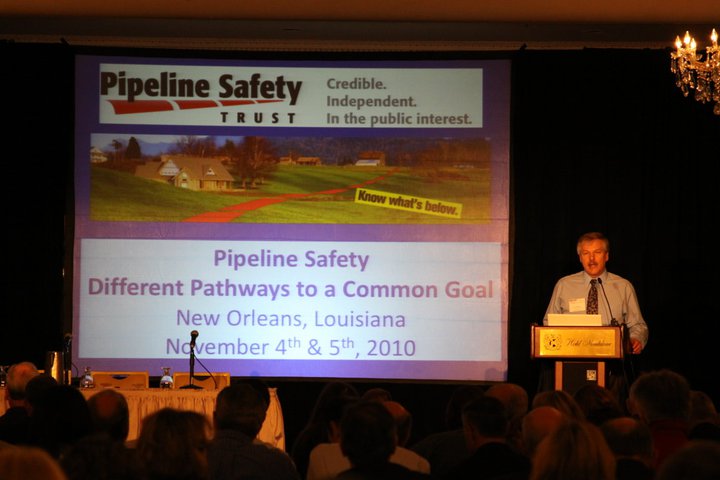
It’s that time of year again! This week, the Pipeline Safety Trust will once again host its annual conference in New Orleans. Among other things, that means Executive Director Carl Weimer will drown his frustrations and celebrate his recent electoral victory in hot, heaping piles of sugar-coated fried dough! He may even once again don that silly hat.
 But when not feasting on beignets, Weimer and the other conference participants will talk about all manner of pipeline safety matters– from public awareness to regulatory oversight to… well, to some technical matters that few people this side of Mike Holmstrom and Robert Whitesides can comprehend. There’s also bound to be plenty of drama and tension: will PHMSA beg the public’s forgiveness? will the pipeline company representatives leave a tip for the waitstaff at Cafe du Monde? will the Exxon people even show their faces? will Rebecca Craven get vertigo from the carousel bar at the Hotel Monteleone? will Beth Wallace be detained at the airport by Homeland Security? will anyone from Enbridge so much as glance in our direction? will Larry Springer be there at all?
We’re not giving a presentation this year, although our friend David Gallagher will be there with, no doubt, some more horrifying pictures of construction right outside his living room. And we can’t wait to meet the tireless Ann Jarrell from Mayflower, Arkansas and citizen-activist Jennifer Baker from Vermont. These heroes will be on this year’s landowners panel, which I will moderate. (I’m still casting about for just the right pithy, cutting remark to kick off the session.) The whole thing will be webcast, just like last year. Consider tuning in. It’s quite fascinating and way more entertaining than you might think.
We will, of course, report on matters as best we can. We might even tweet the occasional Tweet, since the Trust went to all the trouble of making up a fancy, cutting-edge Twitter hashtag. If you’re into that sort of thing, it is: #PSTconf2013. The action begins at 9 am on Thursday and continues through Friday.
by Jeffrey Insko | Nov 18, 2013 |
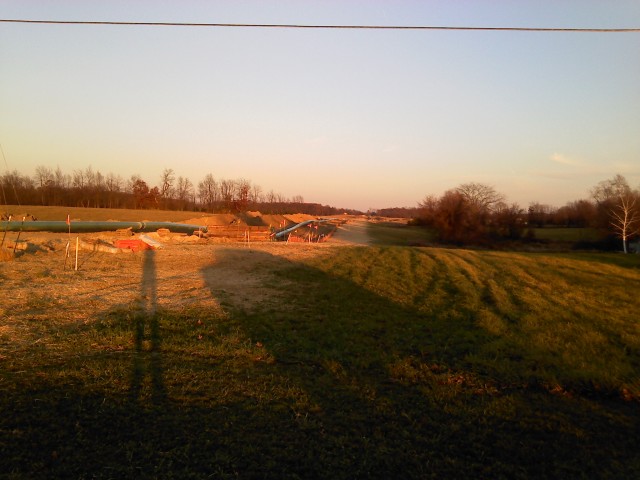
Here’s one we’ve been trying to steal some time to write about for a couple of months now: if you haven’t heard, Enbridge is planning to build a new 600 mile pipeline from North Dakota to Superior, Wisconsin– what they’re calling the “Sandpiper Project.” Not surprisingly, this proposed project has had some landowners worried and concerned, especially a smart and well-organized group of farmers and others in Minnesota calling themselves the Carlton County Land Stewards.
Thanks to their efforts, Enbridge announced last week that it would alter its originally proposed route through Minnesota to minimize disturbances to critical forests and farming operations. Enbridge’s announcement came on the heels of a unanimous vote by the Carlton County Board backing the revised route for the pipeline.
Now, this decision by Enbridge is certainly to be commended. As we’ve said almost from the day we launched this blog, responsiveness to the concerns of landowners and local authorities is absolutely critical for establishing and maintaining good relations between pipeline operators and the public; it’s good for property rights, good for the environment, and good for pipeline safety. The trouble, of course, is that down here in Michigan, Enbridge has too often NOT been responsive or receptive to the concerns of landowners and local citizens. That’s mainly what we’ve spent so much of our time documenting for well over a year now. And that’s why we are calling the news out of Minnesota “good” with a question mark to indicate our wariness, a wariness we’re pretty sure is shared by the Carlton County Land Stewards.
Here’s a bit of context:
A tour through our archives will provide you with plenty of examples of how Enbridge has repeatedly proven itself unresponsive: from failing to hold public informational meetings on this side of the state to declining to attend township meetings, or meeting with municipalities reluctantly, flouting local ordinances, dragging its feet on agreements and actions, failing to return emails and phone calls from landowners, and on and on. We have spent far too much of our time trying to wrap our heads around this pattern of behavior, trying to figure out why it seems to be so hard for Enbridge to act according to its stated values. And we’ve been told more than once by Enbridge representatives that our experience here in Michigan is not ordinary, that it’s an “anomaly,” that for various reasons not clearly explained, the Line 6B project has been unusual. (Of course, in saying this to us, those Enbridge representatives have not taken any real responsibility for the very serious problems they have caused here; they’re just trying, once again, to explain themselves.)
We’ve always found this pill– that matters in Michigan are unique and not the norm for Enbridge– rather hard to swallow. We’ve heard too many stories from elsewhere, like in Canada, that suggest otherwise. Consider, for instance, this profile of Enbridge executive Janet Holder published in a Canadian paper a couple of months back. The article focuses on Holder’s attempts to repair the companies strained relations with the people of British Columbia, whose support is desperately needed by the company in order to get its embattled Northern Gateway project approved. What’s most striking about the article, however, is just how familiar the story it tells is. Initially, Enbridge tried to have its way, to run roughshod through B.C. Only later, after pushback from First Nations and others, did Enbridge launch a PR-style campaign to try and repair the relations it damaged. This is likewise– minus much effort at repairing relations– the story of the Line 6B “replacement.”
Just how endemic to the company is this lack of consideration toward communities and landowners? The most extraordinary part of the article is when it quotes a former Enbridge executive:
LOUSY ENGAGEMENT
But even a former Enbridge executive said the company has done a lousy job of community engagement.
Roger Harris, a former Liberal MLA and Enbridge vice-president, said he quit the company in 2010 after it developed a “grid system” for deciding which public meetings to attend.
He said the grid assigned demerit points for meetings based on the size of the audience, the likelihood of negative questions and whether the media would be present.
Meetings that accumulated too many demerit points on the grid — indicating the company might get a rough ride in front of a large audience with reporters watching — were skipped, Harris said.
“They were afraid to attend meetings other than small, private gatherings of their supporters when they should have been embracing the outrage and trying to win over critics,” Harris said.
“They had to go into rooms of people who didn’t support them, but they refused and it just bred more suspicion.”
Janet Holder is dismissive of these remarks. But for anyone who has attempted to communicate with Enbridge, Harris’s account seems utterly plausible. It’s an explanation for the bizarre pattern of evasive engagement and poor communication we’ve encountered in numerous situations. In fact, what Harris says here is essentially what Enbridge V.P. Mark Sitek told us when he mentioned that Enbridge is reluctant to hold public meetings because it often feels “ambushed.”
So what does this have to do with Minnesota? Well, the very same week that the Holder profile appeared, one of the Carlton County Land Stewards, a farmer named Janaki Fisher-Merritt published an editorial in a local Minnesota paper. In the excellent piece, Fisher-Merritt carefully describes the reasonable concerns of Minnesota citizens about the Sandpiper project (read more on those concerns here and here). But perhaps the most striking things he says is this:
Unfortunately, there seems to be no avenue for public comment on the project at this stage. My neighbors and I have requested to meet with Enbridge to make our concerns clear. Unfortunately, the company’s officials will not meet with groups of landowners or discuss our concerns comprehensively. They instead seem to prefer to single us out and only discuss our small pieces of land, not the route as a whole.
Once again, we have the same story: a reluctance (if not outright refusal) by Enbridge to meet with communities and groups of landowners and a reliance instead on the deeply flawed and alienating land agent system.
The situation in Minnesota parallels our in Michigan in other ways as well. In another article just a few weeks ago, landowners express their frustration at Enbridge’s abuse of easement rights. It seems that Enbridge’s surveying crews were staking on properties without the property owners’ permissions. Evidently, just as they did in Michigan, Enbridge has been exerting eminent domain rights before being granted those rights by the Minnesota Public Utilities Commission. The article also documents some familiar instances of the kind of non-communication so many of us have experienced from Enbridge: evasions, non-explanations, failures to follow up.
Based on this evidence, it’s hard to accept the notion that things in Michigan have somehow been different, that some unique set of circumstances beyond Enbridge’s control have caused all the trouble here. Quite the contrary: it appears that we are simply experiencing some version of the shabby treatment the people of British Columbia experienced. And now the people of Minnesota (and elsewhere) are experiencing the same. This is why we are cautious and chary about how “good” the news is from Minnesota. It appears to be a positive first step. We are very glad Enbridge has taken it. But, as the Carlton County group understands, it’s only a first step. There is much more work to be done. We will continue to watch the story and support our Minnesota friends in whatever ways we can.
If you are in Minnesota and want to learn more or add your voice to the chorus of concerned citizens, there is a public forum planned for later this week. Details are available here.
by Jeffrey Insko | Oct 31, 2013 |
Happy Halloween, everyone! Those of us along Line 6B have more than our fair share of frights over the past year or more. So we’re bringing you a treat instead: a guest post from our friend and hero Beth Wallace!
5 spooky facts about Enbridge’s Mackinac Pipeline
by Beth Wallace
Halloween is one of my favorite holidays for many reasons:
- Dress up..and what girl doesn’t love to dress up!
- CANDY
- And best of all – you get to scare the crap out of people all day and nobody can get mad at you!
Taking advantage of the last point – I would like to share 5 very real and very scary facts about Enbridge’s Mackinac Pipeline.
This past August, I rang in my 30th birthday by joining Enbridge on a panel in Ironwood, Mich., to brief a room of reporters on the Mackinac Pipeline. I went into this conversation determined to gather as much information from Enbridge as I possibly could. I knew this was the best chance I was going to get for a long time considering that both Enbridge and the PHMSA continue to brush off our formal requests for disclosure of integrity around this pipeline.
If you’re not familiar with the Mackinac pipeline – you can watch this video for a quick debrief.
Now, on to the spooky facts:
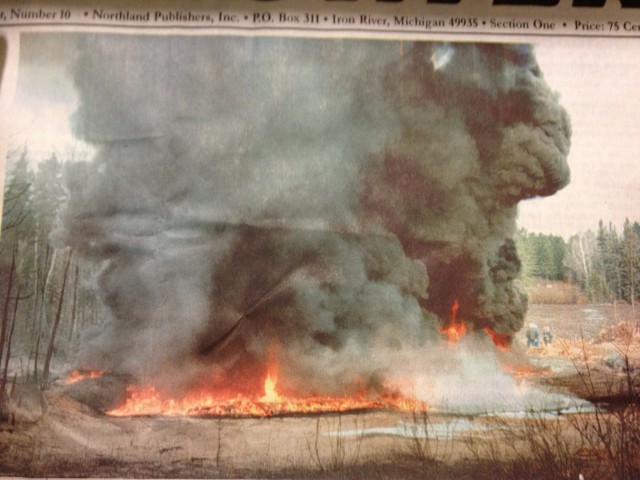 1. Enbridge has increased pressure on the 60 year old Mackinac Pipeline by 50,000 barrels per day. This pipeline has never been replaced and has had a history of failure – including a rupture in Crystal Falls of 226,000 gallons of crude and natural gas liquids in 1999. Like many pipeline failures around the country, Enbridge did not discover this rupture. A motorist driving by smelled the strong petroleum odor and called 911. This spill formed a potentially explosive cloud that forced dozens of nearby residents to evacuate. Enbridge officials ignited the vapor cloud to prevent it from spreading, which touched off a raging fire that burned for 36 hours and scorched eight acres of land.
2. According to Enbridge, in order to increase pressure on their pipeline, PHMSA only required hydro tests of two small sections of the pipeline that had never been hydro tested before. Enbridge indicated that those sections were only ~50 miles in length and ~75 miles in length. The Enbridge folks in the room did not know where those tests occurred, but we know that one took place in Bay City since it turned up a failure on the line. Despite the test indicating failure on the pipeline, Enbridge was given the green light to increase pressure throughout their pipeline and completed that project sometime in July 2013.
3. Enbridge has not yet been required to obtain a presidential permit for the expansion and operational changes made to the Mackinac Pipeline, which would have required an Environmental Impact Statement and public comment periods. Both Enbridge and the American Petroleum Institute stated that these types of permits are arbitrary and only delay projects.
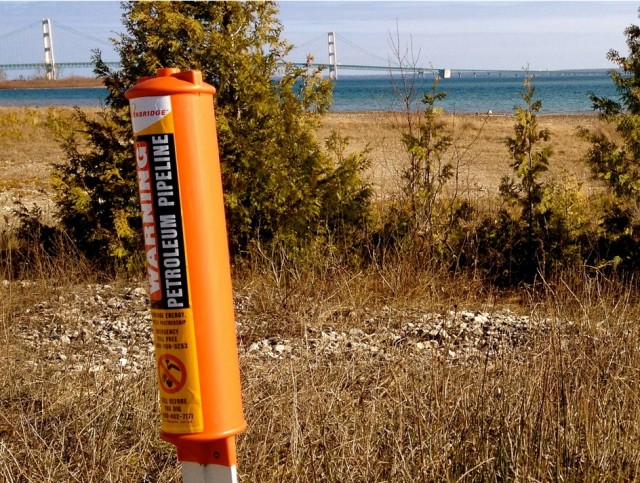
 I took that opportunity to explain that these permits are the only way the public can have a voice in these risky projects. Moreover, a proper Environmental Impact Statement has never been required for this pipeline. Increasing pressure on a massive 60 year old pipeline that crosses the freshwater drinking source for millions of people should go through a public comment period and impact review.
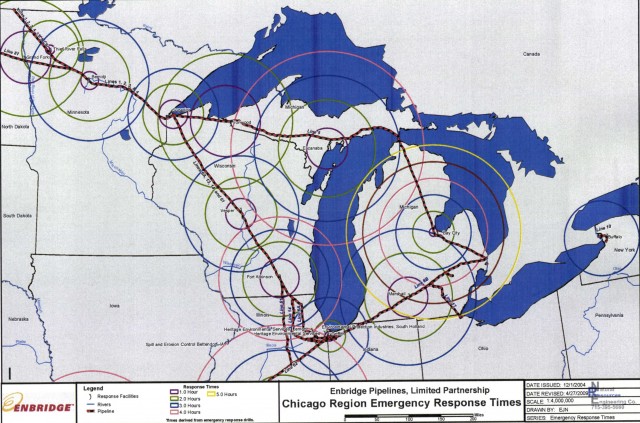
4. If the Mackinac Pipeline were to rupture in or near the Straits of Mackinac, Enbridge has admitted to having only one representative nearby. In Enbridge’s own emergency response plan, they indicate that it would take them 3 hours to respond from Escanaba or 6 hours from Bay City. Depending on the weather, response might not even be possible at all. In addition, we have records that indicate Enbridge is not utilizing state of the art technology at these locations, for shut down of their pipeline, which could cause any rupture to be much greater.
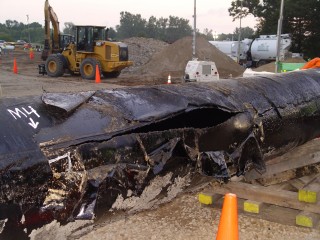 5. Enbridge stated that this pipeline could last indefinitely and that they currently have no plans for replacement of this 60 year old pipeline. The most frightening fact behind this statement is that this kind of thinking is one of the main reasons Enbridge had the largest and most costly inland oil spill in Marshall, Mich., three years ago when Line 6B spilled around 1 million gallons into the Kalamazoo river system. Enbridge knew Line 6b had a large number of problems but they postponed plans for replacement and pressed forward with risky operations. Waiting for a pipeline to have massive failure, before you consider improvements, is extremely frightening and many would argue illegal.
If you would like to contact your senators – NWF has created a very easy action alert reminding our Senators that pipelines that have international border crossings, and go through operational changes- like the Mackinac Pipeline and Line 6B- need to obtain a presidential permit.
by Jeffrey Insko | Oct 15, 2013 |
We apologize that we’re a little late alerting you to the latest from everybody’s favorite Michigan hero. We are knee deep in work matters and have fallen way behind on a number of planned posts. We’re still not done with our landowners stories series; there are restoration updates and ongoing difficulties to discuss further (including that curious contractor business we mentioned last week), plenty of phase two matters to discuss, and the final word on whether the pipeline industry is willing to put its money where its mouth is (what’s your guess?!). We’re trying to get to it all, really we are…
But back to our Michigan hero. No, we don’t mean Max Scherzer. We mean Beth Wallace.
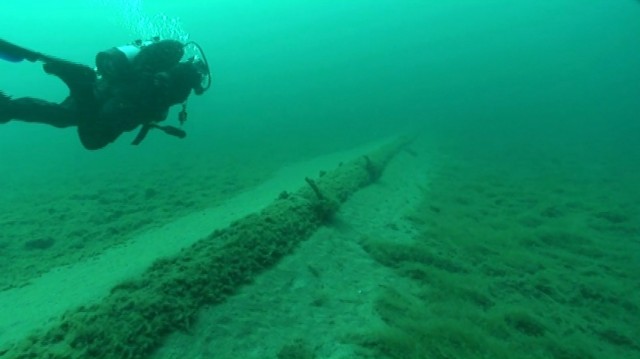
Beth has a very important post up over at the NWF’s Wildlife Promise blog regarding the ongoing Line 5 matter– you know, that line that runs beneath the Straits of Mackinac. Thanks to Beth’s very hard (we’re tempted to say heroic) work on this issue, NWF now has video of footage of just what that pipe looks like. But tuck the kids into bed first; it’s kind of scary.
We will of course continue to keep you informed about this serious issue. In fact, we’re hoping we can convince that very same Beth Wallace to contribute a little something right here on this blog. Stay tuned!
