by Jeffrey Insko | Sep 26, 2013 |
Some breaking news to report: Michigan Representative Fred Upton, who represents plenty of citizens along Line 6B, has introduced legislation that would put an end to the Presidential Permitting process for cross-border pipelines. The bill is intended to fast-track pipeline projects, requiring that they be approved in no more than 120 days. The bill would also explicitly exempt pipeline reversals, volume expansions, and other modifications from the approval process.
For a long time now, we’ve been bemoaning the lack of public input, careful environmental review, and regulatory scrutiny of the Line 6B project as well as other tar sands pipeline projects, like Keystone XL, the Alberta Clipper expansion, the Flanagan South project, and the planned volume expansion of Line 5 under the straits of Mackinac. This bill would make sure that there is even LESS chance for public input, environmental review, and regulatory scrutiny. It is designed to ensure the “anything goes” when it comes to the production and transportation of tar sands pipelines.
This is a bill of the industry, by the industry and for the industry. It represents a serious threat to the Great Lakes. We need to stop it.
Please write or call Fred Upton or your U.S. district representative. The number for Upton’s Washington D.C. office is:
(202) 225-3761
Or you can call his Kalamazoo office at (269) 385-0039.
Or you can send him an email here: http://upton.house.gov/contact/
by Jeffrey Insko | Sep 6, 2013 |
We apologize for the silence around here the past week or so. We took a much needed vacation over to the paradise that is Northern Michigan, spending lots of time at Sleeping Bear Dunes National Lakeshore. As always, it was energizing and a reminder of Michigan’s magnificent natural resources– all the more reason to continue doing whatever small part we can to protect them.
Now that we’re back, we’ve got a plea to make on behalf of our friends at the Pipeline Safety Trust. It’s time for the liquid pipelines industry to put up or shut up.
As you may recall, the Pipeline Safety Trust hosts an annual conference that brings together members of industry, regulators, and ordinary citizens to engage in productive dialogue about pipeline safety. We were privileged to attend and speak at the conference last year. It’s an invigorating and important event. The work that the PS Trust does is quiet, but vital. Ordinary citizens are a crucial part of that work. But here’s the problem:
The PS Trust isn’t exactly rich and the conference isn’t exactly cheap. It’s not easy or affordable for a lot of ordinary citizens to get to New Orleans to participate. In the past, the Trust has been able to subsidize much of that travel by securing external grants. Unfortunately, funding sources have dried up. And that means that a lot of citizens– think, for instance, of those people affected by the terrible spill in Mayflower, Arkansas– will likely not be able to attend.
To solve this problem, the Trust has embarked upon a fundraising effort. They’ve estimated that they’ll need to raise about $15,000- 20,000. We think this this sort of crowdfunding is great and we hope you will consider donating something small. It’s worth a few dollars, we promise. But having said that, here’s the thing:
It should be obvious to everyone where the money for this travel should come from. It’s not the PS Trust or the regulatory agencies or ordinary people who have the resources to fund this sort of thing. It’s industry. We’re talking here about corporations that make hundreds of millions of dollars in profit a year. There’s probably $20k in loose change between the cushions of the couches in the lobby at the corporate headquarters.
But the fact that industry can easily generate the sum the PS Trust needs is the least of the reasons why they should pick up this tab. The more important reason is because it’s in their interest to do so. Regular citizens, particularly landowners with pipelines running through their properties, are crucial players in pipeline safety. Everyone agrees on this. We are the first first-responders. We are supposed to be partners, collaborators in pipeline safety.
In fact, that’s exactly what the industry says. The pipeline companies profess to be committed to cultivating productive partnerships and engaging in open dialogue with citizen stakeholders. For instance:
- PG&E says that “Engaging with our stakeholders is an essential part of our approach to sustainability—and an area of continued emphasis for PG&E. Doing so enables us to learn from, inform and problem-solve with our diverse stakeholders.”
- Exxon Mobil insists that “Continued dialogue is critical to the long-term relationship between our employees and our neighbors. That’s why we invite community members to discuss their concerns with us.”
- TransCanada says that “Everything we do depends on the strength of our relationship with local residents.”
- Williams Pipelines “takes great pride in the relationship of trust and harmony we’ve developed with the many landowners and communities with whom we co-exist.”
- Spectra Energy asserts that “community stewardship means listening to and being responsible members of the communities we serve. We engage local stakeholders affected by our projects and ongoing operations early and often…”
- And Enbridge says that “developing and maintaining good relationships with our stakeholders – the landowners, tenants and neighbours along our pipeline system – is important to us.” And one of the ways they do this is by “consulting with the individuals who live along our pipelines, and with those who may become our neighbours as our pipeline network grows.”
Other companies make similar claims. And we want to believe them. We really do. So here is a chance for them to make good on all of those assertions, to actually go out of their way to ensure that landowners are in attendance at a gathering specifically designed to foster the kinds of engagements, consultations, and relationships of trust and harmony they claim (publicly) to value. Here is a perfect opportunity for those corporations to put their money where their collective corporate mouth is. In fact, it would be a PR coup for them. They could announce their donations on their websites, tout them in their next annual corporate responsibility reports, make them a talking point for their Jason Manshums and Shawn Howards. Heck, we would even praise them right here in this blog for making good on their stated commitments, for taking action commensurate with their words!
And it would hardly cost them a thing. What is, say, $5000 to a billion dollar corporation? Any one of the companies I’ve listed above could cut the Pipeline Safety Trust a check for the full $20k and not even miss it. Just a quarter of that from each of the six I’ve listed above and the PS Trust’s goal would be exceeded by a third.
Or, to put this another way, just consider: in 2011, the total compensation of Stephen Wuori of Enbridge exceeded six million dollars. According to the same source, Russell Girling of TransCanada made about the same. And Christopher Johns of PG&E made more than five million. Do you think that between the three of them they could come up with a mere $15,000 dollars to demonstrate their commitment to pipeline safety? Or better yet, why don’t they show some real vision and leadership by establishing a permanent fund specifically designated for citizen travel to the conference every year and distributed by the Trust, thereby permanently sparing Carl Weimer, who has much better things to do, from ever again having to go around panhandling?
So we’ll see what happens. If the funding for citizen travel does not materialize– or if it only comes from committed and generous people who are NOT from the industry– then we’ll know for sure whether all the industry talk about engaging and consulting landowners and neighbors is a reality or just pleasant-sounding rhetoric.
by Jeffrey Insko | Aug 23, 2013 |
While Enbridge works hard this week to woo the press (much more on this coming up later), they’re also taking some lumps. Comstock Township, like the EPA last week, has considered Enbridge’s request and then told them “no.” Late last night the Township Planning Commission voted unanimously to deny Enbridge special zoning for a dredge pad as they continue to clean up the Kalamazoo River. Lindsey Smith at Michigan Public Radio has the story. Evidently, residents and Bell’s Brewery owner Larry Bell were mighty pleased with the outcome.
Because we don’t know enough about the issue, we never really took a strong position on the dredge pad matter, except to say that in general we think it’s good policy to defer to local authority and community desires on such matters. We’re pretty big fans of local autonomy when it comes to the protection of landowners and natural resources. In fact, Enbridge’s callous disregard of local authority and concerns has been one of the major themes of this blog for more than a year. With that in mind, we’ll indulge in one little observation:
It now appears that Enbridge is going to have real trouble meeting the EPA mandated deadline for this latest round of clean up. And they probably think it’s all Larry Bell’s fault. But they have no one to blame but themselves. This dredge pad situation is a nearly identical replay of what happened on phase one of their project. They tried (despite their stated values) to take the easy way out and circumvent local ordinances. And what happened? Just like in Comstock Township, some brave local officials and concerned citizens cried foul, causing Enbridge to slow down, then scramble to make nice so they could resume their work after some long and painful (to Enbridge) delays. The result? The whole thing took far more time and created far more acrimony and bad feelings than it would (or should) have if Enbridge had simply gone about it thoughtfully, respectfully, and cooperatively in the first place.
In this context, the Comstock Township just demonstrates yet again that Enbridge appears incapable of learning from its mistakes.
by Jeffrey Insko | Aug 19, 2013 |
Update, August 20, 2013: Well, it turns out that what looked like a very big Enbridge whopper (details below) is actually just a run-of-the-mill bit of Enbridge misinformation. Reporter Tina Casagrand has the clarification from Enbridge in a comment to this post. We are glad for spokesperson Katie Lange’s sake that she wasn’t actually saying that the Marshall spill was the result of “something that was stuck in the pipe.” Unfortunately, the clarification doesn’t actually bring all that much clarity to the matter. Here’s why:
Enbridge now says that “the incident” to which Lange’s refers in her statement is the discharge that resulted from a hydrotest of the new Line 6B earlier this summer. (You might remember that we wrote about it at the time.) We’ll take them at their word on this. The problem, however, is that the statement is STILL inaccurate and even, it seems, rather disingenuous. The inaccurate part is that the incident did not take place in Marshall. Ore Creek is in Tyrone Township, Livingston County, nowhere near Marshall. The disingenuous part is that Lange says Enbridge didn’t “purposefully” violate the permit, suggesting instead that the violations were the result of something getting stuck. However, if you look at the violations-– there are ELEVEN of them– it’s hard to see how any of them could have been the result of something getting stuck in the line. For instance, (just to name a few) the DEQ cites Enbridge for not having any on-site representatives during the discharge, for not taking any samples of the discharge on June 17 (three days before the discharge), for not conducting water inspections as required the week before the discharge, and for not inspecting their equipment as required. As far as we can tell, none of these things have anything at all to do with something getting stuck in the pipe. So the question that remains is whether Enbridge failed to perform these required actions “purposefully,” as Lange claims. Maybe that’s a difficult thing to determine, we guess. But if the violations aren’t the result of an accident (and the evidence suggests they weren’t), and they were not purposeful, that only leaves one alternative: incompetence. That is not very comforting.
_____________________
Two very interesting stories appeared in newspapers today written by talented young reporters. Over at the St. Louis Beacon, Tina Casagrand has an excellent piece about Enbridge’s Flanagan South project. As we’ve noted before, this is another one of Enbridge’s clever schemes to out-Keystone Keystone XL. This line will head south through the midwest and eventually make it all the way to the coast. And the most disturbing part? Even though it crosses an international border, Enbridge has once again found a way to skirt the presidential permitting problem and avoid public scrutiny. And also once again, the project is mostly flying under the radar while almost all eyes remain fixed on KXL. This is one reason Tina’s piece (and others that have appeared before it) is so very important.
But the most extraordinary thing of all in the article– and, honestly, we thought we’d heard it all by now– is what Enbridge spokesperson Katie Lange has to say about the Marshall spill. If you’re not sitting down, you might want to. At least be sure you’re holding on to something solid. This whopper is even worse than the infuriatingly dishonest story Enbridge VP of Operations Richard Adams told to the EPA a couple of weeks ago. Okay. Are you ready? Here’s Lange on Marshall:
“For the incident in Marshall, it wasn’t that Enbridge purposefully violated, it was something that was stuck in the pipe,” added Lange.
Something stuck in the pipe?! We have long been baffled and angered by the misleading, disingenuous, obfuscatory, and inaccurate things that Enbridge spokespersons– the Larry Springers and Jennifer Smiths and Jason Manshums say. But this one has to take the cake. One can only wonder where in the world poor Katie Lange got that patently false piece of information. Surely she or someone at Enbridge will call Tina to correct it. Right?
The other interesting story today is from Ursula Zerilli over at MLive, who is following up on her article from last week. For some strange reason, Enbridge decided to get chummy with some reporters as they kick off phase two of the project and so (evidently) reporters got to ride around in a van with Tom Hodge and some others. But unlike last week’s article, in this one Ursula speaks with some Enbridge critics, among them our friend Dave Gallagher, whose situation as an affected landowner is a real nightmare– just get a load of the picture that accompanies the article! The article also features some remarks from inspector Raymond Ashley, who appears to have a real penchant for forced, mawkish metaphors:
“We are trying to weld more than just this pipe together,” said Raymond Ashley, who was proudly wearing a photo of his granddaughter as a badge. “We’re welding more than just a pipeline. We need to bond together the environment, safety and the integrity of this pipeline. We have one day to build integrity and that’s today.”
Anyway, while we think the article is accurate and fair (she even emphasizes Enbridge’s slow response to Marshall), it also left us a little dissatisfied for reasons that might be worth explaining in a bit of detail. The reason we’re dissatisfied– and we don’t really blame Ursula for this– is that the article lacks nuance. It lacks subtlety and complexity. Again, this isn’t really Ursula’s fault. We live in a (news) culture that likes simple binary narratives– us vs. them, black vs. white, good guys vs. bad guys. That’s what (or so editors seem to think) appeals to people. Making this even worse is that Ursula was probably only given about 800 words in which to tell her story– hard to be nuanced in such a short space. Yet nuance is important. Here’s why:
One comes away from the article with a simple dichotomy: there are pipeline proponents (like Tom Hodge and Enbridge) and there are pipeline opponents (the protestors from MICATS). They are the article’s protagonists and antagonists (we’ll let you decide who’s who!). But the problem with this narrative– which pits people who don’t want pipelines against people building pipelines– is that it is precisely the way that Enbridge wants to have this story framed. It’s why former Enbridge CEO likes to talk about “revolutionaries” and why Enbridge spokesman Larry Springer talks about “special interest groups.” That kind of story serves Enbridge’s interests perfectly because it allows them to sound reasonable and pragmatic, while casting everyone else as a little bit crazy, on the fringes, out of the mainstream. So, for instance, Tom Hodge gets to say things like this:
“It’s hard to understand their logic,” he said of those protesting the pipeline replacement project. “It seems like they want us to turn the pipeline off or just not replace this pipeline, which already ruptured. There’s not a good alternative to what we are doing and we feel like it’s a good thing for the State of Michigan.”
And this:
“There would be riots in the streets if food wasn’t being delivered or if fuel wasn’t being delivered,” he said. “I’m all for having an alternate fuel, but until that becomes available, there’s no other option. You can use natural gas but that has to come by pipeline, too. If that ruptures, it’s not a polluting event like oil … It’s a fireball.”
See how that works? Hodge makes it sound like the alternatives are clear and stark: EITHER Enbridge gets to build whatever pipelines it wants to build however it wants to build them OR there will be riots in the streets because people are starving. I mean, what kind of person would be in favor of people starving?!
But here’s the thing: that is complete and total and utter nonsense. It is a ridiculously false choice. Those are quite plainly NOT the only alternatives. People are not going to starve and riot in the street if Enbridge does not get to pump 800,000 barrels of tar sands oil a day across Michigan through a shiny new Line 6B. No serious person believes any such thing. And yet Hodge gets to imply as much and, in doing so, also gets to come off as the person who is being rational and realistic.
And that’s not even the worst part. The other reason this simplistic (and largely false) narrative of people in favor of the pipeline vs. people opposed to the pipeline serves Enbridge so well is because it allows them to evade the real substance of most of the real criticism of the way they have conducted themselves in Michigan over the past three years (or more). As we have said over and over and over and over again (so often we don’t even have the energy to provide links anymore), the problem isn’t that they’re replacing Line 6B. The problem is how they’ve gone about it. Most of us do not oppose the “replacement” of the line– a new pipe is obviously better than an aging pipe. That has NEVER been the issue. What we object to is the way that Enbridge has cleverly skirted federal regulations, the way they have abused their easement rights and mistreated landowners and trampled property rights, the way they have misinformed people, the way they have flouted or ignored local authority and thrown their weight around, the way they have essentially re-written Michigan law to serve their own financial interests. All that plus the fact that we have a bunch of elected officials and a set of pathetically weak regulatory systems that allows all of this to continue.
Those are the real issues. And they are issues that affect and therefore ought to concern all the citizens of the state of Michigan. To pretend otherwise– to pretend that it’s a simple matter of energy production vs. a handful of environmental radicals– does nothing but allow Enbridge to avoid having to face any of the things I’ve described, to avoid ever being confronted with genuinely tough questions. So once again, as always, Enbridge gets exactly what it wants.
by Jeffrey Insko | Aug 16, 2013 |
This just in: the EPA has denied Enbridge’s request for an extension to complete the latest round of dredging in the Kalamazoo River. We don’t know enough about dredge pads and Comstock Township to have a strong opinion on the dredge site matter, but as we explained at length last week (here and in a letter to the EPA), Enbridge was shockingly dishonest in their letter to the EPA asking for the request. One can only surmise that that fact– there’s no way EPA couldn’t have known the truth– had something to do with the denial. It would have been nice to see EPA call Enbridge out on their attempt to blame someone else for the delay with the Comstock permit. But it was satisfying to see EPA call Enbridge out on a similar matter: Enbridge’s attempt to pretend like the Michigan DEQ was slow in issuing permits. From the EPA letter (emphasis ours).
Enbridge also noted in its letter that MDEQ has not yet issued the dredge permit for Morrow Lake and the Delta. Although this is true, it is also true that Enbridge has not yet submitted certain information required by MDEQ for the permit application. Enbridge has had all required information from U.S. EPA for completion of the application since U.S. EPA approved the Dredge Completion Depth Plan on August 1, 2013. U.S. EPA again reminds Enbridge to submit this information to MDEQ immediately.
Snap!
Ursula Zerilli has more in a thorough article over at MLive. Michigan Radio’s Steve Carmody has also filed a report.
by Jeffrey Insko | Aug 11, 2013 |
Evidently, Enbridge thinks the EPA is stupid– or doesn’t have access to the local news.
As MLive reported last week— along with numerous other news outlets— Enbridge has asked the EPA for an extension to complete the latest round of dredging ordered by the agency earlier this year. The reason for the extension request has to do (ostensibly) with the situation in Comstock Township, the Bell’s Brewery lawsuit, and permitting from the Michigan DEQ. In and of itself, the extension request isn’t terribly surprising. And since we don’t know very much about dredge pads and zoning in Comstock Township and haven’t carefully investigated those things, we’re not really in a position to offer any confident opinions about Enbridge’s plan–although if Comstock residents and business owners like Larry Bell have serious concerns, we certainly think they need to be heard.
So this post isn’t really about the site plan. Instead, it’s about the part of the story that no one else (as far as we know) has bothered to mention: the audacity– or, to call it what it is– the flagrant dishonesty of Enbridge’s letter to the EPA. Why the letter’s demonstrable falsehoods– and we don’t use this language lightly– have thus far been given a free pass we do not understand.
Before we explain, let’s put this in a little context. Over the past year, we have said– and shown— repeatedly that Enbridge fails to live up to its professed corporate values. This simple point was even the basis of our talk at the PSTrust conference last year, which a number of Enbridge representatives attended. So they know very well that plenty of us are measuring their actions against their words. Once again, let’s take a quick look at some of those values. The first ones on the list fall under the heading of “Integrity”:
Integrity
-
Maintain truth in all interactions
-
Do the right thing; do not take the easy way out
-
Take accountability for our actions, without passing blame to others
With these things in mind, let’s watch as Senior Vice President of Operations Richard L. Adams violates all three of them in the span of just a few sentences. Here’s what Adams says in his letter to the EPA requesting that extension. The offending portions are in boldface:
Enbridge’s preparation for dredging in the Delta and Morrow Lake area has been discontinued due to an unanticipated issue with securing a dredge pad site. Enbridge originally selected a site for the dredge pad that met all technical and practical requirements and promptly applied for the appropriate permit from the Township of Comstock. Unfortunately, some local residents and business owners have vigorously opposed granting the permit. As a result, the Township of Comstock has not yet issued the required permit to allow use of the specific site selected for the dredge pad.
1. “Maintain truth in all interactions.” Is Adams’s description of why Enbridge’s dredging plan has been delayed truthful? Well, no. Adams makes it sounds as if Enbridge was doing everything precisely as it should and would have made the EPA deadline just fine until some pesky obstructionist locals got in the way and mucked everything up. But that little narrative, flattering though it may be to Enbridge simply does not square with reality.
For one thing, it is quite plainly NOT true to say that Enbridge “promptly applied for the appropriate permit from the Township of Comstock.” Of course, the term “promptly” might seem to leave a little wriggle room (after all, who gets to decide what counts as prompt?). But let’s consider the facts: the EPA issued its dredging order on March 14 of this year. Enbridge only submitted a site plan to Comstock Township on July 9, nearly four months later (and even then, they submitted it to the wrong body, further delaying matters; more on this below). And they only did so after the Comstock Township Supervisor discovered they were about to begin work without the permit and asked them to stop. Would any reasonable person honestly believe that that qualifies as having “promptly applied”? In fact, does that even count as having applied at all? We tend to think not, but can’t say for sure.
But you don’t have to take our word for it. Just consider some of the key players in this matter who also do not think it was prompt. One of them is Enbridge’s own attorney Christopher Tracy. Here is what Tracy said at the Comstock Township Planning Commission on July 25 about that site plan:
I’d like also to apologize on behalf of Enbridge in terms of sort of the fast pace of this. All of you know we’re under an order from the EPA, where work needs to transpire between now and the end of the year.
We would love to have a situation where we weren’t sort of under that kind of clock. So we apologize if we sort of put you in that position and we apologize for not submitting the site plan to you earlier. It should have been done in a different manner, but it was not.
“We apologize for not submitting the site plan to you earlier.” Extraordinary, isn’t it? Not even Enbridge’s own lawyer thinks they applied for the Comstock permit “promptly.” He even apologizes for not having applied for it promptly and says that “it should have been done in a different manner.”
And Tracy is not the only one who doesn’t think Enbridge applied for the Comstock permit promptly. Have a look at what Comstock Township Supervisor Ann Nieuwenhuis says in a July 10 letter to the Michigan DEQ:
At the outset I must express disappointment that substantial work on both of those sites has occurred without Enbridge applying for and obtaining the necessary Township permits required under the Township’s ordinances and its Zoning Ordinance in particular. While representatives of Enbridge have recently expressed to the Township an intent to apply for and obtain the necessary Township zoning approval and otherwise comply with all applicable Township ordinance requirements, this has not yet occurred. Enbridge’s delay in approaching the Township in this regard has unnecessarily exacerbated the Township’s citizens’ concerns and will make it much more difficult to give those concerns as reflected in the Township Zoning Ordinance proper consideration within the abbreviated timeframe that Enbridge indicates is available to it.
So, neither Enbridge’s own attorney nor the Comstock Supervisor think that Enbridge applied for the Township permit “promptly.” In fact, both of them state quite clearly that a major problem here is that Enbridge FAILED to apply for the permit promptly. That failure is the primary cause of the delay, a delay that has in turn caused Enbridge to seek that extension from the EPA. Yet, in the face of this clear fact, as agreed to by both an Enbridge attorney speaking before the Comstock Planning Commission and the Comstock Township Supervisor, Richard Adams tells the EPA that Enbridge applied for the permit promptly.
2. “Do the right thing; do not take the easy way out.” Which leads us to the next “value” that Adams violates in his letter. The whole point of all of this for Ann Nieuwenhuis (or so it seems to us) is that Enbridge did NOT do the right thing from the start, which would have been to initiate discussions with the Township from the very beginning, to communicate their dredging plans with them, and to apply for the appropriate permits before starting work. But they did none of that. That’s what Nieuwenhuis objected to in the first place. Instead, Enbridge tried to “take the easy way out,” tried to just do things the way they wanted to, without consulting local authorities or inviting local input. (This is the same sort of thing they did with Brandon Township and Howell Township earlier this year.) And since then, Enbridge has continued to NOT do the right thing, like, for instance, submitting the site plan to the Planning Commission and not the Zoning Board as the process requires (thus further delaying matters!). Why did Enbridge do that? Well, here is what Supervisor Niewenhuis had to say about that:
The township had previously warned Enbridge when submitting its site applications that it should go through the ZBA first, but Nieuwenhuis said Enbridge tried to expedite the process by going straight to the Planning Commission with its north site application.
“They didn’t want to do that because (notice of the ZBA meeting) has to be posted in a newspaper 15 days in advance of the meeting,” Nieuwenhuis said. “They thought going directly to the planning commission would be the way to go.”
That’s right, Enbridge tried to “expedite the process”; they tried to take the easy way out. The same goes for Adams’s letter. In it, he isn’t doing the right thing. The “right” thing would be to own up to having screwed up and to accept the consequences of that screw up. But that’s not what he is doing in the letter. Instead, he is taking the easy way out.
3. “Take accountability for our actions, without passing blame to others.” Or, to put that last point another way, Adams is most certainly not taking accountability for Enbridge’s actions. Quite the contrary, he is clearly passing blame to others. His letter makes it look like Comstock, the DEQ, and Larry Bell (they can’t even bother to get the name of the brewery right, calling it “Bell Brewery”) are to blame for the delays. It’s everybody’s fault but Enbridge’s. Locals have “vigorously opposed granting the permit,” Adams says. And “as a result,” Enbridge’s plans have been delayed. But that is at best a half-truth. It certainly does not in any way acknowledge Enbridge’s role in delaying the granting of that permit. Such a brazen, deliberate mischaracterization of this situation– aside from egregiously flouting the values Adams is supposed to live by as an Enbridge employee (and not just any employee, but an executive!)– are precisely why Enbridge has lost so much trust with so many people. If they’re willing to look EPA in the eye and pass off clearly demonstrable falsehoods, how is anybody else ever to believe anything they say?
The thing that baffles us most is why Enbridge thinks it can get away with this sort of thing, why they think it’s okay to carefully and deliberately and demonstrably misrepresent the situation to the EPA. Do they think that they can just pull the wool over the eyes of Jeff Kimble, the EPA on-scene coordinator to whom the letter is written? Do they think that Kimble is that stupid? that gullible?
For our part, we think no such thing. We think there’s no possible way that Kimble doesn’t know the truth of the matter. If he really is on scene, he most certainly knows that Enbridge wasn’t just unexpectedly blindsided by a bunch of oppositional Comstock residents one day. He must know that Enbridge created this situation by attempting to proceed without engaging those same Comstock residents or following Comstock’s ordinances. He surely knows all of that. If we were Kimble, we’d be furious, insulted, affronted. And yet we doubt (though we don’t really know) that Kimble and the EPA will call Enbridge out on all of this any more than the press will. Enbridge will most likely get its extension and incur no penalties. Richard Adams’s counterfactual letter will accomplish precisely what it was designed to accomplish regardless of whether it accurately represents the situation.
Which leads us to a pretty frightening, disheartening, demoralizing conclusion– but also an explanation of why Enbridge thinks it can get away with this sort of thing. It’s because they can and do get away with this sort of thing. Over and over. And that’s because everybody just plays along, lets it slide, looks the other way, treats it as no big deal, as just the way things are. So what we have is a situation that looks something like this: Enbridge does not tell the truth to the EPA and knows it’s not telling the truth; the EPA, Comstock Township, and the press all also know that Enbridge isn’t telling the truth; and Enbridge knows that the EPA, Comstock, and the press all know that Enbridge isn’t telling the truth. But nobody says a word about it. Instead, everybody silently agrees to pretend like Enbridge is telling the truth. Everybody agrees to live in a sort of imaginary world where the untrue gets treated as true, rather than a world in which what is true really does matter. It’s the same way that everybody agrees to pretend that Talmadge Creek and the Kalamazoo River are still real creeks and rivers, rather than Enbridge-created ones.
It’s just easier that way.
by Jeffrey Insko | Aug 8, 2013 |
Following up on our earlier link to Alexis Bonogofsky’s great, eerie blog post over at the NWF’s Wildlife Promise blog, we thought we might call your attention to a few other things there:
by Jeffrey Insko | Aug 8, 2013 |
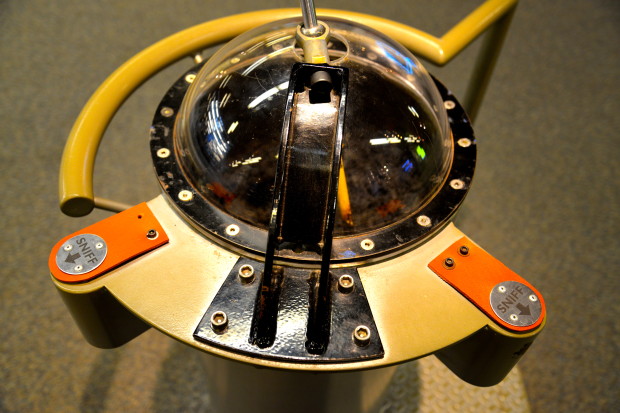
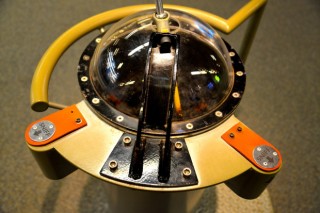
Stir and sniff tar sands in the Oil Sands Discovery Centre in Fort McMurray, Alberta, Canada. Photo by Alexis Bonogofsky
One of the new friends we made on our trip to DC is the NWF’s Alexis Bonogofsky. Alexis recently took a trip to Alberta, Canada to see the tar sands– the place where this whole mess begins– first-hand. What she found at the Fort McMurray informational center is astonishing, hilarious– and deeply disturbing. Check out her great blog post here.
by Jeffrey Insko | Aug 7, 2013 |
We’re working on the second installment on our trip to Washington DC last week to meet with legislators and regulators. If you missed part one– about the meeting we did not have— please check it out.
In the meantime, some interesting articles and stories have appeared in the press in the past week or so. Here we go:
We’ve mentioned before Enbridge’s “Albert Clipper” expansion, which is currently going through the presidential permitting process, just like Keystone XL. This was one of the topics we discussed with representatives of the State Department last week. We’ll have a lot more to say about it in the weeks to come and we’ll likely be encouraging you to speak up once the public comments part of the review begins. For now, we”d just point you to this excellent op-ed in the Milwaukee Journal Sentinel by Eric Hansen. It’s excellent. Here’s a little taste:
Connect the dots on Enbridge’s efforts to quietly network thousands of miles of pipelines — a system that would lock in both Wisconsin and our region as a major transportation corridor to ship tar sands crude oil overseas to the world market for decades to come — and a reasonable citizen would be outraged.
Profit and jobs would go to Canada. Crude oil would go overseas. Toxic risk would stay here, sprinkled throughout our region in the crude oil spills, air quality and public health impacts that would certainly come.
And speaking of Keystone XL (we talked with officials about that, too, in DC), it appears that some legislators are none too happy with some recent remarks by the President (if you missed them, they are here). Which legislators are displeased, you ask? Well, none other than the House Chairman of the Energy and Commerce Committee, Rep. Fred Upton. Yes, that Fred Upton, the guy who represents Kalamazoo! Upton is among the most outspoken supporters of KXL– which, we suppose, gives him something to do since he certainly doesn’t spend any time whatsoever inquiring into what Enbridge is doing back in his home state and district. We’ve spent a fair amount of time here lamenting the appalling failure of leadership in this state when it comes to Enbridge– and we made that point repeatedly to the people we spoke with in Washington– but Upton, with the possible exception of Governor Snyder, might well be the worst offender. Given the district he represents, he should be leading the charge in looking out for the interests of Michigan landowners and the state’s natural resources. Instead, he’s leading the charge in hastening the transportation of more tar sands oil through the U.S.
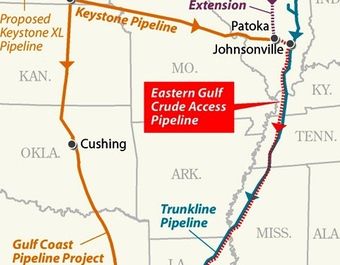
Speaking even more of KXL and Enbridge, Pulitzer Prize winner Lisa Song has another excellent article over at Inside Climate News describing yet another Enbridge plan to out-Keystone TransCanada while almost nobody, as we’ve said many times, is watching. It’s more piecing things together, this time converting gas lines to transport tar sands oil. But it’s okay because you can rest assured that PHMSA will do almost nothing to ensure that the plan is safe and sound. The PSTRust’s Carl Weimer notes that “Operators don’t need permission from PHMSA to change the contents of a pipeline, and the conversion process doesn’t trigger environmental studies. Operators simply create a plan of operation that meets PHMSA’s pipeline safety regulations, he said.”
From Indiana, Jeff Harrell at the South Bend Tribune posted two articles this week about the Enbridge Line 6B project, placing them helpfully in larger contexts. It’s very solid work and we especially appreciate his focus on Native American concerns about the project. His first article begins, for instance, with representatives from the Pokagon Band of the Potawotami Tribe, who live on the Michigan-Indiana border.
Inevitably, Jason Manshum shows up in the article with more absurd, misleading remarks. He’s back to complaining about the “tar sands” term again: “Manshum calls the term “tar sands” “… a misnomer, a slang word associated with this type of crude by opponents.” But of course, this is total baloney. The industry itself used that term for decades until someone in Manshum’s line of work (spin doctoring) decided back in the 1960s that “oil sands” sounded friendlier.
Harrell’s second article, which unfortunately (we don’t hold him responsible for this) bears the very stupid headline, “Pipeline Has Support, Opposition” (they could have just said, “Humans Agree, Disagree”), considers Line 6B in relation to KXL, which we’ve been trying to convince reporters to do for a very long time. Manshum’s on board for this one, too, assuring us all that pipeline corrosion is not a problem with diluted bitumen:
Enbridge’s Manshum cites the U.S. Department of Transportation’s investigation into the spill to dispute the claim that the line broke from abrasive tar sands oil corroding the inside of the pipe.
“One thing they made crystal clear was that the rupture was not caused by internal corrosion, but on the outside, or the exterior of the line related to the coating,” Manshum says.
Strictly speaking, of course, what Manshum says is true. But it’s more than a little ironic that he’d cite the NTSB report, since what it also shows is that Enbridge ignored the pipe’s exterior defects and that their “culture of deviance” from safety protocols contributed tremendously to the Marshall disaster. Honestly, we sometimes wonder how Jason Manshum can sleep at night.
Lastly, Jennifer Bowman has a lengthy and interesting article in the Battle Creek Enquirer about Enbridge’s home buyout program in Marshall. It’s a piece that we imagine is quite pleasing to Enbridge, since Bowman talks with some people who had very positive experiences with Enbridge. She spoke also with some unhappy landowners, but they are more or less portrayed as greedy whiners. We find this entire situation quite fascinating and disturbing in many ways, though we confess we don’t know enough about it to make many confident pronouncements. We also think that Bowman’s article leaves a great many questions unasked; we’re going to think and learn more about this and discuss it more in a later post (hopefully). For now, just one little observation:
What is it with people that makes them so uncharitable toward others? Why the need to belittle those whose experiences differ from their own? We’ve seen this sort of tactic– from fellow landowners!–before. And we see it again from Wayne Groth, who gets lots of ink in Bowman’s article. Groth believes he got a good deal from Enbridge– and we’re very glad for that; we wish it were the case with everyone. But then he has to go and say this:
“The ones screaming the loudest are probably the greediest,” Groth said, “and they’re looking to cash in. They remind me of damn trial lawyers that want to sue for money and put the company out of business.”
In all seriousness: does Groth really know this? Does he even know who is “screaming” loudly, much less what those (imaginary) screamers are screaming about or for? We doubt it. This sort of talk just makes him seem like a guy with very little imagination, very little ability to adopt the perspective of someone else a person whose mindset is, “I got mine; screw the rest of you.” And that’s just downright unneighborly.
by Jeffrey Insko | Aug 5, 2013 |
Today, we officially launch our new series on our trip to Washington D.C. last week. As we noted the other day, the trip was a lobbying “fly-in” hosted by the National Wildlife Federation. We are very grateful to them for the opportunity– and not just because we had the chance to tell the story of Line 6B landowners to congressional staffers and officials at the State Department. We also got to meet all sorts of interesting, committed people from across the country (some of whom we’ll talk about a little during the course of this series).
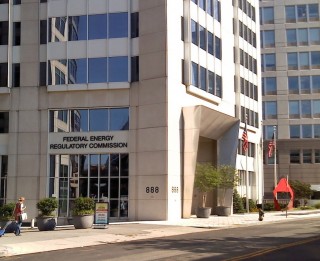
We begin our series not with an account of one of our meetings, but with an account of a meeting we did NOT have. On the right is a picture of the FERC building. FERC, the Federal Energy Regulatory Commission, is the agencey that regulates “the transportation of oil by pipeline in interstate commerce” (among other things). Why a picture of FERC? Well, because we walked past it on our way from Union Station to the hotel. Also, we didn’t get a picture of the building that houses the Pipeline and Hazardous Materials Administration (PHMSA), the agency responsible for regulating oil pipelines.
Why no picture of the PHMSA building? Well, because we didn’t get to see it. You see, the NWF requested a meeting with officials from PHMSA, but the agency declined to meet with any of us. Yes, you heard that right. PHMSA did not want to meet with an important national non-governmental organization, representatives from conservation groups from around the country, and ordinary citizens with a direct stake in pipeline safety. How’s that for responsive government?
This snub, positively Larry Springer-like, is all the more galling since action from PHMSA was one of the key “asks” of the fly-in (an “ask,” I learned, is lobbying jargon for the thing or things you are asking your government to do; hence, the purpose of your meeting with them). Back in May, the NWF, along with a coalition comprised of various other groups and individuals, submitted a petition to the EPA and PHMSA, asking for stricter regulations for tar sands pipelines to help ensure their safety. The measures called for in the petition are utterly reasonable; in fact, when you read them, your first reaction is that you can’t believe such standards and practices don’t already exist. For instance, the petition asks for “industry disclosure of products carried through pipelines and their conveyance schedules” (duh!); “stronger spill response plans” (of course!); “repair of pipelines as soon as defects are discovered” (obviously!); and “pipeline inspection and monitoring by independent entities unaffiliated with pipeline or energy companies” (wait, you mean they’re not independent now?!). These things all strike us utterly uncontroversial (except, perhaps, to to the most zealous of free-marketeering industry leave-us-aloners). You’d think that PHMSA, its reputation severely tarnished by the scathing NTSB report on Marshall, would jump at the chance to consider them. But you’d be wrong.
Which begs the question, why did PHMSA refuse this request for a meeting? Honestly, we have no idea. But we’re pretty sure it’s not because they’re so very busy working on other things related to tar sands pipeline safety. What leads us to such a conclusion? Well, let us tell you what PHMSA recently told Congress about its activities on this front:
First, the background. You might remember that in 2011, Congress passed the Pipeline Safety, Regulatory Certainty, and Job Creation Act of 2011, largely in response to the disaster in Marshall. It’s a pretty mealy-mouthed bill, in our view, but at least it was something. Mostly, it asks PHMSA– again, the federal regulatory agency responsible for pipeline safety– to take certain actions; well, to look into certain things. Among those things is this:
SEC. 16. STUDY OF TRANSPORTATION OF DILUTED BITUMEN.
Not later than 18 months after the date of enactment of this Act, the Secretary of Transportation shall complete a comprehensive review of hazardous liquid pipeline facility regulations to determine whether the regulations are sufficient to regulate pipeline facilities used for the transportation of diluted bitumen. In conducting the review, the Secretary shall conduct an analysis of whether any increase in the risk of a release exists for pipeline facilities trans- porting diluted bitumen. The Secretary shall report the results of the review to the Committee on Commerce, Science, and Transportation of the Senate and the Committee on Transportation and Infrastructure and the Committee on Energy and Commerce of the House of Representatives.
The Act went into effect in January of 2012, which means that we are now past the 18 month point. Has PHMSA produced the “comprehensive review” Congress charged them with producing? No, they have not. They did commission the National Academy of Sciences to produce a review of existing studies of a very narrow topic, which was recently released (and touted by industry, but criticized by just about everyone else, including the Pipeline Safety Trust). But that’s it. A year and a half and PHMSA has failed to comply with what may be the most crucial component of the Act.
But that’s not the worst of it. If you really want to see PHMSA doing nothing, you have to take a look at the recent report they submitted to Congress in late June, which provides their response to a series of safety recommendations issued by the National Transportation Safety Board in 2012. (PHMSA is required to submit these reports annually.) The NTSB issued a number of recommendations, the bulk of them in direct response to their findings in the Marshall investigation. PHMSA’s response, as reported to Congress, is mind boggling. It has to be one of the most extraordinary examples of foot-dragging, excuse-making, stalling, evading, and ass-covering we have ever seen– and that includes nearly two decades of paper deadline extension requests from feckless college students!
We’ll spare you the bulk of the details– it’s pretty dull, bureaucratic stuff– and just provide you with some highlights. The long and the short of it is that PHMSA has done almost nothing in response to the recommendations; they seem incapable of performing even the simplest and least onerous of tasks, and evidently don’t realize, or just don’t care, just how insulting to Congress, the NTSB, and the public their document makes them appear to be. We can’t decide if the report bespeaks PHMSA’s incompetence or its contempt toward Congress. Maybe it’s both.
Of the 10 recommendations issued by the NTSB, PHMSA has completed action on only one of them. In every other case, PHMSA simply says the such-and-such “is under development” or “is currently under development” or “is addressing this recommendation” or “is reviewing” the matter. In fact, if you’re looking for the ideal specimen of tortured, convoluted, obfuscating, shirking, hedging, responsibility-dodging, agency double-speak you probably couldn’t do much better than PHMSA’s response to the recommendation that they “extend operator qualification requirements” for pipeline control center staff. What PHMSA says in response to that one– you should probably sit down for this– is that they are trying “to determine the best way to determine whether or not additional clarification is needed…”
No, we did not make that up.
But there’s more. For instance, the NTSB recommended that PHMSA issue an “advisory bulletin” to notify other pipeline operators “(1) of the circumstances of the Marshall, Michigan, pipeline accident, and (2) of the need to identify deficiencies in facility response plans,” updating them as necessary. Now, just so this is clear, keep in mind that an “advisory bulletin” is really just an informational document. It’s not rulemaking; it’s not fact-finding. It’s the equivalent of reminding your kids to wash their hands after they use the restroom. So has PHMSA issued this advisory bulletin– which really could consist of nothing more than a link to the NTSB report on Marshall along with a headnote that says, “DON’T DO THIS”? No, they have not. Instead, they say that the agency “anticipates publishing” such an advisory bulletin– a way of putting it that makes it seem like it’s out of their hands, like they’re farmers watching weather reports and expecting some much needed rain. A little later PHMSA says that the bulletin “is scheduled to be issued by August 2013.” Today is August 5, 2013. No bulletin has been issued.
The NTSB also recommended a second bulletin, one that describes the “deficiencies observed in Enbridge’s… integrity management program” so that other operators can eliminate similar deficiencies in their own operations. Again, this is a very simple task, the sort of thing that, say, Rebecca Craven of the PS Trust could probably type up during a coffee break on a busy day. In fact, almost anyone who has read the NTSB report could produce this bulletin. PHMSA has had a year to do it. But again, they only “anticipate” issuing a bulletin oft this sort– “by August 2013.” They’ve missed that deadline too.
So maybe all of this is why PHMSA didn’t want to meet with us last week. Maybe they’re ducking and hiding the way students who have not completed their assignments on time will sometimes avoid showing up for class because they know they’ll be called out. Maybe they know they’re asleep at the wheel and don’t want to face a bunch of people who also know it. Maybe they’re even a little ashamed and embarrassed.
Or maybe they’re just overworked and understaffed. In fact, we have no doubt that they’re understaffed. But if that’s the problem, why doesn’t their report reflect that serious problem? Why didn’t they just say to Congress, “You know, Congress, we recognize that this report makes us look hapless, but we are so understaffed and so poor in resources that we can’t even get a simple memo typed up when given a full year to do it, much less produce a comprehensive review of all of the implications of tar sands oil transport. These reports would be much more useful for everyone if you guys would appropriate some real resources to us”? But PHMSA says nothing of the sort. And the fact that it doesn’t say so leads us to believe that this isn’t exactly the problem.
So maybe it’s something else. Maybe they just don’t want to do these things. Maybe they’d prefer not to institute any new regulations or stricter requirements. Maybe they don’t want to rehearse the parade of horrors that was the Marshall spill because they don’t want to make Enbridge look bad all over again. Maybe they are so cozy with industry and so hostile to organizations like the NWF and people like us that they drag their feet on Congressional mandates and NTSB recommendations and they duck and hide from critics and the members of the public they are supposed to protect because that’s better for industry. Because that’s who they’re really working for.
Of course, we don’t really know whether any of that’s actually the case. This is all just speculation on our part. But we have no choice but to speculate because PHMSA, when offered the chance to sit down and talk with us in good faith to explain all of this for itself, just shut the door in our face, rather than face some hard questions and listen to some legitimate citizen concerns.
Around here, we’ve got a name for that sort of avoidance, for the strategy of avoiding, as much as you can, communications with your critics, evading tough questions, pretending like the unhappiness and dissatisfaction isn’t happening and maybe after a while it will all just go away: we call that an Enbridge Special.