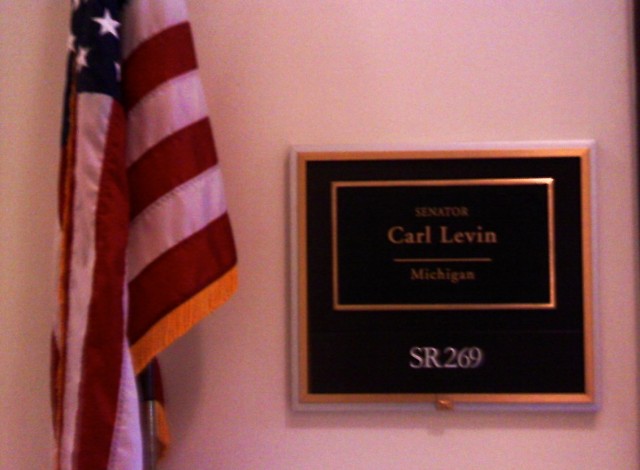
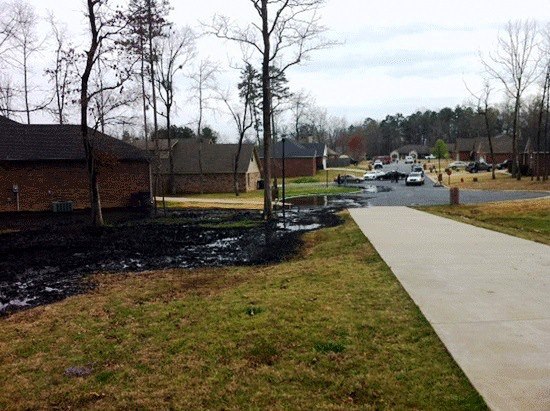
As we mentioned yesterday, we spent a couple of days early this week in Washington D.C., speaking with Michigan legislators and State Department officials. That trip, hosted by the National Wildlife Federation, will be the subject of our newest series– stay tuned for detailed accounts of the conversations we had.
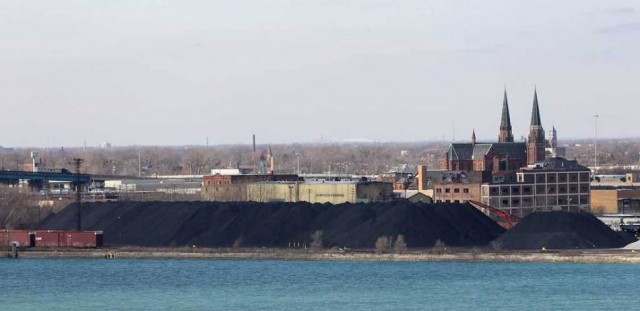
For now, we will note that when we met with representatives from the offices of Senators Stabenow and Levin and Representative Gary Peters, the subject of those piles of petroleum coke at that facility on the Detroit River inevitably came up– partly because the staffers wanted to use it as an opportunity to demonstrate what they’re doing to protect the citizens and the natural resources of Southeast Michigan. We’re glad for that– especially since, as you may have seen by now, the pet coke problem is far from solved. Just this week, a chilling video emerged of clouds of pet coke dust blowing across the Detroit River. Dave Bagatello blogging at the Windsor Star has more details on the story. But here’s the video. Eerily, it put us in mind of the “feathery plume,” the “black billowing cloud,” the “airborne toxic event” of Don DeLillo’s marvelous, disturbing novel White Noise:
Recently, we linked to reports that storage those piles o off pet coke would be suspended, temporarily, at least. We expressed a bit of skepticism about this at the time. And sure enough, reports this week seem to suggest that Detroit Bulk Storage would very much like to continue storing the stuff, which has become a major source of income for them– a source of income that only stands to increase once the “replacement” of Line 6B is completed, since the new line will significantly increase the amount of dilbit– the source of that pet coke– making its way to the Marathon refinery in Detroit.
So it’s good news, as we were told in our D.C. meetings and as the Detroit Free Press is reporting this morning that Senators Stabenow and Levin have introduced a companion bill in the Senate to the one Representative Peters introduced in the House earlier this month. The bill calls on the Department of Health and Human Services and the Environmental Protection Agency ” to conduct a study on the public health and environmental impacts of the production, transportation, storage, and use of petroleum coke, and for other purposes.” (The full text of the House bill is here.)
Now, we think that studies are very good things. We believe in actions grounded in facts and sound science. For those reasons, we strongly support the legislation and commend our Michigan officials for their efforts. But we also believe in caution and prudence when it comes to matters of public health and environmental impacts. And in this case, that means that we ought not to wait for indisputable evidence for public health risks and environmental damage before prohibiting enormous piles of nasty, black, powdery residue, the by-product of dirty tar sands oil. Rather, indisputable evidence that those piles pose no risks whatsoever– an extremely remote possibility, we suspect– ought to be an absolute condition for storing them. The legislation Congress will consider (hopefully, if the bills make it out of committee!) includes no such conditions. Nor are such conditions required, as we understand it, by the DEQ, from whom Detroit Bulk Storage is supposed to obtain permits. But of course, the DEQ, like most of our state and federal regulatory agencies, is weak and mostly gutless.
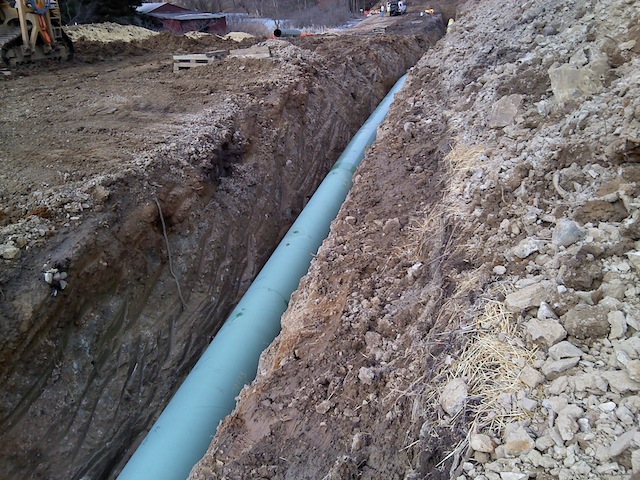
Oh, and speaking of requirements, if it were up to us, we would impose a simple requirement on anyone publicly discussing the matter of pet coke in Detroit (exempting, of course, those residents in Detroit and Windsor directly affected by the stuff): you don’t get to write about it without at least a sentence that states very clearly how that stuff gets here in the first place: It starts with the mining of tar sands oil up in Alberta, Canada, which entails the destruction of thousands of acres of carbon-absorbing, ecologically rich Boreal forest. It then makes its way through a network of pipelines owned and operated by Enbridge, running across the state of Michigan, through our backyard!, and down to the refinery in Detroit, where the tar sands oil is processed, leaving behind–as the filthy byproduct of already filthy fuel– petroleum coke. That’s the stuff that then gets sent to the bank of the Detroit river where it gets blown into the air, into the river, and onto people’s balconies.
In other words, without Line 6B, there would be no pet coke problem in Detroit. If you’re concerned about one, you should be concerned about the other.
Well, we’ve had a pretty eventful couple of weeks– which sort of delayed our plans for a series of one year anniversary retrospective posts (we’ll still get to them). It’s not just all the time we spent playing golf on vacation. No sooner did we return home to Michigan than we hopped on a plane to join our friend Beth Wallace (hero) in Washington D.C. for a “fly-in” hosted by the awesome people at the National Wildlife Federation. (Don’t worry, we had no idea what a fly-in was either.) We met with staff members for Senators Debbie Stabenow and Carl Levin, Representative Gary Peters, and a handful of officials from the State Department. Here is photographic evidence:
We’ll bring you a full report on all of this, which means (of course) a brand new series! Since we’ve never lobbied before, we learned an awful lot. For example: that our government seems to be run by a bunch of teenagers, that you can get both cash and a haircut in congressional office buildings, that some Michigan elected officials might actually be interested in the bad behavior of Enbridge (you’ll have to wait to find out who!), that it is possible to get yelled at by a security guard in the State Department building, that the disturbing similarities between PHMSA and Enbridge run even deeper than we thought, that there is (small, remote) reason for some hope, that English majors are everywhere, and that the Department of Homeland Security might possibly have undercover agents who are somehow able to defy the laws of ordinary locomotion.
Surely you don’t want to miss any of that. Please stay tuned.
You have probably heard the news already (we’re allowed to be a little slow; we’re on vacation!): yesterday, a bunch of protestors from the energetic Michigan Coalition Against Tar Sands (MI CATS) locked themselves to some of Enbridge’s construction equipment over in Stockbridge. Authorities had to cut them free and have arrested 12 people. The story is all over the news. Here is the MiLive version of the story. But there’s more here and here and here and here.
A couple of things struck us with particular force:
First, according to protestor Christopher Corrigan, he is taking action because “Governmental authorities have failed them by the lack of regulation and the ‘endless permitting of these projects,’ he said.” Corrigan is dead right about this. Our state and federal authorities and regulatory agencies have failed us. We’ve said this ourselves over and over.
Secondly, in a statement released to the press in response to this action, Enbridge said (among other things), “The company works hard to encourage dialogue with communities and residents in areas where it has operations.” We’ve discussed that matter so much over the past year, we don’t even have the energy to provide you a link. You can practically choose a post here at random and it will show how Enbridge does not work hard at all to encourage dialogue with communities and residents. If they did, this blog wouldn’t exist. So, unlike Christopher Corrigan, Enbridge in its statement is dead wrong.
Well, once again, things aren’t going so well for Enbridge– and they only have themselves to blame. As usual, Inside Climate News has more details on the story of Enbridge’s violations of a DEQ permit (and we’re so glad to see that David Hasemyer is back on the case!) while discharging water from their hydrotest into Ore Creek. As we noted before, our friend Jake McGraw blew the lid off this matter with his disturbing video of rust-colored water fouling the creek.
We were pleased to see Tyrone Township Supervisor Mike Cunningham talking tough about Enbridge (and we hope he’s backing that tough talk up):
“They think they can come in and do it their way without regard to the local and state rules,” said Tyrone Township Supervisor Mike Cunningham. “But they have to follow the rules.”
The township and Cunningham have butted heads with Enbridge for a year over whether the company should be required to follow local zoning regulations.
“They sometime take for granted they can do what they want,” Cunningham said. “They’ve dropped the ball so many times and they dropped the ball on this one.”
And we were bemused to by the (unsurprising) evasions of our old pal Enbridge spokesman Larry Springer. He’s full of banalities, of course, but Hasemyer points out more than once that Springer and Enbride have no explanation whatever for why they didn’t take the simple measures (like having an on-site monitor) required of them by the DEQ permit. Hasemyer also quotes our friend and fellow landowner Dave Gallagher, who nails it when he says, “It makes you think in terms of their long-term concern for the environment and the people who have to live with their pipeline in their backyards.”
But the money quote comes from the inimitable Carl Weimer, Executive Director of the Pipeline Safety Trust:
Carl Weimer, executive director of the Pipeline Safety Trust, a nonprofit watchdog organization based in Bellingham, Wash., said the incident signals a disconnect between the public image pipeline operators try to promote and the reality of their conduct.
“It doesn’t take many times hearing their PR people say ‘We are going above and beyond the regulations’ and come to find out they aren’t,” Weimer said. “It doesn’t take many of those instances when the reality is different from the promises to undermine the public’s trust.”
Weimer said the nation’s pipeline regulations aren’t that onerous and companies like Enbridge can easily afford to comply with them.
“They keep messing up on things they should be doing right,” he said. “It’s one of my frustrations that the industry has the resources and the technology to comply and they choose not to do so.
Elsewhere, Midwest Energy News has a fascinating and important story this week about yet another Enbridge strategy to build a Keystone XL-like network of pipelines to the Gulf Coast. We’ve been talking about Enbridge’s under-the-radar, permit-evading strategies for months, trying (mostly in vain) to get some of the eyeballs focused so intensely on KXL to turn in Enbridge’s directions. Karen Uhlenhuth’s fine article should be getting a great deal of attention. The bottom line: Enbridge has found yet another loophole that may allow them to escape public scrutiny and regulatory oversight:
Enbridge is trying to use a regulatory shortcut known as Nationwide Permit 12 that might allow it to get its pipe in the ground before it provokes the sort of opposition now marshaled against Keystone XL.
Credit for uncovering this “shortcut” goes to the Sierra Club, which is working hard to bring the details of this project to light.
There is also more news this week on the bizarre scheme to get Enbridge to purchase and remove Ceresco Dam. The Battle Creek Enquirer has the story.
And finally, this weekend’s rally at the Mackinac bridge is getting lots of well-deserved press. Let’s hope for a big turnout and lots of attention to the potential dangers to the Great Lakes posed by Enbridge’s aging pipe under the straits.
Or if you’d rather just make a phone call or write a letter, our marvelous friends at the Pipeline Safety Trust are working this week (and testifying before a congressional committee) on pointing out some serious deficiencies in a piece of legislation known as the “Natural Gas Pipeline Permitting Reform Act.” This is an industry-friendly, landowner-unfriendly bill designed to “streamline” the approval process for interstate pipelines. As you can imagine, the Trust– and we agree vehemently– thinks this is a bad idea. If you’ve read anything here about the pitiful state of federal pipeline regulations or the Michigan state regulatory process, you already know that the last thing these processes need is “streamlining” (which is really just another term for deregulation!). In our view, they are already WAY too streamlined. To take just one little example that we’re sure you’ll find alarming, the bill would simplify the process for eminent domain authorization, making it that much easier for private companies to take indiviuals’ property, severely limiting landowners’ ability to protect their rights. Members of the committee currently considering the bill can be found here. Please write to your representative and urge them to work on behalf of landowners and ordinary citizens, not large corporations!
This just in: the government of British Columbia has rejected Enbridge’s proposal for its Northern Gateway project. The bottom line, according to the B.C. Environment Minister: “Our questions were not satisfactorily answered [by Enbridge] during these hearings.”
One can’t help but wonder how the Line 6B “replacement” project might have been different had Enbridge been subjected to the same level of scrutiny here in the U.S. and Michigan.
Whew! The semester has finally ended, grades have been recorded, and we finally have a little time to post. To compensate for the recent lull, we’re pleased to announce the launch of a new series! This past Friday, we were fortunate to participate in an exciting program. The excellent people at the Institute for Journalism and Natural Resources were generous enough to let us tag along with their 16 (or so) Fellows– journalists from all over the country and Canada– for a portion of their Kalamazoo River Institute. Jennifer Bowman of the Battle Creek Enquirerhas a story on the Institute this morning.
Friday was devoted to the Marshall disaster and its aftermath. The journalists met and interviewed officials from the EPA, the Michigan DNR and DEQ, representatives from Enbridge (well, Jason Manshum), MSU scientist Steve Hamilton (who at this point probably knows more about cleaning up dilbit than anyone on the planet), our friends Beth Wallace from the NWF, Josh Mogerman from the NRDC (nice to finally meet him in person!), and Sue Connolly and Deb Miller. We also made new friends in fellow landowners (on phase 2) David and Karin Gallagher– we’ll bring you their grisly story in the second installment of the series– who graciously invited all of the Institute participants to their home.
One of the highlights of the day was a canoe trip along a two-mile stretch of the Kalamazoo River, following the path of the oil. Although there’s more to be done, the good news is that the river is bouncing back and it really is quite beautiful. Here’s a shot:
In all, it was a terrific experience and we’re deeply grateful to Dave Spratt and Adam Hinterthuer from IJNR for letting us tag along and speak to the journalists. We met lots of smart, interesting people– and we’re looking forward to seeing what kinds of stories the fellows produce. But as we wait, we plan to do some ruminating of our own on the experience in a few installments. In the meantime, here’s a video from the Battle Creek Enquirer taken at Dave Gallagher’s house. If you watch closely, you might even catch us in a brief (but silent) cameo!
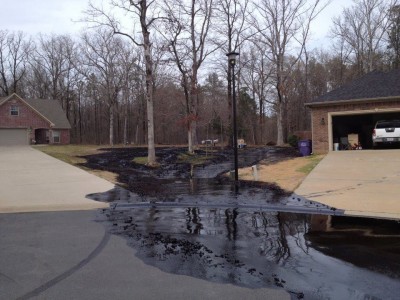
While not directly about Line 6B matters, we’ve encountered a number of tangentially-related material the past couple of days deserving of your attention, not least of which are some follow-ups to the awful spill in Arkansas, a terrible, vivid reminder of why all of us should be deeply concerned and continue to speak up and help foster public discussion of pipeline safety.
Some of our favorite journalists are on the case. Over at her “Riding the Pipelines” blog, Elana Schor provides some interesting— and disturbingly familiar to those who have read the NTSB report on Marshall–background on Exxon’s safety record with regard to the Pegasus line that just burst.
And Lisa Song, who has evidently been extraordinarily busy the past few days, has a terrific article at Inside Climate News linking the Arkansas spill to the recent petition to the EPA and PHMSA filed by the National Wildlife Federation and others for stricter regulations of tar sands oil transport. What caught our eye in particular was this:
The section of the pipeline involved in Friday’s spill in Arkansas was originally built in the 1940s, according to an Exxon spokesperson. The full length of the pipline was used to transport crude oil from Nederland, Texas north to Patoka, Illinois. After lying mostly idle for four years, the pipeline’s flow was reversed in 2006 to carry Canadian dilbit to Gulf Coast refineries. Exxon said the reversal was an industry first, and that it required 240,000 man-hours of work to accomplish.
That’s right: Exxon reactivated a 66 year-old, 20-inch pipe so that they could pump diluted bitumen through it, which must be sort of like sucking peanut butter through a paper straw. And of course, considering that there’s a soon-to-be-idle line in our backyard right now, these examples of pipeline reactivation make us very, very nervous.
Closer to Michigan, the Detroit Free Press has just run two very interesting articles: one about the state of gas pipelines in Michigan and the costs (and difficulties) in repairing them and the second about the dreadful regulatory situation regarding those same lines. The Freep had the good sense to call up our friends at the Pipeline Safety Trust. In the first article, Executive Director Carl Weimer points out the primary difficulty when it comes to repairing these lines (and ensuring public safety!): “What it comes down to in most every state we’ve looked into is, who is going to pay for that replacement?” he said. “It often gets passed along to ratepayers, and public service commissions hate to do that because they catch a lot of grief.” And speaking of the public service commission (which certainly wouldn’t want to catch any grief!) in the second article, the PS Trust’s Rebecca Craven (another of our heroes) notes that the commission’s general haplessness (that’s our characterization, not Rebecca’s) is compounded by the same woeful lack of staffing and resources that plagues PHMSA and agencies in other states:
“They [PHMSA] simply don’t have the number of inspectors they need to adequately oversee the amount of pipeline in the system, and states are in the same boat,” said Rebecca Craven, program director of the Bellingham, Wash.-based Pipeline Safety Trust, a nonprofit organization that advocates for improved energy transportation safety.
Up in Canada, there’s a great article in the Tyee about pipeline safety and landowner advocate Dave Core, who is the founder of the Canadian Association of Energy and Pipeline Landowner Associations (and yet another of our heroes!). Dave recently gave a presentation to a Canadian senate committee. What he had to say will surely resonate with most readers of this blog. Here’s a little taste:
“My goal this morning is to bring perspective to the issues of landowners when confronted by pipeline companies. That is, the issues when private property owners, like yourselves, come up against government supported and subsidized corporations that are allowed to come packing with government regulations to take our lands, our rights and leave us with annual risks, liabilities, a duty of care that we do not want, costs and the pipeline junk which includes the resulting safety and liability issues of historical contamination and pipeline collapse when the companies pack up and leave.
“Before I proceed I would like you to pretend you are sitting around a kitchen table with your family and a ‘land agent’ has just left you with a brown envelope with a Section 87 Notice, an NEB Regulatory Notice, stating that a pipeline company is going to put a pipeline in your backyard and the easement agreement and the compensation offer are included.
“The stress has only just begun. Next come teams of land agents, the men trained in profiling and in telling every tale they can to get the deal signed while they sit at your kitchen table drinking your coffee. He/she might even be your neighbour’s son or daughter. It is like you have stepped into a spaghetti western with cowboys coming to your door, not packing a gun, but a big smile, lots of lies and packing government regulations that allow them to threaten you if you question them.”
Also from Canada comes this interesting op-ed in the New York Times, providing a counterpoint to tar sands development boosterism.
And finally, one closer to home. The Livingston Daily Press & Argusran an article a couple of weeks ago that slipped past our radar (thanks for sending it, Beth Duman!). It’s about the dissatisfaction of some landowners– those good people the Nashes and the Watsons– as construction nears completion. The bad news, however, is that even though the construction phase is coming to a close, a whole new round of likely headaches and difficulties is on the horizon: the restoration phase. You can bet we’ll be on the case.
Speaking of Lisa Song, she also has an excellent report on the recent EPA order to Enbridge requiring more cleanup of the Marshall spill. Enbridge has agreed to comply with the order (there was some doubt about whether they would). It’s not clear whether this means they’re rethinking their claims about how the river is “cleaner than ever.”
Press for Tar Sands Petition
And speaking of concerns about dilbit, the tar sands regulation petition spearheaded by the National Wildlife Federation has received plenty of press of national attention (we participated in a telepresser on the matter just last week)– in New England, in Nebraska, in Minnesota, and in Indiana, where the Northwest Indiana Times has a report by one of our favorite reporters Lauri Harvey Keagle (and no, that’s not just because of the quote at the end of the article!).
More Weak Michigan Regulatory Oversight
A few weeks back, we linked to some potentially disturbing stories about piles of petroleum coke, a byproduct of diluted bitumen, piled up along the banks of the Detroit River. Since that time, the Michigan Department of Environmental Quality has apparently looked into the matter. But don’t worry, they didn’t look too hard. And they responded, true to state regulatory form, with little more than a shrug of the shoulders. Consequently, we recommend against consuming any walleye that comes out of that river.
More Michigan Townships Prepare for the Enbridge Experience
As for Line 6B matters, landowners and townships are preparing for their own encounters with Enbridge as work on phase two nears its commencement. If anyone knows anyone along the route, we hope you’ll share this blog with them; our mission has always been to help inform and protect landowners. For our part, we plan to send a note to Bruce Township Supervisor Richard Cory, who recently expressed some (reasonable, appropriate) concerns about how the project will affect residents. Those concerns were addressed by an Enbridge rep we’ve never heard of:
Supervisor Richard Cory said he was worried about some residents east of Van Dyke since the line will run close to septic fields and property.
Doug Reichley, Enbridge project manager, said Enbridge will work with consultants to have a permanent fix if something needs to be altered, even if it’s engineering a new septic field.
“Our whole point is to take care of these folks and make sure when we leave it’s as good or better than when we first got there,” Reichley said.
With that in mind, Trustee Paul Okoniewski asked if the company would cap 36 Mile Road with limestone from Dequindre to Van Dyke after running its equipment on it.
“It will impact the road with the construction and trucks,” he said.
Reichley said he and other representatives would bring it to the project director’s attention. Similarly, he said Enbridge will replace any torn up grass, trees or fencing caused by construction.
We’ve heard these sorts of assurances before– and we all know how that has gone. Incidentally, we’re most struck here by Doug Reichley’s remarks about replacing trees. We’ve looked into that matter and are working on an extended tree post. Stay tuned for that one in the coming days!
And while pipeline opponents seem to have targeted firms like Enbridge, Daniel insists its green efforts “have not been forgotten by the people that matter.
“When we were in Michigan in 2010 (at the oil pipeline rupture site) one of the first things people who live there told us they did was Google Enbridge because they had no idea of who we were. And they got a very favourable impression when they saw the extent of our renewable and sustainable development.”
Daniel said the pipeline rupture “is less of an issue the closer you get to Kalamazoo and Marshall” because of Enbridge’s cleanup efforts.
That’s right. If you believe Pat Daniel, Marshall might seem like a big deal up in Canada, but down in Marshall, it’s all good. Just ask the people there: Beth Wallace, Susan Connolly, Deb Miller, Michelle Barlond-Smith (and lots of others) will surely tell you what a non-issue that spill is; they’ll eagerly tell you just how favorable their impressions of Enbridge really are.
Beyond Marshall, Daniel says “he can’t understand how opponents can delay pipelines, which mean congestion and much lower prices for Canadian crude”– a statement that once again just confirms everything we’ve said about him in the past. Of course he “can’t understand.” He can’t understand because he lives in a bubble, surrounded by yes-men, showered in praise and awards, completely and utterly isolated from ordinary landowners whose everyday lives are affected by Enbridge’s projects and practices. From all available evidence, Pat Daniel has never— despite what the corporate values developed under his leadership state– bothered to “take the time to understand the perspective of others.”