by Jeffrey Insko | Apr 14, 2014 |
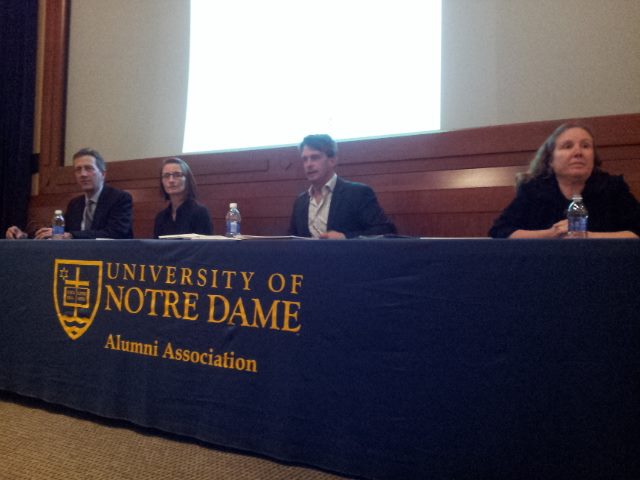
As some of you know, we were fortunate enough to participate in a forum about tar sands oil development in the Great Lakes Region a couple of weeks ago. Organized by our friend, fellow Line 6B landowner, and Notre Dame University professor Patricia Maurice and hosted by the John J. Reilly Center for Science, Technology, and Values.
Patricia and I were joined by MSU’s Steve Hamilton, who has been a consultant on the Kalamazoo River cleanup, and Beth Wallace, who you surely know by now. Each of us presented for 15 or so minutes and then we took questions from a wonderful and wonderfully-engaged audience.
We thought the event was a smashing success. The room was full and the audience interested, each of my fellow panelists was smart, passionate, and informative. We were even able to meet some people face to face whom we’ve only interacted with through the magic of the internet. It was wonderful to put some faces to some names. Our only regret (but not a surprise), no one from Enbridge attended. Still, the forum went so well that we are hoping to reprise it elsewhere in the months to come. Stay tuned.
In the meantime, you can watch the whole thing online, thanks to Prof. Greg Madey for filming and to Notre Dame’s engineering pubs/graphics crew for getting it posted online:
Thanks, finally, as well to all who attended and, especially, for Patricia for her warm hospitality and her hard work bringing everything together.
by Jeffrey Insko | Mar 6, 2014 |
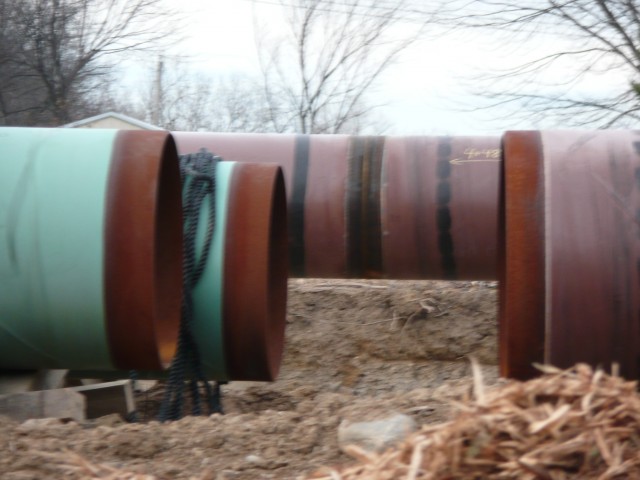
As we mentioned earlier today, Enbridge just announced an enormous new project: the “replacement” of over 1,000 miles of new pipeline all the way from Alberta, Canada to Superior, Wisconsin in the U.S. The project is yet another part of Enbridge’s strategy to out-Keystone Keystone XL, mainly by finding ways to transport tar sands oil across North America while also doing whatever they can to skirt regulatory processes. That’s what they did with Line 6B; it’s what they’re doing with Flanagan South; and it’s what they thought they could do with the Alberta Clipper.
Evidently, Enbridge president Al Monaco thinks there’s no question about this one. Here’s what he said on Tuesday during the announcement:
“It does not require a [new] presidential permit,” Mr. Monaco said on Tuesday. “Of course, Line 3 already operates under an existing presidential permit, so what we’re doing here is restoring Line 3 to its original condition.”
That statement may be more wishful thinking than fact; certainly it was an attempt to reassure investors. But the case might not actually be so clear as Monaco would like– or so we hope. That remains to be seen. We’ve also got our doubts that the project is simply a matter of “restoring Line 3 to its original condition.” That’s surely just a classic bit of Enbridge flimflammery: installing a brand new pipe is not, by any stretch of language or logic, restoration. It’s new infrastructure, which will most likely operate at much higher pressures and transport far greater volumes of product– presumably, mostly diluted bitumen– than the existing Line 3. If the current presidential permit is adequate for such a change in operations, there are even bigger problems with the permitting process than we thought.
In addition to those matters– about which there’s a great deal more to be said– what we’ve been thinking about since the announcement are all of the landowners along the Line 3 route. They’ll need to brace themselves. If recent Michigan history is any guide, they are in for a very unpleasant experience.
One bit of good news for all of those who will be affected by the Line 3 project, however, is that another group of landowners has recently lived through– is STILL living through– an Enbridge replacement project. And not only that, those landowners have spent a good amount of time documenting in as much comprehensive detail as possible exactly how Enbridge conducts itself on these projects: the way it (mis)treats and (mis)informs landowners, the way it (mis)communicates with the public, the way it (dis)regards local authority, the way it tries to evade state and local regulations, and more.
All of it–the whole Enbridge “replacement project” playbook– is documented right here on the Line 6B Citizens’ Blog. For that reason (forgive us for saying so), we don’t think the Line 6B blog has ever been more relevant.
We hope, we think, that Line 3 landowners can learn from our experience. Had we and our fellow landowners known going in all that we know now, we would have been much better prepared in every way for the long, painful nightmare that the “replacement” of Line 6B has been. For that reason, we want to do everything we can to reach out to Line 3 landowners, communities, and public officials in both Canada and the U.S. with the hope that they’ll spend some time here, using our experiences as a resource to protect themselves.
If you can– that is, if you know any landowners or groups in Canada or the Great Lakes region likely to be affected by this project– please let them know about us.
by Jeffrey Insko | Feb 25, 2014 |
On Saturday, a Canadian television report on Enbridge’s proposed Line 9 reversal in Canada got us thinking (yet again!) about Enbridge’s habit of alienating landowners and municipalities by failing to do what one would think is the easiest thing in the world: just being honest, straightforward, and forthright. But for some reason, that is something that is extremely difficult for them.
We were also reminded of that fact a couple of weeks ago, when we read the latest on Enbridge’s quest to secure a dredge pad site for their work on Morrow Lake. On Monday, the Comstock Township Planning Commission finally gave Enbridge approval, with conditions, for a new site. We don’t know the first thing about the new location and are therefore in no position to comment on its suitability. We are inclined, however, to give the Planning Commission and Comstock Township Supervisor Ann Nieuwenhuis the benefit of the doubt on this one.
In order to secure the site, however, Enbridge evidently decided they needed to bring in the big guns, so they sent Vice President of Operations Rich Adams to speak with some Comstock Township residents the week before the Planning Commission meeting. The circumstances of that meeting (as reported by MLive), and Adams’s comments to the press, struck us as absolutely emblematic of the way Enbridge “communicates” with the public. Let’s see how Adams operates according to the Enbridge communications playbook:
1. Carefully control and manage the setting. One of the first things we ever learned about Enbridge was just how reluctant they are to engage the public when they can’t dictate the precise terms and conditions under which that engagement takes place. VP Mark Sitek more or less conceded as much when he told us they worry about being “ambushed” at public meetings. That fear is also why Enbridge reps once told us they were trying to find “the right person” for us to talk to. And it’s surely why Enbridge spokesperson Graham White fabricated a story about Emily Ferguson as some kind of “combative” “activist” raising cain at a public meeting– because like an elephant cowering before a mouse, Enbridge, despite its overwhelming wealth, power, and influence, seems to live in fear of anyone who might confront them with even the mildest word of criticism.
This need to control the setting in which communication takes place is also surely why, as MLive reports, the “informational session” at Comstock Township was “invite-only.” We suspect that that the invitation only idea was Enbridge’s and that, going into the meeting, they were very careful to make sure that they created a situation that would protect Rich Adams as much as possible from any of those scary angry citizens.
2. Never listen; always condescend and dismiss. We also learned quite early on that Enbridge’s style of communication consists almost entirely of attempts to explain itself, not to listen or solicit feedback or cultivate dialogue or consider other points of view than their own and certainly not to engage in any kind of honest self-reflection. We’ve seen this over and over, both in our conversations with Enbridge reps and in their dealings with various municipalities, particularly with Brandon Township. This tendency is part and parcel with Enbridge’s generally dismissive attitude toward anyone who criticizes them.
Adams applies this principle when he explains what went wrong the last time Enbridge tried (and failed) to secure a dredge pad site. He says, “I think that’s what happened the first time around — in terms of us not getting approval — I don’t think we provided the education.” This is a rather extraordinary account of what happened last time. According to Adams, it’s not that Larry Bell and other Comstock residents had legitimate and reasonable concerns about the other dredge pad site; it’s not that Enbridge tried to circumvent the approval process; it’s not that Enbridge failed to consult with Comstock Township authorities. Adams dismisses (by failing to acknowledge) all of those concerns. By his account, the problem “the first time around” was all because Enbridge just didn’t provide the proper education– which is really just his condescending way of saying that all of those people– Larry Bell, Comstock residents, Township officials– just didn’t (or don’t) understand. We can’t help but wonder: does he really believe that? Which leads us to one final principle of Enbridge communication with the public:
3. When in doubt, dissemble. This one is generally the province of Enbridge’s spokespersons and its marketing team; we’ve noted numerous examples over the past couple of years. But even those at the very top at Enbridge are prone to unfair or distorted characterizations of people and situations. Adams himself tried to peddle a pretty distorted account of the dredge pad situation to the EPA late last year.
So what is Adams saying now? Well, this is what he said at the recent Comstock informational meeting: “We were in a real tight timeline and were trying to push it through a little fast and this time we were kind of afforded the opportunity to do it right and kind of present that information.” That is one way to put it, we suppose, if you don’t want to face the realities of the situation or take responsibility for what brought you to this point. We’re especially fond of the part where he says that Enbridge was “kind of afforded the opportunity to do it right”– as if circumstances, rather than their own actions and decisions, prevented them from doing it right the first time; as if an already broken EPA deadline and an order to keep working is just “an opportunity,” as opposed to a responsibility or an obligation; and as if they’ll only do things right when given the opportunity, not as a matter of routine or regular practice.
by Jeffrey Insko | Feb 23, 2014 |
On more than one occasion over the past couple of years, Enbridge officials have told us that the Line 6B situation in Michigan is anomalous– presumably meaning that the contention, the poor communication, the acrimony, and the miscues (on their part) are out of the ordinary. Elsewhere and in the past, they would have us believe, Enbridge does not and has not conducted itself the way it has conducted itself here.
Unfortunately, too much evidence suggests otherwise. The latest glaring example of this has to do with Line 9 in Canada. Line 9, you will recall, runs across Ontario to Sarnia (where Line 6B terminates). Enbridge is currently seeking to reverse the flow of that pipeline, raising serious concerns on the part of residents all along that route.
Just this week, a Canadian television program, CTV’s W5, ran a major story on the project, uncovering some troubling facts about the integrity of Line 9, which is 38 years old. (The video is currently unavailable in the U.S., but we’ll link to it once it is viewable); they even came to Michigan to speak with residents here, like our friend David Gallagher. Among other things, the report discovered far more incidents on the line, including at Enbridge facilities, than previously reported publicly.
Most striking to us about the report– and in a follow-up story at the Toronto Star— is the reaction to this news by local officials. Their refrain is one that we and many others all across Michigan have been singing for a very long time: Enbridge does not, despite all of their claims to the contrary, communicate openly, honestly, and straightforwardly. For instance:
Landowners like Walker living along Enbridge’s Line 9 pipeline say that when problems arise on the pipelines running through their land they struggle with getting answers and help from the company.
“I didn’t believe that a pipeline or anybody would kind of leave you holding the bag the way that they’ve left me holding the bag on this one,” says Walker.
And this:
W5 called the municipalities where these spills occurred and the majority of them were not notified. The Mayor of Sarnia, Mike Bradley, where thousands of litres of product released at an Enbridge terminal, said he wasn’t informed of the nine incidents there since 2006 and believed that regardless of the fact that they were on Enbridge property, he thought the city should be informed.
“If you want to have a good relationship with your community, and you want to get rid of the distrust that is out there for the pipeline industry you disclose everything,” said Bradley.
And in the Toronto Star:
“It’s quite alarming,” said Brian McHattie, a city councillor in Hamilton, where seven leaks over the years have released nearly 3,000 litres of crude oil at company facilities northwest of the city. “This is new information for me.”
McHattie said the information raises concern about what is shared with municipalities. Hamilton staff met regularly with Enbridge officials since the company submitted its application, but none, to McHattie’s knowledge, were ever informed of the spills.
“They just haven’t been very forthcoming with us,” said McHattie. “It just makes you less confident in their integrity as a company and their willingness to share information and be above-board.”
And this:
Cramahe Mayor Marc Coombs said he first learned of five spills that together leached 1,824 litres of oil when he was contacted by a W5 reporter.
“We were not notified of any of them,” said Coombs. “It does (raise concerns), from the point of view of transparency.”
And this:
Sarnia Mayor Mike Bradley said the city isn’t usually notified when spills are contained within facilities and don’t require municipal staff to be involved in containment or cleanup. He said the city hadn’t heard about the nine spills linked with Line 9 facilities in the past decade — but it should.
“It’s just a good practice to notify, and then we can make our own judgment whether we need to do anything further,” said Bradley. “Just tell us. That’s all we want — to know.”
In both reports, Enbridge spokesperson Graham White– he’s the guy who not long ago out-Springered Larry Springer by fabricating a story about one citizen seeking more information about Line 9–is on hand with all of the standard excuses and platitudes. In fact, it appears that he and his team of spin doctors even tried a preemptive strike, sending out a letter to local officials criticizing the report before it had even aired.
Of course, to those of us in Michigan, there’s nothing new about any of this. Enbridge’s failure to communicate honestly with landowners, municipalities, and the public and its desperate attempt to try and solve all of its problems via its vast (and inept) public relations apparatus has been the predominant theme of this blog for a very long time; just see, for example, this and this and this and this. Perhaps Canadians will have more success convincing elected officials and regulators to step up and protect the public than we have in Michigan.
—-
Speaking of the remarkable similarities between the experiences of people along Line 9 and along Line 6B, the latest entry by our Canadian friend Emily Ferguson over at the Line 9 Communities blog is well worth your time. It tells the story of a landowner frustrated by an Enbridge integrity dig. His experience, unfortunately, mirrors the kinds of maddening experiences we have documented here so extensively. Check it out.
by Jeffrey Insko | Feb 11, 2014 |
We’re assuming that by now, all Line 6B landowners have received their completely incorrect 1099 tax forms. Since we first mentioned this extraordinary error— strong and disturbing evidence for theory #3 as an explanation for why Enbridge can’t do better— we have heard from a number of you confirming completely mistaken forms. We have also received confirmation from some who were able to contact land agents that Enbridge does plan to re-issue them. Unfortunately, that means we should probably all hold off on filing our taxes. Yep, apparently Enbridge now gets to dictate that part of your life too.
Worst of all? As far as we know, Enbridge has taken NO proactive steps whatsoever to notify landowners of this mistake. How’s that for “doing the right thing,” “taking accountability,” “following through on commitments,” and “treating everyone with unfailing dignity”?
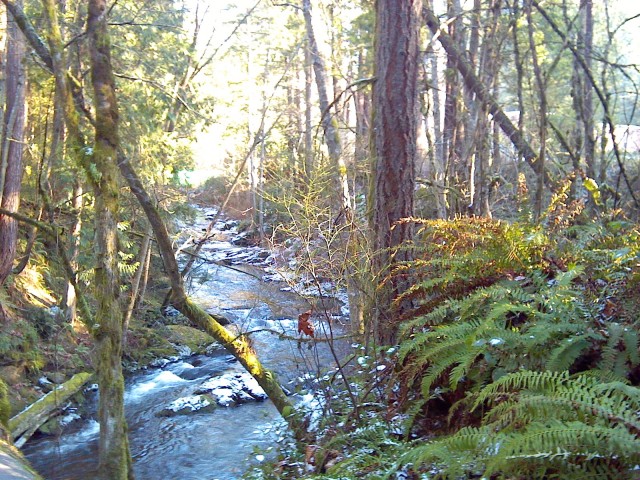
Whatcom Creek, Bellingham, Washington
In better news, we just returned from a trip to Bellingham, Washington, where we attended our first-ever Board of Directors meeting for the Pipeline Safety Trust. We were just recently appointed to the Board and our humbled to get to work with such good and remarkable people. You’ve heard us talk about the PS Trust a lot around here in the past. Our debt to them is truly enormous and we are eager for the opportunity to get to pay that back in some small way by working for and with them and with so many other wonderful people, like our friends in the New Voices project. Michiganders will be especially pleased to know that there are now three of us on the Board: the brilliant environmental law professor Sara Gosman and Michigan’s own hero Beth Wallace are the other two. We’re lucky to be in their company. We will of course keep you updated here on much of the Trust’s important work on behalf of the public interest.
Lastly, as we mentioned a week or so ago, the Michigan CATS activists were convicted and remanded to jail pending sentencing (the remand was completely unnecessary and, in our view, another example of this Judge’s disproportionately churlish and mean-spirited treatment of these three by a Judge oddly prone to chest-thumping displays of his power). At any rate, we want to once again state our support for these three committed individuals and we hope you’ll do the same. They’re receiving support of all kinds from all over the country. To find out what you can do for them, please head over to their website.
by Jeffrey Insko | Feb 5, 2014 |
As we’ve said many times before, Enbridge just can’t seem to get even the simplest things right. Yesterday, we received our 1099 tax from from Enbridge– a form that was supposed to have been issued by Jan. 31st– only to find that the number reported on the form was wrong. Completely wrong. In fact, the number entered on the form appears to be completely random. We are receiving reports that other landowners also received incorrect forms.
Needless to say, this is a ridiculous situation. Enbridge’s handling of tax reporting is already a problem, since the way they report landowner payments does not distinguish between the portion that is taxable (the pipeline receipt and payment for temporary workspace) from the non-taxable portion (compensation for damages). Landowners are left to sort all of this out for themselves. And now, to make matters worse, Enbridge appears to have problems figuring out what they paid to whom. We’d like to know how this sort of mistake happens– bad land agent bookkeeping?
Whatever the case, please pay careful attention to the forms you receive. Enbridge is aware of the problem, but it looks like they’re not going to proactively contact landowners to alert them (big surprise!). We have been told that Enbridge will reissue inaccurate 1099 forms, but we can’t say for sure. If and when we learn more, we’ll let you know. In the meantime, please share this post with your neighbors. And if you want more information, call the number listed on your 1099.
Yet again, Enbridge appears to go out of its way to make things as difficult as possible for Line 6B landowners. It never ends.
by Jeffrey Insko | Jan 30, 2014 |
We’ve been caught up with some matters not directly related to Enbridge (though not completely unrelated either!). Some companion legislation to a bill giving tax breaks for oil and gas development proposes to eliminate some protections for property owners subject to condemnation when a pipeline company comes a-calling. That should sound familiar to folks along the Line 6B route. We know first hand how the kind of disregard a pipeline company can have for landowners. At the very least, if our state is going to encourage the building of more pipelines–and we’re not convinced at all that that’s a good idea– protections for property owners should be considerably stronger, not weaker. So if you haven’t already, please take a moment to contact your House representative and register your objection to HB 5254.
But that’s not the point of this post. We’ve been so focused on this matter, we’ve failed to update you on another one: the MI CATS protestors– the ones who attached themselves to Enbridge equipment at a work site last summer are currently on trial in Ingham County. To catch up on the deliberations the past few days, you can read news articles here and here and here and, in even more detail, at the MI CATS web page.
We hope you will show them a bit of support. The form of protest they engaged has its risks, to be sure– and they know that. But the felony charges they’re facing are, in our view, totally disproportionate and appear to be the result of a pointlessly aggressive prosecutor trying to be a hardass and a judge who, for reasons that aren’t at all clear, is oddly petulant and self-indulgently blustery. We fail to see how the harsh prosecution of these three individuals–Barb Carter, Lisa Leggio and Vicci Hamlin– in any way protects the public or serves the public interest– especially when the state (in the form of the Governor, the legislature, and the MPSC) has failed so miserably to protect the public and landowners from Enbridge’s misbehavior and its attempts to skirt regulations, flout local ordinances, violate its permits, and abuse its easement rights (go ahead, check our archives). Is there anybody who seriously thinks, to take one small example, that what these protestors caused more public harm than what Enbridge did to Ore Creek? This prosecution is a vivid example of how wealthy and powerful get to have their way while those without wealth and power who try to call foul take it on the chin. That is not kind of justice.
This is why, although we’re not likely to go chaining ourselves to any construction equipment any time soon, we still support the MI CATS.
by Jeffrey Insko | Jan 19, 2014 |
Yesterday, we wrote about Graham White’s gratuitous comments about our Canadian friend Emily Ferguson in Jessica McDiarmid’s outstanding Toronto Star series “All Along the Pipeline”. As far as we know, he has yet to write to Emily with the apology he obviously owes her, and it might not be coming very soon, since he’s probably quite busy fielding phone calls about the latest Enbridge oil spill. But while we wait, we thought we’d add just a few more comments on the matter, which while seemingly small, illustrates some much larger problems with the way that Enbridge deals with the public. The contempt that White displays toward Emily Ferguson is not just some isolated incident; it’s an attitude that seems to be endemic to Enbridge.
In this follow-up, we’d just like to highlight a couple of points about this matter. Yesterday, we asked a series of rhetorical questions about White’s remark, asking among other things, whether and how Graham White could possibly have known anything about Emily’s demeanor or behavior at the informational meeting in question, which was held in Conservation Halton back in March of last year. The answer to that question, just to be clear, is that he couldn’t. He doesn’t. For one thing, Graham White wasn’t even at the meeting (at least not according to the official minutes from the meeting, which list the Enbridge representatives in attendance). For another thing, Emily never gave her name to any Enbridge representatives at that meeting. There is no way anybody from Enbridge could possibly know whether she was “abrupt and confrontational” at the meeting because there is no way for anybody from Enbridge to have even known she was there in the first place. Therefore, this can only lead to one conclusion:
Graham White is simply making things up.
Or if he’s not, we’d sure like to hear his explanation of how he knows that Emily was at that meeting acting all abrupt and confrontational-like. Perhaps he’s psychic.
Now, that’s pretty bad. What’s so very bizarre about it, however, is that it’s completely unnecessary. That is, we understand that Graham White has to say something when a reporter asks him a question; that’s his job. But he doesn’t have to make things up. And he certainly doesn’t have to try and portray Emily as some sort of unreasonable rabble-rouser. Frankly, we don’t really want to tell Graham White how to do his job, but this doesn’t seem particularly complicated. It’s not hard to imagine any number of other things he could have said in reply to a reporter’s question about Emily Ferguson. For example:
- He could have just been honest. Like this: “I wasn’t at the meeting in question and therefore I am in no position to comment on what happened there.”
- Or if straightforward honesty isn’t his cup of tea (and it appears not to be), he could have just been evasive. Like this: “It is not Enbridge corporate policy to ask for identification at informational meetings. We provide information freely to all members of the public.”
- Or, even better, he could have given an answer in keeping with Enbridge’s corporate values (“Maintain truth in all interactions,” “Do the right thing; do not take the easy way out,” “Take accountability for our actions, without passing blame to others.”) Like this: “We regret that Ms. Ferguson was asked by one of our representatives for identification. That is not our policy and it should not have happened. We regret our mistake and apologize to Ms. Ferguson.”
That last answer– the high road answer– would have cost Graham White and Enbridge nothing. And it would have made them look good (or at least better than they look right now). It would have made them look like they walk the walk, like they really do adhere to the values they profess guide their conduct. It might even have made Emily Ferguson feel slightly better about the whole unfortunate incident. Perhaps it would have opened the door to a more productive, less combative relationship with citizens who have serious concerns about the Line 9 reversal project.
But Enbridge doesn’t seem to want any of that. They don’t seem to want to be guided by those values. They don’t seem to want to walk the walk. They don’t seem to want to cultivate better relations with ordinary citizens and their critics. They don’t seem to want to be less combative. Of course, this is all ground we have covered before (again and again and again). Enbridge’s failure– or more precisely, its apparent inability– to live up to its own stated values runs deep. It’s almost as if those values aren’t there as guides to its employees’ conduct, but as things to be studiously avoided.
by Jeffrey Insko | Jan 16, 2014 |
Oh boy. We’ve been trying to begin a new semester, which is always slightly frantic, while all sorts of things are happening on the Enbridge front. This has put us behind the curve somewhat; we’re sorry for that. We’re going to try and do some catching up today; it’s going to take more than one post.
The obvious place to start is with the crazy situation out at Dave Gallagher’s property in Ceresco. As most readers of this blog already know, Dave’s situation is a bit of a nightmare, given the proximity of construction to his home (he’s not the only one who has had to live such a nightmare either: just ask Beth Duman or Marty Burke) and he’s been documenting construction activity pretty carefully.
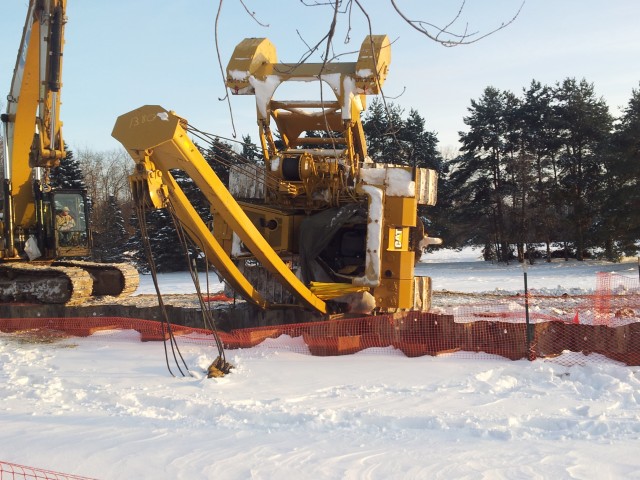
Which is a good thing considering what happened last week: while lowering a section of pipe into the trench, one of the cranes carrying the pipe tipped over completely. You’ve probably seen one or more of the news reports, as the incident has been covered widely. The dramatic pictures tell the story:
Exactly what caused this accident, we have no idea; we’re certainly not pipeline installation experts. Nor do we know how unusual this sort of accident is, though we suspect it’s pretty unusual. Below, we’ll hazard a theory about what may have contributed to the incident. But first, we’ll at least acknowledge that like any other enterprise, especially a large complicated project like the installation of miles of pipeline, accidents are bound to happen. For that reason, the tipping over of the crane– though obviously very serious– may not actually be the most interesting part of the story. It’s what happened next that makes it all so troublesome.
Mainly that’s because what happened next now appears to be a matter of some dispute. Dave, who was there videotaping the whole thing, says that after righting the crane, construction crews simply continued installation. No one on site inspected the pipe for potential damage.
But in a statement released to the news media, Enbridge spokesman Jason Manshum says otherwise:
“…the pipe was lifted out of the ditch and inspected by the senior lead coating inspector, the assistance chief inspector and a utility inspector for all possible damage. The assessment was that no damage occurred as a result of this situation. Work resumed and the pipe was installed into its final position and backfilled in the area that did not have sheet piling.”
Enbridge spokesperson Jennifer Smith tells the same story. According to Michigan Radio’s Lindsey Smith:
Enbridge Energy disagrees with Gallagher. Enbridge community relations advisor Jennifer Smith says three of their lead inspectors were on hand and did a visual inspection of the pipe. She says further inspection would’ve been completed once the section of pipe was installed.
Now, Lindsey (or Jennifer Smith) is very polite to call this a “disagreement”. But this is not disagreement. It is not just some difference of opinion. It is not merely a matter of interpretation. In fact, it’s very simple: either someone on site inspected that pipe or not. Period. Somebody here is not telling the truth. Dave Gallagher was there watching the situation unfold. Jason Manshum and Jennifer Smith were not there. Moreover, both Manshum and Smith have a history of making misleading comments to the press. On that basis, we can only conclude that Smith and Manshum– directed, of course, by the powers-that-be at Enbridge– were instructed to do some serious backside covering. We wish reporters would press them on this point a little. Dave’s is a first-hand, eyewitness account. Can Smith or Manshum produce any sort of evidence at all that their account is true? If so, we would gladly post it here (Enbridge knows how to reach us).
Because no one on site inspected the pipe– despite Enbridge’s claims to the contrary– Dave had the good sense to contact PHMSA. Surprisingly, PHMSA actually looked into the matter, sending inspectors out to Dave’s property and everything. Bizarrely, Jason Manshum tried to pass this off as “routine,” which it quite plainly is not. At any rate, PHMSA directed Enbridge to replace the section of pipe in question, which they did. But of course, as Dave points out in Keith Matheny’s Free Press article, all of this happened only because Dave was there to see it:
“Who knows how many times this has happened before — how many times the homeowner wasn’t home to see this happen, or it happened out in the woods somewhere out of sight?” he said.
Dave actually raises two important issues here, both of which we’ve discussed at length over the past year and a half. The first, of course, has to do with oversight. It shouldn’t be news to anyone at this point to say that our regulatory system is weak, ineffectual, and terribly broken. In a rational world, landowners wouldn’t have to be the ones watching out for the safety and integrity of pipelines during or after construction.
But the reality is, given this seemingly hopeless regulatory environment, that landowners are the first line of defense when it comes to pipeline safety. And for that reason, like it or not, we are (or ought to be) partners with operators like Enbridge whose pipelines cross our properties. Unfortunately– and this is the second issue that Dave’s remarks tacitly raise–Enbridge seems incapable of fostering such partnerships. Just as they have with so many other landowners, Enbridge has, from day one, botched their relations with Dave Gallagher. As a result, he’s become an outspoken critic, vigilant and vocal.
And that poses a serious problem for Enbridge–not because they won’t ultimately get to do whatever they want more or less how they want. They almost certainly will. No. Dave Gallagher poses a problem for Enbridge because reporters keep coming out to his property and writing stories and doing television reports on what’s happening there. And if we’ve learned anything through all of this, it’s that Enbridge cares far more about its public image than it cares about landowners.
Which brings us to our theory about what may have contributed to this construction incident. Enbridge, we suspect, just wants to get the hell off of Dave Gallagher’s property as quickly as they possibly can. The longer they’re there, the more (bad) publicity they’ll get. So they’re rushing, they’re hurrying. It’s why they’re working through all sorts of nasty weather (while at the same time citing winter conditions for NOT continuing work on our side of the state); it’s why they tried to pound steel pilings into the ground before installing seismic monitoring equipment; it’s why they’re blocking his driveway; it’s why they’re working well after dark; it’s why they didn’t inspect the pipe that fell into the ground; maybe it’s even why the crane tipped over in the first place: because they’re acting hastily, in a rush to get finished. And when you rush things, when you act in haste, you are prone to mistakes.
The result? Yet again, Enbridge’s peculiar way of (mis)handling problems only compounds them.
by Jeffrey Insko | Jan 3, 2014 |
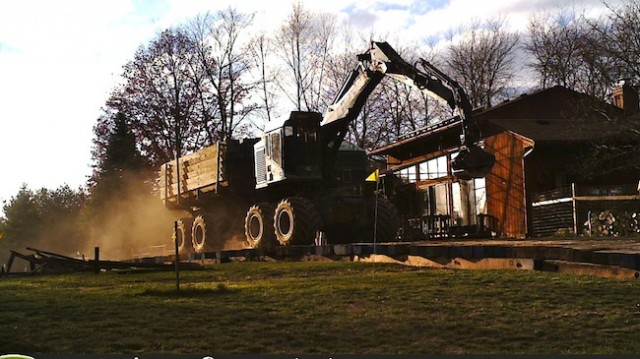
This week, we’ve been running down the Top Ten Line 6B Citizens’ Blog Posts/Stories of 2013. If you missed it, here is the bottom half of the list and here are the next four. We’ve saved #1 for last, in a feeble and probably not-very-effective attempt to build a little suspense. Once more for the record, here’s what the list looks like so far:
10. Line 6B Earns Pulitzer Prize
9. Pet Coke
8. Red Herrings
7. How Not to Write About Line 6B
6. IJNR Kalamazoo River Institute
5. PHMSA
4. Enbridge Thinks EPA is Stupid
3. Why Enbridge Can’t Do Better
2. Enbridge Re-writes Michigan Law
Now, we have to say once more that it was tempting to place “Enbridge Re-Writes Michigan Law” at the top of the list. We still think that’s an important, revealing, deeply disturbing story, one that has garnered far too little interest. Unfortunately, regulatory matters just aren’t terribly interesting to people, even though, in our view, they are tremendously important when it comes to protecting the public interest, the environment, and the rights of ordinary, individual citizens.
On the other hand, the truth is that #1 on our list was obvious from the start. And fittingly, it’s the content on this blog that we did NOT write ourselves. From the very beginning, this blog has always been devoted, first and foremost, to helping and trying to protect landowners– the people most directly affected by Enbridge’s path of destruction. For that reason, the choice for our top story of the year– actually, a series of stories– is a no-brainer:
1. Landowner Stories. Earlier this year, figuring we could stand to shut up for a change, we turned the blog over to our fellow landowners and let them express themselves and describe their Enbridge experiences in their own words. The results, we think, were extraordinarily powerful. What’s more, for every one who has told her or his story here, there are surely 5, 10, or 20 more landowners along the Line 6B route (not to mention along the routes of pipelines all across the U.S. and Canada!) with similar tales. These people are your neighbors and your fellow citizens. They’ve gotten a bad deal from Enbridge and they’ve been left unprotected by ineffectual regulatory agencies and timid state elected officials. They should be heard.