by Jeffrey Insko | Aug 16, 2013 |
This just in: the EPA has denied Enbridge’s request for an extension to complete the latest round of dredging in the Kalamazoo River. We don’t know enough about dredge pads and Comstock Township to have a strong opinion on the dredge site matter, but as we explained at length last week (here and in a letter to the EPA), Enbridge was shockingly dishonest in their letter to the EPA asking for the request. One can only surmise that that fact– there’s no way EPA couldn’t have known the truth– had something to do with the denial. It would have been nice to see EPA call Enbridge out on their attempt to blame someone else for the delay with the Comstock permit. But it was satisfying to see EPA call Enbridge out on a similar matter: Enbridge’s attempt to pretend like the Michigan DEQ was slow in issuing permits. From the EPA letter (emphasis ours).
Enbridge also noted in its letter that MDEQ has not yet issued the dredge permit for Morrow Lake and the Delta. Although this is true, it is also true that Enbridge has not yet submitted certain information required by MDEQ for the permit application. Enbridge has had all required information from U.S. EPA for completion of the application since U.S. EPA approved the Dredge Completion Depth Plan on August 1, 2013. U.S. EPA again reminds Enbridge to submit this information to MDEQ immediately.
Snap!
Ursula Zerilli has more in a thorough article over at MLive. Michigan Radio’s Steve Carmody has also filed a report.
by Jeffrey Insko | Aug 11, 2013 |
Evidently, Enbridge thinks the EPA is stupid– or doesn’t have access to the local news.
As MLive reported last week— along with numerous other news outlets— Enbridge has asked the EPA for an extension to complete the latest round of dredging ordered by the agency earlier this year. The reason for the extension request has to do (ostensibly) with the situation in Comstock Township, the Bell’s Brewery lawsuit, and permitting from the Michigan DEQ. In and of itself, the extension request isn’t terribly surprising. And since we don’t know very much about dredge pads and zoning in Comstock Township and haven’t carefully investigated those things, we’re not really in a position to offer any confident opinions about Enbridge’s plan–although if Comstock residents and business owners like Larry Bell have serious concerns, we certainly think they need to be heard.
So this post isn’t really about the site plan. Instead, it’s about the part of the story that no one else (as far as we know) has bothered to mention: the audacity– or, to call it what it is– the flagrant dishonesty of Enbridge’s letter to the EPA. Why the letter’s demonstrable falsehoods– and we don’t use this language lightly– have thus far been given a free pass we do not understand.
Before we explain, let’s put this in a little context. Over the past year, we have said– and shown— repeatedly that Enbridge fails to live up to its professed corporate values. This simple point was even the basis of our talk at the PSTrust conference last year, which a number of Enbridge representatives attended. So they know very well that plenty of us are measuring their actions against their words. Once again, let’s take a quick look at some of those values. The first ones on the list fall under the heading of “Integrity”:
Integrity
-
Maintain truth in all interactions
-
Do the right thing; do not take the easy way out
-
Take accountability for our actions, without passing blame to others
With these things in mind, let’s watch as Senior Vice President of Operations Richard L. Adams violates all three of them in the span of just a few sentences. Here’s what Adams says in his letter to the EPA requesting that extension. The offending portions are in boldface:
Enbridge’s preparation for dredging in the Delta and Morrow Lake area has been discontinued due to an unanticipated issue with securing a dredge pad site. Enbridge originally selected a site for the dredge pad that met all technical and practical requirements and promptly applied for the appropriate permit from the Township of Comstock. Unfortunately, some local residents and business owners have vigorously opposed granting the permit. As a result, the Township of Comstock has not yet issued the required permit to allow use of the specific site selected for the dredge pad.
1. “Maintain truth in all interactions.” Is Adams’s description of why Enbridge’s dredging plan has been delayed truthful? Well, no. Adams makes it sounds as if Enbridge was doing everything precisely as it should and would have made the EPA deadline just fine until some pesky obstructionist locals got in the way and mucked everything up. But that little narrative, flattering though it may be to Enbridge simply does not square with reality.
For one thing, it is quite plainly NOT true to say that Enbridge “promptly applied for the appropriate permit from the Township of Comstock.” Of course, the term “promptly” might seem to leave a little wriggle room (after all, who gets to decide what counts as prompt?). But let’s consider the facts: the EPA issued its dredging order on March 14 of this year. Enbridge only submitted a site plan to Comstock Township on July 9, nearly four months later (and even then, they submitted it to the wrong body, further delaying matters; more on this below). And they only did so after the Comstock Township Supervisor discovered they were about to begin work without the permit and asked them to stop. Would any reasonable person honestly believe that that qualifies as having “promptly applied”? In fact, does that even count as having applied at all? We tend to think not, but can’t say for sure.
But you don’t have to take our word for it. Just consider some of the key players in this matter who also do not think it was prompt. One of them is Enbridge’s own attorney Christopher Tracy. Here is what Tracy said at the Comstock Township Planning Commission on July 25 about that site plan:
I’d like also to apologize on behalf of Enbridge in terms of sort of the fast pace of this. All of you know we’re under an order from the EPA, where work needs to transpire between now and the end of the year.
We would love to have a situation where we weren’t sort of under that kind of clock. So we apologize if we sort of put you in that position and we apologize for not submitting the site plan to you earlier. It should have been done in a different manner, but it was not.
“We apologize for not submitting the site plan to you earlier.” Extraordinary, isn’t it? Not even Enbridge’s own lawyer thinks they applied for the Comstock permit “promptly.” He even apologizes for not having applied for it promptly and says that “it should have been done in a different manner.”
And Tracy is not the only one who doesn’t think Enbridge applied for the Comstock permit promptly. Have a look at what Comstock Township Supervisor Ann Nieuwenhuis says in a July 10 letter to the Michigan DEQ:
At the outset I must express disappointment that substantial work on both of those sites has occurred without Enbridge applying for and obtaining the necessary Township permits required under the Township’s ordinances and its Zoning Ordinance in particular. While representatives of Enbridge have recently expressed to the Township an intent to apply for and obtain the necessary Township zoning approval and otherwise comply with all applicable Township ordinance requirements, this has not yet occurred. Enbridge’s delay in approaching the Township in this regard has unnecessarily exacerbated the Township’s citizens’ concerns and will make it much more difficult to give those concerns as reflected in the Township Zoning Ordinance proper consideration within the abbreviated timeframe that Enbridge indicates is available to it.
So, neither Enbridge’s own attorney nor the Comstock Supervisor think that Enbridge applied for the Township permit “promptly.” In fact, both of them state quite clearly that a major problem here is that Enbridge FAILED to apply for the permit promptly. That failure is the primary cause of the delay, a delay that has in turn caused Enbridge to seek that extension from the EPA. Yet, in the face of this clear fact, as agreed to by both an Enbridge attorney speaking before the Comstock Planning Commission and the Comstock Township Supervisor, Richard Adams tells the EPA that Enbridge applied for the permit promptly.
2. “Do the right thing; do not take the easy way out.” Which leads us to the next “value” that Adams violates in his letter. The whole point of all of this for Ann Nieuwenhuis (or so it seems to us) is that Enbridge did NOT do the right thing from the start, which would have been to initiate discussions with the Township from the very beginning, to communicate their dredging plans with them, and to apply for the appropriate permits before starting work. But they did none of that. That’s what Nieuwenhuis objected to in the first place. Instead, Enbridge tried to “take the easy way out,” tried to just do things the way they wanted to, without consulting local authorities or inviting local input. (This is the same sort of thing they did with Brandon Township and Howell Township earlier this year.) And since then, Enbridge has continued to NOT do the right thing, like, for instance, submitting the site plan to the Planning Commission and not the Zoning Board as the process requires (thus further delaying matters!). Why did Enbridge do that? Well, here is what Supervisor Niewenhuis had to say about that:
The township had previously warned Enbridge when submitting its site applications that it should go through the ZBA first, but Nieuwenhuis said Enbridge tried to expedite the process by going straight to the Planning Commission with its north site application.
“They didn’t want to do that because (notice of the ZBA meeting) has to be posted in a newspaper 15 days in advance of the meeting,” Nieuwenhuis said. “They thought going directly to the planning commission would be the way to go.”
That’s right, Enbridge tried to “expedite the process”; they tried to take the easy way out. The same goes for Adams’s letter. In it, he isn’t doing the right thing. The “right” thing would be to own up to having screwed up and to accept the consequences of that screw up. But that’s not what he is doing in the letter. Instead, he is taking the easy way out.
3. “Take accountability for our actions, without passing blame to others.” Or, to put that last point another way, Adams is most certainly not taking accountability for Enbridge’s actions. Quite the contrary, he is clearly passing blame to others. His letter makes it look like Comstock, the DEQ, and Larry Bell (they can’t even bother to get the name of the brewery right, calling it “Bell Brewery”) are to blame for the delays. It’s everybody’s fault but Enbridge’s. Locals have “vigorously opposed granting the permit,” Adams says. And “as a result,” Enbridge’s plans have been delayed. But that is at best a half-truth. It certainly does not in any way acknowledge Enbridge’s role in delaying the granting of that permit. Such a brazen, deliberate mischaracterization of this situation– aside from egregiously flouting the values Adams is supposed to live by as an Enbridge employee (and not just any employee, but an executive!)– are precisely why Enbridge has lost so much trust with so many people. If they’re willing to look EPA in the eye and pass off clearly demonstrable falsehoods, how is anybody else ever to believe anything they say?
The thing that baffles us most is why Enbridge thinks it can get away with this sort of thing, why they think it’s okay to carefully and deliberately and demonstrably misrepresent the situation to the EPA. Do they think that they can just pull the wool over the eyes of Jeff Kimble, the EPA on-scene coordinator to whom the letter is written? Do they think that Kimble is that stupid? that gullible?
For our part, we think no such thing. We think there’s no possible way that Kimble doesn’t know the truth of the matter. If he really is on scene, he most certainly knows that Enbridge wasn’t just unexpectedly blindsided by a bunch of oppositional Comstock residents one day. He must know that Enbridge created this situation by attempting to proceed without engaging those same Comstock residents or following Comstock’s ordinances. He surely knows all of that. If we were Kimble, we’d be furious, insulted, affronted. And yet we doubt (though we don’t really know) that Kimble and the EPA will call Enbridge out on all of this any more than the press will. Enbridge will most likely get its extension and incur no penalties. Richard Adams’s counterfactual letter will accomplish precisely what it was designed to accomplish regardless of whether it accurately represents the situation.
Which leads us to a pretty frightening, disheartening, demoralizing conclusion– but also an explanation of why Enbridge thinks it can get away with this sort of thing. It’s because they can and do get away with this sort of thing. Over and over. And that’s because everybody just plays along, lets it slide, looks the other way, treats it as no big deal, as just the way things are. So what we have is a situation that looks something like this: Enbridge does not tell the truth to the EPA and knows it’s not telling the truth; the EPA, Comstock Township, and the press all also know that Enbridge isn’t telling the truth; and Enbridge knows that the EPA, Comstock, and the press all know that Enbridge isn’t telling the truth. But nobody says a word about it. Instead, everybody silently agrees to pretend like Enbridge is telling the truth. Everybody agrees to live in a sort of imaginary world where the untrue gets treated as true, rather than a world in which what is true really does matter. It’s the same way that everybody agrees to pretend that Talmadge Creek and the Kalamazoo River are still real creeks and rivers, rather than Enbridge-created ones.
It’s just easier that way.
by Jeffrey Insko | Aug 1, 2013 |
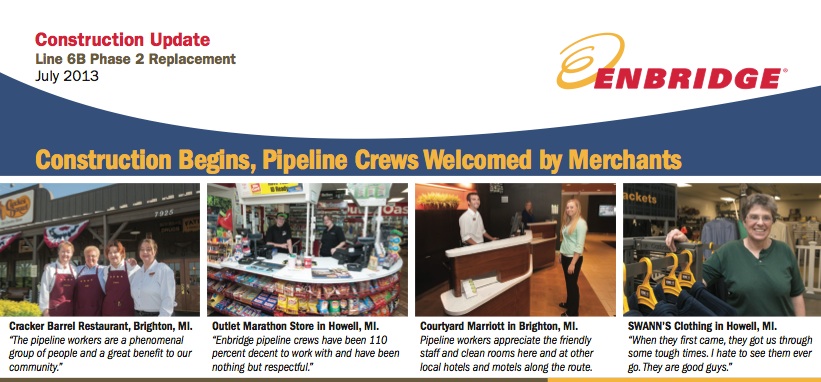
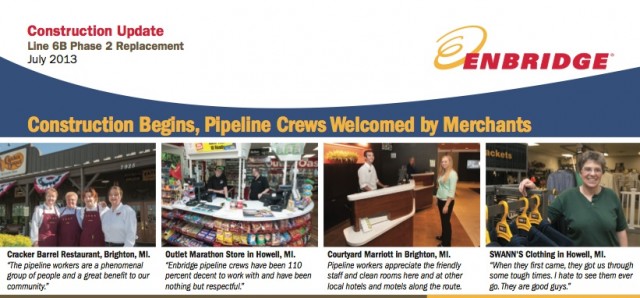
Have you received your July 2013 “Construction Update” from Enbridge? Ours arrived just after our return from Washington D.C. Fortunately, it doesn’t contain any vital information that we could have shared with our legislators. Plus, we figure they’re all on the Enbridge mailing list anyway.
Still, it’s a pretty interesting edition of the monthly newsletter. For this one, it appears that Enbridge’s vast public relations brain trust huddled together in a conference room and generated a brand new strategy. You see, having learned (apparently) that nobody much trusts the things uttered by the people who run the company (or formerly ran it), or the disingenuous spinmeisters who represent the company (there are lots and lots of them), or the land agents (including the fictional ones) who are landowners’ primary interface with the company, they’ve decided to lean on the only group of people associated with this project left with any sort of credibility at all: the construction workers. It’s right there in the newsletter’s main headline:
The accompanying letter from Project Director (is this a promotion? he used to be Project Manager) Thomas Hodge is all about the construction crews, focusing heavily on how they’ll be “spending their paychecks locally for goods and services.” Enbridge has even provided some real-life testimonials, from honest-looking employees at various local businesses, about what swell people the construction workers are: “a phenomenal group,” according to somebody at the Cracker Barrel in Brighton; “nothing but respectful,” according to someone from the Outlet Marathon store in Howell; “good guys,” according to a person at a clothing store in Howell.
Of course, we don’t doubt any of this. As regular readers of this blog know, we’ve spent a great deal of time ourselves talking with these construction workers. Obviously, they’re “good guys” (and women, we would add!). Who said otherwise? Who ever would have assumed otherwise? Shouldn’t this go without saying? Did the people at the Outlet Marathon Store in Howell think they’d be difficult to work with? Disrespectful? A bunch of desperadoes and outlaws, like those roving bands of violent thugs and ruffians terrorizing people along secluded highways that always show up in post-apocalyptic movies? Or does Enbridge think that the bad reputation they’ve got derives not from the people actually running the company, but from the people at the very bottom of the pay scale, the workers in the trenches? If that’s the case, they are sorely mistaken. Frankly, we’ve seen lots of ill-conceived PR tactics from Enbridge over the past year. But mainly that’s because they tend to be so very misleading. This one, by contrast, is just bizarre.
Which is not to say that it isn’t also misleading. The other striking thing about the newsletter is that it is packed full of vague, unverifiable claims: construction crews “are comprised of about 60 percent specialized pipeline workers and 40 percent hired from local union halls”; local merchants “will see an economic boon estimated at $330,000 a week along the route”; “the contractor is anticipated to spend up to $665,000 a week on consumables related to the project.”
We hardly have the energy to interrogate this. Can we see the hiring rolls documenting that 60/40 split (it certainly does not jibe with our experience talking with workers)? Who has made that $330k estimate? And what if the reality falls short of that estimate? Will Enbridge make up the difference? Similarly, who anticipates the contractor spending all that money? Spending it where? On what “consumables”? (We heard one story earlier this summer of how a local farmer in our neighborhood had to throw a fit to get Enbridge to buy straw from him, rather than bringing it in from much farther away.) And what about that picture and caption of the Courtyard Marriott? How many pipeline workers are really staying there, we wonder?
We’ll wrap this up with just one more observation, something we have never said before on this blog. And the reason we’ve never said it is because, unlike Enbridge, we generally don’t like making unverifiable claims. It’s why, as we’ve said many times, we don’t tell even a fraction of the many terrible stories of terrible Enbridge behavior that we hear about– not because we don’t trust the people telling us these stories; generally we do. It’s just that we like to be careful– which is what respect for the truth demands. Nevertheless, we will share this, since it’s based not on hearsay, but on our own experience:
In our conversations with dozens of the “phenomenal,” “decent,” “respectful,” “good guys” (and women) working construction on this pipeline in our neighborhood, there have been two common refrains from these people, two things that always seem to come up in our conversations with them. The first thing is that they are ready to go home (to Oklahoma and Texas and Arkansas and Mississippi, rarely to somewhere here in Michigan). Most of them have been here for a very long time. They’re tired and they miss their families and friends. The second thing– and this is why Enbridge’s latest PR strategy is not only bizarre, but deeply, cruelly ironic– is that they have no love and very little respect whatsoever for Enbridge. Repeatedly, we have heard from them– completely unprompted by us– that while they may like their jobs and take pride in their work, they would not say the same about Enbridge.
by Jeffrey Insko | Jul 10, 2013 |
Well, once again, things aren’t going so well for Enbridge– and they only have themselves to blame. As usual, Inside Climate News has more details on the story of Enbridge’s violations of a DEQ permit (and we’re so glad to see that David Hasemyer is back on the case!) while discharging water from their hydrotest into Ore Creek. As we noted before, our friend Jake McGraw blew the lid off this matter with his disturbing video of rust-colored water fouling the creek.
We were pleased to see Tyrone Township Supervisor Mike Cunningham talking tough about Enbridge (and we hope he’s backing that tough talk up):
“They think they can come in and do it their way without regard to the local and state rules,” said Tyrone Township Supervisor Mike Cunningham. “But they have to follow the rules.”
The township and Cunningham have butted heads with Enbridge for a year over whether the company should be required to follow local zoning regulations.
“They sometime take for granted they can do what they want,” Cunningham said. “They’ve dropped the ball so many times and they dropped the ball on this one.”
And we were bemused to by the (unsurprising) evasions of our old pal Enbridge spokesman Larry Springer. He’s full of banalities, of course, but Hasemyer points out more than once that Springer and Enbride have no explanation whatever for why they didn’t take the simple measures (like having an on-site monitor) required of them by the DEQ permit. Hasemyer also quotes our friend and fellow landowner Dave Gallagher, who nails it when he says, “It makes you think in terms of their long-term concern for the environment and the people who have to live with their pipeline in their backyards.”
But the money quote comes from the inimitable Carl Weimer, Executive Director of the Pipeline Safety Trust:
Carl Weimer, executive director of the Pipeline Safety Trust, a nonprofit watchdog organization based in Bellingham, Wash., said the incident signals a disconnect between the public image pipeline operators try to promote and the reality of their conduct.
“It doesn’t take many times hearing their PR people say ‘We are going above and beyond the regulations’ and come to find out they aren’t,” Weimer said. “It doesn’t take many of those instances when the reality is different from the promises to undermine the public’s trust.”
Weimer said the nation’s pipeline regulations aren’t that onerous and companies like Enbridge can easily afford to comply with them.
“They keep messing up on things they should be doing right,” he said. “It’s one of my frustrations that the industry has the resources and the technology to comply and they choose not to do so.
Elsewhere, Midwest Energy News has a fascinating and important story this week about yet another Enbridge strategy to build a Keystone XL-like network of pipelines to the Gulf Coast. We’ve been talking about Enbridge’s under-the-radar, permit-evading strategies for months, trying (mostly in vain) to get some of the eyeballs focused so intensely on KXL to turn in Enbridge’s directions. Karen Uhlenhuth’s fine article should be getting a great deal of attention. The bottom line: Enbridge has found yet another loophole that may allow them to escape public scrutiny and regulatory oversight:
Enbridge is trying to use a regulatory shortcut known as Nationwide Permit 12 that might allow it to get its pipe in the ground before it provokes the sort of opposition now marshaled against Keystone XL.
Credit for uncovering this “shortcut” goes to the Sierra Club, which is working hard to bring the details of this project to light.
There is also more news this week on the bizarre scheme to get Enbridge to purchase and remove Ceresco Dam. The Battle Creek Enquirer has the story.
And finally, this weekend’s rally at the Mackinac bridge is getting lots of well-deserved press. Let’s hope for a big turnout and lots of attention to the potential dangers to the Great Lakes posed by Enbridge’s aging pipe under the straits.
by Jeffrey Insko | Jul 2, 2013 |
It’s no secret that Michigan has had its troubles recently; the state, especially our economy, is in pretty rough shape in all sorts of ways. But we still love it here. And if you asked us for the two biggest reasons why, we would cite (1) its astonishingly beautiful natural resources: the Kalamazoo River! the Upper Peninsula!, Sleeping Bear Dunes! the thumb region!; and (2) its exciting and delicious variety of locally produced craft beer: Arcadia! Shorts! Right Brain! North Peak! Bell’s!
In the past few weeks, Enbridge has gone and messed with both of them.
Of course, they’ve been fouling up our natural resources, directly (the Marshall spill) and indirectly (the Detroit River’s pet coke mess), for a while now. But apparently, that’s not enough for them. Last week, we linked to a report and a video (taken by the indefatigable Jake McGraw, who deserves serious credit here) of the nasty-colored discharge from Enbridge’s Line 6B hydrotest pumping into Ore Creek. Well, the DEQ has now looked into the matter. And what did they discover? Well, they found Enbridge guilty of 11 violations– that’s right, ELEVEN– of their permit. You can view the notice here. Now this is truly extraordinary: with their track record in this state, with so many of us watching their every move, with all of the bad press and criticism they’ve received over the past three years and on this project in particular, with all of their statements about making things right and being good neighbors– with all of this and they STILL can’t just abide by some simple regulations? Here again is an occasion (these occasions seem never to end) to ponder the imponderable: why can’t Enbridge do better?
(Of course, in this instance, one reason they can’t do better is that they don’t really have to. After all, what repercussions do they have to face from the DEQ? A cessation of their activities? A disabling fine? Criminal charges? No, none of the above. Instead, they’ve been ordered to “submit a written plan.” That’ll teach ’em a lesson!)
But as bad as that news is, it gets worse. They’ve also recently gone and angered Larry Bell. Yes, that Larry Bell, the guy who brews what might be the best beer on the planet: Bell’s Two-Hearted Ale. What’s got Bell upset? Well, it seems that Enbridge, in complying with the EPA’s recent order to continue cleaning up the Kalamazoo River, has embarked upon a work plan without bothering to notify or consult any of the locals, including the local government, about it (sounds familiar, right?). And that has Larry Bell and other residents and business owners concerned about the effects that work might have on their business and their lives.
It’s just one thing after another, with no apparent end in sight. And it’s one thing to mess with landowners, to flout local authority, to disregard regulations, and to dissemble and make hollow pronouncements to the public. But to go and mess with our beer? That’s just cruel.
by Jeffrey Insko | Jun 28, 2013 |
Yesterday, we launched a new series devoted to the question, why can’t Enbridge do better? We’re trying to figure out what causes them to continue to alienate landowners and to fail to live up to the values they profess publicly. The reason we’re thinking about this is that construction crews returned to our property this week to tear it up again. And no one let us know anything about it– and in our view, that’s just downright unneighborly. So we’ve been exploring some possible theories that might account for Enbridge’s apparent inability to do things right. In our last post, we advanced 5 possible theories, some of which we dismissed and others which seem to us to have some merit. Today, we’ll consider a few more possibilities:
Theory #6: It’s hard for old dogs to learn new tricks. Or perhaps a better way to put this is to say that you can’t conduct business in the twenty-first century as if it’s still the twentieth. Yet that’s exactly what Enbridge is attempting to do. And it’s not just that they seemed to think, at the start of this project, that they would come down here to Michigan and find things just as they were in 1969 when all of their easements were first acquired: a bunch of farmland, where dwellings are acres distant from their pipeline. It seems not to have occurred to Enbridge that things might have changed in 50 years, that population density would have increased, that matters are different when construction crews will be right next to houses, not way back in yonder pasture with the wheat and the cattle. It’s not just that. The metaphorical landscape has changed as well. People today, we think, are generally more skeptical toward the activities and motivations of large corporations, slightly less trusting of big business (surely we don’t need to rehearse the litany of early-21st-century reasons why, right?). Such wariness is especially pronounced when it comes to energy companies. There exists today far more awareness of and concern about our dependence on petroleum and fossil fuels, concern for the environment, worries about climate change. On top of all this, add the internet and social media, which facilitate instant communication among strangers and the spread of information in ways unimaginable 20, 30, 40 or more years ago. People in similar situations can talk via email; they can Skype; they can find each other on Facebook. They can start blogs. Enbridge’s treatment of landowners, their slow-footed, ham-handed, clumsy responses to citizen organizing, demonstrates pretty clearly that they have only a dim understanding of any of this.
So we think this is a pretty compelling theory; it accounts for a great deal. On the other hand, it has its flaws. After all, any decent dog trainer will tell you that it is not at all hard to teach old dogs new tricks. Dogs stay smart and curious and adaptable well into their twilight years. Enbridge appears to be neither smart nor adaptable. Enbridge is a bad dog. For instance, Enbridge has had more than a year, mountains of bad press, countless expressions of landowner dissatisfaction (lots of it posted here), condemnation suits, lawsuits, countless tense conversations and contentious negotiations to learn from. Yet they appear to have learned nothing. We’re still, a year later, hearing the same old stories about rude or abusive land agents, misinformation, poor communication between Enbridge and its agents and agents and landowners. A very large body of evidence suggests that they haven’t learned anything, that they have changed very little. What is to explain that?
Theory #7: They’re accustomed to getting their way. One theory that could explain their failure to get their act together and try a different approach on phase two than the one that earned them nothing but heartburn on phase one is this: like a spoiled child, they’re accustomed to getting their way. And when they don’t get their way (or when someone questions whether they should get their way), it’s everybody else’s fault but their own. This one is surely true. It’s surely more or less true of their entire industry for the last 50 or more years. They are weakly regulated, largely get to write their own rules, have cozy relationships with regulators. They have power and money and influence. They’re the biggest kid on the block. And when you’re the biggest, you can more or less do as you please. Personally, we’ve never found ourselves in this situation (growing up, we mostly had older siblings!). But we can imagine that one gets used to this sort of thing. One starts to think it’s entirely natural, that it’s just the way of the world.
And why wouldn’t they? They’ve certainly gotten their way here in Michigan. Hardly a single elected official ever said so much as “boo” during the MPSC approval process or before. And Enbridge didn’t just sail through the MPSC, they almost completely refashioned it in their own image, ensuring that its regulatory authority is crippled for themselves and their industry counterparts for many years to come. When you can do that, when you can bend an entire state to your will, why wouldn’t you consider, say, a small local township or a few unhappy landowners as mere trifles, as things hardly to be bothered with at all?
Theory #8: It’s the culture, stupid. Combine these last three theories and what they add up to is a longstanding, deeply embedded set of cultural practices and attitudes– of the sort that we described quite a while ago when thinking over the remarks of Enbridge’s former CEO Patrick Daniel. There, we described a corporate culture that is insular, clannish, defensive, given to hollow sloganeering in place of principled conduct, and seemingly incapable of honest self-reflection. And maybe this shouldn’t be so surprising. After all, culture is a hard thing to change. The attitudes and practices of one’s culture run so deep as to be invisible to those inside of it. To those within the culture, the things they do or believe don’t seem to be derived from culture at all; they don’t seem like things that even can be changed, much less things that ought to be changed. Rather, they just are. They’re like air and water or the blood coursing through your veins.
This is why, when it comes to corporate cultures, it’s so important for someone– whether that be legislators, local, state, and federal regulatory agencies, customers, citizen watchdog groups, or journalists– to provide those inside with an outside view. It’s why critics (to name just one more group that can provide valuable perspective) are so very important. It’s why, as we’ve said before, what we do here at the Line 6B Citizens’ Blog is actually a service to Enbridge. We can help them. We are trying to help them. If only they were willing to listen.
by Jeffrey Insko | Jun 27, 2013 |
In an earlier post, we (longwindedly) pondered the question: why can’t Enbridge do better when it comes to cultivating amicable, productive relationships with landowners? Over and over they fail to do the simplest of things that would go a long way to fostering such positive relationships and ending what must seem to them like a never-ending stream of criticism. In this post, we’ll consider several possible answers to that question.
Theory #1: It’s not them, it’s us. Unlike Enbridge, we’re capable of self-reflection, of taking a sober look at ourselves and taking seriously the possibility that we are the problem. So maybe it’s us. After all, this blog is primarily devoted to criticism. From Enbridge’s point of view, we must surely seem like people who just like to complain, who are always adversarial, who will just never be happy (as Tom Hodge once said of displeased landowners generally). So why should they bother cultivating good relations with us? We’re a lost cause. If we’re not notified of construction activity, if our agents can’t give us any clear information, if Enbridge reps– Doug Aller, Jason Manshum, Mark Curwin– ignore our emails, well, we’ve got it coming. That’s what we get for all of the negative things we’ve said here, in newspapers, and elsewhere.
It’s a plausible theory. But there are a few reasons it doesn’t quite hold up. For one thing, it’s not just us. We’ve heard (and told) far too many stories of Enbridge’s disregard for other landowners, landowners who have never uttered a peep of criticism publicly against them. For another thing, in our correspondence with Enbridge reps we have always been unfailingly polite and respectful (we have every single email; we can show them to you!). In our correspondence with Enbridge, we have never given anyone any cause to think that we’re not communicating with them openly and honestly (as they say they communicate). And frankly, the same goes for this blog. Sure, we’re critical. But we don’t engage in personal attacks. We’re not inflammatory or ad hominem. We try very hard to stick to the facts. If there’s something here that is untrue, all Enbridge needs to do is say so and we will correct it. But they have never once done so. Finally, there’s one more reason why we think the “it’s us” theory doesn’t hold up: the fact of the matter is, like it or not, we are STILL Enbridge stakeholders. Their pipe runs through our property. We’re in this together no matter how little either of us likes it. They’re stuck with us just as we’re stuck with them. And we’ve never seen the part where their treatment of landowners or their corporate values exclude people who utter criticisms of them in public. If that’s the case, if their practice is really to “Take the time to understand the perspective of others… until they criticize you,” or if their actual policy is “Treat everyone with unfailing dignity… unless they say things you don’t like,” then maybe they need to revise their corporate values statement. But until they do, we’ll hold them to the original.
Theory #2: They’re evil. If it’s not us, it really must be them. So maybe they’re just bad, rotten to the core. Evil. One of the first things Enbridge Vice President Mark Sitek said to us when we spoke on the phone is, “we’re not evil.” And we quickly pointed out that we have never said any such thing about Enbridge. And in fact, after all this time, we would still never say that. So let’s be very clear: we do not think that Enbridge is “evil.” Frankly, we don’t really even know what such a statement could possibly mean in the first place.
Theory #3: Ineptitude. So if Enbridge isn’t evil, what are they? Well, one theory might hold that they’re simply inept. They’re incompetent. They don’t know what they’re doing and they lack the skills to do it. This is a tempting theory, especially given the fact that they so consistently fail to do things right. But there are several reasons we think this theory doesn’t hold. For one thing, they are a very large, very successful corporation. They make hundreds of millions of dollars a year. They operate and maintain a complicated and sophisticated network of pipelines and manage large, varied demands from diverse customers, partners, and stakeholders. You can’t do that if you’re inept (unless you win the lottery or something).
So maybe they’re only inept at dealing with landowners. This one we’re willing to consider. But Jason Manshum (and I’m sure others) assures us that the “vast majority” of landowners over the past 60 years are quite happy with Enbridge. And even though, judging from the way he’s dodging our questions about this point, he can’t provide any real evidence for that claim, let’s take him at his word. Let’s assume that they DO know how to deal successfully with landowners. Let’s assume it’s NOT ineptitude. The question still remains, why don’t they do what they know how to do?
Theory #4: They just don’t care. This one is tricky. It’s tricky because they talk a lot about how much they care. There are those corporate values, for example. There are all of those fancy and expensive ads (and more and more and more) designed to convince everyone of just how much they care. There are all of the statements that they make in public. But here’s an instance where it’s a little harder to take them at their word. After all, it’s easy to say you care. It’s easy to say you want to be a good neighbor. It’s a little harder to actually be a good neighbor. But not that much harder. Which is precisely the point. How difficult is it, really, to make sure that land agents know when and where construction crews are going to go digging up buried pipe so that they can notify the affected landowners? It can’t really be very hard. So why not just do it? Maybe because it doesn’t occur to you to do it. And the reason it doesn’t occur to you is because you don’t really care. Considering how a landowner who thought construction was over might feel if construction were to re-commence takes a little bit of empathy. Caring people empathize. So maybe this one’s true; Enbridge just doesn’t care– even though they want you to think they care.
Theory #5: It’s not them, it’s their contractors. The fair-minded part of us still wants to hold the tiniest bit of hope that theory #4 is wrong and that when Enbridge reps say they care, they actually mean it. So maybe the problem isn’t with them, but with their contractors. After all, most of what goes on on the ground, most of the people that landowners deal with aren’t actually Enbridge employees. They’re contractors. The construction crews are with an outfit called Precision Pipeline. The right of way agents (or so we understand; this whole system is rather murky) are apparently with a company called Salem Professional Services. And judging from what we heard at the Michigan International Right of Way Association, Salem may not have the best reputation in the industry. Our experience with their agents (though not all of them) seems to support the conclusion that Salem has some problems with quality or experience or professionalism or something. So perhaps there’s some merit to this theory. But we can’t say the same, not in our experience, with Precision. Not being pipeline engineers or welders, we’re hardly in a position to judge the quality of their work– although they appear to be experienced and efficient– but we can certainly say from dozens of conversations and encounters that they hire good people who take pride in their work. We have very much enjoyed meeting and talking with Precision’s construction workers. With very few exceptions they’ve been friendly, respectful, pleasant, serious and happy to engage and answer questions. Our only regret is that more of them haven’t been from Michigan.
So ultimately, we’re disinclined to pin it on the contractors, even though we have our concerns about Salem. After all, it shouldn’t be that hard for Enbridge to demand that its contractors adhere to its values and standards– regardless of the contracting company’s standards. And we know that Enbridge has its own employees in the area of land rights; we visited them. Those are the people, we assume, who should be training and monitoring the contract workers. They are the people, not Salem and its employees, who should be ultimately responsible for the failures and incompetencies and inaccuracies emanating from the land agents. So those are the people– or so our experience suggests– who seem not to really care, lending further credence to theory #4. After all, if the people in the corporate office of land rights aren’t willing to listen to and engage seriously and empathetically with landowners, how can the non-Enbridge employees they oversee be expected to do so?
But we still don’t think “they don’t care” is quite adequate. However, it appears that the answer to this simple question is so complicated that it requires a series of posts to do it justice. In fact, we’ve got a handful of more theories to consider. We’ll take those up in later installments. Please come back.
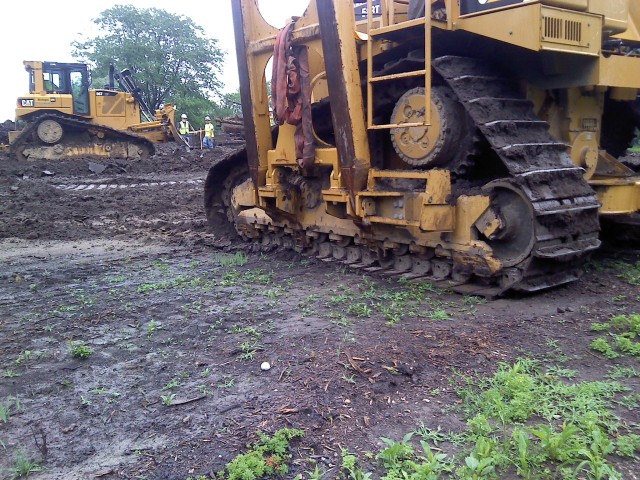
by Jeffrey Insko | Jun 27, 2013 |
This week, while we’ve watched Enbridge’s construction crews return to our property, which is now once again torn up, strewn with long sections of pipe and heavy equipment and also, thanks to the weather, a big, sloggy, muddy mess, we’ve been stewing a little. And we’ve been ruminating on one basic question: why can’t Enbridge do better?
In this case, we’re not even talking about their operations. We’re not making a big deal out of the fact that some 400 feet of pipe they pulled beneath a road and across a couple of our neighbors’ properties is damaged and has to be replaced. We are not suggesting that this is a sign of carelessness or shoddy work or ineptitude or any such thing. We are not pipeline construction experts. We assume that these sorts of things happen from time to time; laying hundreds of miles of pipe is a complicated, sophisticated process about which we do not pretend to know very much (other than what we’ve learned over these several months). And in fact, we’re sure it’s better that they’re fixing the problems their tests discovered rather than finding ways to dismiss indications of problems (as was the case in Marshall in 2010). So, we have no real quarrel with the fact that they’ve had to re-commence construction in our neighborhood and on our property– even though we are tired tired tired, oh-so-tired of dealing with the noise, the mess, the intrusions, and the disruptions.
No, the problem– and this has ALWAYS been the problem– is with how they’ve gone about, with the thoughtless disregard Enbridge has shown toward us (in this case) and toward so many landowners over the course of this project. And for reasons we still cannot fathom– especially given all that has happened over the past year, all of the complaints and bad press and contention and legal-wrangling– Enbridge simply can’t seem to rectify this problem. They simply can’t seem to do any better. Why?
Let’s back up and review what’s transpired this week as we consider this most difficult of questions:
Some time a few weeks ago, our neighbors immediately adjacent to us were notified by an Enbridge rep that hydrotesting was about to take place on the newly installed line. We were not notified. Presumably, there is some reason for this– proximity, perhaps?– so we didn’t think a great deal of it. But then last weekend, construction crews arrived on that same neighbor’s property and began digging, commencing the process they are now in the middle of, replacing that stretch of pipe.
Naturally, we wondered if any construction would be taking place on our property. We also had some lingering questions about restoration, questions we’ve been trying to get answered since February. So we figured it was as good a time as any to give an agent a call (that is, the agent whose name we were given by our former agent who has since departed). Now, this particular agent happens to be, at least in our limited dealings with him, a very nice guy, polite, respectful, all of that. But he’s clearly overworked; he told us he was working on more than one Enbridge project at present. And not only is he overworked, he has obviously not been given any information about much of anything by anyone in any kind of supervisory position. (Who’s his boss? Doug Aller? Micah Harris? We’re not sure, but whoever it is, that person would appear to be doing a very, very poor job.) The reason we say he has not been given any information is because he told us, flatly and forthrightly (which was rather refreshing, to be honest) that he did not know anything about any of the questions we were asking– about restoration, including some things we’ve been told by Mark Curwin and Tom Hodge, about the recent tests, about the construction currently taking place, about the prospects for work taking place on our property. Nothing. He just didn’t know.
Now, it’s worth pausing here for one second to pose the obvious question: what is the point of giving landowners the contact information of people who are completely unable to answer any of their questions? What is a landowner supposed to do in such a situation? We’ll return to this question.
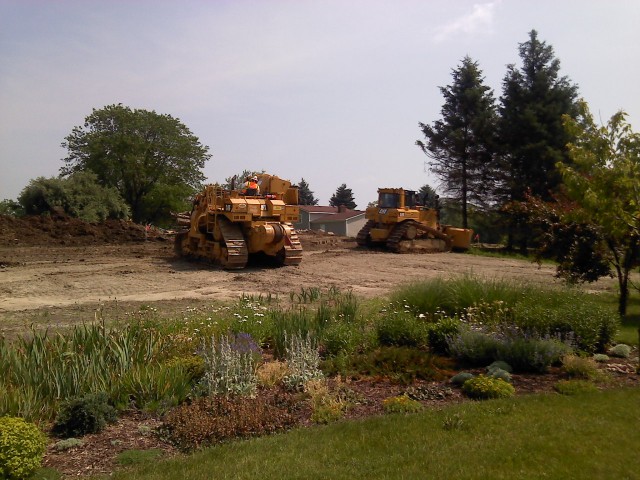
That call was early Monday morning. Then, surprisingly, not 10 minutes after hanging up the phone, we look out the back door and see surveyors on our property. So we went out to talk with them. The surveyor, unlike the land agent, did seem to know some things. He seemed to have some idea of how the pipe was damaged and the steps that crews were preparing to take in order to fix it. He told us that our property was going to be used to stage some pipe. What he did not say– and we don’t blame him for this; he’s just a surveyor– was that bulldozers were about to arrive to start pushing aside all of our topsoil and that other heavy equipment and a fleet of pickup trucks and all manner of noise and mess and mayhem would ensue. But over the next few days, that is exactly what has happened. We posted pictures of the scene yesterday.
Now, again, all of this mess is terribly unfortunate and frustrating. But ordinarily, we’d be disinclined to complain about it. We know it’s just the deal. Enbridge has an easement on our property. They need to install their pipe. They have to fix it when they find problems. We get all that. The problem, however, is this: no one from Enbridge ever told us beforehand that this was going to happen. We received NO notification. Not a friendly knock on the door, not a phone call, not even an email. Nothing. One day we’re thinking about planting some trees; the next day bulldozers are back. Just like that.
So here’s a second question: does that sound neighborly to you? Do good neighbors just show up unannounced, without so much as a courtesy call to let you know they’ll be dropping by? And when you later tell them that you don’t appreciate them just dropping by without the slightest warning– as I did in an email to Mark Curwin and Tom Hodge– would a good neighbor just ignore you?
Which brings us back to our original question: why can’t Enbridge do better? What is it that prevents them from taking even the simplest steps to cultivate good relations with landowners? What keeps them from doing the things they say they’ll do? from living up to the values they profess and the principles they say guide their conduct? from conducting themselves in such a manner that would prevent us from having an endless amount of material to write about? Why do they seem to be completely incapable of getting it right?
Well, we started this post wanting to answer that question. But the posing of the question has gotten much longer than we anticipated. So we’ll explore some answers in a separate posting. Stay tuned.
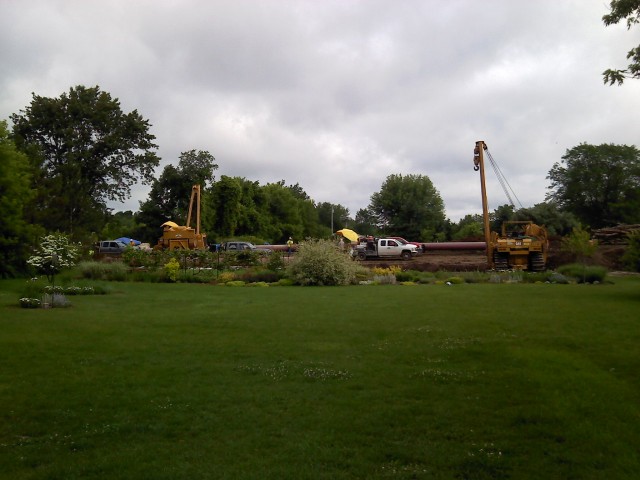
by Jeffrey Insko | Jun 26, 2013 |
What a week! After a few weeks of relative silence (and almost complete silence from us– we’re sorry!), things Enbridge-related exploded this week.
It started Monday morning with a harmless phone call to an Enbridge land agent to try and get some simple information about restoration. But he didn’t know anything. Nothing. At all.
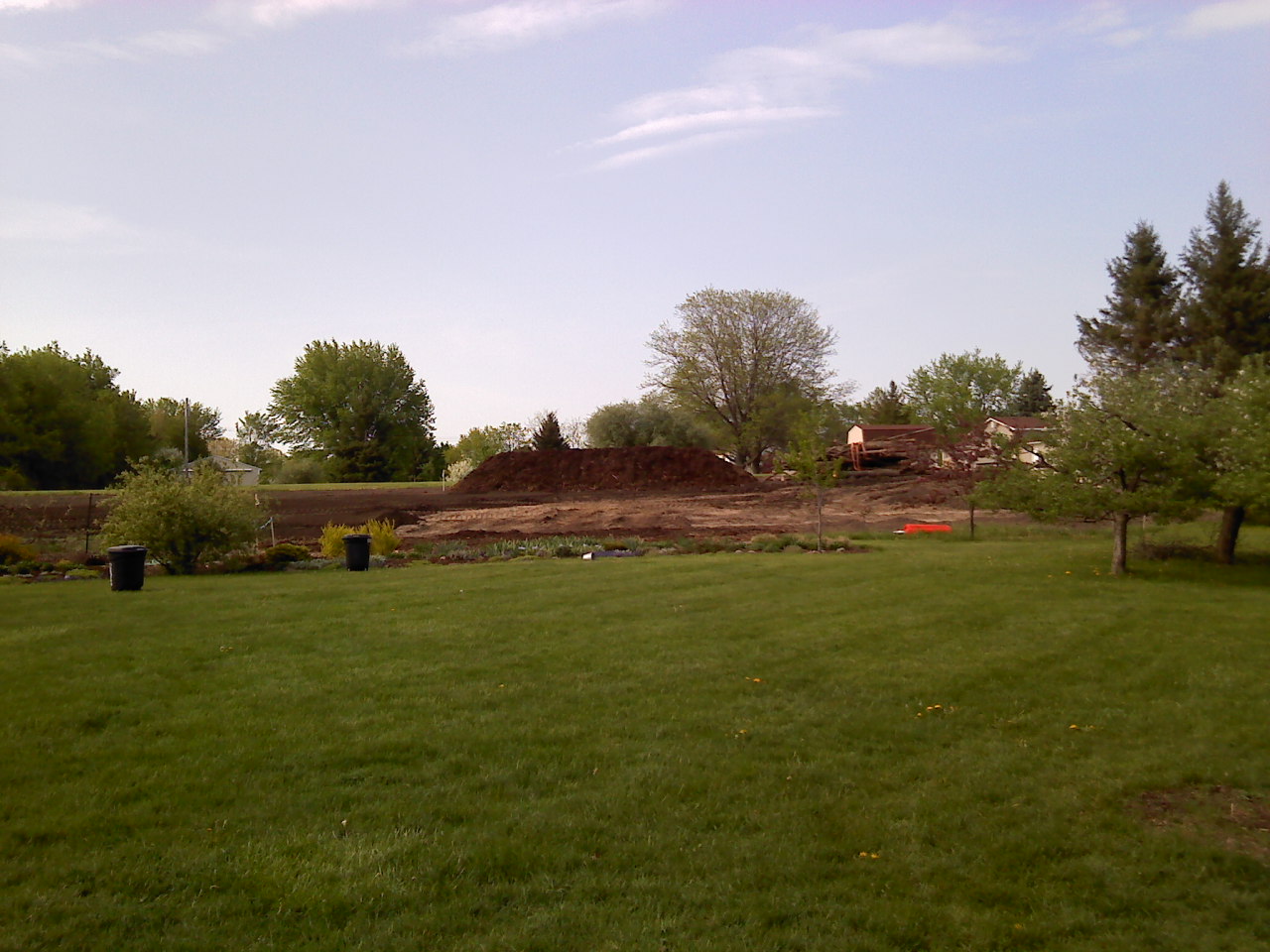
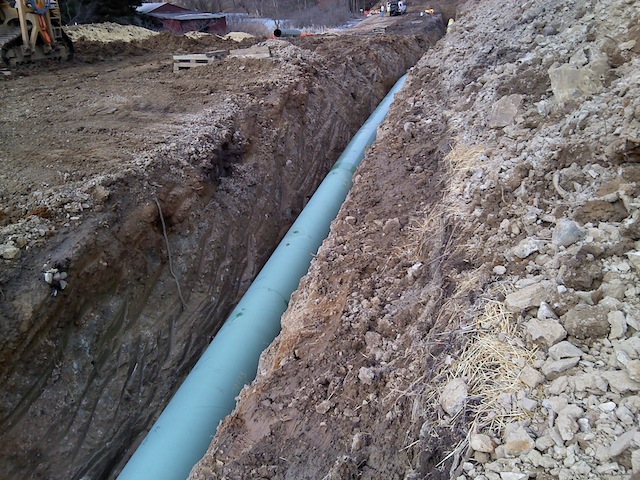
But no sooner did we hang up the phone than we saw some workers pounding stakes into the ground on our property. Minutes after that, bulldozers arrived and started pushing dirt around. Now hundreds of feet of pipe are back on our property, causing us to have traumatic flashbacks to last November. Here is what our property looked like last week:
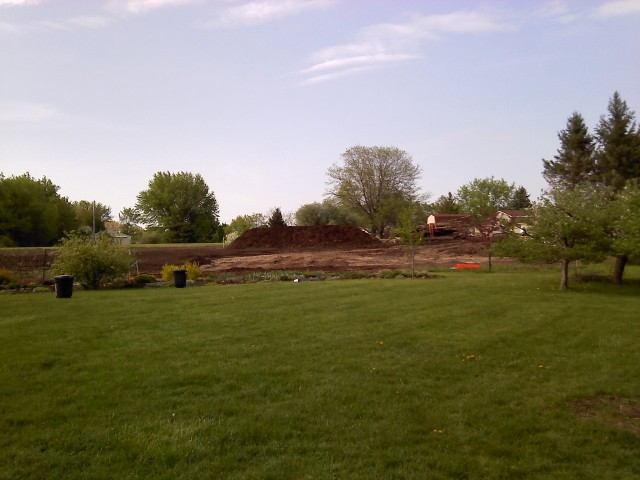
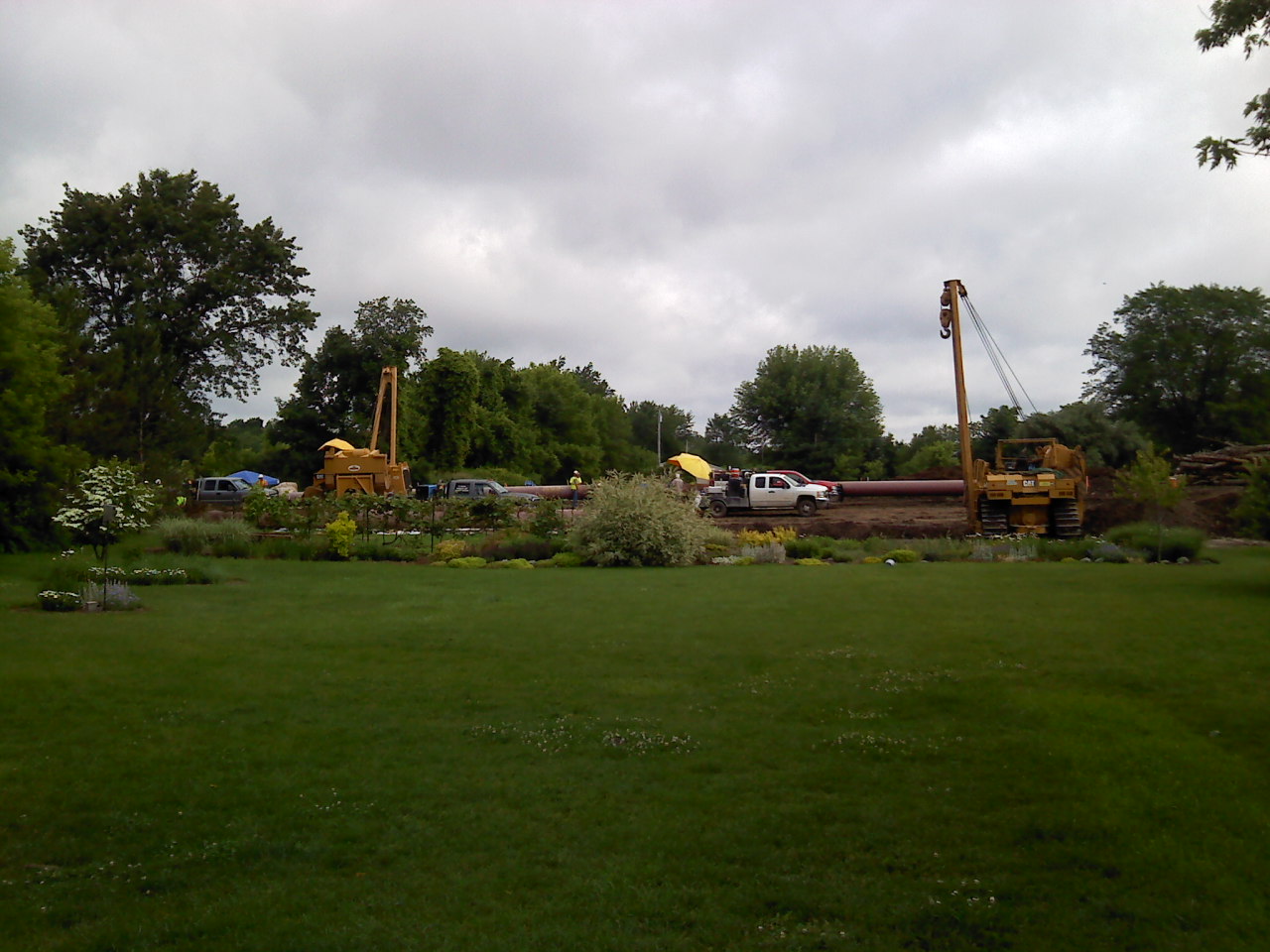
And here is what it looks like this morning (we’ll bring you the full story of all of this in a subsequent post):
The same day, the second of two reports on Line 6B by Keith Matheny appeared in the Detroit Free Press. It’s fine work, though as usual, the disingenuous remarks of Enbridge spokesperson Jason Manshum raised our hackles. So we wrote to him for clarification. It’s been two days now and he has not responded. Evidently, Manshum is not obligated to adhere to Enbridge’s stated corporate values of “maintain[ing] truth in all interactions,” “tak[ing] the time to understand the perspective of others,” and “treat[ing] everyone with unfailing dignity.”
Also on the same day, an intrepid young activist decided to climb inside a section of Line 6B to protest the transportation of dilbit from Canada to the U.S. Reports say he is healthy and safe.
Then, as if all of that weren’t enough, the National Academy of Sciences released its congressionally-mandated report on the safety of transporting dilbit. It’s pretty weak tea, we have to say, but in place of our analysis we’ll just point you to stories by our favorite reporters Lisa Song at Inside Climate News and Elana Schor at Energy & Environment News. And we’ll also direct you to important responses by our friends Anthony Swift of the NRDC and Carl Weimer of the Pipeline Safety Trust.
We will add one tiny bit of our own commentary here. The industry response to the NAS study included this little gem by Shawn Howard, a spokesman for TransCanada:
“At some point, the professional opposition that has used Keystone XL and the oil sands industry as a symbol for their fundraising and advocacy campaigns will need to accept the fact that this product has been moving through the U.S. for decades, that oil is oil and that pipelines remain the safest way to move oil to refineries where it is needed,” TransCanada Corp. spokesman Shawn Howard said via email.
“As a responsible, publicly traded company, TransCanada has an obligation to provide accurate and factual information about our projects to the public and our shareholders — and we hope that the professional opposition to this project will start to do the same.”
Taking a page from the Pat Daniel playbook, Howard refers to a diverse group of citizens with varied and mostly reasonable concerns as “professional opposition.” And he does it twice, in a willfully dishonest attempt to dismiss critics of his industry. What rankles us so much about this– and we’ve seen a similar tactic employed by Enbridge; not just Daniel, but also Larry Springer and even, we’re sorry to say, Tom Hodge— is not just that it is reductive, misleading, and an affront to the truth. It’s also that Howard does it in the very same sentence in which he’s trying to convince us that TransCanada is “responsible” and devoted to “accurate and factual information”! It’s exactly like Enbridge telling us they’re committed to being good neighbors while in the midst of behaving in an unneighborly manner.
But that’s not all this week has had in store for us. Yesterday, the president gave a much anticipated climate speech. Many groups are heartened by his remark that the KXL project should go forward “only if this project does not significantly exacerbate the problem of carbon pollution.” For ourselves, we don’t think that’s a terribly unequivocal statement. But we’re trying to be hopeful.

by Jeffrey Insko | May 31, 2013 |
Honestly, we thought, after all this time, that things might change. We thought– despite the available evidence— that Enbridge might learn from its mistakes. We thought–we hoped– that landowners along phase two might benefit from the experiences of and all the noise made by those of us on phase one. We thought, at the very least, that Enbridge– so very thin-skinned and so desperately image-conscious— might want the tales of bad behavior and the criticisms to just stop and, therefore, that they would begin to conduct themselves in ways that comport with all of their good neighbor rhetoric.
Looks like we were wrong. Over the next several days, we’ll bring you three ugly stories of landowners along phase two, stories that are no less troubling because they sound so terribly familiar to those of us on phase one. Not surprisingly, these stories, like countless others we’ve heard over the past year, mainly have to do with the unreliability, untrustworthiness, and unprofessionalism of Enbridge’s right of way agents. This has long been a problem, perhaps the primary source of landowner unhappiness and dissatisfaction. There’s just no getting around the fact that Enbridge’s land agents (not every single one, of course; there are surely some good ones; as we’ve noted in the past, during construction and restoration, ours was very responsive) have done the company and landowners a terrible disservice. Their actions– misinforming, failing to return phone calls, communicating sporadically or poorly, dismissing legitimate concerns, using the threat of condemnation as a cudgel to beat landowners into submission (even before, as in our case, the state had granted Enbridge that right), treating people disrespectfully– have gone a long way toward breeding an atmosphere of mistrust and contention between Enbridge and landowners along the pipeline route. It makes one pine for the fictional land agent conjured up by Enbridge’s public relations machine.
But while a lot of blame for this breakdown of relations can be laid at the feet of Enbridge’s land agents (we’re not letting them off the hook), it’s Enbridge that bears ultimate responsibility for all of this (and this is why, we repeat once more, we have NEVER ONCE called out a land agent by name– though we could; nor have we told even the tiniest fraction of stories about their bad behavior that we’ve heard over the past year or so). Most of those agents aren’t really even Enbridge employees; they’re contractors– (which is an interesting story in itself; in fact, we know the land agent company that has contracted with Enbridge and have been looking into this; we hope to post more about it at a later date). When we, along with Kim Savage, told some of these stories of land agent behavior to the members of the Michigan chapter of the International Right of Way Association a few months back, they were shocked and appalled, nearly incredulous.
So why does this kind of land agent conduct seem to be continuing even today? After all, there are Enbridge employees who are (ostensibly) in charge of supervising those land agents (or so we think). And those supervisors surely know about the kinds of behavior we’re talking about. They have surely heard these stories by now, if not from this blog, then from plenty of other sources. Yet they appear not to want to hear it or do anything about it. At least that’s true in our experience: Mike Bradburn, Doug Aller, Mike Harris– all of them brushed us off, ignored our attempts to contact them; none have been willing to actually listen, take seriously, and respond forthrightly to landowner concerns about the people they supervise, then take action to correct these persistent problems, problems that have done nothing but alienate people, cause needless conflict and strife, and delay the timely completion of the project.
What’s more, all of this has led to a very strange situation in which, when things get particularly bad (or go public), people like Mark Curwin and Tom Hodge– people who have other jobs to do– have to step in and try to do the job that land agents should be doing: cultivating amicable relationships with landowners, addressing reasonable concerns, solving problems created by right of way agents. We saw this first hand, for instance, the night we met Tony Amico at a Brandon Township meeting. Honestly, if we were Curwin and Hodge, we’d be furious about this state of affairs; we’d be cracking heads over in the office responsible for land acquisitions and rights-of-way (and for all we know, maybe they have done just that; we haven’t got a clue what goes on behind the scenes).
But we have our doubts. One of the things we’ve learned after all these months, and we’ve discussed this before, is that Enbridge isn’t that good at being introspective, at taking a cold, sober look at their own conduct (and this despite their own stated corporate values), at being self-critical and making appropriate adjustments. That’s because to them, all of these are just p.r. problems, not systemic ones. So instead of altering their conduct, they tend to hunker down and get defensive. Or they just buy a new ad, send out a glossy new brochure, find someone compliant to help them polish their image. Or they deploy Jason Manshum or another one of their seemingly endless horde of spinmeisters.
The one thing they appear not to do– or so the stories we’ll bring you over the next few days– is the one thing that would actually solve all of these problems: treat landowners with respect and consideration; just stop giving us stories to tell.