by Jeffrey Insko | May 29, 2013 |
Early last week, we kicked off our latest series— on our experience with IJNR Kalamazoo River Institute— by ruminating on the strange current state of Talmadge Creek and the Kalamazoo River. Yes, both are lovely and seemingly very clean. Objectively speaking, it’s hard to say that Enbridge did not clean them up well (you can do a lot with a billion dollars)– although there’s much more to be done (so says the EPA). Of course, in our view, the cleanup effort is not really cause for any great celebration or any reason to go heaping praise on Enbridge. After all, if you break something that doesn’t belong to you, you should be obligated to fix it– and not congratulated for doing so.
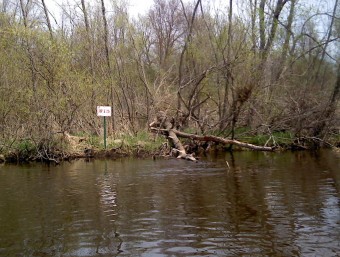
But as we said in that previous post, what was most striking to us about the creek and the river was, first, the way in which the history of the spill appears to have been erased. The truth about what happened there in 2010 is evident only through a series of barely perceptible signs, all but unreadable to the average visitor. This, in our view, is a travesty. If there’s a sign commemorating the site where the Jeffery family once lived, there also ought to be a sign explaining why they don’t live there anymore. There ought to be signs and plaques up and down the river telling future generations of river-goers exactly what happened to the ecosystem and to the lives of all those decent, ordinary people– the Deb Millers and Susan Connollys. The future citizens of Michigan ought to know about the mess. They ought to know the truth– that people’s lives were disrupted, in some cases ruined, that their health was affected, that flora and fauna were destroyed– not just the clean up, and the greenwashing.
The other thing that struck us about the current state of the river and the creek– and it’s related to the first– is their “hyperreal” quality. The pre-2010 river and creek are gone and a new river and a new creek have taken their place, rivers and creeks re-made and, to a large extent, operated by Enbridge. Public, natural resource have become (to a degree) semi-private, artificial creations. And we just find that a little, um, creepy.
So why are we rehashing this today, having just written about it a few days ago? Well, because no sooner had we posted about this than we stumbled upon a perfect illustration of our point. Let us introduce you to David Jephson:
Jephson is the deputy fire chief in Terrace, British Columbia up in Canada– which is one of the (many) places where Enbridge has run into a bit of opposition with their massive Northern Gateway project (sort of Canada’s Keystone XL). Earlier this month, Enbridge invited a number of B.C. officials to a tour of Marshall and the Kalamazoo River so that the officials could observe first-hand just how marvelous and squeaky-clean it is now. This, evidently, is Enbridge’s way of persuading Canadian officials of the company’s all-around wonderfulness and putting to rest any apprehensions the officials might have about a Marshall-like spill in northern B.C.
Well, deputy chief Jephson was mighty impressed, as he told the CBC in a radio interview (he has also spoken to a local newspaper). For one thing, Jephson seems to think it’s meaningful– evidence that it was no big deal?– that some random people the delegation met in Detroit didn’t know very much about the spill. But the most extraordinary thing Jephson says is “you wouldn’t know there was a spill there unless you were told”– as if the erasure of the history of that spill and the devastation it caused were a good thing, as if the view and experience, and history of the river and the spill they were getting from Enbridge were accurate, transparent, and honest– rather than carefully orchestrated. The level of gullibility on display by Jephson is truly extraordinary. In fact, Enbridge is so pleased with the things Jephson has been saying since the tour that they have posted a transcript of the radio interview on their website and appear to have adopted him as their new mascot– they’ve replaced poor Michael Milan!
But of course, few people really know what the tour Enbridge took Jephson on was really like, even though Jephson says it was a “fact finding trip”– and nobody other than Jephson appears to be talking We have no idea who the officials on the tour met and spoke with– and we’ve been trying to find out. As is typically the case with Enbridge, the tour, the information supplied by the tour, and information about the tour, all seem to have been very carefully controlled, even a little secretive. But you can be sure that the people on the tour certainly didn’t speak with any Enbridge critics. Nor do they appear to have met or spoken with any of the important scientists or organizations working on restoration (this according to our friend Beth Wallace, who also tried to find out). But you can bet that they talked to plenty of Enbridge’s deep pool of public relations message massagers.

by Jeffrey Insko | Apr 10, 2013 |
As the rain rains and the poor, nervous dog shakes and cowers from the thunder outside, we’re playing some catch-up here on the blog. Frankly, we’re a little swamped with posts-that-need-to-be-posted and not quite sure which ones to type up first. Earlier today, we brought you news of a promising legal development in Indiana, and we’ve got bad legal news from Michigan to share as well. We’ve also been bookmarking links to articles about the dreadful spill in Arkansas and plan to do a roundup post about that incident and its relation to Line 6B. And there are restoration matters to discuss and describe– specifically, an overdue tree post–as well. We’re not sure if we can get to all of it today, but we’ll get to some of it.
But this post is about none of those things. Instead, it’s an update on the frustrating dirt story we brought you last week. If you recall, construction crews mindlessly piled a mountain of subsoil right on top of our top soil– something that is not just bad practice, but in clear violation of their own stated procedures and our line list agreement. Needless to say, we contacted our right of way agent to try and resolve the matter.
As we’ve said before, during the construction phase of this project, our ROW agent has been quite responsive (more so, as we understand it, than many other agents, unfortunately). So last week, he came out along with the project’s environmental inspector. The inspector confirmed that we had, as he put it, a “legitimate gripe” and agreed that all of our top soil was compromised. To rectify the matter, our agent agreed to add to our line list a couple of important revisions: significant decompaction of our subsoil– our property has taken a real beating with heavy equipment, as it has more or less been the primary staging area for the immediate neighborhood– and, equally important, bringing in new top soil to replace the stuff ruined by mixing last week.
In terms of (hopefully) restoring our property to some remote semblance of what it was before– a green-wall of beautiful trees and a lush perennial garden, this is very important and give us a glimmer of hope that plants will grow and flourish back there again.
One of the things we have said repeatedly here at the blog is that Enbridge is largely in control of what we write about them. They have no one but themselves to blame that most of what we’ve written here has been critical. But here’s a post that illustrates the former point: on this matter of our dirt, Enbridge worked with us promptly, efficiently, and cooperatively to correct their mistake. We’re grateful for that.
by Jeffrey Insko | Mar 31, 2013 |
The Arkansas Spill
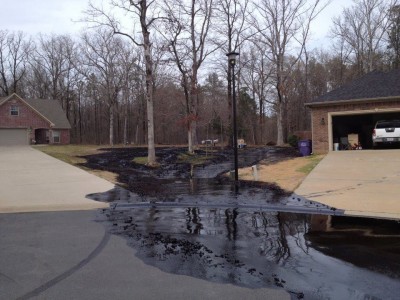
More details are emerging about the awful dilibt spill down in Arkansas. Lisa Song over at Inside Climate News is on the case. And to place the spill in some context– context which includes the Line 6B pipe moving more of the stuff through our properties– our friend Anthony Swift over at the NRDC Switchboard blog has a useful review of what we know and don’t know about transporting diluted bitumen.
Kalamazoo Cleanup
Speaking of Lisa Song, she also has an excellent report on the recent EPA order to Enbridge requiring more cleanup of the Marshall spill. Enbridge has agreed to comply with the order (there was some doubt about whether they would). It’s not clear whether this means they’re rethinking their claims about how the river is “cleaner than ever.”
Press for Tar Sands Petition
And speaking of concerns about dilbit, the tar sands regulation petition spearheaded by the National Wildlife Federation has received plenty of press of national attention (we participated in a telepresser on the matter just last week)– in New England, in Nebraska, in Minnesota, and in Indiana, where the Northwest Indiana Times has a report by one of our favorite reporters Lauri Harvey Keagle (and no, that’s not just because of the quote at the end of the article!).
More Weak Michigan Regulatory Oversight
A few weeks back, we linked to some potentially disturbing stories about piles of petroleum coke, a byproduct of diluted bitumen, piled up along the banks of the Detroit River. Since that time, the Michigan Department of Environmental Quality has apparently looked into the matter. But don’t worry, they didn’t look too hard. And they responded, true to state regulatory form, with little more than a shrug of the shoulders. Consequently, we recommend against consuming any walleye that comes out of that river.
More Michigan Townships Prepare for the Enbridge Experience
As for Line 6B matters, landowners and townships are preparing for their own encounters with Enbridge as work on phase two nears its commencement. If anyone knows anyone along the route, we hope you’ll share this blog with them; our mission has always been to help inform and protect landowners. For our part, we plan to send a note to Bruce Township Supervisor Richard Cory, who recently expressed some (reasonable, appropriate) concerns about how the project will affect residents. Those concerns were addressed by an Enbridge rep we’ve never heard of:
Supervisor Richard Cory said he was worried about some residents east of Van Dyke since the line will run close to septic fields and property.
Doug Reichley, Enbridge project manager, said Enbridge will work with consultants to have a permanent fix if something needs to be altered, even if it’s engineering a new septic field.
“Our whole point is to take care of these folks and make sure when we leave it’s as good or better than when we first got there,” Reichley said.
With that in mind, Trustee Paul Okoniewski asked if the company would cap 36 Mile Road with limestone from Dequindre to Van Dyke after running its equipment on it.
“It will impact the road with the construction and trucks,” he said.
Reichley said he and other representatives would bring it to the project director’s attention. Similarly, he said Enbridge will replace any torn up grass, trees or fencing caused by construction.
We’ve heard these sorts of assurances before– and we all know how that has gone. Incidentally, we’re most struck here by Doug Reichley’s remarks about replacing trees. We’ve looked into that matter and are working on an extended tree post. Stay tuned for that one in the coming days!
The Latest from Pat Daniel
Lastly, earlier this month, we ran across an article on former Enbridge CEO Pat Daniel, who was recently given the Canadian Business Leader Award from the Alberta School of Business. You might recall that, in our analysis, Daniel is the person most responsible for the callous, defensive and thin-skinned, insular corporate culture at Enbridge. Even in retirement, Daniel is true to form, as defiant and delusional (or perhaps just disingenuous or even dishonest, we’re not sure) as ever. Here’s what Daniel, nearly three years after the fact, has to say about Marshall:
And while pipeline opponents seem to have targeted firms like Enbridge, Daniel insists its green efforts “have not been forgotten by the people that matter.
“When we were in Michigan in 2010 (at the oil pipeline rupture site) one of the first things people who live there told us they did was Google Enbridge because they had no idea of who we were. And they got a very favourable impression when they saw the extent of our renewable and sustainable development.”
Daniel said the pipeline rupture “is less of an issue the closer you get to Kalamazoo and Marshall” because of Enbridge’s cleanup efforts.
That’s right. If you believe Pat Daniel, Marshall might seem like a big deal up in Canada, but down in Marshall, it’s all good. Just ask the people there: Beth Wallace, Susan Connolly, Deb Miller, Michelle Barlond-Smith (and lots of others) will surely tell you what a non-issue that spill is; they’ll eagerly tell you just how favorable their impressions of Enbridge really are.
Beyond Marshall, Daniel says “he can’t understand how opponents can delay pipelines, which mean congestion and much lower prices for Canadian crude”– a statement that once again just confirms everything we’ve said about him in the past. Of course he “can’t understand.” He can’t understand because he lives in a bubble, surrounded by yes-men, showered in praise and awards, completely and utterly isolated from ordinary landowners whose everyday lives are affected by Enbridge’s projects and practices. From all available evidence, Pat Daniel has never— despite what the corporate values developed under his leadership state– bothered to “take the time to understand the perspective of others.”
by Jeffrey Insko | Mar 4, 2013 |
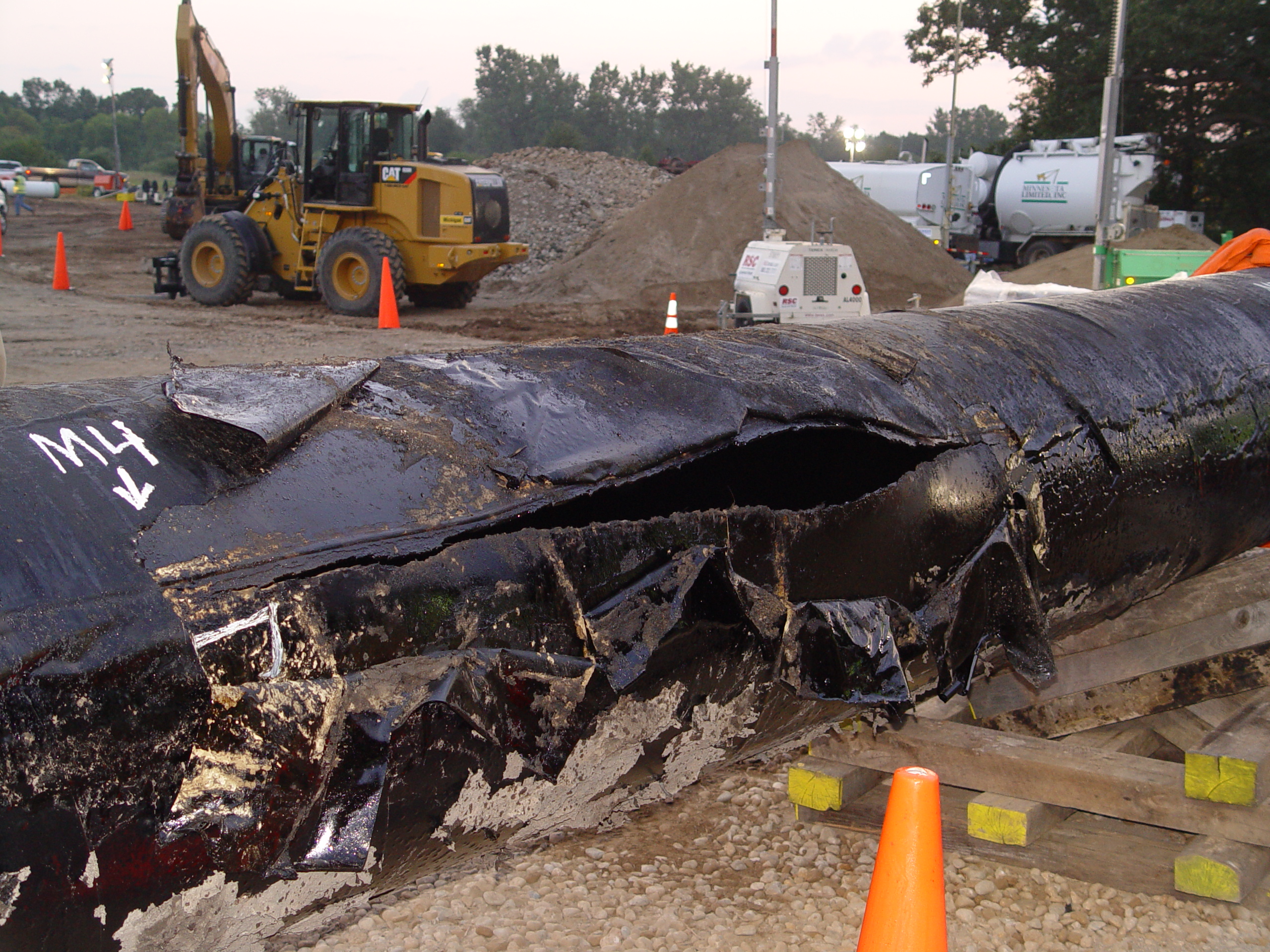
Oh boy. This morning Eric Lawrence of the Detroit Free Press (as we’ve said many times, one of our favorite reporters who has done excellent work on Enbridge matters for months) has a new piece explaining that Enbridge does not want to pay for more studies assessing damage from the Marshall spill. Here’s a taste:
The pipeline company responsible for the 2010 tar sands oil spill that fouled almost 40 miles of the Kalamazoo River is refusing to pay $800,000 to complete two new studies to assess the spill’s damage.
Trustees of the National Resource Damage Assessment, an effort to assess the damage caused by oil spills and other hazards, wants Enbridge to participate in the studies, which involve vegetation and recreational use in the area affected by the spill.
The group comprises state and federal agencies, such as the Michigan Department of Environmental Quality and the U.S. Fish and Wildlife Service, as well as two tribal governments.
But Enbridge notified trustees in June and October that it was “declining to cooperate” because adequate data had already been collected.
Here we have yet another example of something we have discussed repeatedly over the past eight months: Enbridge’s unwillingness to take full and complete responsibility for the Marshall spill. Instead, they only pretend to take responsibility. Mostly, they want to pretend that the Marshall debacle is over and done with; they want desperately just to move on. We’ve covered numerous examples of this:
We have also dealt with this matter in our discussions about and with Enbridge executives. For example:
The point in all of those cases (and others) has always been the same: Enbridge seems not to understand what it means to truly take responsibility. They seem to think that somehow they get to decide when things have been made right. But truly taking responsibility means leaving that determination up to those whom you have wronged, or those in a position to decide when the situation you created has been rectified, when the mess you have made has been cleaned up.
What’s even worse is that in the face of that disaster and Enbridge’s refusal to fully take responsibility for it, the good people of the state of Michigan have STILL allowed Enbridge to build a new pipe that will increase the capacity of oil they can transport and thereby increase their profits– by millions and millions of dollars.
by Jeffrey Insko | Feb 9, 2013 |
The last time we saw any Enbridge representatives– Mark Curwin, Thomas Hodge, and Mike Ashton, to be precise– they were primed for action. This was at a Brandon Township Board of Trustees meeting last December where Enbridge was bound and determined to finalize an agreement with the township. The matter was clearly of the utmost urgency to Enbridge and they made it clear that there was no way they were leaving that meeting without an agreement. Waiting just one more week to sign the agreement, they said, would cause them “heartburn.”
Well, the agreement they reached that night (well, actually, they didn’t actually finalize it that night) was signed by Mark Curwin (on behalf of Enbridge) on Dec. 13 and by Supervisor Kathy Thurman on Dec. 17, making it official and legal. Why are we telling you this? Well:
Because Enbridge has already violated that agreement.
Yes, you heard that right. You see, as part of the settlement– specifically with regard to Brandon’s Woodlands Ordinance, Enbridge agreed to pay Brandon Township $10,000, a payment, the agreement states, which “shall be due and payable 21 days after the execution and delivery” of the agreement. That means that Brandon should have received this payment about the second week of January. But it’s now a month later than that and they STILL have not received that payment, even though Brandon has reminded them about it. Twice.
Now let us be clear about something here (speaking for ourselves, not Brandon Township). This isn’t about the money Enbridge promised. In fact, we’re not even suggesting that Enbridge will not eventually pay that money. We have no doubt that they will. And who knows what sort of large corporate bureaucratic accounting labyrinth something like this has to go through in order for a check to get cut somewhere up in Canada. We certainly have no idea. But that’s not the point and that’s no excuse. Rather, in addition to once again disrespecting Brandon Township, the point here is this:
When Enbridge wants what it wants, they act with tremendous haste and urgency. They turn up the pressure and throw their weight around and they get exactly what they want. They did it to the MPSC, they did it to the Brandon Trustees, they did it to us. But when it’s something of importance to others and not to them, like a paltry $10k to some tiny township, they drag their feet as if they just don’t care– even if that means failing to abide by a settlement contract they themselves have signed. We have said for months, that Enbridge makes it very difficult for anyone to believe the things that they say. And here we have a simple and clear illustration of the point. Enbridge signed an agreement that said they would do X– an agreement, mind you, that they were in a tremendous hurry to reach– and, despite the terms of that agreement, they still have not done X.
And they wonder why people don’t trust them.

by Jeffrey Insko | Jan 16, 2013 |
No offense to Canadian parliament member Marc Garneau, but um. . . . duh! Apparently, Garneau thinks that Enbridge could use some lessons in dealing forthrightly with the public:
“Enbridge needs to learn about public relations. You don’t come in and treat people that way,” said Garneau in an interview On the Coast with Stephen Quinn on CBC Radio One in Vancouver.
Garneau is right on the money, of course. It’s just that we’ve been saying this over and over for months (again and again and again). And even we aren’t telling many readers of this blog anything they don’t already know from first-hand experience. Still, we appreciate Mr. Garneau speaking out, even though the record shows that Enbridge, in fact, does and has come in and treated people that way.
by Jeffrey Insko | Dec 12, 2012 |
To the extent that Enbridge gives any thought to us here at the Line 6B Citizens’ Blog (and they probably don’t think about us very much), we would guess that they find us rather antagonistic, combative, overly-critical, possibly even unfair. But the truth is, we’re trying to help them. We’re not joking. This has been the case ever since we popped into the Enbridge corporate offices in Superior, Wisconsin to have a chat about how they treat landowners. In fact, just yesterday, we offered some helpful suggestions about how they could improve their public relations efforts. We honestly believe it wouldn’t be that hard for Enbridge to win us all over: they just have to do what they say. We offered the same advice to them at the Pipeline Safety Trust conference last month.
Why are we thinking about this sort of thing now? Well, because the latest news out of Brandon Township has us once again shaking our heads. It demonstrates– yet again–how Enbridge’s actions actually work at cross-purposes to their own objectives. You see, last week, they were in a MAJOR hurry to reach an agreement with Brandon Township; they did everything but turn cartwheels to ensure that that happened. Nevertheless, Jeff Axt and myself cautioned the Board, asking them to exercise a bit of prudence and not allow themselves to be rushed into an agreement. (Caveat: we weren’t urging them not to reach an agreement, only to take their time.) Enbridge was having none of that. They said that waiting just one more week for the Trustees to give the agreement a careful reading would give them heartburn.
What happened next? Well, the Trustees voted to approve the agreement that night pending some adjustments to its language and Enbridge almost immediately went back to work in Brandon Township— which is all they ever really wanted to do anyway.
But here’s the important part: they went back to work despite the fact that they did NOT have a signed agreement with Brandon Township. This, to put it kindly, is a bit presumptuous. And sure enough, at this week’s meeting, the Trustees were not at all happy with the final version of the agreement. Nor were they happy with the fact that Enbridge had commenced construction in the township without a signed written agreement. So now Brandon has once again asked Enbridge to halt its construction activities in the Township.
So what did all of Enbridge’s pressure on the Brandon Trustees last week gain them? Nothing. They’re right back where they started. In fact, they now might have to endure further delays, since the Trustees are probably feeling a little bit disrespected and are likely much more inclined now to be circumspect. It could be another week, or two, or more, before the Trustees are ready to sign the agreement.
If Enbridge had only allowed the Brandon Trustees to take their time; if only they had acted in the spirit of reaching an amicable agreement, rather than acting (selfishly) according to their own desperate desire just to get back to work; if only they’d done that, they’d be back at work. Now, it appears they have to wait even longer. And, as always, they did it to themselves.
We hope that Hodge and Curwin and Asthon have some Tums.
by Jeffrey Insko | Dec 11, 2012 |
No sooner had we finished up our latest post about Enbridge’s apparently congenital inability to deal with stakeholders straightforwardly than we were provided with yet another illustration of the phenomenon in the form of the latest news from Brandon Township. Sadly, it doesn’t surprise us.
The Brandon Trustees held another meeting last night, where they were expected to sign and finalize their agreement with Enbridge. We took the night off and did not attend the meeting, though we’ve received a report of it. And just as we predicted, things did not go smoothly. Therefore, no agreement has been signed.
There are a couple of sticking points: understandably (in our opinion), the Trustees are concerned about the limited scope of the oversight granted to the township’s inspector (we thought the same thing when we read the proposed agreement). And secondly, apparently Enbridge did not want to put anything in the agreement about their environmental stewardship program. In our view, this is especially disturbing since these are the two elements of the agreement that will be most important to other townships. Given that fact, however, it’s not so surprising that Enbridge would hedge about them. And to make it all worse, Enbridge has apparently re-started construction in Brandon–without a signed agreement. This is, in our view and the Board’s (as we understand it), not only presumptuous, but a slap in the face.
For now, we’ll just say this: it gives us no great joy to say “I told you so.” But all of this is exactly what we told the new Brandon board two weeks ago. As we reported then, we told them:
Based on [our] experience, what will happen is fairly predictable: Enbridge will show up, smile, talk about working together and being good neighbors; they’ll say lots of pleasing-sounding things; they’ll try and make it look like they really do want to work with the Township; they’ll also patronize and condescend (because they can’t help it)– and then they’ll leave and continue to try and do whatever it is they want.
And this is exactly what has happened. Jeff Axt saw it coming, too. It’s why both of us pleaded with the board at the last meeting to proceed cautiously, despite Enbridge’s pressure to hurry them up. But then, everybody has to learn their own Enbridge lessons. We trust that the new Board– now that they’ve seen Enbridge thumb its nose at them, just as they did the old board– has learned theirs.
by Jeffrey Insko | Dec 11, 2012 |
We begin this installment with a correction. You see, unlike Enbridge we do not like saying things that are not strictly true. And it appears we’ve been slightly wrong about one thing:
On numerous occasions during the month of November, we mentioned that Enbridge had still not answered any of the questions they promised to answer at the Brandon “workshop” back in September. However, we learned last week that Enbridge did, in fact, provide some answers to the Board at the very end of October or early November. So while we said that it had been more than two months without any answers, it appears that Enbridge provided answers after about six weeks. We regret that we said otherwise.
Of course, we’ve since seen those answers and we can tell you that they’re not terribly thorough. Nor did they answer all of the outstanding questions from the workshop. And the “answers” did come, curiously, right before Brandon filed their intervention in federal court. And also, Brandon did have to ask Enbridge for them more than once. So the general point we’ve been making about this matter for a long time– that it simply illustrates the lack of respect and candor Enbridge has displayed in its dealings with Brandon (and other stakeholders)– still stands. But we were evidently wrong on some of the details.
Which brings us to the subject of this post. This little matter– these minor things gnaw at us because we think the truth is vitally important– got us thinking: why didn’t someone from Enbridge point out our error? After all, we know they read the blog (at least occasionally); they’ve told us they do. So here was a chance for them to prove us wrong; they could have made the case that we’ve been criticizing them unfairly. And we would have had no choice but to concede the point (on this little matter). Or at the very least, they just could have let us know what the truth is, thereby demonstrating that it means as much to them as it does to us. We’d have given them credit for correcting us. But they didn’t.
You may be wondering what this has to do with the Brandon-Enbridge agreement. Well, as we noted in our previous installments, we had a little encounter with the three Enbridge representative at the meeting on Monday. It took place during the Brandon Trustees’ arduously long closed session. There wasn’t much to do while we waited– and there were only about six of us there. Mostly, we just sat around gabbing. But not with the Enbridge contingent. Mark Curwin, Thomas Hodge, and Michael Ashton spent that long break outside.
It may be that they just wanted to enjoy the cool air; it was an awfully nice December evening. Or maybe they thought it would be a little awkward to stay in the same room with myself, Jeff Axt, and reporter Susan Bromley. Whatever the case, we figured that the separation– “us” in there and “them” out there– was equally awkward, or at least weirdly conspicuous. It seemed to us an opportunity to have an actual conversation (Hodge and Curwin had no trouble talking with Tony Amico at the meeting). And anyway, we’re all just human beings; surely we can have a civil chat. So we went outside to try.
Now it may have just been our own impression, but we thought the reception we got from the Enbridge reps seemed a little chilly. At any rate, we mentioned the blog and they said that they knew who we were and knew about the blog. We also mentioned to Hodge our interest in (what we’ve been calling) his recent Road Show and how lots of us landowners have been wondering why Hodge and Wuori were talking to the press, rather than to us. Then we asked Hodge if he’d be interested in doing a Q&A for this blog. And this is where things got a little weird.
First, Mark Curwin stepped in immediately and said (a little paternalistically) that he didn’t think that would be appropriate. But when we asked why he didn’t think it was appropriate for Hodge to talk to landowners, he said he didn’t think it was the right time or place. Evidently, he thought we were asking Hodge to do a Q&A right then and there– which we certainly, obviously, were not.
Once we got past that odd moment, however, Hodge did not accept our offer. Instead, he and Curwin talked about how they’re trying to find the “right person” to talk with us. Their explanation for this was that rather than having us go from one person to another, receiving various answers to various questions, they thought it might be best to have just one person who could answer all of our questions. But they also said they hadn’t quite figured out who that person is yet. Now, in fairness, Tom Hodge did give us his card and he and Curwin said we should feel free to send along some questions and they would get them to this yet-to-be-discovered person who could get us some answers. So we guess that’s at least something. But it’s not much.
But let’s consider some of the myriad problems with this response to our simple request for a Q&A with Tom Hodge:
As we said in an earlier installment, if we have questions that we’d like to ask Tom Hodge, then the “right person” for us to talk with is quite plainly Tom Hodge. In the same way, when we have questions for, say, Doug Aller, then we think the right person for us to talk with is Doug Aller. Or, when we want clarification from, say, Jennifer Smith about something that Jennifer Smith said, then it seems to us that the right person for us to contact for such clarification is Jennifer Smith herself. This seems like a rather simple and uncomplicated principle of ordinary communication to us.
But Enbridge appears not to operate according to ordinary principles of communication. Rather, what Curwin and Hodge were really saying to us, we think, is that we somehow need to be managed, handled carefully, dealt with through some kind of controlled message-coordinating apparatus.
Of course, as we’ve been saying for months, this is the whole problem with the way that Enbridge communicates with stakeholders. They seem to think that everything has to be managed and controlled, PR-style. They simply CAN’T– evidently as a matter of either company policy or longstanding practice–just communicate openly, honestly, and straightforwardly. That’s all I was trying to do: I walked outside, looked Tom Hodge in the eye, offered my hand, and asked him a simple, straightforward question. I gave him an opportunity to be open and honest with me. What I got in return was a needlessly complicated, un-straightforward, committee-generated reply. As a result, instead of typing up how much I appreciate Tom Hodge’s candor and his willingness to walk the walk and have a frank, respectful, productive exchange with a landowner– a critical landowner, no less– I’m typing this.
What’s so strange about this is that Enbridge’s approach in this regard isn’t even good PR. After all, if they want people like me to go away or shut up or stop criticizing them, then this is a very poor way to accomplish any of those things. In fact, it only makes matters worse. If they want people like me to tell others that Enbridge really does mean it when they say they are committed to open and honest dialogue, or that they really do take seriously stakeholder feedback, then not engaging in open and honest dialogue and not taking stakeholder feedback seriously is a very poor way to accomplish that as well. It seems absurd to have to say this, but if what you want is for people to trust you and to believe that you are honest, transparent, and straightforward, then the best thing you can do is be honest and transparent and straightforward. Otherwise, people might not trust you.
In other words, for some reason we still cannot fathom, Enbridge simply can’t see that the best kind of PR would be sitting down with homeowners, hearing them out, agreeing to fix problems and make things right, then fixing them and making them right. This would effectively solve most of their PR troubles.
Or to put this yet another way: Enbridge still hasn’t figured out that they are largely in control of what we write here at the Line 6B Citizens’ Blog. We would have no choice but to shut up if they didn’t continue to provide us with so much material.
by Jeffrey Insko | Dec 5, 2012 |
A couple of interesting news items worthy of your attention:
First, yesterday’s NPR program “Stateside” featured a segment on the use (and perhaps abuse) of eminent domain. And guess what company was the primary subject of the discussion? Our friends Carol Brimhall and Connie Watson are featured in the story. Following the piece is a conversation with attorney Alan Ackerman, who has represented Line 6B landowners. At the end of the piece, Ackerman provides an example of a company that has done things right. Who, you ask? Well, it shouldn’t come as a surprise given who took the time to talk with us at the Pipeline Safety Trust conference last month.
The second item is an article in the Livingston Daily Press & Argus featuring Connie and Tom Watson— fine, decent, kind, ordinary people. Do they look like a “special interest group” to you? Do they strike you as people who will just “never be happy.”
