by Jeffrey Insko | Dec 1, 2012 |
Given enough time, we could probably hold forth at at much more length about the remarks of Stephen Wuori and Thomas Hodge during their editorial board stops last week. Wuori’s attempt to waive away concerns about the transportation of dilbit, for instance, is ripe for some serious scrutiny, though we’ll just refer you to this recent piece by our friend Anthony Swift, which speaks almost directly to Wuori’s remark about tar sands and corrosiveness.
We’ll let the rest pass for now. But not without a brief final thought or two:
Firstly, we’ll echo a point our friend Beth Wallace made this week: if Wuori and Hodge were serious about addressing concerns citizens have had about this project and serious about having real conversations about Enbridge’s practices, they could have taken their road show down to the Pipeline Safety Trust conference in New Orleans last month and faced landowners, pipeline safety advocates, regulators, and some of their (more responsive) industry peers. But they did not. Instead, unlike almost every other company at the conference, Enbridge sent only a pack of PR sloganeers– a revealing fact, we think.
Secondly, while here in Michigan last week, they also could have taken the time to meet with some real landowners, rather than talking about the easily-dismissed imaginary ones they’ve conjured in their heads. We would have been more than happy to round up a whole bunch of decent people affected by this project for a sit-down conversation. But then Wuori and Hodge would not have been able to control the message the way could in their little newspaper meetings. They would have had to face some of the realities of how their company and its representatives have conducted themselves in Michigan since 2010. And that, we have said time and again, appears to be something Enbridge is completely– stubbornly, intractably, steadfastly– unwilling to do.
by Jeffrey Insko | Nov 30, 2012 |
Forgive us for this morning’s flurry; it’s just that the latest media effort featuring a couple of Enbridge heavy-hitters—Stephen Wuori, the president of the Liquids Pipelines Division, and Thomas Hodge, Line 6B Project Manager— have got us all on fire. We’ve already discussed Hodge’s dismissive characterization of landowner displeasure (twice now). But we’ve yet to take a look at Wuori’s comments. Partly that’s because the Lansing State Journal doesn’t quote him at all.
In retrospect, that may have been a good idea, because when Wuori does speak (to the Daily Press & Argus) it does not go well. This is what Wuori says about Marshall:
Wuori said the 2010 oil spill has been unfairly represented in the press, namely claims that Enbridge had knowledge of how to prevent the spill but didn’t act on it.
Wuori said the spill was caused by a series of cracks in that section of Line 6B, and that company officials did not have prior knowledge that line break would occur.
This is extraordinary. Two years later and top executives from Enbridge are STILL, as our friend Susan Connolly pointed out yesterday, unwilling to take full responsibility for Marshall? They’re still portraying themselves as victims of unfair treatment by the press? Even if what Wuori says here were true (and we’re getting to that), how can he not recognize that this sort of self-presentation is a very poor way to try and win people over?
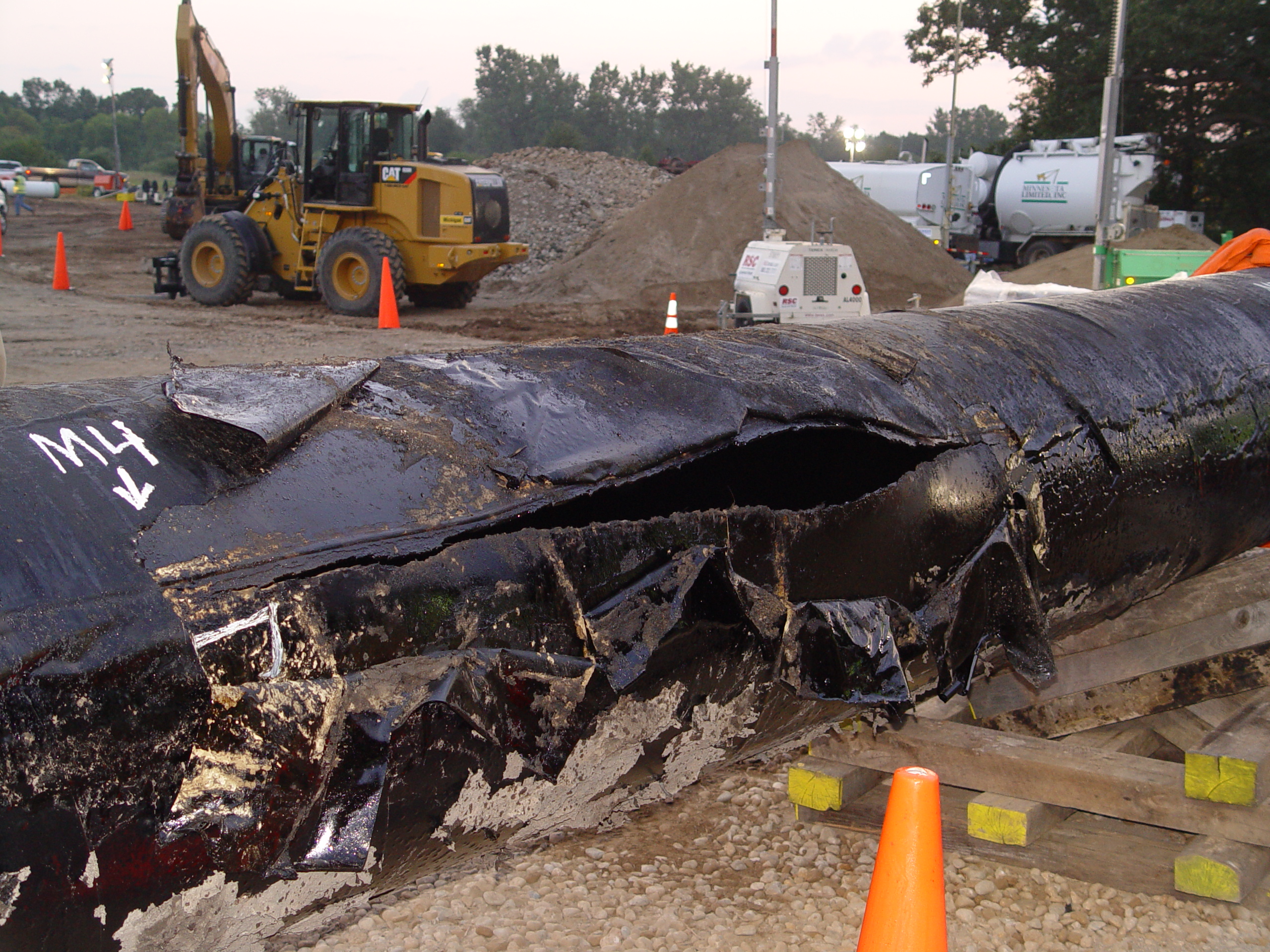
But let’s get to the facts. Wuori appears not to have read the NTSB report. We don’t know what “claims that Enbridge had knowledge of how to prevent the spill” he’s talking about, exactly. But we do know what the NTSB says about Enbridge’s knowledge of the series of cracks that eventually caused the pipe to rupture. Let’s review:
Among the NTSB’s most important findings was:
The inadequacy of Enbridge’s integrity management program to accurately assess and remediate crack defects. Enbridge’s crack management program relied on a single in-line inspection technology to identify and estimate crack sizes. Enbridge used the resulting inspection reports to perform engineering assessments without accounting for uncertainties associated with the data, tool, or interactions between cracks and corrosion. A 2005 Enbridge engineering assessment and the company’s criteria for excavation and repair showed that six crack-like defects ranging in length from 9.3 to 51.6 inches were left in the pipeline, unrepaired, until the July 2010 rupture.
In other words, in contradiction to Wuori’s claim, Enbridge DID have knowledge of serious “crack-like defects” in the pipe, the very defects that caused the rupture. Yet they failed to repair them– for FIVE years.
Again, the NTSB:
The Enbridge crack management plan operated under the premise that defects in an aging pipeline with disbonded coating could be managed using a single in-line inspection technology and that prioritization of crack defects for excavation and remediation could be effectively managed through engineering assessments based strictly on the crack tool inspection data.
The program did not account for errors associated with in-line inspections and the interaction of multiple defects on a pipeline. The 51.6-inch-long crack-like feature that eventually led to the Line 6B rupture was one of six features that had been detected on the ruptured segment during an in-line inspection conducted by Enbridge’s integrity management program in 2005. Non-detection and improper classification of the defect are inherent risks when relying solely on in-line inspection data to ensure the integrity of the pipeline, yet for nearly 5 years following the inspection, the integrity management program failed to identify the 51.6-inch crack feature located adjacent to the weld as a threat to the pipeline.
And here are a few more of the NTSB’s findings about Enbridge’s failure to adequately address the crack issue:
Enbridge applied a lower margin of safety when assessing crack defects versus when assessing corrosion defects.
In 2005, Enbridge had no procedure that accounted for the interaction between corrosion and cracking and the potential influence on crack depth reporting.
Enbridge did not have a procedure to account for wall loss due to corrosion when it was evaluating the in-line inspection crack-tool-reported data and was preparing the excavation list.
Enbridge integrity management did not adequately address the effects of a corrosive environment on crack growth rates.
Enbridge’s crack management program and reinspection interval selection is inadequate because it fails to consider all potential crack growth mechanisms that are prevalent in its pipeline.
And this is just a small taste. We encourage you to read it for yourself. Oh, and none of this even addresses the actions of Enbridge following the rupture, like the way they ignored their own safety protocols.
So, did Enbridge “company officials have prior knowledge that line break would occur”? Well, Wuori’s way of putting it suggests that they couldn’t have had a crystal ball– and that’s probably true. So no, maybe they didn’t “know that line break would occur.” But, did company officials know (for five years) that there were serious defects in the pipe? Yes, they did. And did they also know that such defects could, possibly, lead to line break? Certainly. Yet, according to the NTSB, they chose not to take steps necessary to prevent it. These aren’t mere representations in the press; these are the facts discovered by an exhaustive investigation conducted by a federal agency.
by Jeffrey Insko | Nov 30, 2012 |
You may have noticed in the last couple of days that Enbridge executives have been very chatty– with some newspaper editorial boards: first, the Lansing State Journal and then the Livingston Press & Daily Argus. This is a very curious turn of events and we’re curious to know how these meetings came about. We suspect that Enbridge initiated them as a kind of extension of the PR campaign they launched with those bizarre Free Press ads (we know that we still owe you all an analysis of the last one; it’s coming…). And, as Katy pointed out in a comment a couple of days ago, we also suspect that it’s because Wuori and Hodge were in town to bend the ear of the governor as he prepared to announce his new energy plan.
Whatever the case, we find ourselves pretty appalled by the things Wuori and Hodge have been saying– even though it’s mostly stuff we’ve heard before. Hodge, for instance, continues to find ways to dismiss legitimate landowner concerns, portraying those who have spoken out as an impossible-to-please tiny fringe element. Aside from the fact that this is yet another example of Enbridge’s unwillingness to take landowner concerns seriously, we crunched some numbers yesterday (unscientifically, we admit) that suggest the number of disaffected landowners is far greater than Hodge would have you believe.
Yet he persists. This is what he told that Daily Press & Argus this week:
Hodge said the majority of landowners in the project area have not complained about the project, but some living within feet of pipeline easement have had to contend with large machinery nearby their homes.
“There is a small minority that I think you hear the most from in the press and on the radio, and they’re making the loudest noise about the way they’ve been treated. Most of those, I believe, are residents who are affected most adversely by this project,” Hodge said.
It is probably true that “the majority of landowners have not complained.” But that’s hardly the point. Is that what matters to Enbridge? A simple majority? Is their goal to reach amicable agreements with 51 percent of landowners? In fact, what is their goal? Do they consider it a successful project if they only alienate one-quarter of landowners?
Furthermore, what is the point of Hodge’s statement that the “small minority” “making the loudest noise” are “residents… affected most adversely by this project”? Wouldn’t you think that those affected most adversely would be the people Enbridge would work hardest to treat fairly– just out of simple decency? Yet Hodge seems to think of them as little more than wartime casualties. We also can’t help but add that we are certain that we are NOT among those most adversely affected by this project, even though we are among those making the loudest noise. So Hodge’s statement is not even true. He would know that if he ever bothered to actually talk with some of us.
As frustrating as Hodge’s remarks are, however, they may well be outdone by the astonishing things his boss Stephen Wuori has to say. We’ll make those remarks the topic of a separate post– because shedding light on them is going to take some serious doing.
by Jeffrey Insko | Nov 29, 2012 |
Well, the Wuori-Hodge road show/media blitz continues. My goodness how they’re accessible to the media these days. We wonder why? And as you can imagine, we’ve got LOTS to say about this one. We’re working on it. Meantime, we’ll just say that we sure wish these guys would sit down for some questions from OUR editorial board.
by Jeffrey Insko | Nov 29, 2012 |
We’ve been doing a little math.
You see, we were more than a little flummoxed by yesterday’s article in the Lansing State Journal— the one where “Enbridge executives address local homeowner opposition.” There’s a lot that’s baffling about the article: Why are Enbridge executives talking to the paper’s editorial board? Why all of a sudden does Tom Hodge appear to be taking the role of spokesperson? Why did Stephen Wuori emerge out of nowhere? Why doesn’t he have anything to say in the article? And most baffling of all, as our friend Donna Taylor has pointed out, why aren’t these two talking to directly to landowners themselves instead of to a newspaper in Lansing? Wouldn’t that be a more appropriate way to “address” our concerns?
But of course, they aren’t really addressing our concerns. Instead, they are addressing what they would prefer to describe as “opposition”– taking a page out of Larry Springer’s book and pretending (or insinuating) that all of us who are speaking out “oppose” the project, even though, as we’ve said over and over and over, we do not oppose the project. We simply object to the ways Enbridge has conducted itself throughout the project, to the way it has flouted local and state ordinances and laws, to the way it has treated landowners.
So how do these execs “address” this “opposition”? Well, here is Project Manager Thomas Hodge, who we thought was a straight shooter (oh, how naive we were back in September!):
Thomas Hodge, the head of Line 6B replacement project, said he’s never seen the kind of organized homeowner resistance that the company has faced here in Michigan, likely because of simmering distrust over 2010 spill.
“I’ve been in the pipeline business for close to 30 years,” Hodge said. “I’ve never seen the scrutiny, the level of concern or the organized opposition as we’ve faced in getting this pipeline replaced.”
Now, it is almost certainly true that much of the scrutiny this project has received is attributable to “simmering distrust” over Marshall, though it’s not clear whether Hodge recognizes or would concede that such distrust is entirely unsurprising, totally warranted, and completely reasonable. But what is equally true is that that is only one of many reasons why this project has received such scrutiny and caused such a high level of concern. This blog has been devoted to explaining the myriad reasons why landowners are– and should be– deeply concerned, why we continue to have trouble trusting Enbridge.
A ramble through our archives will provide plenty of specific examples of those reason. For now, we’ll give just one. It’s one we’ve mentioned over and over and over. More than two months ago, Thomas Hodge looked Supervisor Kathy Thurman and the other Brandon trustees right in the eyes and promised, like a good neighbor, to get them answers to a handful of perfectly reasonable questions. To date, he has still not gotten them answers. Does that sort of action foster trust? neighborliness? respect? honest communication?
Which gets us closer to the math. We got pretty worked up when we read this:
Most homeowners agreed to the company’s compensation offers for the land or for restoration of damaged property, but more than 70 in Ingham and Livingston counties refused for various reasons. Enbridge took those homeowners to court through a process called condemnation to force them to give up their land.
Hodge said some homeowners were never going to be happy with the company’s offer, no matter what Enbridge did.
“We will do everything we can to work with individual homeowners, as long as they’ll talk to us and let us on the property to tell them what work space we need,” he said.
This is the sort of thing we’ve heard from Enbridge reps before. One of their favorite tactics is to pretend that anyone who expresses any sort of concern is unreasonable, “a special interest group,” someone who is “never going to be happy” After all, those sorts of people are much easier to dismiss. And further, those folks are just a fringe element, unlike “most homeowners” who aren’t unreasonable troublemakers. (And we have to say, it is deeply disappointing to hear Tom Hodge playing this card.)
Even worse, Hodge seems to think– or so he would have readers of the Lansing State Journal believe– that there’s a bunch of landowners out there who are simply refusing to allow Enbridge to come and talk with them. Maybe he even really believes this. Whatever the case, here is something we believe: we believe that Thomas Hodge doesn’t have the faintest idea of what goes on in private negotiations between landowners and ROW agents. If he did– and if he were willing to take landowners seriously, rather than dismissing them, and if he were willing to take a cold, sober look at those agents’ practices and tactics– he might well experience a genuine awakening. He might come away with a very different picture of the relations his company cultivates with landowners.
That picture comes into focus with a little math. Here’s what we did: we went to the MPSC and found the list of homeowners to whom Enbridge sent the original MPSC “Notice of Hearing” on phase one. This is the list of potentially affected landowners along the pipeline route. We then counted up the number of those landowners who live in Livingston and Ingham counties. That total, according to our search, is 317. Of those 317, according to the newspaper article, 70 landowners were taken to condemnation by Enbridge. That’s 22 percent of landowners– a very high number in our view. That percentage is even higher when you consider that a significant number of the homeowners on the list aren’t actually affected at all by the project– there’s no easement of workspace on their property; they’re just close by (like our next-door neighbors). So let’s say, conservatively, that that’s 10 percent of the list. That gets us to 25 percent of landowners who were taken to condemnation. So is Tom Hodge saying that a full one-quarter of the people on the pipeline route in Livingston and Ingham counties are just unreasonable, are people who will never be happy with Enbridge no matter what? Is that really his view of the good people of the state of Michigan?
And what happens if we add to this number all of the people (like ourselves) who are mightily displeased by the way Enbridge has treated them personally and conducted itself publicly? People who reached agreements but who are nevertheless unhappy. How high would the percentage of dissatisfied landowners then be? Enbridge’s portrait of “most” landowners might well begin to look very different.
by Jeffrey Insko | Nov 28, 2012 |
Well, this has got to be among the strangest articles we’ve encountered yet— and a very odd way of “addressing” local homeowner opposition. We’ll explain when we have more time.
Until then, we’ll just say what we’ve said before: Beth Duman and Carol Brimhall (like so many other landowners we met) are totally awesome.
by Jeffrey Insko | Nov 19, 2012 |
We’re back from a nice weekend break from Enbridge-related matters. Hopefully, you also enjoyed some of the nice autumn weather. We’ve got more reports on the PS Trust conference coming— most notably, an account of the terrific environmental panel with Beth Wallace, Anthony Swift, and Gabe Scott. Stay tuned for that. We also have another Enbridge newspaper ad to respond to as well.
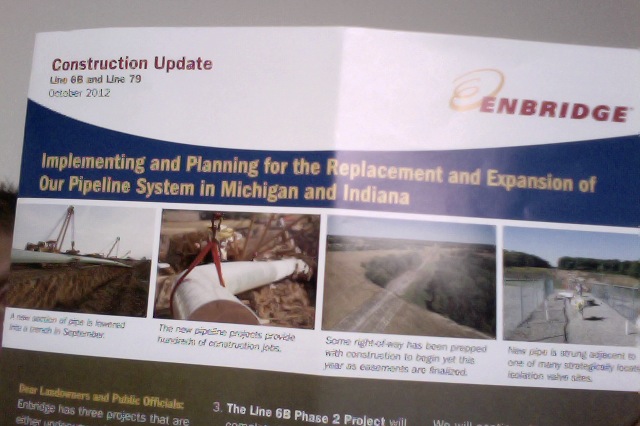
In the meantime, we’re perusing the colorful, glossy newsletter from Enbridge that we received in the mail recently. Presumably, many of you received it also. As far as Enbridge communications go, it’s not half-bad (which isn’t saying much), although we can’t help but wonder where this devotion to communicating with the public was back when Phase 1 of the project kicked off. We didn’t receive any glossy newsletters back in February (or March, April, May, June, July, or August) when we were first contacted by a ROW agent. We also weren’t notified of any open houses in our area of the sort Thomas Hodge says Enbridge held last summer:
Enbridge conducted four open houses on this project [Phase 2] in June 2012. Thank you to the nearly 300 people who attended these open houses. Attendees were able to meet with project staff to ask questions, view detailed project maps and provide input.
All of that sounds great. It’s a shame, however, that all four of those open houses were held in a very small area near Kalamazoo and in Indiana. Over here on the east side (and all along the Phase 1 route), no such open houses were held. We haven’t a clue as to why not.
The open house story is not the only part of the newsletter that paints a misleading picture of Enbridge’s public awareness campaign. On the back page of the brochure, there is this very curious paragraph under the heading “Local Residents Offer Feedback on Enbridge Communications”:
This past September, Enbridge conducted focus groups in several communities in Michigan and Indiana. Faocus groups consist of a guided discussion led by a moderator and designed to be casual and interactive. In total, we met with more than 120 people who live and/or work near our pipelines and who shared their thoughts and feedback about us and our operations. We hald these meetings for the primary purposes of developing better communications and building stronger relationships with the communities in which we operate. The results from the focus groups will help guide our future communications and outreach activity as the projects move through the planning, regulatory and construction phases.
This is very curious indeed. For one thing, 120 people strikes us an extremely small sample given the scope of the project. For another, we don’t recall an invitation to participate in any “focus group”– though we have a vague recollection of a mysterious call inviting us to some kind of energy-related meeting. At the time, we though it was a marketing scam, since the caller could not give us any specific details. Was this the Enbridge focus group? If so, it’s a very poor way to gather honest input from affected landowners– though not surprising, coming from Enbridge. Instead of soliciting landowner feedback directly, this would suggest that they just hired some market research firm. But if they really wanted to hear about the experiences of affected stakeholders wouldn’t it have been better (and not very difficult) just to call all of us? Invite us all to fill out some kind of survey? Of course, that might elicit real feedback, not the carefully-controlled, p.r. driven, market research-style input that Enbridge would prefer to generate. As we’ve noted time and again, when it comes to serious, honest, pull-no-punches comments from landowners, Enbridge just doesn’t want to hear it.
One last item in the newsletter worth commenting upon: on a page describing “High Safety Standards for All Enbridge Projects,” we are provided these two intriguing bullet points (among others):
- The new pipeline segments will contain more remotely-operated isolation valves than what is required by federal regulations.
- The new pipeline segments will be internally inspected more frequently than U.S. regulatory requirements, using state of the art in-line inspection technology.
Our regular readers might recall that we have asked questions seeking clarification about this matter of exceeding federal regulatory requirements on numerous occasions. We asked about it directly at the Brandon Township workshop, for instance. More recently, we wrote to Enbridge’s Terri Larson asking her which specific features of the design exceed which regulatory requirements. Enbridge reps couldn’t answer that question at the workshop– and more than two months later they still haven’t answered it. As for Terri Larson, it’s been more than a week now and she still hasn’t gotten us an answer. Now, to be clear: we do not think this is Terri’s fault; we believe her when she tells us she is looking into it. The problem appears to be that the information just isn’t very easy to obtain. But if the claim is true, why should it be so hard to answer such a simple question?
As we await more information from Terri on this, we are also looking into the specific claims cited above (about isolation valves and inspections)– but that involves doing a bit of research into federal regulations– ugh! But once we’ve got some answers, we will pursue this matter in more detail.
by Jeffrey Insko | Nov 14, 2012 |
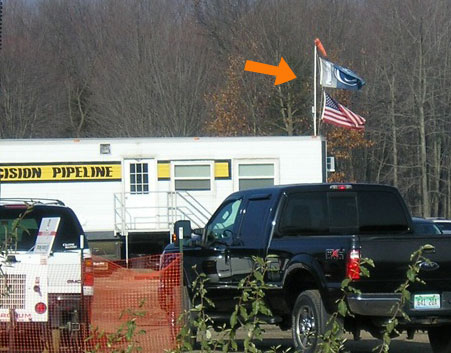
We live in a crazy world. The Precision Pipeline flag blunder story received a fair amount of attention yesterday. After the Detroit Free Press printed the photo, a handful of other news outlets picked it up (for instance, here and here and here) and it made some rounds on Facebook and probably got some tweets as well. There were even a few new details: evidently, it wasn’t a corporate flag, but a Penn State flag, placed there by a couple of employees– themselves veterans, according to a Precision representative.
We confess to some misgivings about all of this. Our original post was meant to be cheeky. Aside from the breach of U.S. flag etiquette, which probably ought not to be dismissed, we just found the image an amusing metaphor for some of the disregard and thoughtlessness Enbridge and some of its contractors have displayed toward landowners, local municipalities, and the citizens of Michigan– things we’ve been documenting with grave seriousness for months. If it were up to us, we’d much prefer to see this story or this one or this one (to name a few) receiving lots of attention.
Still, it bothers us if it is true that the persons responsible for raising the Penn State flag may face disciplinary action, as the Free Press headline states. That would be an unfortunate unintended consequence of this and we would regret having a hand in it; surely those men meant no real harm– even though it was clearly not a good idea to hang that flag the way they did.
Furthermore, it is probably also true that this little dust-up will look to Enbridge like another example of how they just can’t get a fair shake, how their every little move (or even moves they don’t themselves make) becomes fodder for critics looking to bash them at every turn. We can understand that. It’s surely one reason why so many Enbridge representatives– Denise Hamsher at the Pipeline Safety Trust conference last week is a case in point– often seem so defensive.
Yet Enbridge also has to take responsibility for creating the atmosphere of mistrust and antagonism that causes people to view their every move (and the moves of their associates) with such suspicion. That’s the consequence of their mishandling (to put it charitably) of Marshall, of their attempt to steamroll their way through this replacement project, of their flouting of local ordinances and their dismissal of local authority, of their unfair treatment of landowners, of their violations of line list agreements, and of the dozens of evasive, misleading, and counterfactual statements in public and in private from their spokespersons and ROW agents. Those are the things that, ultimately, generated this little flag flap. As Beth Duman herself has said before, if it weren’t for all of that bad behavior, we wouldn’t be paying attention to Enbridge or (Precision Pipeline) at all.
by Jeffrey Insko | Nov 13, 2012 |
The Detroit Free Press has a story this morning on the Precision Pipeline flag faux-pas. Beth Duman, as always, brings the heat and Enbridge’s Jason Manshum issues a canned apology. But the best part of the story is when Manshum says:
Manshum said the company respects Veterans Day and has many veterans on its staff in the U.S. Enbridge is based in Canada.
We spoke with reporter Eric Lawrence yesterday also but didn’t make the cut for the story. Our remarks echoed Beth’s: we just thought the flag mistake served as an apt metaphor for the way pipeline companies place their own interests ahead of all others.
In addition to the indefatigable Beth Duman, we would also like to thank our original source for this little story: a neighbor of ours who happened to drive by that site last week. His tip (and befuddlement at what he saw) started this whole thing.
by Jeffrey Insko | Nov 12, 2012 |
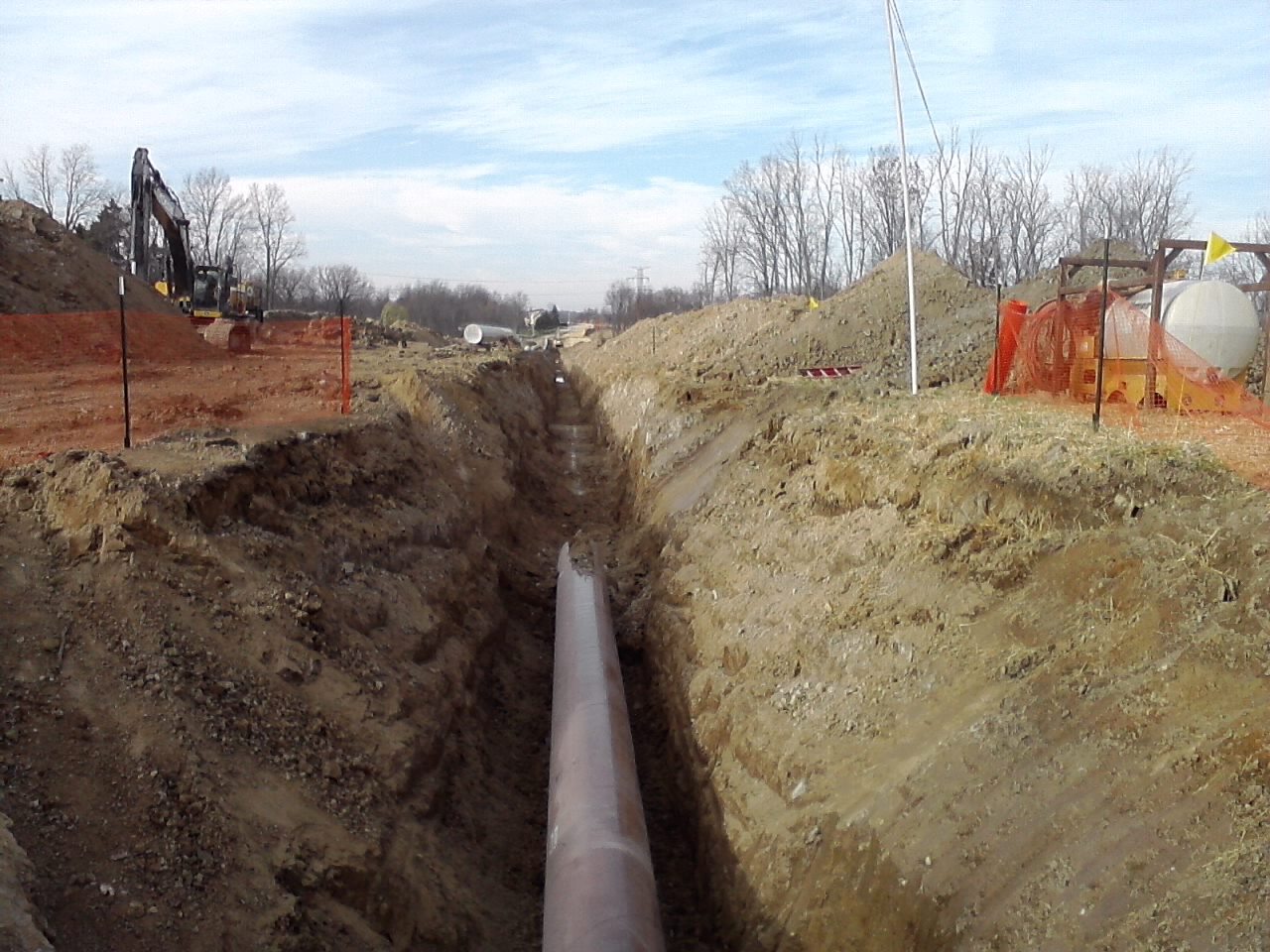
We’re continuing to play catch-up with all of our unfinished business around here, while also re-visiting our notes from the Pipeline Safety Trust conference (the subject of our recently launched new series!). Among other things, we’re still scratching our heads over Enbridge contractor Precision Pipeline’s baffling flag faux-pas and we’re a little worked up over yesterday’s Enbridge Freep ad (teaser: they found a happy landowner!). We also drove around a bit this weekend and took some construction pictures– since entries to our photo contest are few and far between (but it’s not too late to submit! Please?!). More on all of that is coming up.
Meanwhile, it’s high time we wrapped up our series on our conversation with Enbridge Vice President Mark Sitek. We had a second call with him on Monday and while it, too, was candid and respectful, we’re not sure it was terribly productive. We haven’t quite given up on Mark yet, but we’re less hopeful now about the potential fruits of this exchange than we were a few weeks ago.
But we can start with one positive note: Mark assured me that Enbridge is going to change the indemnification language they present to landowners. The new language will not be two-way indemnification (which we’ve expressed lots of concerns about before), but only a one-way indemnification (that is, Enbridge will indemnify landowners, not the other way around). As an example– we don’t know if this is precisely what they’ll use– here is the one-way indemnification clause in the contract we signed (after objecting to the original two-way language):
Lessees agree to indemnify and hold Lessor harmless against any and all claims, demands, and causes of action, intentional misconduct of its employees, agents, representatives, contractors, subcontractors or invitees.
Now, this change is undoubtedly good news and it does show that Enbridge is capable of a certain degree of responsiveness. We are grateful to Mark for looking into the matter and taking action. He deserves credit for that. At the same time, we do have to qualify our praise on this point since (1) this is a pretty modest action, an easy step for Enbridge to take; and (2) Mark still refused to concede that there was any real problem with the original language other than that it was “confusing” (as opposed to an attempt to shift a portion of liability onto unsuspecting homeowners, as we’ve always maintained). Nevertheless, it is a little step and we’ll take it. And we thank Mark Sitek for it sincerely.
As for other matters, we’ll just say that in general it seemed to us that Mark demonstrated what we have already described as Enbridge’s general unwillingness to honestly, soberly, and self-critically reflect upon its actions and practices or to consider how they look, not from the perspective of Enbridge, but from the perspective of landowners. We believe that unwillingness– perhaps it’s stubbornness– is absolutely endemic to Enbridge corporate culture.
For instance, at a certain point in each of our conversations with Mark, he set forth a kind of bottom line: the fact is, he told us in our last conversation (as I recall, we were talking about compensation for “disturbance and inconvenience”) that Enbridge owns easement rights on most of these properties, rights they have owned for 40 years. And the further fact is that those rights allow them the use of adjacent land (i.e., temporary work space).
Now, on the one hand, this is an indisputable fact (although owning easement rights doesn’t mean they can simply do whatever they want), a fact that we have never once questioned in any way. On the other hand, as we said to Mark at the time, if that’s Enbridge’s bottom line–“we have rights and we’re going to use those rights to do what we want”– that’s fine. Then just say so. But don’t then also pretend that you’re devoted to being a good neighbor, that you want to cultivate good relationships, that you are committed to openness and honesty, etc, etc. Because if you say all that latter stuff, we are going to expect it. And expecting it, we are going to be disappointed and frustrated and call you out when you fail to live up to it.
We’ll give just one further example of this: at one point, Mark also said he thought we’d been a little unfair to Enbridge spokesperson Jennifer Smith. You remember, she’s the one who said that Enbridge does not ask landowners to sign agreements granting indemnification to Enbridge. We have also pointed out that Smith claims Enbridge compensates landowners for “disturbance and inconvenience,” even though Mark himself conceded that, strictly speaking, this is not exactly true. By contrast, we think it is absolutely fair to point out when someone makes dubious claims. In fact, we went out of our way to be fair to Jennifer Smith by writing to her directly to ask her for clarification. Her response? Nothing. She did not respond to us at all. (How’s that for respect and open and honest communication?)
In fact, if anybody has been unfair to Jennifer Smith– and to her fellow spokespersons, PR people, and marketers– it is Enbridge itself. As we said when we first mentioned her, we think it’s probably the case that the Jennifer Smiths who work for Enbridge have no idea about what’s in the agreements presented to landowners or what what actually goes on in negotiations between landowners and ROW agents. Instead, what Enbridge’s Jennifer Smiths know is what Enbridge tells them to say. And when those things turn out not to be true, it’s the spokespersons– because they’re the ones saying it– who have to take the heat for peddling misinformation. Which means that Enbridge is hanging its own people out to dry.
We don’t know whether our interactions with Mark have reached a conclusion. Graciously, he invited us to contact him in the future if we need to do so. We’ll also say that we think that Mark is a genuinely nice guy; we’re sure he’s quite good at his job. But we also think that he is a product of what we’ve been diagnosing as the peculiar malady that afflicts Enbridge culture. Consider this point of contrast: after our PS Trust talk this week, executives of Marathon Pipe Line told us that the story of our experience caused them to think, “is that us?” That is, we gave them reason to take a hard look at themselves and their practices, to consider whether they were actually living up to their own stated values. However, never once– and this includes our exchanges with Mark– have we heard the same from Enbridge. Instead, all we have ever heard from them is, “that’s not us.” Unlike Marathon and others, they remain steadfastly, intractably unwilling to take a hard look at themselves.
