
by Jeffrey Insko | Oct 7, 2013 |
Happy Monday everyone. This week, among other things we’ll be discussing a couple of newspaper articles from phase two of the Line 6B project, one from Griffith, Indiana and the other from Niles, Michigan. What do the two articles have in common? Well, they both feature some of that good old fashioned Enbridge public relations film-flammery. Here’s part one:
Over the past year or so, we think we’ve established pretty clearly that the things Enbridge’s spokespersons say can rarely be trusted. Their utterances can generally be grouped into five categories:
- Statements that are true, BUT...
- Statements that are hollow and vacuous
- Statements that simply can’t be verified
- Statements that are terribly misleading
- And statements that are simply not true
We’re not sure if there’s some sort of training manual that teaches these people how to communicate this way, whether it just somehow comes naturally to them, or whether it’s the result of imbibing the Enbridge culture. But what we do know is that the obvious sixth category– just saying things that are honest, forthright, and transparent– is an area into which Enbridge spokespersons rarely stray; perhaps they occasionally get there accidentally.
At any rate, our latest specimen of Enbridge PR-speak comes from the Northwest Indiana Times. Apparently, Enbridge will be removing a dozen trees from a local park in Griffith, Indiana. That fact is uncontroversial, as the Town Council reached an agreement with Enbridge and received compensation months ago. The problematic part is when Enbridge spokesperson Jennifer Smith (you may recall her from months ago) says this:
Enbridge has a neutral footprint program, so for every tree the company removes, it will plant a new one, Smith said. However, trees will not be replanted into the easement due to the safety issues, Smith said.
What we have here is a Category Four statement (terribly misleading). Why? Well, just imagine that you are a casual reader of this Griffith news article. You would likely come away from reading it with the idea in your head that Enbridge will be replanting all the trees they cut down– including the dozen or so they’re cutting down at that town park. Then later, when you are driving home and you see the enormous swath of denuded land that Enbridge has cut through your county and beyond, you might understandably think, “Well, that’s quite a lot of tree removal they’re doing, but at least they’re going to replant them.” At some other time, you might notice somewhere around town that Enbridge is taking down large quantities of trees on someone’s property– at which point you might reasonably say to yourself, “Wow, that would suck to see all the trees in your yard getting cut down. But at least Enbridge is going to replant them.” And as a result of all of this, you might well find yourself saying to someone during casual conversation at dinner, “Man, Enbridge sure has cut down a lot of trees around these parts. But while that’s a little unfortunate, I learned from the newspaper that they will be replanting all the trees they cut down. And that’s pretty neat. They sure are a respectful and responsible company. Let’s raise a toast to Enbridge!”
And that’s just how Jennifer Smith and Enbridge like it.
Unfortunately, all of those thoughts you’d be having and that positive impression you’d have based on your (quite reasonable) understanding of Jennifer Smith’s statement would be very, very wrong. You see, while Enbridge might very well be planting a dozen trees in that park in Griffith to replace the ones they’re cutting down, they absolutely will NOT be replanting new trees for every tree they cut down all around town and on people’s property. Despite the rosy, generous, responsible impression conveyed by Jennifer Smith’s blithe statement, that is not at all how their “neutral footprint program” works.
You see, it’s not really true that Enbridge plants a new tree for every tree the company removes. It certainly isn’t true when it comes to trees on individual properties; believe us, we’ve asked. Moreover, to the extent that Enbridge DOES replant trees to offset those that they remove, they don’t necessarily replant them in the same place where they took them down. Rather, the slightly misleadingly named “Tree for a Tree” program is really just a way to try and offset, in some general way, the depletion of resources as a result of some project as a whole. We are quite confident that nobody has been out counting the number of trees Enbridge has cut down along Line 6B and equally confident that nobody is then making sure the same number get planted as a result. Our best guess is that there is some general formula for this neutral footprint: X number of acres of forest were affected (which probably doesn’t include individual properties) so somewhere up in some Canadian wilderness (or who knows where), Enbridge pays to have that same X number of acres planted with some saplings– or something. But there is no real way to verify that that actually happens (if Enbridge plants a tree in the woods and no one is there to see it…). Nevertheless, Enbridge does pretend like they keep some sort of scrupulous count of trees; they keep a running tally on their website–which is itself a Category Three infraction: that number can’t possibly be verified!
Why does all this matter? Well, as always, we just think the truth matters– even though Enbridge and Jennifer Smith, it would appear, do not. But it also matters because there are lots of us along Line 6B who have been devastated by the loss of our trees and more than a little dismayed to learn that the Tree for a Tree program Jennifer Smith is so proud to tout in order to make Enbridge look so very neighborly does not actually apply to us. We have heard that there may well be some alternative tree replanting program that might well apply to us, but despite our numerous and repeated attempts over the course of several months to obtain some information about that program– phone calls, emails, follow up emails– we’ve gotten nowhere. If that somehow magically changes, we’ll let you know.
by Jeffrey Insko | Sep 26, 2013 |
Some breaking news to report: Michigan Representative Fred Upton, who represents plenty of citizens along Line 6B, has introduced legislation that would put an end to the Presidential Permitting process for cross-border pipelines. The bill is intended to fast-track pipeline projects, requiring that they be approved in no more than 120 days. The bill would also explicitly exempt pipeline reversals, volume expansions, and other modifications from the approval process.
For a long time now, we’ve been bemoaning the lack of public input, careful environmental review, and regulatory scrutiny of the Line 6B project as well as other tar sands pipeline projects, like Keystone XL, the Alberta Clipper expansion, the Flanagan South project, and the planned volume expansion of Line 5 under the straits of Mackinac. This bill would make sure that there is even LESS chance for public input, environmental review, and regulatory scrutiny. It is designed to ensure the “anything goes” when it comes to the production and transportation of tar sands pipelines.
This is a bill of the industry, by the industry and for the industry. It represents a serious threat to the Great Lakes. We need to stop it.
Please write or call Fred Upton or your U.S. district representative. The number for Upton’s Washington D.C. office is:
(202) 225-3761
Or you can call his Kalamazoo office at (269) 385-0039.
Or you can send him an email here: http://upton.house.gov/contact/
by Jeffrey Insko | Sep 19, 2013 |
If you’re bored at work this afternoon, you might want to tune in to the Tom Sumner radio program on WFNT out of Flint from 4-5 pm. His guests will be the awesome Beth Wallace of the National Wildlife Federation (you know her!) and, um, yours truly. Let’s just say that the bumbling and the stammering won’t be coming from Beth.
You can listen live on the internet.
Oh, and if you really want a full day of tar sands talk, the U.S. House of Representatives Energy and Commerce Committee is holding hearings on Keystone XL today. Right now. Our friends Anthony Swift of the NRDC and Jane Kleeb of Bold Nebraska will both be testifying.

by Jeffrey Insko | Sep 16, 2013 |
If you want to see what distinguishes Pulitzer Prize-caliber reporting from what ordinarily passes for journalism, take a look at the latest report from David Hasemyer at Inside Climate News. Coinciding nicely with our latest series, Hasemyer’s piece tells the stories of landowners on the Line 6B route–all of whom you’ve encountered here, including our friend Dave Gallagher– whose homes are in close proximity to the pipeline. Gallagher’s situation, in particular, because it is so harrowing and the images so striking, has received quite a bit of media attention over the past couple of months. But few of those reports have provided any useful information about the matter. And some have been really appalling.
By contrast, the Pulitzer Prize-winning Hasemyer (showing once again why he’s a Pulitzer Prize winner) understands and presents to his readers some of the complexity of the situation. He provides some valuable and important context for what Gallagher and Marty Burke and Judy Tanciar have gone through while also remaining sensitive to their experiences. In particular, Hasemyer notes how the current regulatory environment– the laxity of rules and oversight from both PHMSA and the Michigan Public Service Commission– is what makes situations like Gallagher’s, Burke’s, and Tanciar’s possible, leaving them with very little recourse. Hasemyer states the matter succinctly in this powerful sentence, a nice encapsulation of everything we’ve said here on this blog for more than a year:
Without state or federal regulations to protect them, people who live along the 210-mile Michigan section of Enbridge’s new pipeline have been left to plead with a company many say is indifferent to their concerns.
We should have this sentence printed on t-shirts and coffee mugs, bumper stickers and billboards. Schoolchildren all across the state should memorize it and recite it in the morning after the Pledge of Allegiance.
Understandably (ICN is a national publication, after all), Hasemyer focuses a bit more on federal rather than state regulations. And indeed, one can’t stress enough just how weak, ineffective, and cowed by industry PHMSA really is. But as a result of that focus, the MPSC gets off way too easy. That body could have done something to prevent this nightmare, but instead as we discussed at length (and we urge you to read our series on the travesty of the Phase 2 proceedings; if the results of them weren’t so devastating for landowners, they’d be comical), it just rolled over and let Enbridge have its way. Or worse, it actually assisted Enbridge and, we would argue, smoothed the way for other pipeline companies in the future. We don’t mean to suggest in any way that this is a flaw in Hasemyer’s excellent article, only that there is even more (obviously!) to be said about the state regulatory environment and how poorly it served the landowners Hasemyer profiles.
Finally, we can’t fail to note the appearance in the article of our old friend Larry Springer, who shows up to say nothing at all of substance or value. In fact, we could have easily typed up his vapid comments ourselves and saved Hasemyer the trouble of having to track down anyone from Enbridge:
“Safety is our number one priority and in any construction situation our focus is to protect the public, our workers and the environment,” Springer said. “We work with landowners to minimize the impact to their property and to address their concerns through amicable agreement.”
Other than that bit of boilerplate, Springer keeps mum. For instance,
Springer said he couldn’t discuss the company’s dealings with Gallagher, Duman or Burke because those matters are confidential. Gallagher sent a note to Springer giving the company permission to disclose details to InsideClimate News, but Enbridge still declined to discuss his case.
And:
Enbridge’s Springer declined to explain how the company decided to reroute around some houses and not others. The company also did not disclose how many times Line 6B was rerouted to avoid houses.
Of course, in fairness, this is probably a good thing, though not for the reasons of confidentially Springer uses as cover. The fact of the matter is that Springer simply isn’t qualified to discuss his company’s dealings with landowners, because as we’ve pointed out more than once, we don’t believe that he knows even the first thing about those dealings. We suspect he also doesn’t know anything about those other questions– about routing– that he declined to address. Then again, we do have to give him a little bit of credit here; it is generally good policy not to comment on matters you don’t know anything about. But if Springer were really devoted to “open and honest dealings,” what he would have told Hasemyer is “I don’t know how or why the company decided to reroute around some houses and not others. I will find out and get back to you.”
Anyway, all of this is just to say that Inside Climate News continues to do brilliant work. The citizens of Michigan and Arkansas– and everyone else– owes them a debt of gratitude for their continued devotion to thoughtful, informative journalism that serves the public interest.
by Jeffrey Insko | Aug 23, 2013 |
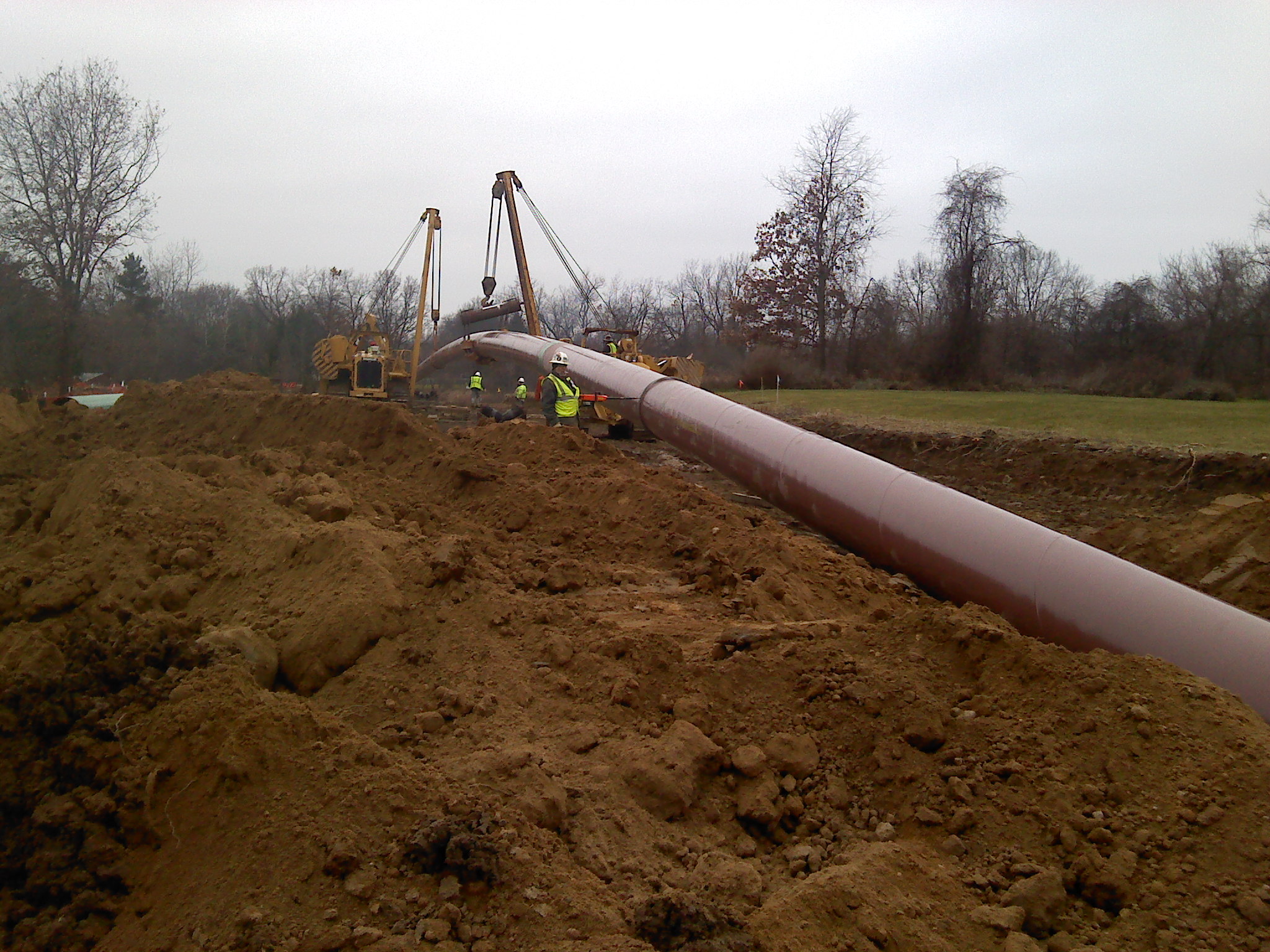
As we mentioned earlier today– and discussed earlier this week— Enbridge has suddenly, inexplicably, decided to woo the press with a bit of pipeline construction stagecraft now that phase two of the Line 6B “replacement” is in full swing. Tom Hodge has been cast in the role of charming leading man– not a bad move, we have to admit. We’ve always found Hodge quite personable and certainly much more credible, straightforward, and responsive than Enbridge’s brood of PR hustlers– though we have also seen, to our disappointment, that Hodge is prone to the occasional Manshumism (that’s our new term for disingenuous or misleading statements; what do you think?).
Anyway, it’s not hard to see why Enbridge puts on these little media shows: they appear to work. Just take a look at two of the reports filed following yesterday’s mid-day matinée: one from Lisa Satayut at MLive (why didn’t they send Ursula Zerilli?) and another from Scott Davis at the Lansing State Journal. As far as we know, neither Davis nor Satayut has written about the Enbridge project before– and it shows. In fact, in order to try and be generous and fair, we’re going to assume that this fact accounts for both articles’ deficiencies. In our view, we think it’s best if reporters know as much as possible about whatever subject it is they’re writing about; we think readers are much better served that way– as we pointed out in our discussion of Tom Hillen’s disastrous TV spot this week. But we also know (though we’re not in the business) that that isn’t how things always work in practice. Satayut and Davis are given assignments and tight deadlines and not enough time to do the sort of homework that’s going to produce genuinely informative journalism. Because of this, the only thing they can do is type up an account of what happens right in front of their eyes. The results are unfortunate.
Davis’s piece reads just like an Enbridge press release. With the exception of very brief mentions of “the July 2010 pipeline spill that polluted the Kalamazoo River near Marshall” and recent protests (“In recent weeks,” Davis writes, the project “has been hampered by environmental protesters who have linked arms or climbed trees to temporarily block the work”), there is almost no context for the story whatsoever, not even an acknowledgment that this is the second phase of a project that has been going on for well over a year, rife with controversy and contention. Instead, Davis just seems sort of hypnotized by the impressiveness of the operation, waxing a bit lyrical, and then more than happy to step aside and let Jason Manshum pretend like everything has been going just swell, like this:
In most cases, the company purchased additional easements from the 2,500 landowners between Stockbridge and Griffith, Ind., offered reimbursements for crop losses and pledged to restore damaged property once the work is done, said Jason Manshum, spokesman for Enbridge.
“We try to listen to the neighbors and their concerns,” Hodge said. “We try to accommodate them.”
Sigh.
While Davis’s article isn’t much different than one of Enbridge’s notorious full page ads (perhaps this one in particular), at least Satayut recognizes, however simplistically, that there’s more to the story than just a bunch of guys with big equipment and a long stretch of steel pipe. She devotes six paragraphs (well, very short paragraphs) to controversy over the project and provides a full paragraph on Marshall. And there are hyperlinks to related articles.
Unfortunately, the article suffers from the same deficiencies we pointed out with regard to Ursula Zerilli’s piece a couple of days ago. What Satayut innocuously calls “differing opinions on the project” are once again reduced to a crude, ill-informed, and simplistic binary that pits safety-minded Enbridge against some felonious protestors climbing into or chaining themselves to the pipe. That’s it. Nothing about the fact that Enbridge has used the power of eminent domain to take dozens and dozens of landowners to court. Nothing about the fact that numerous Michigan citizens intervened in the MPSC’s approval proceedings for the project, a process that was prolonged, contentious, and raised an array of serious concerns that were not mere “opposition” to the project. Nothing about the fact that a grassroots citizen-group made up primarily of landowners along the pipeline route sued Enbridge in county, then federal court. Nothing about the long, complicated, fascinating standoff between Enbridge and Brandon Township, which illustrated vividly Enbridge’s contemptuous attitude toward and treatment of local authority and local ordinances. Nothing about similar skirmishes (though shorter and quieter) with a number of other townships along the route. Nothing about the silence and apathy of Michigan’s state and federal legislators who have turned a blind eye to Enbridge’s ongoing activities in this state, despite what we know about Marshall. Nothing about the NTSB report on the 2010 spill, which is where we learned so much of what we know about what happened in Marshall (and it ain’t pretty). And, perhaps worst of all, nothing whatsoever about the many, many, many landowners who have never opposed the project, but who have nevertheless felt abused, mistreated, bullied, disrespected, misinformed, under-compensated, beaten down and worn out by Enbridge and its land agents.
Now, we understand that a single article can’t do everything and certainly can’t take on all of that. We recognize that there’s only so much a reporter can do with a limited word count, a limited amount of space. We don’t expect Scott Davis and Lisa Satayut to know about or write about everything we just mentioned in one short article. However, it doesn’t seem to us too much to expect that they could have some dim awareness of all of this and write an article that in some way reflects that awareness, an article that is not either just an Enbridge press release masquerading as a news article (the Davis piece) or a news article that (once again) reduces a set of very important and very complicated and long-running set of concerns to a single woman climbing up into a tree one day (the Satayut piece).
In fact, if you don’t think that can be done, let us direct your attention to the report filed today by Mark Brush of Michigan Radio. Their team– including Rebecca Williams and Lindsey Smith– has been outstanding in their coverage for more than a year. And Mark’s report manages to accomplish– in fewer words!– what Davis and Satayut each fail to do: providing readers with some of the complex, varied, and serious issues that Enbridge’s little performance tried to hide backstage. And it’s not just that Brush went to Dave Gallagher’s house (though that’s no small thing). Mark also manages to mention the NTSB report. He points out (shrewdly) that technology isn’t everything when it comes to pipeline safety. And he mentions legitimate, reasonable landowner concerns that are not just a matter of “opposition.” Obviously, there’s a lot more meat that could still be put on those bones. But what Brush accomplishes in such a short piece is excellent.
It’s what you get when you give a story to a reporter who knows a thing or two about the story he’s covering.

by Jeffrey Insko | Aug 22, 2013 |
If you’ve been paying attention, you’ve probably noticed that there has been a flurry of Enbridge Line 6B coverage this week. A great deal of it centers upon the harrowing situation at the house of our friend Dave Gallagher in Ceresco (and more and more). And the rest has been instigated by Enbridge itself, which has decided to launch a charm offensive with the press lately (see this and this). We can’t help but think these things are related; Enbridge seems to enjoy few things as much as a pr battle.
Anyway, we think Dave’s story is worth paying attention to. But not only because of the dramatic pictures and videos–and they certainly are dramatic. It’s also important because it illustrates vividly how and why Enbridge has bulldozed its way (literally and figuratively) through the state. In fact, we think that Dave’s situation represents a teachable moment. After all, plenty of other people on this route have experienced what Dave is going through– have you seen the pictures from Beth Duman’s house? Or Amy Nash’s? There are properties right in my neighborhood where the pipe runs within 10 or 15 feet of dwellings, just as it does Dave’s. Dave’s situation, and he’ll be the first to tell you this, is awful, but it’s far from singular.
Unfortunately, much of the press is unlikely to avail itself of the teachability of this moment. This is particularly true of television news. Witness, for instance, this rather awful report from Tom Hillen at WOOD-TV out of Grand Rapids. Go ahead and watch. We’ll continue after you’re done…
There are a number of serious problems here, not all of which are entirely Tim Hillen’s fault. Let’s review:
First and foremost, there are the remarks of the now-ubiquitous Jason Manshum, who unlike most of us has a job where he gets to say things all the time without ever being challenged or without worrying about whether what he says is at all verifiable. This time, he addresses Dave’s concerns that his property value will plummet. In response, Manshum says this:
“Studies have shown on our pipeline as well as other energy transportation companies that values — home values — do not decrease with pipelines. There is not a direct correlation that we have found,” Enbridge spokesman Jason Manshum said.
Those are certainly interesting claims and we would be very eager to verify whether thy are in fact true. For that reason, we’ve written to Manshum asking to see his data. Unfortunately, if history is any guide, he will ignore our query– because, as we said, Manshum lives in a dream-world where it doesn’t much matter whether his assertions are backed by any actual evidence. We’ll keep you posted.
The next problem with the report– and it is a MAJOR problem– is in fact Hillen’s fault. Here is what he says:
Enbridge is able to do the work because it has an easement on Gallagher’s property, which means it owns some of the land in his backyard.
Now, it’s not clear here whether this is something that Enbridge said to Hillen or whether Hillen generated this statement on his own. But one thing is clear: this is absolutely NOT TRUE. And the fact that it is not true is why this report is not only sloppy, but positively harmful. It does a tremendous disservice not only to Dave Gallagher, but to public discourse. It feeds a terrible misconception about property rights in general and Enbridge’s treatment of landowners in particular.
An easement does NOT mean that Enbridge “owns some of the land” on someone’s property. Dave Gallagher owns that land, period. An easement (or a right of way) simply means that Enbridge has the right to access and use that land for specific activities as specified in the easement agreement. They do NOT get to do whatever they want with it whenever they want to. They do not have total control over that property nor do they have total control over what Dave Gallagher does with that property. Even Enbridge would not dispute this. They can’t dispute it because it is a legal fact. And because easement rights are not ownership, it is entirely possible for easement holders (like Enbridge) to abuse or overstep their easement rights. (One might even argue that Enbridge has abused its easement rights). But just because Enbridge would not or cannot claim that they “own” the land for which they hold rights-of-way doesn’t mean that they’re not perfectly happy to have landowners and the public believe, mistakenly, that having an easement means owning that property. The more people believe that, the less likely Enbridge’s activities are to be challenged; the less likely know-nothings who post internet comments on stories like this one are to sympathize with situations like Dave’s. That’s just the way Enbridge likes it.
The last problem is the fault of Enbridge and Hillen both. On the subject of eminent domain, this is what Hillen says:
Enbridge says they didn’t have to pay Gallagher or other land owners, but they do because they want a good relationship with them. According to Manshum, Enbridge has eminent domain, which would give the company the right to lay the pipeline no matter what.
This is misleading at best. What does Manshum mean when he says Enbridge “didn’t have to pay… land owners”? That they don’t have to pay for exercising their easement right? That may be true, depending upon the easement agreement. But in most cases, that’s beside the point. Rather, the issue of payment frequently has more to do with (a) the acquisition of NEW easement rights– which is the case with Dave’s property. For that, they do have to pay; and (b) the use of “temporary workspace” and whatever damages that use causes. On our property, for instance, Enbridge took (temporarily) an additional 65 feet outside their existing easement. That’s where most of our trees and our garden were. Enbridge DID have to pay for that; they did not just pay us “because they want a good relationship with” us, as Manshum claims. They were legally obligated to compensate us for damages.
Perhaps even worse, though, is both Enbridge’s and Hillen’s glib treatment of eminent domain. Manshum trots it out, callously, like a sort of trump card and in doing so characterizes the whole situation so that it appears that every scrap and crumb Enbridge gives out is a sign of its tremendous generosity, when if they really wanted to they could just trample on us all like cockroaches. This is exactly what Enbridge VP Mark Sitek said to us after we went round and round for quite some time. One can only assume that this is what Enbridge really believes, despite all the good neighbor rhetoric: “you helpless, groveling peasants ought to be grateful we’re giving you anything at all!”
Hillen and his colleagues are all too happy to promulgate this view. Just watch their daft back and forth about it at the end of the report, shrugging their shoulders about eminent domain as if it’s just a fundamental law of the universe: “yeah, that’s just how it is with gravity. Nobody could stop that apple from falling from that tree.” The problem, however, is that eminent domain is NOT a natural law. Enbridge was granted that right by the Michigan Public Service Commission, through a process that, as we have written about exhaustively, was deeply flawed and failed to serve the interests of the citizens of this state. Hillen had a chance to explore that, to initiate a discussion about the use (and abuse) of eminent domain. But he did no such thing. Instead, he simply demonstrates that he doesn’t really understand eminent domain law any more than he understands easement rights.
As a result, a chance to actually inform the public, to explain to people why, aside from mere “inconvenience,” landowners might have some legitimate complaints, to use Dave Gallagher’s terrible story to help people understand easement rights or how and why foreign companies are granted the power of eminent domain, or to initiate some important discussions about matters like property rights and energy policy and our regulatory systems, things that ought to be of interest to every citizen, is missed. And because of that, even though Enbridge isn’t running bulldozers right outside all of our living rooms, we’re all still getting Gallaghered. Score another one for Enbridge.
by Jeffrey Insko | Aug 19, 2013 |
Update, August 20, 2013: Well, it turns out that what looked like a very big Enbridge whopper (details below) is actually just a run-of-the-mill bit of Enbridge misinformation. Reporter Tina Casagrand has the clarification from Enbridge in a comment to this post. We are glad for spokesperson Katie Lange’s sake that she wasn’t actually saying that the Marshall spill was the result of “something that was stuck in the pipe.” Unfortunately, the clarification doesn’t actually bring all that much clarity to the matter. Here’s why:
Enbridge now says that “the incident” to which Lange’s refers in her statement is the discharge that resulted from a hydrotest of the new Line 6B earlier this summer. (You might remember that we wrote about it at the time.) We’ll take them at their word on this. The problem, however, is that the statement is STILL inaccurate and even, it seems, rather disingenuous. The inaccurate part is that the incident did not take place in Marshall. Ore Creek is in Tyrone Township, Livingston County, nowhere near Marshall. The disingenuous part is that Lange says Enbridge didn’t “purposefully” violate the permit, suggesting instead that the violations were the result of something getting stuck. However, if you look at the violations-– there are ELEVEN of them– it’s hard to see how any of them could have been the result of something getting stuck in the line. For instance, (just to name a few) the DEQ cites Enbridge for not having any on-site representatives during the discharge, for not taking any samples of the discharge on June 17 (three days before the discharge), for not conducting water inspections as required the week before the discharge, and for not inspecting their equipment as required. As far as we can tell, none of these things have anything at all to do with something getting stuck in the pipe. So the question that remains is whether Enbridge failed to perform these required actions “purposefully,” as Lange claims. Maybe that’s a difficult thing to determine, we guess. But if the violations aren’t the result of an accident (and the evidence suggests they weren’t), and they were not purposeful, that only leaves one alternative: incompetence. That is not very comforting.
_____________________
Two very interesting stories appeared in newspapers today written by talented young reporters. Over at the St. Louis Beacon, Tina Casagrand has an excellent piece about Enbridge’s Flanagan South project. As we’ve noted before, this is another one of Enbridge’s clever schemes to out-Keystone Keystone XL. This line will head south through the midwest and eventually make it all the way to the coast. And the most disturbing part? Even though it crosses an international border, Enbridge has once again found a way to skirt the presidential permitting problem and avoid public scrutiny. And also once again, the project is mostly flying under the radar while almost all eyes remain fixed on KXL. This is one reason Tina’s piece (and others that have appeared before it) is so very important.
But the most extraordinary thing of all in the article– and, honestly, we thought we’d heard it all by now– is what Enbridge spokesperson Katie Lange has to say about the Marshall spill. If you’re not sitting down, you might want to. At least be sure you’re holding on to something solid. This whopper is even worse than the infuriatingly dishonest story Enbridge VP of Operations Richard Adams told to the EPA a couple of weeks ago. Okay. Are you ready? Here’s Lange on Marshall:
“For the incident in Marshall, it wasn’t that Enbridge purposefully violated, it was something that was stuck in the pipe,” added Lange.
Something stuck in the pipe?! We have long been baffled and angered by the misleading, disingenuous, obfuscatory, and inaccurate things that Enbridge spokespersons– the Larry Springers and Jennifer Smiths and Jason Manshums say. But this one has to take the cake. One can only wonder where in the world poor Katie Lange got that patently false piece of information. Surely she or someone at Enbridge will call Tina to correct it. Right?
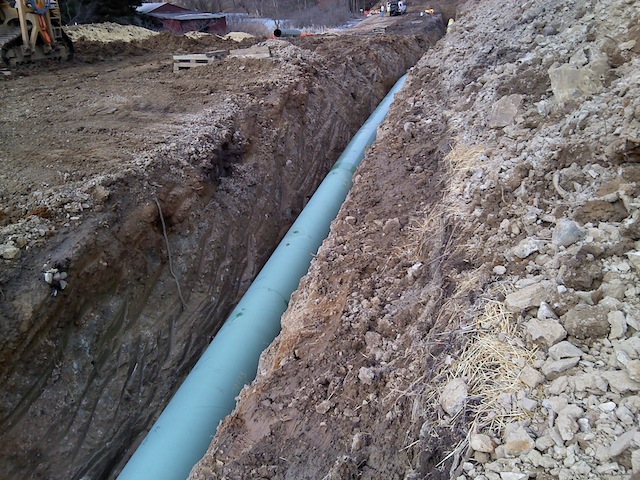
The other interesting story today is from Ursula Zerilli over at MLive, who is following up on her article from last week. For some strange reason, Enbridge decided to get chummy with some reporters as they kick off phase two of the project and so (evidently) reporters got to ride around in a van with Tom Hodge and some others. But unlike last week’s article, in this one Ursula speaks with some Enbridge critics, among them our friend Dave Gallagher, whose situation as an affected landowner is a real nightmare– just get a load of the picture that accompanies the article! The article also features some remarks from inspector Raymond Ashley, who appears to have a real penchant for forced, mawkish metaphors:
“We are trying to weld more than just this pipe together,” said Raymond Ashley, who was proudly wearing a photo of his granddaughter as a badge. “We’re welding more than just a pipeline. We need to bond together the environment, safety and the integrity of this pipeline. We have one day to build integrity and that’s today.”
Anyway, while we think the article is accurate and fair (she even emphasizes Enbridge’s slow response to Marshall), it also left us a little dissatisfied for reasons that might be worth explaining in a bit of detail. The reason we’re dissatisfied– and we don’t really blame Ursula for this– is that the article lacks nuance. It lacks subtlety and complexity. Again, this isn’t really Ursula’s fault. We live in a (news) culture that likes simple binary narratives– us vs. them, black vs. white, good guys vs. bad guys. That’s what (or so editors seem to think) appeals to people. Making this even worse is that Ursula was probably only given about 800 words in which to tell her story– hard to be nuanced in such a short space. Yet nuance is important. Here’s why:
One comes away from the article with a simple dichotomy: there are pipeline proponents (like Tom Hodge and Enbridge) and there are pipeline opponents (the protestors from MICATS). They are the article’s protagonists and antagonists (we’ll let you decide who’s who!). But the problem with this narrative– which pits people who don’t want pipelines against people building pipelines– is that it is precisely the way that Enbridge wants to have this story framed. It’s why former Enbridge CEO likes to talk about “revolutionaries” and why Enbridge spokesman Larry Springer talks about “special interest groups.” That kind of story serves Enbridge’s interests perfectly because it allows them to sound reasonable and pragmatic, while casting everyone else as a little bit crazy, on the fringes, out of the mainstream. So, for instance, Tom Hodge gets to say things like this:
“It’s hard to understand their logic,” he said of those protesting the pipeline replacement project. “It seems like they want us to turn the pipeline off or just not replace this pipeline, which already ruptured. There’s not a good alternative to what we are doing and we feel like it’s a good thing for the State of Michigan.”
And this:
“There would be riots in the streets if food wasn’t being delivered or if fuel wasn’t being delivered,” he said. “I’m all for having an alternate fuel, but until that becomes available, there’s no other option. You can use natural gas but that has to come by pipeline, too. If that ruptures, it’s not a polluting event like oil … It’s a fireball.”
See how that works? Hodge makes it sound like the alternatives are clear and stark: EITHER Enbridge gets to build whatever pipelines it wants to build however it wants to build them OR there will be riots in the streets because people are starving. I mean, what kind of person would be in favor of people starving?!
But here’s the thing: that is complete and total and utter nonsense. It is a ridiculously false choice. Those are quite plainly NOT the only alternatives. People are not going to starve and riot in the street if Enbridge does not get to pump 800,000 barrels of tar sands oil a day across Michigan through a shiny new Line 6B. No serious person believes any such thing. And yet Hodge gets to imply as much and, in doing so, also gets to come off as the person who is being rational and realistic.
And that’s not even the worst part. The other reason this simplistic (and largely false) narrative of people in favor of the pipeline vs. people opposed to the pipeline serves Enbridge so well is because it allows them to evade the real substance of most of the real criticism of the way they have conducted themselves in Michigan over the past three years (or more). As we have said over and over and over and over again (so often we don’t even have the energy to provide links anymore), the problem isn’t that they’re replacing Line 6B. The problem is how they’ve gone about it. Most of us do not oppose the “replacement” of the line– a new pipe is obviously better than an aging pipe. That has NEVER been the issue. What we object to is the way that Enbridge has cleverly skirted federal regulations, the way they have abused their easement rights and mistreated landowners and trampled property rights, the way they have misinformed people, the way they have flouted or ignored local authority and thrown their weight around, the way they have essentially re-written Michigan law to serve their own financial interests. All that plus the fact that we have a bunch of elected officials and a set of pathetically weak regulatory systems that allows all of this to continue.
Those are the real issues. And they are issues that affect and therefore ought to concern all the citizens of the state of Michigan. To pretend otherwise– to pretend that it’s a simple matter of energy production vs. a handful of environmental radicals– does nothing but allow Enbridge to avoid having to face any of the things I’ve described, to avoid ever being confronted with genuinely tough questions. So once again, as always, Enbridge gets exactly what it wants.
by Jeffrey Insko | Aug 7, 2013 |
We’re working on the second installment on our trip to Washington DC last week to meet with legislators and regulators. If you missed part one– about the meeting we did not have— please check it out.
In the meantime, some interesting articles and stories have appeared in the press in the past week or so. Here we go:
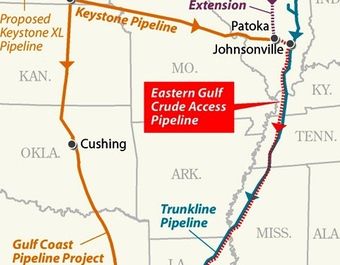
We’ve mentioned before Enbridge’s “Albert Clipper” expansion, which is currently going through the presidential permitting process, just like Keystone XL. This was one of the topics we discussed with representatives of the State Department last week. We’ll have a lot more to say about it in the weeks to come and we’ll likely be encouraging you to speak up once the public comments part of the review begins. For now, we”d just point you to this excellent op-ed in the Milwaukee Journal Sentinel by Eric Hansen. It’s excellent. Here’s a little taste:
Connect the dots on Enbridge’s efforts to quietly network thousands of miles of pipelines — a system that would lock in both Wisconsin and our region as a major transportation corridor to ship tar sands crude oil overseas to the world market for decades to come — and a reasonable citizen would be outraged.
Profit and jobs would go to Canada. Crude oil would go overseas. Toxic risk would stay here, sprinkled throughout our region in the crude oil spills, air quality and public health impacts that would certainly come.
And speaking of Keystone XL (we talked with officials about that, too, in DC), it appears that some legislators are none too happy with some recent remarks by the President (if you missed them, they are here). Which legislators are displeased, you ask? Well, none other than the House Chairman of the Energy and Commerce Committee, Rep. Fred Upton. Yes, that Fred Upton, the guy who represents Kalamazoo! Upton is among the most outspoken supporters of KXL– which, we suppose, gives him something to do since he certainly doesn’t spend any time whatsoever inquiring into what Enbridge is doing back in his home state and district. We’ve spent a fair amount of time here lamenting the appalling failure of leadership in this state when it comes to Enbridge– and we made that point repeatedly to the people we spoke with in Washington– but Upton, with the possible exception of Governor Snyder, might well be the worst offender. Given the district he represents, he should be leading the charge in looking out for the interests of Michigan landowners and the state’s natural resources. Instead, he’s leading the charge in hastening the transportation of more tar sands oil through the U.S.
Speaking even more of KXL and Enbridge, Pulitzer Prize winner Lisa Song has another excellent article over at Inside Climate News describing yet another Enbridge plan to out-Keystone TransCanada while almost nobody, as we’ve said many times, is watching. It’s more piecing things together, this time converting gas lines to transport tar sands oil. But it’s okay because you can rest assured that PHMSA will do almost nothing to ensure that the plan is safe and sound. The PSTRust’s Carl Weimer notes that “Operators don’t need permission from PHMSA to change the contents of a pipeline, and the conversion process doesn’t trigger environmental studies. Operators simply create a plan of operation that meets PHMSA’s pipeline safety regulations, he said.”
From Indiana, Jeff Harrell at the South Bend Tribune posted two articles this week about the Enbridge Line 6B project, placing them helpfully in larger contexts. It’s very solid work and we especially appreciate his focus on Native American concerns about the project. His first article begins, for instance, with representatives from the Pokagon Band of the Potawotami Tribe, who live on the Michigan-Indiana border.
Inevitably, Jason Manshum shows up in the article with more absurd, misleading remarks. He’s back to complaining about the “tar sands” term again: “Manshum calls the term “tar sands” “… a misnomer, a slang word associated with this type of crude by opponents.” But of course, this is total baloney. The industry itself used that term for decades until someone in Manshum’s line of work (spin doctoring) decided back in the 1960s that “oil sands” sounded friendlier.
Harrell’s second article, which unfortunately (we don’t hold him responsible for this) bears the very stupid headline, “Pipeline Has Support, Opposition” (they could have just said, “Humans Agree, Disagree”), considers Line 6B in relation to KXL, which we’ve been trying to convince reporters to do for a very long time. Manshum’s on board for this one, too, assuring us all that pipeline corrosion is not a problem with diluted bitumen:
Enbridge’s Manshum cites the U.S. Department of Transportation’s investigation into the spill to dispute the claim that the line broke from abrasive tar sands oil corroding the inside of the pipe.
“One thing they made crystal clear was that the rupture was not caused by internal corrosion, but on the outside, or the exterior of the line related to the coating,” Manshum says.
Strictly speaking, of course, what Manshum says is true. But it’s more than a little ironic that he’d cite the NTSB report, since what it also shows is that Enbridge ignored the pipe’s exterior defects and that their “culture of deviance” from safety protocols contributed tremendously to the Marshall disaster. Honestly, we sometimes wonder how Jason Manshum can sleep at night.
Lastly, Jennifer Bowman has a lengthy and interesting article in the Battle Creek Enquirer about Enbridge’s home buyout program in Marshall. It’s a piece that we imagine is quite pleasing to Enbridge, since Bowman talks with some people who had very positive experiences with Enbridge. She spoke also with some unhappy landowners, but they are more or less portrayed as greedy whiners. We find this entire situation quite fascinating and disturbing in many ways, though we confess we don’t know enough about it to make many confident pronouncements. We also think that Bowman’s article leaves a great many questions unasked; we’re going to think and learn more about this and discuss it more in a later post (hopefully). For now, just one little observation:
What is it with people that makes them so uncharitable toward others? Why the need to belittle those whose experiences differ from their own? We’ve seen this sort of tactic– from fellow landowners!–before. And we see it again from Wayne Groth, who gets lots of ink in Bowman’s article. Groth believes he got a good deal from Enbridge– and we’re very glad for that; we wish it were the case with everyone. But then he has to go and say this:
“The ones screaming the loudest are probably the greediest,” Groth said, “and they’re looking to cash in. They remind me of damn trial lawyers that want to sue for money and put the company out of business.”
In all seriousness: does Groth really know this? Does he even know who is “screaming” loudly, much less what those (imaginary) screamers are screaming about or for? We doubt it. This sort of talk just makes him seem like a guy with very little imagination, very little ability to adopt the perspective of someone else a person whose mindset is, “I got mine; screw the rest of you.” And that’s just downright unneighborly.
by Jeffrey Insko | Jul 26, 2013 |
Yesterday, the three year anniversary of the spill in Marshall brought with it, as we pointed out, some excellent reports by some of our favorite reporters and writers– Dave Hasemyer, Lindsey Smith, Jacob Wheeler, and Josh Mogerman, to name a few.
By contrast, today, the day after the anniversary, has brought us some reports that are to, a greater or lesser extent. just plain maddening.
Take, for instance, the anniversary story released today by UPI, the people, you might recall, who think Beth Wallace is a “global warming advocate.” Unlike the group we mentioned above, the UPI typist couldn’t be bothered to do anything at all except quote back the hollow phrases served up to them by Jason Manshum. In fact, that’s the story’s lead:
There’s always a chance of failure when dealing with mechanical equipment and oil pipelines, Canadian pipeline company Enbridge said.
A couple of paragraphs later, the story offers up the same disingenuous load of hay about “mechanical equipment” from Jason Manshum that we discussed yesterday. Which really just raises one question: wasn’t UPI once a reputable news service?
Less maddening from a journalistic standpoint, but still a little maddening, is this item from a local paper covering Macomb County in Michigan, through which phase two of the Line 6B replacement runs. The headline of the story, oddly, is “NTSB report harshly criticizes Enbridge for oil spill in the Kalamazoo River.” This confused us a little at first, considering the fact that that report was released one year ago this month. But once we got our bearings, we realized that the story is a very good thing. The good citizens of Macomb and St. Clair counties need to know about that report, even if it’s a year old. So we commend The Voice and reporter Jim Bloch, who does a nice job of summarizing the report, for running the story. He even includes the really important stuff, like this:
The report condemned the “culture of deviance” that characterized Enbridge operators, pointing to “systemic flaws in operational decision-making.” The company’s operating culture was one “in which not adhering to approved procedures and protocols was normalized.”
Bloch also has a second story in The Voice, reporting on a meeting between some Enbridge reps and the Marysville, Michigan city council. It mainly consists of Enbridge saying, as they always do, “hey, none of this is any big deal; don’t you worry.” But at one point, Enbridge project manager Doug Reichley says this extraordinary thing:
“The original pipeline was built in the late ‘60s,” said Reichley. “We’ve had some repair issues and some maintenance issues, so we thought it best to replace the entire thing.”
That’s right. On the third anniversary of the most expensive inland oil spill in U.S. history, Reichley says they’ve “had some repair issues.”
The last two maddening items from today are of the déjà vu sort. The Minnesota Star-Tribune has a truly infuriating story about Enbridge violating the terms of some environmental permits:
Enbridge Energy said Friday it will pay a $425,000 fine to settle federal allegations that it made illegal discharges into wetlands and rivers while testing two Minnesota pipelines, including one being upgraded to carry more crude oil.
The violations pertain to the discharge of water during testing of the lines in 2009 and 2010. Sound familiar? It should. Because that’s exactly what happened in Michigan a few weeks ago when Enbridge discharged some rust-colored water into Ore Creek, violating ELEVEN conditions of its MDEQ permit. We believe this constitutes a pattern. The fact is, as our friend Beth Wallace pointed out, that Enbridge treats these matters simply as the cost of doing business. To which we would add that our regulations are so weak and the fines issued for these violations are so small that there is no disincentive for companies like Enbridge to violate these permits. So as much as we want to point out that Enbridge is a very bad actor, we also hasten to add that the systems we have in place compound the problem: they are too weak to force companies like Enbridge to behave.
We also did a double-take when we read that “Enbridge spokeswoman Terri Larson said the company didn’t admit to the violations, but decided to settle the case and avoid litigation.” It’s not just that we remember our own not-unpleasant encounter with Terri Larson at the PSTrust conference back in November (though we have a strong hunch that she was subsequently told to stop replying to our emails). It’s that this also seems to be a pattern with Enbridge. Long time readers might recall that when Enbridge finally reached a “consent agreement” with Brandon Township, they did not admit that they’d violated an ordinances or that they were required by law to seek consent. Enbridge is nothing if not recalcitrant.
Lastly, Michigan Radio’s Lindsey Smith, who’s doing great work, spent a long, late evening at the Comstock Township Planning Commission last night, as the commissioners considered whether to approve Enbridge’s dredging plan. Based on Lindsey’s fine report, it sounds like it was an interesting, if a little exhausting, meeting. But the déjà vu moment for us in the story was this:
Tracy presented the plans to the township’s planning commission after apologizing for not coming sooner. Enbridge set up a lot of equipment at the location near Morrow Lake in June, without getting township approval.
“There is a small slice of time here, that’s no excuse for not coming you to begin with,” Tracy said.
He also apologized to planning commissioners who said they were kicked off the proposed site when they attempted to see it.
This, too, is part of a pattern with Enbridge, something we have seen (and pointed out) on numerous occasions. Enbridge shoots first and aims later. They plow forward, doing whatever they want, and then later, pretending to be innocent and sincere, they issue apologies or offers to fix whatever problems they have caused. It’s a very convenient strategy– for Enbridge– and far too many regulatory and governing bodies have allowed them to get away with it for far too long. Here’s hoping Comstock Township does not do the same.
Lastly, here’s something really interesting for this anniversary. When the spill happened in Marshall 3 years ago, a lot of committed people took lots of different forms of action. This included a small local paper called the Michigan Messenger, which did a lot of vital reporting in real time and did a great job of trying to hold Enbridge’s feet to the fire. Through the magic of the internet, a great deal of that reporting lives on. So if you really want a look back upon that nightmarish summer, hop a ride on the internet wayback machine.
by Jeffrey Insko | Jul 25, 2013 |
In case you haven’t heard, this week marks one full year of existence for the Line 6B Citizens’ Blog. This has put us in a reflective mood. And to celebrate, after thanking some of the marvelous friends we’ve made in the past year, we’ve planned to re-visit what we think (a little self-indulgently; we hope we’ll be forgiven!) some of our greatest hits– which is really just a way of pointing out what we think are some of the more revealing episodes in the life of the Line 6B replacement project. But we’re on vacation this week and, to be honest, golf has sort of taken precedent over reviewing. Which just means that we’ll be dragging this anniversary out a bit longer than we thought we would.
But today marks another, far more important anniversary, the anniversary of the event without which the Line 6B “replacement” and, hence, this blog never would have existed in the first place. Yes, it was three years ago today that the Line 6B pipeline ruptured near Marshall, Michigan and began spilling what would eventually be more than a million gallons of oil into Talmadge Creek and the Kalamazoo River.
This is an anniversary that is not worth celebrating.
But it is a good day to read through the NTSB report on the incident, just to remind ourselves of who is responsible for that disaster; it wasn’t a matter of mere mistakes. Nor was it a failure of technology. It was the inevitable result of Enbridge’s “culture of deviance.” It’s all right there in the report.
To commemorate this day, various news outlets are looking Back. Most notably, Pulitzer Prize-winning journalist Dave Hasemyer of Inside Climate News (we’re so glad he’s back!) has an excellent, lengthy article this morning that everyone should (and will) be reading. We make a brief appearance, as do our friends Steve Hamilton, Deb Miller, and Dave Gallagher. But the money quote comes Robert LaForge, whose property next to Talmadge Creek was affected by the spill so badly that he had to sell it to Enbridge– for far less than a fair price, in his view.
LaForge’s message for Enbridge? “Go to hell.”
Over at Michigan Radio, there’s an informative interview with Lindsey Smith. As always, she’s knowledgeable and clear.
Up in Canada, Brenda Gouglas is also looking back on the past three years. Having observed Enbridge’s actions since the spill, she’s wary of their rhetoric meant to assure Canadians about the Northern Gateway Project. In her fine piece this morning in the Vancouver Observer, she asks, “Can Enbridge be trusted.” Guess what the evidence suggests.
One last item of note: the Comstock Township Planning Commission will consider Enbridge’s permit tonight. You can bet Larry Bell and plenty of others will be there to urge the commissioners to deny it. They’re expecting a full house. Wish we could attend!
(Not so) Happy Anniversary!
