by Jeffrey Insko | Jul 24, 2013 |
There’s been some VERY interesting news this week and, we’re happy to report, some of it quite good or at least very intriguing. A couple of days ago, we linked to the many news reports telling of the bold action taken by the committed members of the Michigan Coalition Against Tar Sands (MI CATS).
Well, today, reports say that Enbridge plans to beef up its security in response. As always, Enbridge spokesman Jason Manshum is on the case, ready with more vapid, equivocal statements:
“We are looking at around the clock, 24/7 security,” he said. “When you think about it, you are talking about people’s safety on the site. You are also talking about the integrity of that pipeline.”
But much more interesting than Enbridge’s security measures is the news from Comstock Township. As we reported a couple of weeks ago, Larry Bell of Bell’s Brewery– makers of our favorite beers, Bell’s Two-Hearted Ale and Oberon Ale (the perfect summer beer)– is, like others in Comstock, mighty unhappy with Enbridge’s latest plans for their continued dredging of the Kalamazoo River. This week, Bell’s filed a lawsuit against Enbridge and a developer with whom Enbridge has a lease agreement. MiLive has the story here. According to the suit, Enbridge’s plan:
will “release pollution, hazardous substances, odor, dust and particulate” which could negatively impact brewery operations.
The complaint alleges Enbridge violated condominium covenants by failing to submit a site plan application before installing equipment. It also alleges that CCP, as developer of the commerce park, violated the Michigan Condominium Act by failing to disclose to the condominium association its intent to lease property to Enbridge.
We will of course be watching developments with regard to this suit very closely. In addition to protection of the beautiful Bell’s beer, a large part of what’s at stake here is once again local autonomy– something Enbridge has disregarded all across the state of Michigan for a very long time.
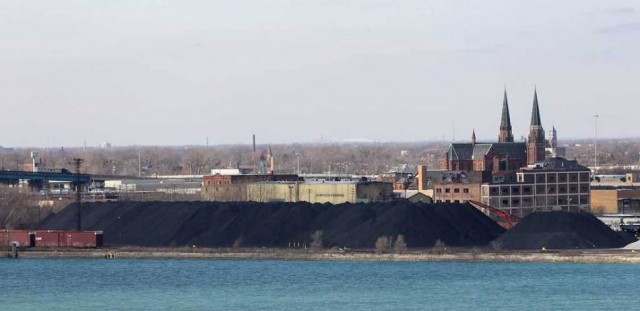
And in one final bit of excellent news, Keith Matheny at the Detroit Free Press is reporting that those nasty piles of petroleum coke along the Detroit River will be going away– at least for the time being. We’re hopeful about this, although the statements coming from Detroit Bulk Storage, the company that’s keeping the stuff– ““We are exploring all options at this time”– are positively Manshum-like in their haziness, which does not exactly inspire confidence.

by Jeffrey Insko | Jun 29, 2013 |
Yesterday, we experienced the near impossible. No, Enbridge did not announce that they’re going to remove the old Line 6B and issue an apology to all landowners for behaving callously toward them. That, too, would be a miracle. No, instead, after numerous conversations with construction workers this week– workers from Tennessee and Texas and Oklahoma and Mississippi– we finally met someone from Michigan! And from the immediate area, no less. We’re not sure if this one guy gets 1,000 jobs of if the other 999 local workers Enbridge likes to talk about are being hidden somewhere else, but it was nice to see a fellow Michigander in a hard hat and safety vest for a change.
There’s some other news to report as well. We’re happy to see that citizens in Indiana are keeping up the pressure, calling for more state regulatory oversight of Enbridge and other pipeline companies. Believe it or not, they might have a weaker regulatory system than Michigan. We’re also glad to see that they’re working with our awesome friends from the Pipeline Safety Trust.
According to the Hartland Patch, the Michigan DEQ is investigating the possibility of contamination in Ore Creek following that discharge from Enbridge’s hydrotest.
Also, the EPA has posted an update on the Kalamazoo River cleanup. Dredging is now happening at four sites. Just in case you’re not keeping count, though we’re sure you are, this is now THREE YEARS after the spill.
Lastly, it now looks like Enbridge is going to buy– and remove– Ceresco Dam. Evidently, the DNR thinks removing the dam is a good idea and, as this is something we know nothing about, we don’t have an opinion about it. But we do find it bothersome and rather ominous that Enbridge is going to buy up even more of the Kalamazoo River– it’s yet another example, in addition to the one we mentioned yesterday, of how they are remaking the state of Michigan in their own image. Local resident Greg Lawcock agrees: “”That’s too much control for one company if you ask me,” said Lawcock.
Details have yet to be released on Enbridge plans to acquire the sun and the moon.

by Jeffrey Insko | Jun 26, 2013 |
What a week! After a few weeks of relative silence (and almost complete silence from us– we’re sorry!), things Enbridge-related exploded this week.
It started Monday morning with a harmless phone call to an Enbridge land agent to try and get some simple information about restoration. But he didn’t know anything. Nothing. At all.
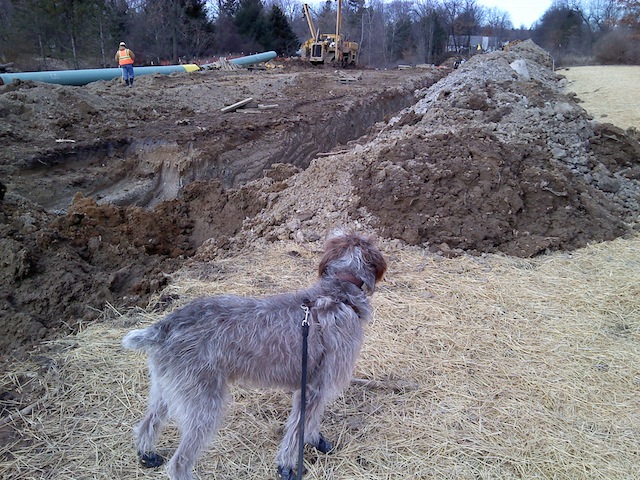
But no sooner did we hang up the phone than we saw some workers pounding stakes into the ground on our property. Minutes after that, bulldozers arrived and started pushing dirt around. Now hundreds of feet of pipe are back on our property, causing us to have traumatic flashbacks to last November. Here is what our property looked like last week:

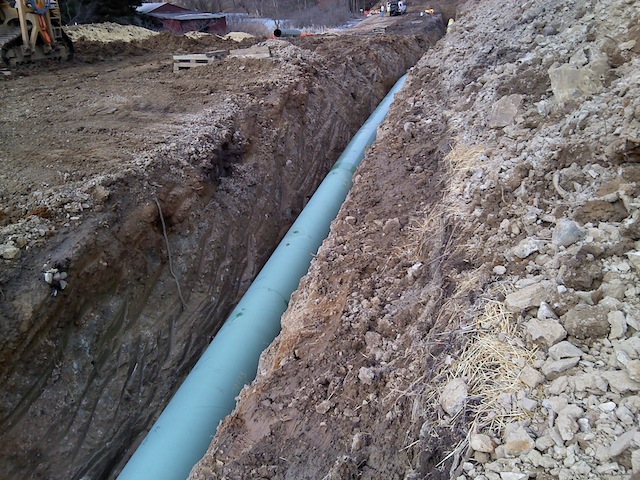
And here is what it looks like this morning (we’ll bring you the full story of all of this in a subsequent post):
The same day, the second of two reports on Line 6B by Keith Matheny appeared in the Detroit Free Press. It’s fine work, though as usual, the disingenuous remarks of Enbridge spokesperson Jason Manshum raised our hackles. So we wrote to him for clarification. It’s been two days now and he has not responded. Evidently, Manshum is not obligated to adhere to Enbridge’s stated corporate values of “maintain[ing] truth in all interactions,” “tak[ing] the time to understand the perspective of others,” and “treat[ing] everyone with unfailing dignity.”
Also on the same day, an intrepid young activist decided to climb inside a section of Line 6B to protest the transportation of dilbit from Canada to the U.S. Reports say he is healthy and safe.
Then, as if all of that weren’t enough, the National Academy of Sciences released its congressionally-mandated report on the safety of transporting dilbit. It’s pretty weak tea, we have to say, but in place of our analysis we’ll just point you to stories by our favorite reporters Lisa Song at Inside Climate News and Elana Schor at Energy & Environment News. And we’ll also direct you to important responses by our friends Anthony Swift of the NRDC and Carl Weimer of the Pipeline Safety Trust.
We will add one tiny bit of our own commentary here. The industry response to the NAS study included this little gem by Shawn Howard, a spokesman for TransCanada:
“At some point, the professional opposition that has used Keystone XL and the oil sands industry as a symbol for their fundraising and advocacy campaigns will need to accept the fact that this product has been moving through the U.S. for decades, that oil is oil and that pipelines remain the safest way to move oil to refineries where it is needed,” TransCanada Corp. spokesman Shawn Howard said via email.
“As a responsible, publicly traded company, TransCanada has an obligation to provide accurate and factual information about our projects to the public and our shareholders — and we hope that the professional opposition to this project will start to do the same.”
Taking a page from the Pat Daniel playbook, Howard refers to a diverse group of citizens with varied and mostly reasonable concerns as “professional opposition.” And he does it twice, in a willfully dishonest attempt to dismiss critics of his industry. What rankles us so much about this– and we’ve seen a similar tactic employed by Enbridge; not just Daniel, but also Larry Springer and even, we’re sorry to say, Tom Hodge— is not just that it is reductive, misleading, and an affront to the truth. It’s also that Howard does it in the very same sentence in which he’s trying to convince us that TransCanada is “responsible” and devoted to “accurate and factual information”! It’s exactly like Enbridge telling us they’re committed to being good neighbors while in the midst of behaving in an unneighborly manner.
But that’s not all this week has had in store for us. Yesterday, the president gave a much anticipated climate speech. Many groups are heartened by his remark that the KXL project should go forward “only if this project does not significantly exacerbate the problem of carbon pollution.” For ourselves, we don’t think that’s a terribly unequivocal statement. But we’re trying to be hopeful.
by Jeffrey Insko | Jun 24, 2013 |
As we mentioned earlier today, the Freep’s excellent new environmental reporter Keith Matheny has a second article about Line 6B in today’s paper. We think he is doing fine work (the first story is here) and not just because he spoke with us and our friend David Gallagher (happy birthday, David!). But the one thing that stuck in our craw a little reading this story was something Jason Manshum, with his never-ending cache of hollow and misleading quotations, said:
Enbridge spokesman Jason Manshum said the company has worked with thousands of landowners along its pipelines over more than 60 years and “the vast majority of landowners we’ve worked with are pleased with negotiations.”
Now, we’ve heard this line from Enbridge reps in the past, more than once. And we’ve also commented upon it. But this time, we decided not to let it pass. And so, we dashed off the following email to Jason Manshum:
Dear Jason Manshum-
I’m hoping you can answer a few questions for me. This morning I read your comments in the Detroit Free Press and was struck by your statement that “the vast majority of landowners we’ve worked with are pleased with negotiations.” I have read similar statements from you and other Enbridge representatives in the past. As a Line 6B landowner myself, this got me to wondering:
- The article seems to suggest that this statement has to do with all landowners Enbridge has dealt with “over more 60 years.” But I’m not sure how that is relevant to this project. So, would you say that the “vast majority of landowners” on the replacement of Line 6B have been “pleased with negotiations”?
- If so, I’d be interested to know the basis upon which you make that determination. Does “pleased” mean that you didn’t have to take them to court? Would those whom you count as “pleased” include, for example, people who have never expressed any dissatisfaction publicly but who nevertheless were not at all happy with their negotiations? Would it include people for whom negotiations and/or compensation went smoothly, but who did not, say, trust their land agent or Enbridge generally? How many landowners on Line 6B have you actually spoken with? How have you gathered data otherwise? I’m just trying to understand what evidence you are drawing upon to support your assertion.
- Assuming that you are right and it is true that the vast majority of landowners have been pleased with negotiations, what would you say is an acceptable level of displeasure for Enbridge? Ten percent of landowners? Twenty? Thirty?
- Relatedly, how many landowners would you say need to be displeased in order for Enbridge to consider and/or acknowledge that they might be responsible for landowner dissatisfaction (as opposed to just assuming that unhappy landowners are just people who will never be pleased with anything)?
I don’t mean these to be rhetorical questions. Any help you can provide would be very much appreciated. I look forward to your reply.
Best,
Jeff Insko
Groveland Township, MI
We will of course provide you with a full report of Manshum’s reply if and when we receive it.
by Jeffrey Insko | May 21, 2013 |
This morning, we’re a little irritated. Remember that story about those disturbing piles of petroleum coke, a byproduct of the dilbit refining process, that we reported on a couple of months ago? Well, the New York Times ran a piece by reporter Ian Austen on the story just this week– and it’s getting a lot of play. It’s all over the web and social media. And of course, we think this is a very good thing. In fact, the more attention this gets the better. The last thing we want is to have that gunk spilling into the Detroit River. And a national discussion about the costs of using this filthy byproduct– what one expert in the article calls “the dirtiest residue from the dirtiest oil on earth”– is long overdue. So, three cheers for Ian Austen and the New York Times. Well, make that two cheers.
Why are we irritated? Two reasons:
First, because the main reason the story seems to be getting so much play– and perhaps a major reason why the Times picked it up in the first place (two months after the story broke here in Michigan)– is because the petcoke can now be linked to the Koch brothers, those wealthy conservative super-villains (to people on the left). Linking this story to the Kochs makes for some good outrage. Here’s how Austen frames his piece:
Detroit’s ever-growing black mountain is the unloved, unwanted and long overlooked byproduct of Canada’s oil sands boom.
And no one knows quite what to do about it, except Koch Carbon, which owns it.
The company is controlled by Charles and David Koch, wealthy industrialists who back a number of conservative and libertarian causes including activist groups that challenge the science behind climate change. The company sells the high-sulfur, high-carbon waste, usually overseas, where it is burned as fuel.
The coke comes from a refinery alongside the river owned by Marathon Petroleum, which has been there since 1930. But it began refining exports from the Canadian oil sands — and producing the waste that is sold to Koch — only in November.
But in our view, it really shouldn’t matter; it shouldn’t make it any more concerning to know that the Koch brothers own that stuff. We’d find those piles of black dust on the shores of the river alarming if they were owned by our own brothers. The fact that this story has to be shoe-horned into a familiar ideological narrative in order to get it on the national radar is, we confess, bothersome– irritating.
The second reason we’re irritated is because the Times piece never says how that stuff– or the stuff that makes that stuff– got to Detroit in the first place. Instead, it says only this:
An initial refining process known as coking, which releases the oil from the tarlike bitumen in the oil sands, also leaves the petroleum coke, of which Canada has 79.8 million tons stockpiled. Some is dumped in open-pit oil sands mines and tailing ponds in Alberta. Much is just piled up there.
Detroit’s pile will not be the only one. Canada’s efforts to sell more products derived from oil sands to the United States, which include transporting it through the proposed Keystone XL pipeline, have pulled more coking south to American refineries, creating more waste product here.
Marathon Petroleum’s plant in Detroit processes 28,000 barrels a day of the oil sands bitumen.
See what happened there? The Times went and pulled a Stabenow on its readers (if we may coin a phrase). That is, just at the moment when one might expect an explanation of how Enbridge’s Line 6B– the line that ruptured in Marshall in the worst inland oil spill in U.S. history– feeds diluted bitumen to that Marathon refinery, at that very moment, instead of rehearsing a bit of Enbridge history in Michigan and beyond, Austen turns to a discussion of… Keystone XL! Never mind that Enbridge, as we’ve said before, is quietly building its own KXL. Never mind that Marathon’s plant is about to increase production by more than half because of the” replacement” of Line 6B (thereby producing even more petroleum coke). To the Times, it’s as if Enbridge and Line 6B don’t exist. Once again, as with Senator Stabenow’s staff, Keystone appears to be the only game in town.
And we’re sure that’s just how Enbridge likes it.
by Jeffrey Insko | Apr 24, 2013 |
This morning we’ve fought our way to the surface from beneath a mountain of end-of-term student papers to bring you a brief tour of local news reports. Line 6B construction activity has been pretty quiet recently owing first to frost-law restrictions and, more recently, to rain, rain, rain. (We hope you’re staying dry!) But other things are happening, among them negotiations with landowners along phase two (about which we hope to bring you more very soon). In the meantime, we’ll just call your attention to some recent local news reports, some of them rather revealing (and not in a good way):
First, up, some unfortunate news out of Howell Township. The Livingston Daily Press & Argus reported yesterday that Enbridge apparently breached water and sewer lines at the intersection of Burhkart Road and Grand River Avenue:
[Township Treasurer Jonathan] Hohenstein said the lines were likely breached sometime in March while Enbridge was boring underground to make room for new pipeline.
For now, the damaged portion of the sewer line has been abandoned and sewage is being hauled from a pump station to the treatment plant. The damaged portion of the water line has been plugged to halt leaking.
The article contains no statement from Enbridge on the damage, but it will be interesting to see how satisfactorily this situation is resolved. Generally, we don’t like to indulge in “I-told-you-sos,” but surely someone on the Howell Township Board of Trustees is wishing they would have enforced their pipeline ordinance months ago– an ordinance that, despite Enbridge’s and the Howell Township attorney’s claims, appears to be entirely enforceable and not pre-empted by federal law, at least according to a recent federal Circuit Court decision.
Moving westward, last week a group of demonstrators gathered outside the Enbride offices in Calhoun County to protest against tar sands oil– the stuff that spilled into the Kalamazoo River, the stuff that spilled into a suburban neighborhood in Arkansas earlier this month, the stuff that the proposed Keystone XL pipeline would transport. The stuff that will be flowing through our backyards. In response to the protests, Enbridge spokesman Jason Manshum offered this extraordinarily disingenuous comment:
“The term tar sands is a misnomer. That is a slang term. There is no tar, there’s never been tar in it,” Manshum said, “It is a normal crude oil it’s just a different type. so no it is not more environmentally damaging.”
It is true that “tar sands” is a colloquial term and it is true that there is no tar in diluted bitumen. But those facts are apropos of nothing. Nobody (that we’re aware of) is claiming, or has ever claimed, that the problem with dilbit is that there is tar in it. So Manshum appears to be responding to a phantom of his very own making. It’s part of a name game that Enbridge has been playing for a long time– as our friend Josh Mogerman at the NRDC explained about three years ago.
Even farther west, late last month the good people at The Hermitage retreat center in Three Rivers held their service of lament and hope. We couldn’t make it, but about 50 people attended. As people who know a thing or two about grieving lost trees, we were struck by one ritual in particular that the participants engaged in:
To embody their prayers of lament, the group moved meditatively toward the woods, pausing to pray at several locations. They tied strips of fabric to trees tagged for cutting. The strips came from a sliced painted mural portraying a young man grieving the loss of a cut tree. The group gathered in a circle to dance and sing their prayers of hope.
Headed back to the eastern part of the state, Bruce Township last week received a $38,000 dollar check from Enbridge as payment for 5 acres of new easement in the township. And evidently Supervisor Richard Cory– no, not that Richard Cory!— has learned from other township supervisors how to (misguidedly) shrug his shoulders in resignation:
Cory said a big company like Enbridge gained approval at the state level for the pipeline so the township can’t do much about it. However, he said Enbridge has given its word to work with landowners.
“When a pipeline cuts through residential streets and people’s septics and wells, it’s huge, it’s a big concern for those people,” he said.
Even further east, according to this morning’s Detroit Free Press, Enbridge made a presentation to the Macomb County Commissioners on the Line 6B project earlier this week. The Freep article is devoid of any detail whatsoever; it doesn’t say who was there from Enbridge. Nor does it say whether the Commissioners bothered to ask any questions. It does note, however, that “Some residents in the state and environmental groups have criticized Enbridge for its plans to leave the old pipeline.”
Somewhat more entertaining is the comically hapless version of the story produced by UPI (the same people who not long ago described the NWF’s Beth Wallace as a “global warming advocate”). Almost every single sentence in the short article is wrong or imprecise, contains some typographical error or otherwise demonstrates an embarrassing lack of even the most rudimentary understanding of the Line 6B project, the Marshall spill, and dilbit. Here are just three:
-Part of a pipeline in Michigan will be filled with inert gas to make way for the construction of a new section of the line that leaked in 2010, Enbridge said.
-The company will fill the old section with inert place and leave it in place as per federal safety regulations, the Detroit Free Press reports.
-Line 6B was carrying Canadian crude oil, a type that sinks in water and is more difficult to clean than conventional crude oil.
Thankfully, the UPI article makes the one published earlier this month in a local Macomb County paper seem almost less bad by comparison. And while we think it’s perfectly appropriate to take a national, 100-year old news outlet to task for shoddy work, it gives us no pleasure to pick on little guys like reporter Matthew Fahr. But, as the Brandon Citizen’s Susan Bromley has amply demonstrated, there is no reason why a local reporter can’t be clear, thorough, and effective. Unfortunately, Matthew Fahr also doesn’t seem to have a strong understanding of the basics of the project, which he reports ” is currently going through the regulatory approval process in Oakland, Macomb and St. Clair counties.” We confess that we’re not really sure what that means. Even worse, though, is this:
Enbridge will be replacing 285 miles of natural gas pipeline, referred to by the company as Line 6B, that spans from Griffith, Ind., to Port Huron. The pipe delivers natural gas across the state to cross the border for use in Ontario, Canada.
And not to nitpick, but in addition to correcting such basic factual errors, the teacher in us would also like to help Fahr correct some of his awkward verb constructions: the project, he writes, “will be affecting counties.” Enbridge, he says, “will be replacing” pipeline. And then there’s our favorite, which gave us a chuckle not for its use of the passive voice, but for its unique rendering of the name of a familiar Enbridge spokesman: “Jason Mansion, from the Enbridge Public Affairs group, explained all aspects of how the company will be handling the project both locally and statewide.”
Happy Earth Day week everybody!

by Jeffrey Insko | Apr 15, 2013 |
How’s this for some great news: the ace reporters over at Inside Climate News— David Hasemyer, Lisa Song, and Elizabeth McGowan– have just been awarded the Pulitzer Prize for national reporting
If those names sound familiar, and they should, it’s because they’ve featured us (and by “us,” we mean landowners along Line 6B) in a number of their reports. They were recognized not just for the brilliant series “The Dilbit Disaster,” about the Marshall spill and its aftermath, but also for the follow-up stories they did on the difficulties faced by landowners like ourselves (like this one and this one and this one and this one). Here is the list of stories the Pulitzer committee cited specifically. We’ve been praising and promoting their work for months and we are so pleased that they’ve received this prestigious national honor. Hooray!
by Jeffrey Insko | Apr 1, 2013 |
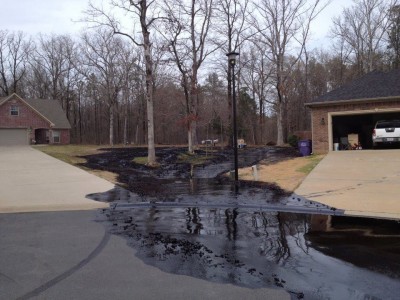
While not directly about Line 6B matters, we’ve encountered a number of tangentially-related material the past couple of days deserving of your attention, not least of which are some follow-ups to the awful spill in Arkansas, a terrible, vivid reminder of why all of us should be deeply concerned and continue to speak up and help foster public discussion of pipeline safety.
Some of our favorite journalists are on the case. Over at her “Riding the Pipelines” blog, Elana Schor provides some interesting— and disturbingly familiar to those who have read the NTSB report on Marshall–background on Exxon’s safety record with regard to the Pegasus line that just burst.
And Lisa Song, who has evidently been extraordinarily busy the past few days, has a terrific article at Inside Climate News linking the Arkansas spill to the recent petition to the EPA and PHMSA filed by the National Wildlife Federation and others for stricter regulations of tar sands oil transport. What caught our eye in particular was this:
The section of the pipeline involved in Friday’s spill in Arkansas was originally built in the 1940s, according to an Exxon spokesperson. The full length of the pipline was used to transport crude oil from Nederland, Texas north to Patoka, Illinois. After lying mostly idle for four years, the pipeline’s flow was reversed in 2006 to carry Canadian dilbit to Gulf Coast refineries. Exxon said the reversal was an industry first, and that it required 240,000 man-hours of work to accomplish.
That’s right: Exxon reactivated a 66 year-old, 20-inch pipe so that they could pump diluted bitumen through it, which must be sort of like sucking peanut butter through a paper straw. And of course, considering that there’s a soon-to-be-idle line in our backyard right now, these examples of pipeline reactivation make us very, very nervous.
Closer to Michigan, the Detroit Free Press has just run two very interesting articles: one about the state of gas pipelines in Michigan and the costs (and difficulties) in repairing them and the second about the dreadful regulatory situation regarding those same lines. The Freep had the good sense to call up our friends at the Pipeline Safety Trust. In the first article, Executive Director Carl Weimer points out the primary difficulty when it comes to repairing these lines (and ensuring public safety!): “What it comes down to in most every state we’ve looked into is, who is going to pay for that replacement?” he said. “It often gets passed along to ratepayers, and public service commissions hate to do that because they catch a lot of grief.” And speaking of the public service commission (which certainly wouldn’t want to catch any grief!) in the second article, the PS Trust’s Rebecca Craven (another of our heroes) notes that the commission’s general haplessness (that’s our characterization, not Rebecca’s) is compounded by the same woeful lack of staffing and resources that plagues PHMSA and agencies in other states:
“They [PHMSA] simply don’t have the number of inspectors they need to adequately oversee the amount of pipeline in the system, and states are in the same boat,” said Rebecca Craven, program director of the Bellingham, Wash.-based Pipeline Safety Trust, a nonprofit organization that advocates for improved energy transportation safety.
Up in Canada, there’s a great article in the Tyee about pipeline safety and landowner advocate Dave Core, who is the founder of the Canadian Association of Energy and Pipeline Landowner Associations (and yet another of our heroes!). Dave recently gave a presentation to a Canadian senate committee. What he had to say will surely resonate with most readers of this blog. Here’s a little taste:
“My goal this morning is to bring perspective to the issues of landowners when confronted by pipeline companies. That is, the issues when private property owners, like yourselves, come up against government supported and subsidized corporations that are allowed to come packing with government regulations to take our lands, our rights and leave us with annual risks, liabilities, a duty of care that we do not want, costs and the pipeline junk which includes the resulting safety and liability issues of historical contamination and pipeline collapse when the companies pack up and leave.
“Before I proceed I would like you to pretend you are sitting around a kitchen table with your family and a ‘land agent’ has just left you with a brown envelope with a Section 87 Notice, an NEB Regulatory Notice, stating that a pipeline company is going to put a pipeline in your backyard and the easement agreement and the compensation offer are included.
“The stress has only just begun. Next come teams of land agents, the men trained in profiling and in telling every tale they can to get the deal signed while they sit at your kitchen table drinking your coffee. He/she might even be your neighbour’s son or daughter. It is like you have stepped into a spaghetti western with cowboys coming to your door, not packing a gun, but a big smile, lots of lies and packing government regulations that allow them to threaten you if you question them.”
The rest of the article, aptly titled “Pipeline Company Bullies,” is well worth reading.
Also from Canada comes this interesting op-ed in the New York Times, providing a counterpoint to tar sands development boosterism.
And finally, one closer to home. The Livingston Daily Press & Argus ran an article a couple of weeks ago that slipped past our radar (thanks for sending it, Beth Duman!). It’s about the dissatisfaction of some landowners– those good people the Nashes and the Watsons– as construction nears completion. The bad news, however, is that even though the construction phase is coming to a close, a whole new round of likely headaches and difficulties is on the horizon: the restoration phase. You can bet we’ll be on the case.
by Jeffrey Insko | Mar 31, 2013 |
The Arkansas Spill
More details are emerging about the awful dilibt spill down in Arkansas. Lisa Song over at Inside Climate News is on the case. And to place the spill in some context– context which includes the Line 6B pipe moving more of the stuff through our properties– our friend Anthony Swift over at the NRDC Switchboard blog has a useful review of what we know and don’t know about transporting diluted bitumen.
Kalamazoo Cleanup
Speaking of Lisa Song, she also has an excellent report on the recent EPA order to Enbridge requiring more cleanup of the Marshall spill. Enbridge has agreed to comply with the order (there was some doubt about whether they would). It’s not clear whether this means they’re rethinking their claims about how the river is “cleaner than ever.”
Press for Tar Sands Petition
And speaking of concerns about dilbit, the tar sands regulation petition spearheaded by the National Wildlife Federation has received plenty of press of national attention (we participated in a telepresser on the matter just last week)– in New England, in Nebraska, in Minnesota, and in Indiana, where the Northwest Indiana Times has a report by one of our favorite reporters Lauri Harvey Keagle (and no, that’s not just because of the quote at the end of the article!).
More Weak Michigan Regulatory Oversight
A few weeks back, we linked to some potentially disturbing stories about piles of petroleum coke, a byproduct of diluted bitumen, piled up along the banks of the Detroit River. Since that time, the Michigan Department of Environmental Quality has apparently looked into the matter. But don’t worry, they didn’t look too hard. And they responded, true to state regulatory form, with little more than a shrug of the shoulders. Consequently, we recommend against consuming any walleye that comes out of that river.
More Michigan Townships Prepare for the Enbridge Experience
As for Line 6B matters, landowners and townships are preparing for their own encounters with Enbridge as work on phase two nears its commencement. If anyone knows anyone along the route, we hope you’ll share this blog with them; our mission has always been to help inform and protect landowners. For our part, we plan to send a note to Bruce Township Supervisor Richard Cory, who recently expressed some (reasonable, appropriate) concerns about how the project will affect residents. Those concerns were addressed by an Enbridge rep we’ve never heard of:
Supervisor Richard Cory said he was worried about some residents east of Van Dyke since the line will run close to septic fields and property.
Doug Reichley, Enbridge project manager, said Enbridge will work with consultants to have a permanent fix if something needs to be altered, even if it’s engineering a new septic field.
“Our whole point is to take care of these folks and make sure when we leave it’s as good or better than when we first got there,” Reichley said.
With that in mind, Trustee Paul Okoniewski asked if the company would cap 36 Mile Road with limestone from Dequindre to Van Dyke after running its equipment on it.
“It will impact the road with the construction and trucks,” he said.
Reichley said he and other representatives would bring it to the project director’s attention. Similarly, he said Enbridge will replace any torn up grass, trees or fencing caused by construction.
We’ve heard these sorts of assurances before– and we all know how that has gone. Incidentally, we’re most struck here by Doug Reichley’s remarks about replacing trees. We’ve looked into that matter and are working on an extended tree post. Stay tuned for that one in the coming days!
The Latest from Pat Daniel
Lastly, earlier this month, we ran across an article on former Enbridge CEO Pat Daniel, who was recently given the Canadian Business Leader Award from the Alberta School of Business. You might recall that, in our analysis, Daniel is the person most responsible for the callous, defensive and thin-skinned, insular corporate culture at Enbridge. Even in retirement, Daniel is true to form, as defiant and delusional (or perhaps just disingenuous or even dishonest, we’re not sure) as ever. Here’s what Daniel, nearly three years after the fact, has to say about Marshall:
And while pipeline opponents seem to have targeted firms like Enbridge, Daniel insists its green efforts “have not been forgotten by the people that matter.
“When we were in Michigan in 2010 (at the oil pipeline rupture site) one of the first things people who live there told us they did was Google Enbridge because they had no idea of who we were. And they got a very favourable impression when they saw the extent of our renewable and sustainable development.”
Daniel said the pipeline rupture “is less of an issue the closer you get to Kalamazoo and Marshall” because of Enbridge’s cleanup efforts.
That’s right. If you believe Pat Daniel, Marshall might seem like a big deal up in Canada, but down in Marshall, it’s all good. Just ask the people there: Beth Wallace, Susan Connolly, Deb Miller, Michelle Barlond-Smith (and lots of others) will surely tell you what a non-issue that spill is; they’ll eagerly tell you just how favorable their impressions of Enbridge really are.
Beyond Marshall, Daniel says “he can’t understand how opponents can delay pipelines, which mean congestion and much lower prices for Canadian crude”– a statement that once again just confirms everything we’ve said about him in the past. Of course he “can’t understand.” He can’t understand because he lives in a bubble, surrounded by yes-men, showered in praise and awards, completely and utterly isolated from ordinary landowners whose everyday lives are affected by Enbridge’s projects and practices. From all available evidence, Pat Daniel has never— despite what the corporate values developed under his leadership state– bothered to “take the time to understand the perspective of others.”
by Jeffrey Insko | Mar 17, 2013 |
While we were toiling away all last week at our regular job, a number of interesting Enbridge-related news items appeared. The most important of which, of course, is the new EPA order telling Enbridge they need to do more dredging to remove oil from the Kalamazoo River. Enbridge has 15 days to respond to the order, although indications are– judging from what’s coming out of Jason Manshum’s mouth– that they’ll be looking for ways to resist the order:
Enbridge spokesman Jason Manshum released a statement touting the progress of the cleanup to date and suggesting that “dredging and active recovery may cause incremental damage as determined by the U.S. EPA’s own Net Environmental Benefit Assessment.”
“The weathered and degraded oil remaining in the river is in extremely small concentrations found in the bottom sediments (and) is nonhazardous upon incidental contact according to the results of a study conducted by the Michigan Department of Community Health (MDCH).
Our favorite part of this is when Manshum then adds, by way of a complete non sequitur, “Furthermore, the drinking water from private wells near the river has been and continues to (be) safe for consumption, as verified by the MDCH”– something that is evidently true, but has nothing whatsoever to do with the EPA’s order for more dredging.
But of course, as we have pointed out before, Enbridge’s style of communication does not always adhere to the ordinary rules of rational discourse. For instance, Manshum’s statement about the EPA order also says that Enbridge is “focused on cooperation with the EPA and other authorities in doing what is best for the river and the environment based on analysis and sound science.” Yet Enbridge appears to have some slightly different ideas about what constitutes “sound science” than the rest of us. Case in point, a recent study commissioned by Enbridge that claims that dilbit floats in water– a rather startling claim given the fact the dilbit they spilled into the Kalamazoo River did NOT float. It sank. Which is why the EPA wants them to do more dredging.
Our friend Beth Wallace has a brief blog post about this matter over at Wildlife Promise.
In other news, the Lansing State Journal has an item about a potential problem over in Ingham County. According to the report:
Samples from a county drain are being tested after a sheen was detected on the water’s surface over the weekend near the Enbridge Inc. facility in southeastern Ingham County
As of Tuesday night, no petroleum had been detected, but testing was continuing, Deputy Ingham County Drain Commissioner Carla Clos said Tuesday afternoon.
“At this point, we don’t really know what it is,” Clos said. “(The tests) are not showing anything to be worried about.”
For our part, we have our doubts that there’s anything much to this. At the same time, we also have our doubts about what’s coming out of the mouth of our old pal Larry Springer, who, by way of offering reassurances, tells us it might just be… um, decaying leaves:
Many things other than petroleum can cause a sheen on water, including decaying leaves, and there was no indication of an oil or gas leak, [Larry] Springer said.
But in both cases, we admit, we don’t really know. We hope that local and state officials continue to monitor the matter closely.
Moving north, there are a couple of interesting items out of Wisconsin. A state Court of Appeals has ruled that a family can pursue a trespass claim against Enbridge for allegedly exceeding the easement rights they have on the family’s land. The ruling means that the family could force Enbridge to remove pipelines they’ve installed on the family’s property.
In unrelated news, Enbridge wants to upgrade its pipeline capacity from Canada to Superior, Wisconsin— to transport diluted bitumen. In order to do so, they must seek permission from the State Department, since they’ll be transporting oil across a border. Can anyone say “Keystone XL“?
Even farther north, up in Canada (unless we’re accused of being unfair!) comes this heartwarming article about what great neighbors Enbridge has been while working on Line 9.
By way of counterpoint, closer to home residents over in Rose Township, just to our west, haven’t had quite the same pleasant experience. The Tri County Times this week has the story of some construction trouble in that area. Resident Ellie Vance has some positive words to say about Enbridge’s contractor, but not so much for Enbridge and its ROW agents:
One supervisor with Precision Pipeline has picked her up personally from her door with a golf cart to take her out to her car, which is marooned on the other side of the construction. She has enjoyed dealing with the Precision Pipeline, the group carrying out the work on the pipeline that Enbridge owns. She does not, however, like working with Enbridge. She has been through two land agents, and said the recent land agent has been very brisk.