by Jeffrey Insko | Feb 21, 2013 |
This week (or so) is just about (we don’t remember the precise day) the one year anniversary of the day an Enbridge ROW agent showed up at our door (yes, armed with condemnation papers– even though at that time Enbridge had not technically been given that power yet. But what did we know, all green and wet behind the ears?!). Looking back on the year that has been, we can’t say we’d want to relive it all over again. But it has had its bright spots: as we’ve said many times, we’ve gotten to know some really marvelous people. And, at the very least, it’s been awfully interesting. How much we’ve learned!
It has also, at times, been more than a little weird. In fact, we’ve got and handful of weird items to share. We’ll start with just one and save the others for later posts:
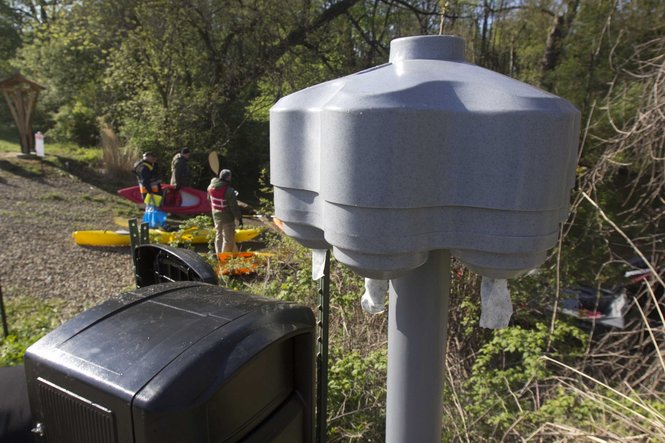
First up, some old news that we were reminded of this morning during Nate Pavlovic’s excellent Line 6B webinar. (If you missed it, the recording is available now. It’s well worth your time, especially if you’re in Indiana). Anyway, Nate included a picture of one of the oddest things that’s come out of the Marshall spill. When the Kalamazoo River reopened last summer, containers were installed along the riverbank containing wipes, so that when swimmers and boaters get out of the river they can clean the oil off of themselves and their vessels. It’s just like nature intended! Come to think of it, maybe these wipe dispensers are what those political staffers we spoke to were talking about when they told us the Kalamazoo River was cleaner than ever— a phrase that was surely picked up from Enbridge.

by Jeffrey Insko | Feb 8, 2013 |
Some interesting articles have appeared over the past couple days. Over at Inside Climate News, their crack staff of reporters continues to do great work. Lisa Song has two excellent articles. The first is on the MPSC’s phase two approval. A couple of choice quotes:
“I am concerned with the haste with which this project has proceeded,” said Jeff Insko, an English professor at Michigan’s Oakland University who started the Line 6B Citizens’ Blog for concerned landowners. “It’s been fast-tracked both by Enbridge and the regulatory body here in Michigan. And given Enbridge’s history in our state, it seems to me prudence and caution ought to guide us, and they haven’t.”
And this excellent bit from our friend attorney Kim Savage:
Savage once worked as an attorney for gas and electric utilities. At her old job, she said, it was a “terminable offense” to mention condemnation while negotiating for a voluntary easement. “The course Enbridge is taking is shocking, having worked on the other side,” she said.
Song’s second article is a disturbing tale of lax regulations of the pipeline industry. Check this out, for instance:
In 2010, after a massive oil spill in Michigan’s Kalamazoo River, pipeline operator Enbridge Inc. initially reported to PHMSA that the accident occurred at 11:41 a.m. on July 26, which is when the company discovered the spill. It was soon determined that the spill actually happened 17 hours earlier, but Enbridge’s subsequent reports did not correct that inaccuracy.
The timing discrepancy was highlighted last summer, when PHMSA fined Enbridge $3.7 million for breaking 22 federal rules during the Kalamazoo spill, including $100,000 for reporting the time of accident as “11:41 on July 26, 2010, when it had been clear within hours of discovery that the failure date and time was approximately 17:58 on July 25, 2010.”
Despite that fine, Enbridge did not correct the error in its most recent report to PHMSA, filed less than two months ago.
Elsewhere, apparently Enbridge is telling some tall tales about the behavior of dilbit in bodies of water–as if nobody has seen what happened in the Kalamazoo River. And the same newspaper, the Vancouver Sun has launched an excellent new series, the first part of which is an introduction to Enbridge. The portrait is not that pretty.
From over in Niles, Michigan, here’s a tv report about Line 6B’s path through a family farm.
Finally, over at MiLive, they’re hosting a live chat with Congressman Mike Rogers today at 10:30 am. Personally, we think Rogers’s silence and lack of leadership on Enbridge and Line 6B is shameful and unforgivable. Unfortunately, we’ll be on the road this morning and won’t be able to make that chat, but if you get a chance to participate and ask him why he’s been almost completely silent on an issue of great importance to his constituents, we’d love to hear a report of his response.

by Jeffrey Insko | Feb 6, 2013 |
It’s no secret that we’re big fans of Beth Wallace of the National Wildlife Federation; she’s one of the many fine people it’s been our good fortune to get to know since Enbridge entered our lives. Beth is a dogged advocate for Great Lakes region conservation and the protection of Michigan’s natural resources. She’s also been a thoughtful and valuable critic of the way Enbridge has conducted its business in this state in the wake of Marshall and beyond. And she has been a trusted advocate for landowners on the Line 6B project.
So here’s something cool: we all have a chance to express our gratitude to Beth for all of her hard, committed work– by helping her to win a “Telly” for the video NWF made about Beth’s pathway into activism. Just follow this link to give the video your “thumbs up.“
by Jeffrey Insko | Feb 4, 2013 |
Back in September, we attempted to formulate the problems we have with Enbridge’s Line 6B project in a single, succinct sentence. We came up with this:
Enbridge has run roughshod over the citizens of the state of Michigan and our state elected officials have stood by idly and allowed it to happen.
A couple of weeks later, we revisited that statement in a post discussing the fruitlessness of our many attempts to convince state elected officials to take some notice. The only outspoken voice we have encountered has been Lance Enderle, who unfortunately failed to unseat Mike Rogers-– a man who has been no advocate for landowners and no critic of Enbridge.
Now, just to be clear: this is a nonpartisan blog. It’s not that we don’t have political convictions (trust us, we do!); it’s that in our view everyone, regardless of political affiliation should be concerned with property rights, with the behavior of multinational corporations, with the protection of Michigan’s priceless natural resources. And when it comes to those matters, we will call them like we see them.
And today, we are exceedingly pleased to heap some praise upon a couple of Michigan state legislators who spoke up just last week– are you ready for this??!!– criticizing, forcefully, the activities of Enbridge in our state. Honestly, we were bowled over! Who are these brave souls and what did they say? They are state representatives Tom Cochran of Mason and Kate Segal of Battle Creek, who issued a stinging press release calling for some much needed (we would even say belated!) Enbridge vigilance. Here’s Cochran:
“Enbridge has earned a bad reputation in our state by allowing its pipeline to spill onto Michigan’s soil and pollute our water for 18 hours before taking action to stop the massive spill,” Cochran said. “Enbridge spilled as much as a million gallons of oil, resulting in the evacuation of about 50 families and a $3.7 million fine from the U.S. Department of Transportation. Enbridge’s track record in Michigan has been literally disastrous.”
Not bad, that! What’s more, it appears that Cochran even read the NTSB report and understands that we cannot forget about what happened in Marshall! But then Kate Segal’s remarks might even be even better:
“When Enbridge completes this massive new project, they will have nearly tripled the capacity of their old pipeline without going through a comprehensive review process or completing critical environmental impact studies. They have rushed forward with this replacement line in a piecemeal fashion in order to circumvent federal reviews and standards,” Segal said. “Worse, Republicans in Lansing have passed laws that reduced state oversight of corporate cleanups and weakened polluter pay laws, and the Michigan Public Service Commission simply does not have the resources or power to sufficiently assess the project. This makes it harder to keep Michigan pure and clean. Rather than relaxing environmental regulations on corporations that pollute and fast-tracking projects for a company that has already irreparably damaged our pristine environment, we should be demanding tougher laws that hold big companies and special interests accountable.”
Segal hits a few of the most important points that we, and others, have been talking about for months: the haste with which the project has proceeded, its evasion of federal oversight, and the woeful state of regulations in Michigan. Our only real quibble here is that Segal is a bit too soft on the MPSC. We don’t doubt that it’s true that they need more resources. But they also clearly need more will; as far as we’ve seen– and we’ve been thinking about them a lot lately— there have been no indications that they’d like to take a tougher line on Enbridge. Quite the contrary.
Nevertheless, we applaud Kate Segal and Tom Cochran most enthusiastically. You can bet that we’ll be reaching out to them and encouraging them to take further action. We encourage you to contact them as well. The more public interest wind we can put in their sails, the more likely they’ll be to take meaningful steps to protect landowners and our natural resources.

by Jeffrey Insko | Feb 4, 2013 |
Over at the Detroit Free Press, Eric Lawrence, one of our favorite reporters, has a follow-up piece to his article a few days ago on last week’s MPSC decision. In this one, he says that we “blasted” the MPSC. We thought our comments to Eric were rather more subdued than that. Rather, it’s in our recent post on the MPSC ruling where we really blasted them. Among the things for which we blasted them was the commission’s astonishing claim that the intervenors’ attempt to introduce the NTSB report into the proceedings was a “red herring.” How a discussion of the federal report on the incident that led to this project in the first place can be described as intentionally misleading– because to intentionally mislead is what the red herring metaphor means– is almost beyond comprehension.
Which makes the most interesting parts of today’s article (in our view)– the ones where Lawrence quotes a couple of satisfied landowners– especially illuminating. These two landowners provide perfect illustrations of real red herrings.
First up is “Chip Rascher of Oakland County’s Brandon Township.” Chip “said he is pleased the project was approved.” Chip goes on to say that:
he was compensated fairly and expressed surprise that there has been so much “fussing” from some landowners. He said they should have known about the pipeline easement on their properties.
Now, let us say clearly that we’re glad Chip Rascher thinks he was compensated fairly. We’ve never doubted that plenty of landowners have had good experiences on this project. We just wish that were the case for everyone. Chip, on the other hand, seems to think that his experience somehow does stand for everyone’s, which, we are sorry to say, makes his view slightly narrow. After all, it’s really not that hard to imagine that somebody’s experience is different from your own, is it?
But that’s not the red herring part. The red herring is when Chip says that other landowners “should have known about the pipeline easement on their properties.” With all due respect to Chip, this is a pretty silly remark. Whether or not one knew about the pipeline on one’s property (and unlinke Chip we’re assuming everyone did know!) has never been the issue. That’s what makes his statement misleading. We have never heard anyone say, “hey, stop this project! this is the first I’ve heard about a pipeline easement on my property!” Conveniently. his statement makes Chip look like he understands something all those other people do not.
But perhaps Chip Rascher has never had occasion to speak with many of the people we’ve met: people who are not unhappy because Enbridge has an easement on their property, but people who are unhappy with how Enbridge has tried to exercise (or in some cases to overstep) its easement rights. Moreover, in many, many instances Enbridge has needed to acquire new easement rights– that’s what has been a bone of contention for many landowners. More moreover, there is the sticky matter, not of easement rights, but of Enbridge’s need for and taking of “temporary workspace.” And none of this even gets to the matter of how landowners and municipalities have been treated by ROW agents, Enbridge representatives, and construction crews– that is, the way that Enbridge has conducted itself throughout this process. Over the past several months, we have documented dozens of reasons why there has been “fussing”– and not one of those reasons has to do with people not knowing about pipeline easements on their properties.
So, to pretend like all of the “fussing” has only to do with Enbridge’s existing easement rights on people’s property is profoundly misleading; it is, well, a red herring.
The second landowner Eric Lawrence quotes is Enbridge mascot, Michael Milan. You remember him: he’s the rugged fellow with the cool camouflage jacket who also just happens to be a real-life doctor— the guy Enbridge has featured in some of its ads and brochures. And what does the good doctor have to say? Well, there’s this:
“We need all the oil we can get, and the more oil delivered to refineries in the Midwest the less we pay for gasoline,” he said, noting the new pipeline will be an asset. “The quicker we get the old pipe out of commission, the less likely we are to have any more spills.”
On the first point here, Milan is just plain wrong. Neither Enbridge nor Marathon– the company with the Detroit refinery where some of Enbridge’s tar sands oil will go– make any claims that this oil will reduce gas prices. In fact, here is what Marathon says in the FAQ at their “Heavy Oil Upgrade Project” website on that very point:
Will this result in lower prices for gasoline and other petroleum products from the refinery?
We cannot predict the price of gasoline or other petroleum products. Gas prices are determined by a variety of market factors. However, this project will help secure the supply of petroleum products for the state of Michigan by offering an alternate supply source (Canada) whose continuity is not impacted by the weather issues that affect the U.S. Gulf Coast.
But being wrong is not a red herring; it’s just being wrong. It’s Milan’s second statement that gets us closer to the red herring. We should note first of all that Enbridge asserts that the old pipeline is not really at risk of any more spills. If it were, one would assume that it wouldn’t currently be in use (and it is currently in use!). Rather, Enbridge just states that the new pipeline will allow them to increase capacity– a a claim we certainly do not dispute. Enbridge also says the new pipe will be safer– another point which nobody disputes. After all, compared to a 40 year old pipe, how could it not be safer? So, one point here is that Michael Milan, while he might be a good “face” for Enbridge, what with his medical degree and his hunting gear, doesn’t seem to have a terribly firm grasp of the basic facts of this project.
But what’s really misleading here is the way that Milan’s comments– he describes himself as a “supporter of the project”– imply that other people are “opponents” of the project. But as we have stated time and time and time again, we do NOT oppose the replacement of Line 6B. We don’t know anybody who is against Enbridge getting a new pipeline. To suggest otherwise in the face of repeated clear and unequivocal statements to the contrary (Beth Wallace of the NWF was crystal clear about this recently in the San Francisco Chronicle) is either just obtuse or intentionally misleading– a red herring.
by Jeffrey Insko | Feb 3, 2013 |
Last week’s MPSC ruling– which we’ve already discussed at length— has received plenty of press, though not much of it is particularly detailed. We already linked to Eric Lawrence’s article in the Detroit Free Press (Lawrence understand the importance of the NTSB report!). Over at MiLive, they’ve run two articles about the ruling. The first contains a couple of gems from our old friend Jason Manshum. There’s the familiar condescending Enbridge chestnut about how people use petroleum products in their everyday lives:
“This is all about meeting demand in the region, specifically Michigan,” he said. “We (consumers) are using more fuel and products that come from petroleum.”
And then there’s the fuzzy, evasive claim about all the jobs this product is going to create:
The project should provide about 1,000 temporary and permanent jobs, Manshum said.
We’ve already discussed how this claim is at best disingenuous. Notice the equivocation of Manshum’s “should” there. And notice how Manshum does NOT say that these will be Michigan jobs. And notice that he says nothing about how many of those will be temporary and how many permanent.
The other MiLive article gives us a statement from an MPSC spokesperson:
“The commission took a very long and hard look at the entire record of the case, and they did determine … that the pipeline will serve a public need, that it is designed and routed in a reasonable manner, and that it meets or exceeds current safety and engineering standards,” said MPSC spokeswoman Judy Palnau.
Please take note and remember this three-part standard here. As we’ll discuss at length in the next installment of our newest series, this is very important. And the fact that the Judy Palnau has gone out of her way to emphasize it– effectively making it a talking point–only goes to show how central this framework has become for this case. Here’s the teaser: Enbridge created this framework.
In The Macomb Daily, Frank DeFrank cites the same three criteria at the end of his article. He also spoke with Armada Township supervisor John Patarek, who says that he:
has met with Enbridge officials and Paterek said company officials have communicated well with residents and township officials “so far.”
We hops that “so far” is an expression of caution, or better, of skepticism. We also hope that he’s spoken with his peer Kathy Thurman.
Beyond Michigan, the San Francisco Chronicle has a nice piece on the news. They had the good sense to call our friend Beth Wallace, who is clear, smart and on-point as always:
The National Wildlife Federation, one of the environmental groups that criticized Enbridge for the spill, said it was disappointed that the Michigan commission approved the permit. While replacing the pipeline is a good idea, the company shouldn’t have been allowed to divide the project into segments, which enabled it to avoid a more stringent federal review, said Beth Wallace, the federation’s Great Lakes community outreach adviser.
“There would have been more public input as well as a long-term environmental impact assessment” if the federal government were involved, Wallace said.
Finally, not directly related to the MPSC decision, check out one of our favorite Enbridge-made activists the irrepressible Michelle Barlond-Smith, who was up in Canada last week telling it like it is, as she always does. Go Michelle!
by Jeffrey Insko | Jan 28, 2013 |
The crack staff of journalists at Inside Climate News— this time, Lisa Song– continues to do outstanding work. This morning comes another excellent article. It seems that Enbridge is not too keen about having to perform more cleanup of the Kalamazoo River. Not surprisingly, that doesn’t sit too well with our friend Deb Miller, on point as always:
We were promised this would be made whole, that the river would be made better than it was before…In my mind, it comes down to a bottom line. They don’t want to put the money into dredging.”
On the bright side, Enbridge did recently write a big, fat check to the Calhoun County Trailway Alliance. So that’s something.
We were also interested in this story, of a religious retreat center that recently withdrew its petition to intervene in Phase Two. Why? Well, pretty much because of Enbridge’s overwhelming power and MPSC complicity (about which, by the way, we’ve had some things to say recently):
“It became really quite clear that [Enbridge] was sure of getting a permit,” [Center director Naomi] Wenger said. She and her colleagues felt anything they did would simply delay the inevitable. Lack of resources to hire a lawyer was also a factor.
Finally, while not directly related to Enbridge or Line 6B, we found this New York Times article on some of the unintended consequences of oil production in North Dakota rather alarming. (And you know whose pipelines transport much of that oil.) We can’t help but note a strange omission from the article, though: couldn’t some of those oil companies just offer health care to their workers?!

by Jeffrey Insko | Jan 25, 2013 |
We work pretty hard here at the Line 6 Citizens’ Blog to keep our cool. It’s not always easy. Case in point: yesterday, we linked to a recent editorial piece by Doug Ross of the Times of Northwest Indiana. To be frank, the piece is so bad, so reliant upon Enbridge talking points (he appears to have taken almost everything he says from one of Enbridge’s brochures, like this one) , and demonstrates such an astonishing ignorance of even the most basic facts of the Line 6B “replacement” project and citizen concerns about it, that we could hardly believe a reputable paper would publish such a thing (and make no mistake about it, reporters at that paper have done some excellent work).
What doesn’t Doug Ross understand? Let’s take a look:
The most extraordinary thing about Ross’s op-ed is that there is no mention whatsoever of Marshall. Ross seems to think that Enbridge just one day decided to make an enormous capital investment in a new pipeline because they just care so much about safety. Here is what Ross says:
The company should be commended for recognizing the need for a new pipeline, to both minimize the danger of leaks and to increase the flow capacity.
Enbridge “should be commended for recognizing the need for a new pipeline”? Honestly, in the six months or so since we started reading, researching, documenting and discussing all things related to Line 6B, this has got to be the most extraordinary statement we’ve heard yet. Ross seems to be suggesting that the replacement project is some sort of preemptive action on the part of Enbridge, when in fact everybody knows– everybody, that is, except Doug Ross– that the ONLY reason Enbridge is replacing Line 6B is because in 2010 the old pipeline ruptured, spilling more than a million gallons of diluted bitumen into Talmadge Creek. Prior to that spill (frankly, it makes us angry to have to rehearse this yet again), Enbridge disregarded known defects in the pipe. Why? That’s not entirely clear, but one reasonable theory is that it’s because they did NOT want to make the sort of capital investment they would have had to make to repair those defects.
But what about after the spill– the most expensive inland spill, we would remind Doug Ross, in U.S. history? Did Enbridge then “recognize the need for a new pipeline”? Well, no, they did not. In fact, just two weeks after the spill, Enbridge sought permission from PHMSA to restart the line. And PHMSA denied their request, finding Enbridge’s plans for a safe restart inadequate. Soon after this, Enbridge began a number of “integrity digs” to replace or repair sections of the pipe here and there along the route (including in our neighborhood). It wasn’t until later, in August of 2011, that Enbridge applied to the Michigan Public Service Commission to “replace” the pipeline. Why? Well, Enbridge likes to say it’s because replacing it would mean fewer maintenance activities on the old pipe and less disruption to landowners (which may or may not be true)– a claim that Ross is all too happy to parrot: ” Installing a new pipeline means less maintenance, so there would be fewer disruptions to property owners,” Ross writes.
But more importantly, the real reason Enbridge decided to replace the pipeline had very little to do with landowner disruptions or safety and everything to do with making money. Here’s what Enbridge says in their application to the MPSC:
Enbridge has conducted numerous discussions and meetings with its shippers regarding their current and future transportation requirements on Line 6B. These discussions have played an important role in Enbridge’s decision to replace the remainder of the Line 6B pipeline segments because shippers have expressed a present need for additional pipeline capacity. However, with Line 6B expected to operate at pressures below the previous maximum operating pressure, the available pipeline capacity on Line 6B would be reduced. By replacing the remaining segments of Line 6B with new pipeline, Enbridge will be able to achieve the original ultimate capacity and also provide the pipeline capacity necessary to meet its shippers’ current transportation requirements.
What’s interesting here, however, is what Enbridge does NOT say. Why was the existing “Line 6B expected to operate at pressures below the previous maximum operating pressure”? Enbridge’s way of putting this makes it seem like that is a fact beyond anyone’s control, as if operating pressures just sort of ebb and flow like the tides. But the truth of the matter is that Enbridge was under a corrective order from PHMSA to reduce operating pressure. And why were they under that corrective order? Because the pipeline had just ruptured and spilled over a million gallons of diluted bitumen into Talmadge Creek!
So no, Enbridge ought NOT to be “be commended for recognizing the need for a new pipeline.” They were forced by circumstances–circumstances created by their own neglect and operational failures, according to the NTSB– and by financial exigencies to replace the pipeline. Had Marshall never happened, you can bet that there would be no replacement project.
Let’s consider some of Ross’s other claims. Ross says that “What has brought so much public attention to this project is the need to expand the easement through people’s yards and fields.” This is only partially true. Certainly the expansion of the easement is a (totally valid) concern for many landowners, one to which Ross appears not to have given much thought. In some cases, that easement is astonishingly close to people’s homes; in other cases, it will disrupt portions of people’s property– trees, gardens, and other spaces– that mean a great deal to homeowners. Yet even considering that, the real problem isn’t that Enbridge needs (or wants) additional easement rights. The problem is the way they’ve gone about acquiring those rights in so many cases: strong-arming landowners, negotiating in poor faith, misleading and misinforming people. Stories of bad behavior and bad faith dealings abound along the Line 6B route; we’ve documented many of them here (and heard dozens more that we have not written about).
What’s more, the additional easement is just one of the many things that “has brought so much public attention to this project.” There’s also Enbridge’s use (or taking) of additional temporary workspace, their flouting of local ordinances and state laws, their general litigiousness, their refusal to meet and talk with local municipalities (until forced to do so), their unfair and disrespectful treatment of landowners and local officials, their violations of construction agreements— all the things that we and others have been documenting for months. Has Doug Ross bothered to look into any of this? Did he have even one conversation with anyone other than Tom Hodge and Enbridge spokespersons before writing his editorial?
Oh, but there’s more. Ross also repeats Enbridge’s claim that “building the new pipeline will create more than 1,000 temporary and permanent jobs, which,” Ross says, is “a big plus in itself.” Ross seems to think that these will be local jobs, even though Enbridge doesn’t even make that claim; instead, they just say, vaguely, that “Many workers will be drawn from the local workforce.” How many? It’s impossible to say. Enbridge can’t (or won’t) even say. They only speculate with the help of some mathematical magic. (Unscientifically, we can tell you that we’ve spoken to about 30 construction workers in our area and so far only 3 have been from Michigan.) At best, Enbridge’s claims of job creation and local economic benefits are unverifiable– and thus hardly a basis upon which to build a trenchant argument in support of the project– unless you’re as gullible as Doug Ross.
Two quick final points:
Cheerfully, Ross says that “This is a necessary project, and public input — which Enbridge has sought out and is receiving — is essential.” It is true that Enbridge has done a relatively good job seeking public input in Indiana with regard to Phase Two of the project. But it’s pretty clear to us up here in Phase One– where Enbridge did no such thing— that they’ve done so mainly because of all the push back and bad press they’ve received. In other words, the public input they’ve sought in Indiana is, in part, just damage control.
Lastly, Ross says that the Line 6B project “is not the Keystone XL pipeline, but a smaller project with major economic and environmental potential,” which once again just goes to show how little he really knows about this. As one of the commenters to his op-ed notes, Line 6B is part of one of the largest crude pipeline systems in the country and will be transporting the same tar sands oil that has been the source of such concern about Keystone.
So what to take away from all of this? The point of this post is not really to argue that Doug Ross is wrong. After all, his version of this matter is so simplistic as to make that a moot point. As we have said countless times, we ourselves do not “oppose” the replacement of Line 6B. Rather, the point of this post is that Doug Ross doesn’t really know what he’s talking about. He does not appear to understand the history or the context of the project; he doesn’t show that he understands the range of concerns that reasonable people have about the project; and he seems not to have made the slightest attempt to verify or question in any way the claims made by Enbridge about the project. And yet, despite all of that, he still thinks he is in a position to make confident pronouncements about it.
by Jeffrey Insko | Jan 24, 2013 |
Way back at the beginning of October, we submitted an op-ed piece to Doug Ross at the Northwest Times of Indiana. The editorial board obviously decided against running it. And, evidently, they didn’t bother to read a word of what we’ve been documenting on this blog all these months. What leads us to that conclusion? Why, this simplistic, credulous, ill-informed op-ed by that same Doug Ross.
You can bet we’ll have some things to say about it (when time allows).
by Jeffrey Insko | Dec 27, 2012 |
Apparently, “fuming” Line 6B landowners made for the fifth biggest story of the year over at the Livingston County Daily Press & Argus. We will say this much: Christopher Behnan stayed on the story like few other local reporters (Susan Bromley and Eric Lawrence excepted). And the story made hardly any impression at all over at The Oakland Press, which is one of the great mysteries (and travesties) of the year in local journalism as far as we’re concerned.
But the Daily Press headline does have us wondering one thing: have we been fuming? Do we fume here at the Citizens’ blog? (Privately, it’s another matter altogether…)
