by Jeffrey Insko | Dec 4, 2020 |
Another day, another hour of my time wasted typing up the same blog post I’ve been typing up for more than 8 years now. Enbridge, once again, has been fined for a series of safety violations. Ace reporter Mike Soraghan has the story at E&E News. Unfortunately, the article is behind a paywall and who knows whether any other outlets will even bother to pick it up. This sort of thing happens with so much frequency when it comes to Enbridge that everybody seems completely numb to it. We’re all expected just to shrug our shoulders, look away, and move along. Meanwhile, Enbridge gets to start construction on Line 3 in Minnesota despite the ethical opposition of tribal and citizen groups. And here in Michigan, people who are supposed to be stewards of the public trust not only take seriously Enbridge’s absurd tunnel plan, they actively work to support it.
The violations, if you’re interested in the details, involve all sorts of things: failing to do a required review after a leak, not following up on aerial patrols, and in one case, federal regulators discovered exposed sections of pipe that lacked appropriate anti-corrosion coating.
These are all serious matters; if they weren’t, there wouldn’t be regulations that are supposed to enforce compliance with them. But what does Enbridge have to say about this? The same old bullshit. Rather than taking responsibility, they wave it off as no big deal and blow the same smoke they always blow:
“It’s important to note that none of the findings show or pose an immediate safety concern,” said Enbridge spokesman Michael Barnes. “Enbridge takes our responsibility to operate pipelines in a safe manner seriously, and we are committed to working with our regulator, PHMSA.”
In other words, “nothing to see here,” Enbridge says, again. But this enforcement action from PHMSA– a notoriously toothless agency, it must be said– comes just months after the EPA fined Enbridge $6 million for a bunch of things that Enbridge likewise treated as No Big Deal. PHMSA has proposed $122,000 in fines, which is itself a joke. That kind of money is lying around as loose change in the break room at Enbridge’s corporate office. If you open your windows, you can probably hear Enbridge executives and attorneys giggling over this right now.
Which is simply to point out that there are no real consequences for these repeated failures and violations. They’re unlikely to be taken up, for example, in any of the legal proceedings Enbridge is currently embroiled in with the state of Michigan. A discussion of this pattern of violations, part and parcel with Enbridge’s pattern of dishonesty, surely won’t be admissible in the MPSC proceedings, which are hamstrung by the narrow framework Enbridge successfully imposed upon those proceedings. And none of this will make any impression whatsoever on the gullible shills in the Michigan legislature who hungrily swallow whatever hollow claptrap Enbridge serves up to them about how they’ve learned so many lessons since 2010.
But Rebecca Craven of the Pipeline Safety Trust isn’t having it:
“If this has been their dramatic improvement since then that makes me more worried.”
There are maybe a handful of people on the entire planet who know more about these matters than does Rebecca Craven. You’d think people might want to listen up. But will anybody else, most importantly anybody in a position of authority in Minnesota or Michigan or Wisconsin, share her worry? Will anyone else share my outrage? I’ve about exhausted my supply.
by Jeffrey Insko | Nov 26, 2020 |
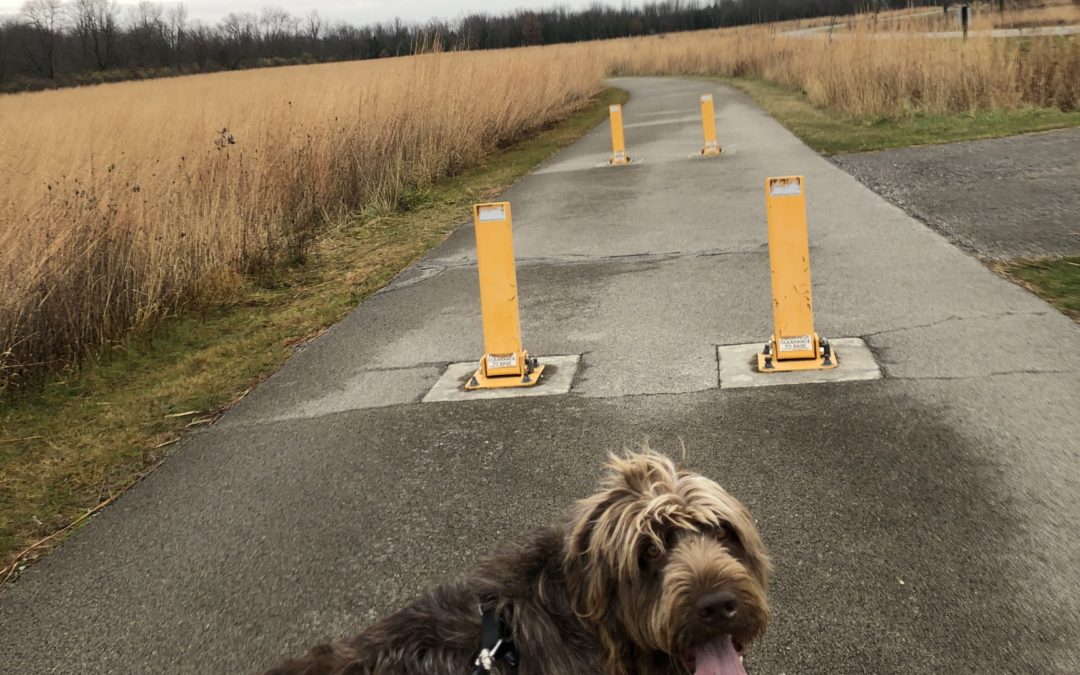
Took a morning run with my dog Murphy today on the land of the Potawatomi now called northwest Indiana and found myself thinking how grateful I am for all of the water protectors and land defenders and fire keepers out there, all the pipeline fighters and safety advocates, the climate activists and the keep-it-in-the-grounders, the disgruntled landowners and outraged citizen activists, the passionate young and the resilient old, the nature lovers and the lovers of the Great Lakes, the birders and the wildlife conservationists, the tree huggers and hippies and greens and enviros, the lefties, socialists, commies, and EJ- and SJ- and eco-warriors, the environmental attorneys and the environmental humanists, the long-sighted policy makers and the direct action activists– all the people undeterred by the unimaginative naysayers saying what can’t be done, the people working instead to ensure a habitable planet for the future and trying to envision and build a more just world devoted to the collective, mutual, interconnected flourishing of all human and nonhuman life. I see you. I give you my thanks.
by Jeffrey Insko | Nov 13, 2020 |
By now, you’ve probably heard the day’s amazing news: Governor Whitmer has notified Enbridge that the state is revoking its easement to operate Line 5 in the Straits of Mackinac (coverage here and here and here) This is a rare act of remarkable courage on the part of a strong, far-sighted governor.
And as always, I try to read up on the details so you don’t have to. I am happy to report that AG Nessel’s filing on behalf of Governor Whitmer seeking injunctive relief for the state’s notice to revoke the Line 5 easement is absolutely devastating. Hastily composed, here are some highlights:
The state revokes the easement on two grounds. First, for violating the public trust. And secondly, for violations of the easement’s “due care” clause. The latter is the more powerful charge in my opinion. Its enumerations are scathing.
- The complaint states that “has persistently and incurably violated its due-care and specific compliance obligations under the Easement.” For instance, the easement stipulates pipeline supports every 75 feet. Yet “for virtually the entire life of the Easement, Enbridge disregarded its obligation to comply with the 75′ pipe span requirement, and even failed to take corrective action when pipe spans exceeded 200′ in length.” When it comes to supports, the AG says, Enbridge has “exhibited an astonishing lack of candor and indifference to its due-care obligations under the Easement.”
- The easement also requires Enbridge to maintain protective coating on the pipeline. Yet, “by failing to undertake a detailed examination of the condition of the pipeline coating/wrap despite being on notice of the need to do so for 13-14 years…..evidences a pattern of indifference to, and violation of, the conditions of” the easement
- The easement also has specific requirements regarding the curvature of the pipeline. But “Enbridge ignored the pipeline curvature mandate of… the Easement, perhaps from the very beginning… Noncompliance with the curvature condition continues today and remains uncorrected.
- The bottom line is a version of something I’ve been saying about Enbridge in various contexts for many years: “There is nothing Enbridge can do to change its past behavior and callous disregard for its duties under the Easement, and its breaches of the Easement’s terms and conditions cannot be corrected or otherwise cured.”
Lastly, I don’t want to neglect entirely the public trust argument, which is also strong. The AG notes that the state has an obligation to protect the public trust, including the Great Lakes. However, the complaint states “Recent events have made clear that continued operation of [Line 5] cannot be reconciled with the State’s duty to protect public trust uses of the Lakes from potential impairment or destruction… transporting millions of gallons of petroleum products…..each day through two 67-year-old·pipelines that lie exposed in the Straits… presents an extraordinary, unreasonable threat to public rights b/c of the very real risk of further anchor strikes… and the foreseeable, catastrophic effects if an oil spill occurs at the Straits.”
As far as I know, Enbridge has yet to respond publicly. I’ll be sure to provide more summary and analysis as this matter unfolds. For now, we should feel really great about the state’s strong executive leadership. Thank you, Governor Whitmer. And congratulations to all the amazing individual and groups who have worked so tirelessly for so long to get us to this point!

by Jeffrey Insko | Oct 23, 2020 |
Last night at their Virtual Community Meeting Enbridge, once again, misinformed the public. Now, perhaps you find that as unsurprising as the rising and the setting of the sun– and that sort of response is justifiable. But it’s important not to accept this as a natural phenomenon; it’s important not to normalize Enbridge’s persistent failure simply to tell the truth. So let me explain what happened and then I will explain why it matters.
After a boilerplate presentation, Enbridge accepted questions from attendees. At one point, a questioner asked why Enbridge misrepresents their safety to protocols in the media to appease the public. But this was not precisely the question the Enbridge moderator asked. Instead, despite the questioner’s request that the question be read just as it was phrased (I know this because the questioner, who was not me, happens to be a friend of mine), the moderator re-worded it into a more anodyne question about Enbridge’s safety systems. That’s bad enough.
But the response to the question was even worse. (And here let me say that I could name the Enbridge rep who answered this question but instead I’m just going to say “Enbridge” because this issue of not telling the truth is not an individual problem. It’s systemic; it is, in fact, endemic to the way Enbridge communicates with the public). At any rate, in response to this question, Enbridge offered up some familiar platitudes about how the 2010 spill had forever changed them. Then, as an example of how they’ve changed, Enbridge said they have instituted a 10-minute restriction: a rule that says if they can’t identify and resolve a problem with a pipeline for which they’ve received a warning within ten minutes, they will shut the line down until the problem is resolved. Enbridge added, explicitly, that they did not have a 10-minute restriction in place in 2010.
But this is patently false! Enbridge most certainly had a ten minute restriction in place in 2010. In fact, what makes this falsehood particularly striking is that the ten minute rule was a major point of discussion in the NTSB report outlining Enbridge’s failures in 2010. The NTSB cited that rule as of the prime examples of Enbridge’s “culture of deviance” from their own safety protocols and systems. In addition, the ten minute rule wasn’t even new then. It had already been in place for almost 20 years, instituted in 1991 after another Enbridge oil spill in Minnesota. I wrote about this at length eight years ago as an illustration of how Enbridge does not change, does not learn from their mistakes. You can check it out here.
So just let this sink in: in response to a question about misrepresenting their safety protocols, Enbridge misrepresented their safety protocols.
Now, maybe you’re thinking this isn’t such a big deal. Maybe you’re thinking that this falsehood is relatively inconsequential compared, say, to the time the Enbridge CEO failed to tell the truth about the type of oil that spilled into Talmadge Creek, or the time Enbridge lied to the EPA, or the time Enbridge pretended like the spill in Marshall didn’t happen when it happened, or the time Enbridge simply made disparaging things up about a concerned Canadian citizen, or the time Enbridge made the Mississippi River disappear in Minnesota, or the time Enbridge failed to disclose important information about protective coating on Line 5 to Michigan state officials, or… any number of other examples I could cite. But the existence of all these other examples is one very important reason why this one matters so very much. Nor is that all. Consider:
- The reason Enbridge even scheduled this week’s Virtual Community Meetings in the first place was to comply with the terms of the Consent Decree they reached with the Department of Justice as a settlement for the 2010 spill. That stipulation exists because the NTSB found Enbridge’s community awareness efforts inadequate, a fact that contributed to the magnitude of the spill. So these meeting are meant to help correct that inadequacy. But if what’s happening at those meetings is the spread of misinformation, one could plausibly argue that Enbridge hasn’t really fulfilled its obligation under the terms of the agreement. After all, it is surely not the case that the DoJ just wanted Enbridge to hold meetings, regardless of the accuracy of the information presented at those meetings, right?
- In fairness, it may well be the case that this piece of misinformation was simply an error (though it was definitely NOT an example of misspeaking; that much was clear). Maybe this particular representative from Enbridge simply doesn’t know the history of the ten minute rule. Maybe this person doesn’t have a strong grasp of Enbridge’s safety protocols before or since the 2010 spill. But if that’s the case, shouldn’t that person be disqualified from talking about it? If Enbridge wants to inform the public accurately, shouldn’t they send a representative who actually knows these things? Or shouldn’t Enbridge simply provide better training for the people they send out to interface with the public? The fact that they don’t does not engender confidence about their corporate systems and protocols.
- This is a pattern of behavior. It just can’t be stated enough: this is not an isolated example (see examples above), this is a decade-long pattern of behavior, one that almost defies explanation. But the inescapable fact is that Enbridge simply cannot be trusted to tell the truth, even when like last night, there’s not really even much to be gained from spreading misinformation.
- Finally, the fact that Enbridge cannot be trusted to tell the truth has enormous consequences. At this moment, Enbridge is seeking approval in multiple states for massive new infrastructure projects: Line 3 in Minnesota and Line 5 here in Michigan, most notably. And to advance those interests, Enbridge is also involved in massive public relations and lobbying efforts to persuade members of the public and elected officials to support their projects. But why would anyone– how can anyone– believe their rosy assurances? How can public agencies be assured that Enbridge is taking part in regulatory proceedings in good faith? How can the public have confidence in those proceedings when the party at the center of them is so habitually dishonest? How can anyone possibly accept that Enbridge respects tribal sovereignty in Wisconsin or cares at all about safeguarding waterways in Minnesota or that they can build a concrete tunnel under the Straits of Mackinac in Michigan in just three years?
So, sure, maybe in the context of one short, sparsely attended online community meeting last night’s falsehood doesn’t seem like much. But in this broader context, as part of Enbridge’s persistent, abiding, ongoing pattern of dissembling, withholding, spreading misinformation, and prevarication, I think it’s of tremendous importance. How much longer are state officials and credulous members of the public going to shrug their shoulders, dismiss, ignore, or explain away Enbridge’s untrustworthy conduct?
by Jeffrey Insko | Aug 12, 2020 |
Look, I realize that nobody likes the guy who says “I told you so”– especially when he tells you he told you so repeatedly. It’s annoying for sure. I don’t even like that guy. And yet, I am here this morning to say I told you so.
You see, just yesterday, Enbridge made some new filings with the Michigan Public Service Commission in the Line 5 case. Specifically, Enbridge is urging the MPSC to reject petitions to intervene filed by environmental groups, tribes, and Attorney General Dana Nessel. I’ll spare you most of the abstruse legal argumentation. Suffice it to say that there are particular rules and standards for allowing legal interventions into these proceedings and Enbridge’s crafty lawyers, doing what crafty lawyers do, are mining those rules and standards to find ways to eject certain groups from participating in the proceedings or to limit how they might participate– that is, limit what kinds of questions they’re allowed to raise. So, really, you only need to know one thing about Enbridge’s argument and that is when they say this:
The actual issue in this case is narrow.
There you have it. That’s it. What Enbridge wants– what Enbridge desperately needs– is for the issue in the Line 5 case before the MPSC to be as narrow as possible. They want to set aside or remove all sorts of questions from consideration. The narrower the scope of the proceedings, the better it is for Enbridge. So their objections to the petitions to intervene essentially boil down to the fact that Enbridge wants the Commission to rule that groups like FLOW and the National Wildlife Federation and the Bay Mills Indian Community and the Grand Traverse Band of Ottawa and Chippewa and Indians and others are trying to broaden the scope of the proceedings in ways that are disadvantageous to Enbridge’s interests.
Of course, Enbridge doesn’t put it quite that way. Instead, they try to play a trick that has worked for them in the past. And here is where I have to say I told you so. Because, you see, way back in 2013, right here on this blog, I said that this was going to happen. Please bear with me while I roll some tape:
In 2013, Enbridge was seeking permission from the MPSC to “replace” Line 6B. And at that time, various individuals and groups sought to intervene in those proceedings in order to raise all kinds of valid concerns. But Enbridge, just as they’re doing now, worked hard to narrow the scope of what could be discussed. Specifically, they asserted that the Commission could only consider three things:
…whether (1) there is a public need for the Project, (2) the proposed pipeline… is designed and routed in a reasonable manner, and (3) the construction of the pipeline… will meet or exceed current safety and engineering standards.
In their objections this week,
Enbridge once again cites these three criteria as a way of claiming that the issues raised by the groups named above are out of bounds. In fact, as evidence for their claim, they even cite the MPSC decision on the Line 6B replacement project in 2013! But back then, I knew this very thing was bound to happen. Here’s what I wrote about this three-part standard at that time (relevant portion highlighted):
the insistence on a strict adherence to this standard– an adherence enforced by [Administrative Law Judge] Sheets– hamstrung everybody and prevented a complete and thorough hearing of the case– precisely what Enbridge wanted. And the worst part is that now that the standard has been invoked and endorsed (by Judge Sheets) and repeated and reiterated (in the MPSC press release, in news articles), it will surely take on even greater weight and authority; it will surely be cited in future cases before the MPSC and treated as settled law (even though it is not).
At the same time, I also explained why Enbridge and the ALJ and the MPSCE were completely wrong about this narrow framework.
Last April, I pointed this out again when even some of the intervenors in the Line 5 proceedings, in what struck me as a self-defeating gesture, seemed to accept that framework.
So here I am saying it once again. I know there are lots of sharp legal minds working on this matter. And they’re crafting good arguments about historical treaty rights, the public trust doctrine, climate change, Enbridge’s lame attempt to separate the tunnel from the pipeline, and more. But none of those argument are going to matter, none of them are ever going to see the light of day in front of the MPSC, unless those same sharp legal minds persuade the MPSC that Enbridge is dead wrong about the scope of the proceedings. That issue needs to be dealt with head-on and dealt with immediately. Otherwise, Enbridge’s will once again succeed in cutting off all interventions at the knees just like they did seven years ago.
The good news for the intervenors is that everything they need to demonstrate that Enbridge is wrong and that the MPSC has the authority to think about the Line 5 re-route as broadly as they choose is right there in Act 16. Better yet, it’s right there in my blog post from 2013– pro bono.

by Jeffrey Insko | Jun 21, 2020 |
It’s been a bad week for Enbridge.
By now, I assume you’ve seen the news: Enbridge disclosed to the state on Thursday that they’ve discovered serious but unexplained damage to an anchor supporting a segment of Line 5. Apparently it was bad enough that Enbridge shut the line down briefly. The governor sent a letter requesting more information but before the ink was even dry on that letter Enbridge started the line up again, prompting a second stern letter from Governor Whitmer. As of this writing, no one really knows what happened.
This news comes on the heels of the announcement, which I wrote about on Friday, that the EPA fined Enbridge more than $6 million dollars for safety violations related to the 2017 consent decree. Unsurprisingly, Enbridge offered up a whole bunch of lame excuses for their lack of compliance with some very simple rules.
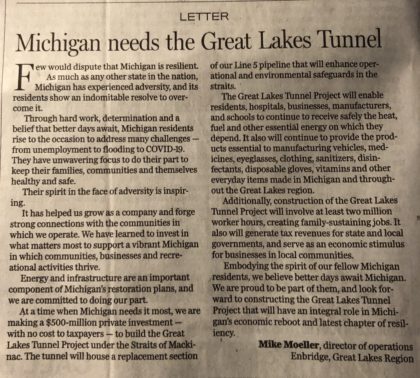 It also comes on the heels of a rather extraordinary letter published in the Detroit News by Enbridge’s Great Lakes Director of Operatons Mike Moeller. Of course, the letter has nothing interesting to say at all. What makes it extraordinary is the sheer number of bromides Moeller (or the PR shill who wrote it for him) is able to pack into a short letter to the editor. It trots out every hackneyed phrase (“indomitable resolve”! “unwavering focus”! “hard work [and] determination”) its authors could think of and then, just when you start to feel queasy, they add some platitudes about “resilience” and “forg[ing] strong connections with the communities in which we operate” and Michigander’s “spirit in the face of adversity”– a spirit Moeller apparently finds “inspiring.” Gag.
This sort of clichéd prose, as any reader can tell instantly, is the hallmark of insincerity. And ordinarily, I wouldn’t even bother commenting on yet another pointless assemblage of vapid phrases from Enbridge. But the juxtaposition of Moeller’s letter with the other Enbridge news of this week provides a striking reminder of something else everyone else knows but that can’t be repeated often enough:
That despite all their public relations claptrap about “critical infrastructure” needs, all their hollow talk about their commitments to Michigan, and all their unconvincing assurances about “operational and environmental safeguards,” Enbridge really only cares about one thing: pumping as much oil through their pipelines as quickly and for as long as they can to make as much profit as possible. Period. That’s it.
So if that means treating landowners, communities, and local officials shabbily, so be it. If that means withholding information of pipeline defects from the state or dragging their feet to fix those defects, so be it. If that means treating “administrative” matters as an afterthought, so be it. And if that means thumbing their nose at a Governor rightly concerned about the revelation of a potentially dangerous situation and hastily starting Line 5 up again despite her calls that they proceed with caution and transparency, then so be it.
Update (6/23): In response to the re-start and disregard of Gov. Whitmer’s request for a full investigation, Attorney General Dana Nessel has filed a Court motion seeking a temporary restraining order and preliminary injunction pending more information. Nessel also released a statement:
To date, Enbridge has provided no explanation of what caused this damage and a woefully insufficient explanation of the current condition and safety of the pipeline as a result of this damage…We cannot rely on Enbridge to act in the best interests of the people of this State so I am compelled to ask the Court to order them to.”
As I’ve said before, Nessel gets it. She knows very well what everybody else knows: Enbridge is never going to change. They literally can’t. They can’t even if the individuals who work for the company, like Mike Moeller, honestly would like to. That’s because Enbridge exists only to do one thing and they’re going to keep doing that thing until someone tells them they can’t. The only interest they’ll ever act in favor of is their bottom line. That’s why it’s long past time for the Governor, who thankfully supports Nessel’s latest action, to continue to pretend there’s an amicable solution to the Line 5 problem. It’s long past time for her to finally take decisive action.
At this point, there is really only thing to ask of Enbridge: just spare us the bullshit.
by Jeffrey Insko | Jun 19, 2020 |
Enbridge has been fined again. This week, Enbridge announced that it has reached a settlement with the Environmental Protection Agency for failing to comply with safety-related measures stipulated in the U.S. Department of Justice consent decree Enbridge agreed to in 2017 as a result of the Marshall spill.
You can read the whole thing here. The fines totaling $6.7 million are the result, among other things, of Enbridge’s failure “to complete timely identification and evaluation of thousands of ‘shallow dent’ features on Lakehead System pipelines” and to take measures to repair or mitigate those defects in their pipelines.
Sound familiar?
This is exhausting. I’ve been writing this same blog post for 8 full years now. I’m frankly tired of it. How many times do I have to point out that Enbridge, despite all of its corporate public relations rhetoric, never learns from its mistakes? How many times do I need to document how they repeat precisely the same (unsafe) behavior over and over? How many times do I have to rehearse the fact that when they get busted they prevaricate and dissemble and make laughable excuses like a teenager caught sneaking peppermint schnapps from the liquor cabinet?
First, let’s be very clear about one thing: failing to take swift action to correct defects on a pipeline is very serious business. By now, everyone reading this knows that is exactly what led to the disastrous spill in Marshall. We all know that Enbridge knew, for years, about cracks and other defects in Line 6B but they did not take measures to fix those problems. We also know the result: a million gallons of diluted bitumen in the Kalamazoo River.
Secondly, fast forward to 2017, when Enbridge once again tried to hide or downplay pipeline defects, this time with Line 5. Enbridge knew about damaged protective coating on Line 5 for years before divulging that very important and very serious information to Michigan state officials
Thirdly, Enbridge’s response in these instances is always grudging compliance and excuse-making. Never do they take responsibility. The present example of this is so extraordinary I need to tell you about it in some detail. Please stick with me:
Although Enbridge has agreed to pay the $6-plus million in fines, they steadfastly refuse to concede that they have committed any safety violations. Instead, in a truly stunning letter to the EPA, Enbridg’s attorneys shamelessly attempt to write the whole thing off as no big deal, insisting that “all of these alleged violations were largely administrative in nature and did not result in any safety issues, missed integrity risk reduction activities, loss of product or any damage to the environment.” So, for example, when the EPA fines Enbridge for failing to report crack features in a timely manner, Enbridge says it was because of “an administrative oversight.” And when the EPA fines Enbridge for completing their Threat Integration for Line 3 a few days late, Enbridge shrugs it off as “an administrative error.” And on and on and on. No parent of a child would ever accept such bullshit.
But two things are worth recognizing here with regard to these “administrative” matters. First, this kind of administration is incredibly important. Enbridge seems to want the EPA and the rest of us to believe that because these things are all “administrative in nature” they are of no particular concern. But there are important reasons for these rules; there are important reasons that regulatory bodies require, say, the timely reporting of crack defects in pipelines: it’s one way to assure that those defects get corrected before there is a problem, like a massive spill. Applying for a driver’s license and keeping your auto insurance updated are also “administrative in nature,” but they are important. Administration is prevention.
Secondly, if a corporation is making that many “administrative errors” isn’t that a sign of some deeper problems? Sure, anybody can make one mistake. There are a hundred reasons why someone might make an auto insurance payment late; insurance companies even make allowances for such things. But if I pay my insurance bill late over and over, eventually my insurer will probably terminate my coverage. And make no mistake about it, Enbridge has a long history of exhibiting troubling patterns of behavior, a long history of just these kinds of systemic problems. Have we already forgotten about the NTSB’s description of the company’s “culture of deviance” from safety protocols? How can Enbridge expect to earn the public’s trust if they’re so sloppy and lax with regard to “administrative” matters?
Finally– and this is the most important part– Enbridge insists to EPA over and over that these administrative problems “did not result in any safety issues, missed integrity risk reduction activities, loss of product or any damage to the environment.” But that argument is outlandish. To extend my analogy, just because I drove my car home safely without a license or insurance does not mean I should have been driving the car. And I definitely shouldn’t be driving it while drinking, which is basically what Enbridge is doing by continuing to operate pipelines with known defects. Just because nothing happened this time doesn’t mean it won’t. Again, that’s the whole point of all of this: prevention.
Frankly, I don’t know how EPA can abide Enbridge’s cavalier attitude toward these things, especially given the way Enbridge has thumbed its nose at the EPA in the past. But one thing is for sure: this troubling behavior, these lapses, these failures to take responsibility, this disturbing pattern of behavior should be given serious consideration when it comes to regulatory approvals (or disapprovals) of Line 3 and Line 5. Enbridge calls them “administrative errors”; I call them “evidence.”
by Jeffrey Insko | May 15, 2020 |
Sheltering in place this week, I’ve spent some time reading comments and other filings on the Line 5 case before the Michigan Public Service Commission— work I happily take on so you don’t have to! It’s heartening to see so many Michigan citizens adding their voices to the proceedings. Hundreds of people have written to express their opposition to the tunnel plan, while only a handful have written in support. Let’s hope the Commissioners take seriously the “Public” in the agency’s title.
It’s been especially inspiring to see the comments of so many tribal groups, in my view the most important voices to be heard in these proceedings. In fact, I encourage everyone to seek out and read the comments of the Sault Ste. Marie Tribe of Chippewa Indians, the Bad River Band of the Lake Superior Ojibwe, the Match-E-Be-Nash-She-Wish Band of Pottawatomi Indians, the Keweenaw Bay Indian Community, the Lac Vieux Desert Band of Lake Superior Chippewa Indians, the Lac du Flambeau Band of Lake Superior Chippewa Indians, the Sokaogon Chippewa Community, the Bay Mills Indian Community, the Little Traverse Bay Bands of Odawa Indians, and the Nottawaseppi Huron Band of the Potawatomi if only to be reminded of the vital living presence of indigenous peoples in our state and region. Taken together, these comments also provide a remarkable and remarkably important history lesson– of settler violence, (broken) treaties, and violations of tribal sovereignty—that every citizen should know. As James Williams Jr, Tribal Chairman of the Lac Vieux Desert Band puts it, “descendants of the Ojibwe [have] inhabited and maintained life from these lands for time immemorial. Our lives are tied to these lands and we have consistently been at the mercy of Enbridge and the State of Michigan as our lives are still tied to our historical waters.”
Recounting that history and ensuring that indigenous groups have their say in the present is precisely what makes Enbridge’s heavy-handed attempt to hobble this process by seeking a declaratory ruling under an Order granted in 1953 so galling. As Richard A. Peterson Tribal Chairman of the Red Cliff Band says in his comments, granting Enbridge’s request would “deprive…impacted tribes the opportunity to participate in the proceedings.” That would simply be unconscionable and in my view is reason enough alone to rule against Enbridge.
Others have weighed in as well. I appreciated the comments of the Michigan Resource Stewards, who call Enbridge’s request for declaratory relief a “ludicrous and a self-serving act.” Senator Jeff Irwin submitted a thoughtful letter emphasizing that “Line 5 also advances climate change and threatens energy security” and making the excellent point that the tunnel plan is backward looking. “Tunnelling will take a decade or more to complete,” Irwin writes, “by 2030, many communities are aiming to eliminate fossil fuels. This ruling would counter these productive goals.”
Attorney General Dana Nessel’s office also filed yesterday. The AG focuses upon the absurdity of Enbridge’s claim that the Line 5 tunnel project is merely “maintenance” rather than new construction in a new location. The AG also makes the particularly devastating point that the last time Enbridge embarked upon a “maintenance and rehabilitation” project– the “replacement” of Line 6B– they applied for MPSC approval, a fact that blatantly contradicts their current position that such approval is not required.
Other filings reiterate these arguments and add to them as well. The comments and objections from the Environmental Law & Policy Center and Michigans Climate Action Network eloquently describe Enbridge’s reliance upon the 1953 approval as an attempt “to freeze that determination and transport it forward in time forever” as if (as I have pointed out on more than one occasion) we’re still living in the twentieth century. Attorney Margrethe Kearney explains,
That 1953 determination of the public interest did not have the benefit of 67 years of accumulated knowledge regarding the Great Lakes. The Great Lakes are home to 20 percent of the fresh surface water on the planet, provide drinking water to hundreds of thousands of people, and anchor a thriving tourism industry. We know and recognize that the Straits of Mackinac is one of the most ecologically sensitive areas in the world.
The success of this especially urgent argument, as I pointed out in my last post, depends upon recognizing the broad authority the MPSC possesses in these matters. It is heartening, therefore, to see the latest filing on behalf of the Michigan Environmental Council, Grand Traverse Band of Ottawa and Chippewa Indians, Tip of the Mitt Watershed Council, and the National Wildlife Federation taking up the argument I made in my last post regarding the narrowness of the three-part framework Enbridge worked hard to codify during the Line 6B MPSC proceedings. This time, attorney Christopher Bzdok emphasizes the fact that Act 16 “provides the Commission with broad jurisdiction to approve the construction, maintenance, operation, and routing of pipelines delivering liquid petroleum products for public use” and authorizes the Commission “to make all rules, regulations, and orders necessary to give effect to and enforce the provisions of this act.” Therefore, Bzdok asserts, “the commenters believe the scope of the Commission’s review should be broader than these three standards, in recognition of modern realities.” Bravo!
Which brings me finally to Enbridge’s latest filing, which is so strange, so tortured, and so poorly written that it’s almost laughable. As if reflecting just how impoverished Enbridge’s position really is, attorney Michael Ashton ties himself into knots to make something stick. That something is Rule 447, which outlines requirements for applications pertaining to the construction of pipelines and electric facilities. Ashton is trying to claim that under Rule 447, an application for the Line 5 project is not required. But it’s an argument that requires such contortions that Ashton winds up producing barely coherent, ungrammatical sentences like this:
In interpreting the type of construction that subject to Rule 447, meaning must be provided to the phrase “to be furnished” and the term “new” which modifies the type of “construction” or “extension” in Rule 447.
Ashton means to appeal here to the “plain language” or “plain meaning” of 447. But he then spends four pages trying to beat the terms “to be” and “new” into proper submission. Now, I am by trade a Professor of English; interrogating the slipperiness of language is my stock-in-trade. There are decades-long theoretical debates among literary scholars regarding whether meaning is inherent in language or whether it is a thing that “must be provided.” I also happen to adhere to Herman Melville’s dictum in Moby-Dick that “in this world it is not so easy to settle… plain things. I have ever found your plain things the knottiest of all.” But all of that is why literary critics, unlike lawyers, rarely make appeals to “plain meaning”– because we recognize that if it takes you 200 words to try and convince someone, for example, that the word “new” doesn’t apply to a massive, $500 million construction project to install a section of pipeline of a different size in a different location than the ones that are already in place then what you are really arguing is that the meaning of the rule isn’t “plain” at all. Either that or you are simply engaging in deliberate, outlandish obfuscation: war is peace, freedom is slavery, ignorance is strength.
The same goes for Ashton’s weird argument about “to be.” Because Rule 447 has requirements regarding descriptions of “the nature of the utility to be furnished,” Ashton wants to pretend that “to be” only refers to services “not yet provided, but to be provided in the future.” But he’s just grasping at straws. Anyone who’s ever watched a tv show that ends “To Be Continued” knows that services (whether narrative or the delivery of petroleum) can both already be provided and be provided in the future. Duh.
All of which is to say that it seems to me quite, um, plain that Enbridge has an extremely weak case with regard to their request for a declaratory ruling. It would be utterly irresponsible for the Commissioners to fast-track such a high-profile project of such massive scale in such an ecologically sensitive area with so much opposition.
This is going to be a very long process.
by Jeffrey Insko | Apr 22, 2020 |
As part of their ludicrous plan to build the infrastructure of the mid-20th century, last Friday Enbridge filed an application with the Michigan Public Service Commission (MPSC) seeking approval to replace and relocate a segment of Line 5 under the Straits of Mackinac. It’s a strange application, since Enbridge simultaneously seeks MPSC approval and claims that it already has MPSC approval from 1953 and therefore doesn’t need the MPSC to approve it again. So thoughtful of them to give the present Commission this convenient time-saving alternative!
Reading Enbridge’s filing this week, I experienced a bit of déjà vu. It took me back to 2012-13 when Enbridge sought MPSC approval for the Line 6B “replacement” project. They’ve even hired the same attorney, Michael S. Ashton of the firm Fraser Trebilcock, to lead the new effort (I had a run-in or two with him back in the day). As this process begins, it might be instructive to re-visit how things went the last time around. It’s not a pretty story.
The short version is this: the analysis of that project provided by the commission’s public engineer consisted mainly of taking Enbride’s word for things, the MPSC staff attorney spent a significant amount of time laboring on behalf of Enbridge, the rulings of the Administrative Law Judge who oversaw the proceedings favored Enbridge’s tendentious claims at almost every turn, the MPSC attorney who wrote the final ruling in the case mocked and ridiculed public intervenors, and, worst of all, by the end Enbridge had effectively re-written Michigan law.
That last fact is crucial. Without going into too much detail here (you can read more about it if you’re so inclined), what happened was that Ashton and his team of crafty lawyers helped narrow the scope of the MPSC’s authority, preventing the Commission from taking all sorts of factors into consideration when approving pipeline applications. Instead, the Enbridge lawyers seemed to convince the Commission that its only legal charge is to determine three things: whether a pipeline project “will serve a public need, is designed and routed in a reasonable manner, and meets or exceeds current safety and engineering standards.” At the time, I expressed concern about what this severely limited framework might mean in the future. Here’s what I wrote in 2013:
the worst part is that now that the standard has been invoked and endorsed (by Judge Sheets) and repeated and reiterated (in the MPSC press release, in news articles), it will surely take on even greater weight and authority; it will surely be cited in future cases before the MPSC and treated as settled law (even though it is not).
Already, I worry that my fears are being realized. In the first petition to intervene that has been filed in the Line 5 case, for example, the Michigan Environmental Council cites the Line 6B ruling as the MPSC’s criteria for approval:
Before the Commission can approve Enbridge’s Act 16 request, the Commission will consider whether “(1) the applicant has demonstrated a public need for the proposed pipeline, (2) the proposed pipeline is designed and routed in a reasonable manner, and (3) the construction of the pipeline will meet or exceed current safety and engineering standards.” In re Enbridge Energy Limited Partnership, Case No. U-17020, January 31, 2013, Order, p. 5.
Of course, the MEC goes on to challenge the Line 5 application on each of these grounds, which is all well and good. The problem is that adopting this narrow framework plays right into Enbridge’s hands by severely limiting what the MPSC can and cannot consider. This restricted framework will preclude discussion of all kinds of other important questions that the MPSC might otherwise take into consideration– and which they can take into consideration– since the relevant law here, known as Act 16, gives the Commission much broader authority than what Enbridge (and the MEC, apparently) would have you believe. Those things might include, for example, Enbridge’s safety history (like the 2010 Marshall spill), the sovereign rights of tribal groups, future-oriented energy policy in Michigan, and of course the urgencies of climate change.
But mark my words: when intervenors try to raise these questions, Enbridge will ask that they be ruled inadmissible because they are beyond the scope of those three criteria. And they’ll most likely get their way. This is exactly what happened last time, when the ALJ disallowed, for instance, the National Transportation Safety Board’s report on the Marshall spill as evidence in the matter.
Maybe things will be different this time. There are new commissioners, new MPSC staff attorneys. Hopefully, these changes include a change in outlook, a greater commitment to the public good than was on display in 2013. But if I’m being honest, I’m wary.
We may get our first indication today, when the MPSC meets on the matter, electronically, at 2:30. The meeting will include time for public comments. The public may also submit comments on the case docket here. The case number is U-20763
by Jeffrey Insko | Mar 9, 2020 |
Much of the debate over the fate of Enbridge’s Line 5 beneath the Straits of Mackinac has taken the form of speculative fiction: frightening imaginative projections of a not-so-distant future. Opponents and proponents of Line 5 alike each cast their gaze forward and offer competing semi-apocalyptic narratives of what they foresee. Those calling for the shut down of Line 5 imagine a catastrophic rupture, in which thousands of gallons of oil spill into the Straits, get swept away by powerful currents, and despoil hundreds of miles of Lake Michigan and Lake Huron shoreline, poisoning the water and killing fish and wildlife. On the other side, Enbridge and its supporters conjure a dangerous future that features a nation in thrall to foreign sources of energy, rising gasoline prices, grandmothers freezing in UP winters, and convoys of exploding tanker trucks rumbling across the Mackinac Bridge.
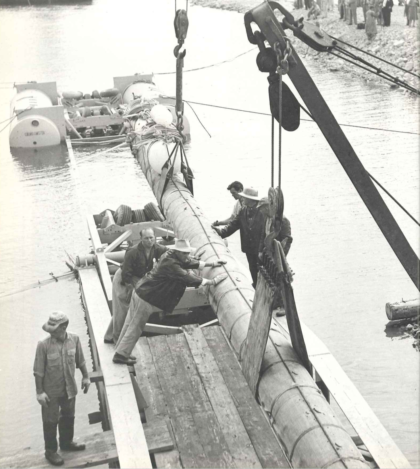
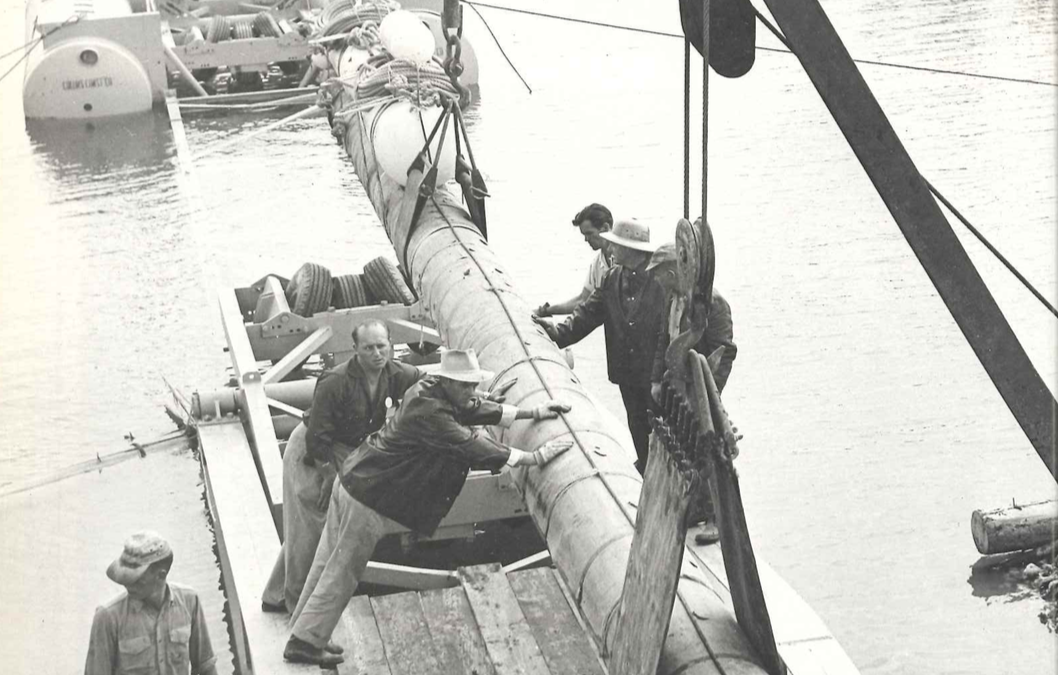
Crews in 1953 prepare to pull steel pipe across the Straits of Mackinac
Two sides of the same coin, these doomsday narratives echo the nightmare visions of post-apocalyptic fictions: nuclear winter, zombies, or the mass floods and burned-out landscapes of “cli-fi” (fiction about climate change)– books and movies that simply duplicate the terrifying projections of climate scientists. Just read the latest report from the Intergovernmental Panel on Climate Change (IPCC), for example, or a nonfiction best-seller like David Wallace-Wells’s The Uninhabitable Earth. The power and appeal of this dystopic, future-oriented narrative form resides in its potential to rouse people from apathetic slumber, its ability to inspire action-before-it’s-too-late. After all, we should be worried and scared. Therefore, visions of a frightful future might well prove rhetorically, and perhaps even politically, effective.
But lately, I’ve become increasingly concerned with what I think are some of the limitations of this concern for the future, this preventative attitude that, strangely, unites people on both sides of the Line 5 question. For one thing, I’m increasingly worried that imagining catastrophe as belonging to some imagined, avertable future allows us to pretend that things are okay right now. More and more, I wonder whether we focus on future possibilities, good and bad, as a way of avoiding present realities.
The latest news from Enbridge has prompted these reflections. Just last week, they announced that they’ve secured contractors to build their tunnel (itself, as I’ve argued before, an implausible speculative fiction). I was particularly struck by the comments of Enbridge’s Vice President of U.S. Operations Brad Shamla, who, according to the Detroit News insisted that Line 5 is “essential to the state’s energy future.” Shamla then repeats the standard Enbridge boilerplate about the “critical fuel” Enbridge Line 5 provides and touts “the thousands of products Line 5 helps make possible.”
Shamla’s claim about “critical fuel” succinctly evokes the Enbridge dystopic narrative about freezing UP residents and national energy (in)security. But what about the “thousands of products Line 5 makes possible”? What does that phrase evoke? It’s a fairly new line of argument for Enbridge, one that didn’t feature prominently in Enbridge’s PR two or three years ago, when all the talk was about propane and gasoline. Deliberately nonspecific, this new talking point is meant to remind us that the oil Line 5 transports isn’t just used as fuel to heat our homes and power our cars, but is used in the production of a myriad of everyday products. At the same time, Enbridge is careful not to push the point too hard, careful not to specify precisely what those “thousands of products” might actually be.
Imperial Oil web copy
Which brings me to the catastrophe of the present. What Enbridge doesn’t say about the products Line 5 makes possible is that nearly all of them have one thing in common: plastic. I’ve written about the early history of Line 5 elsewhere; it’s worth remembering that the pipeline wasn’t built to deliver propane to heat Michigan homes; it was built to feed the rapidly expanding oil and gas refineries in Sarnia, Ontario, the manufacturing hub now known as “Chemical Valley.” To this day, the vast majority of oil Line 5 transports is exported to Sarnia, where refiners like Imperial Oil (a subsidiary of ExxonMobil) transform it into petrochemical feedstock like polyethylene and vinyl intermediates, materials that are used to manufacture everything from shopping bags to plastic bottles and kayaks—literally “1,000s of products,” as Imperial also boasts.
The problem with this boast is that plastic pollution, as we’ve discussed on this blog before, is choking the planet, inundating the oceans, killing wildlife, penetrating the earth’s soil, and infiltrating our drinking water. A recent article in Rolling Stone magazine tells the story in grisly detail. Buy you’ve likely already seen the appalling images: the great Pacific garbage patch, sharks entangled in plastic nets, pounds of plastic found in the stomachs of dead whales, cattle grazing on pastures of plastic.

Photo credit: Zikri Maulana/SOPA Images/LightRocket/Getty Images
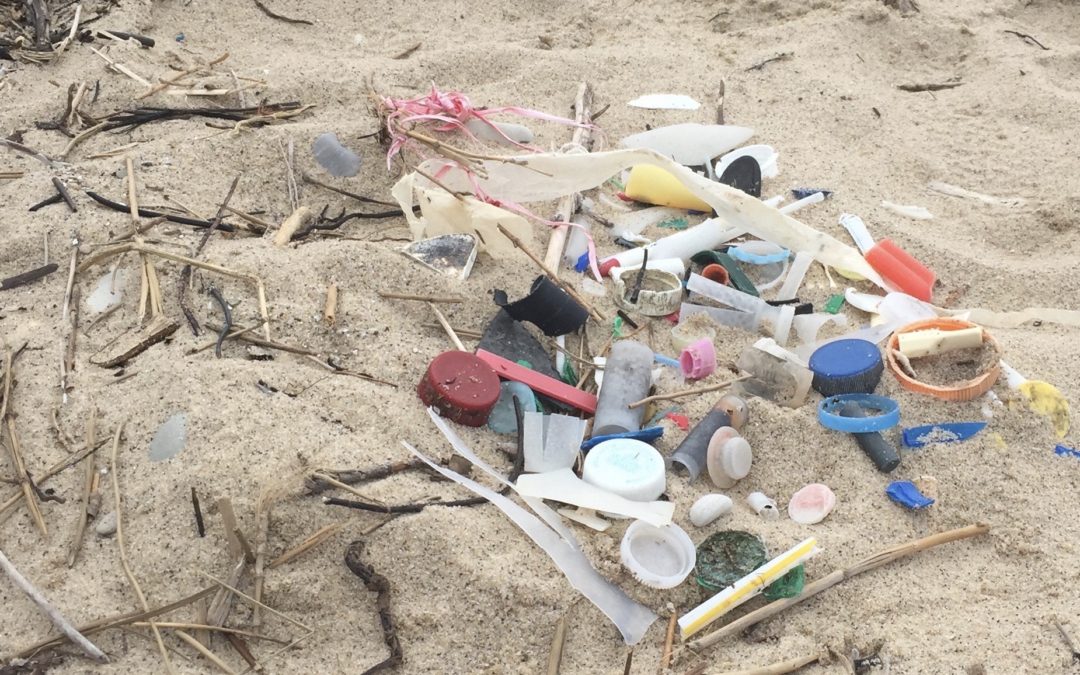
Less visible and less extensively studied, the Great Lakes are likewise awash in plastic. These days, a casual stroll of any Lake Michigan shoreline will yield you far more plastic debris than it will Petoskey stones. Experts estimate that more than 20 million pounds of plastic winds up in the Great Lakes each year. Researchers have also discovered that tiny microplastic particles are ubiquitous in the Great Lakes, where they are ingested by fish, then by the birds (and humans) that feed on those fish. Microplastics pervade our drinking water and even, according to a recent study, our craft beer. The health effects of ingesting all this plastic, full of toxins, are still unknown.
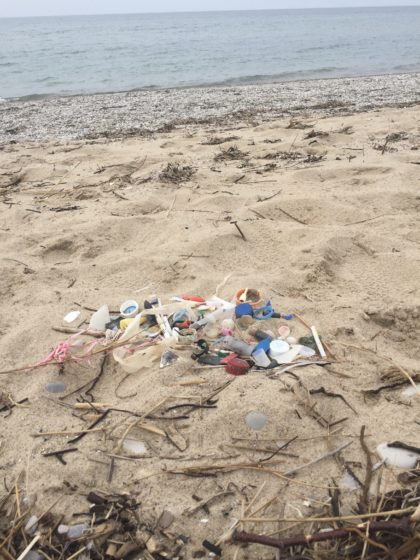
Lake Michigan shoreline, Glen Arbor
All of which is to say that Line 5 is not just a disaster waiting to happen; Line 5 doesn’t just threaten to pollute the Great Lakes and to poison wildlife and humans alike. Line 5 has already polluted the Great Lakes. Line 5 has already poisoned wildlife and humans. Line 5 has already helped produce a disaster.
A tunnel to house Line 5 beneath the Great Lakes simply guarantees a continuation—an intensification—of this ongoing planetary calamity at a moment when everybody knows that what we desperately need is to find a way to reverse course, to figure out how to kick our plastic habit. And make no mistake about it: Enbridge understands this. Their recent rhetoric touting “the thousands of products Line 5 makes possible” is part of an industry-wide effort to increase petrochemical production as demand for fossil fuels decreases due to the climate crisis. Fossil fuel companies seem to figure that if they can’t set the planet on fire, they can nevertheless bury it in plastic.
Obviously, Enbridge’s Line 5 isn’t the sole source of petrochemical feedstock. Nor will shutting down Line 5 solve the problem of plastic pollution. But sooner or later– probably sooner– the dismantling of the fossil fuel infrastructure that is destroying species and the planet has to commence. Michigan has an opportunity to lead the world in the process of undoing an unsustainable system and building a new, better one.
For that reason, maybe it’s time those of us who want to see the permanent decommissioning of Line 5 to stop talking about prevention, to stop imagining disaster as looming in the future, to stop telling stories about what might happen . Maybe instead we should be telling stories about the damage, visible and invisible, that is all around us here in the present. After all, the catastrophic future is now.
