by Jeffrey Insko | Oct 13, 2014 |
We left off yesterday’s post about ET Rover’s recent meetings with local officials by expressing some concern about whether some of those officials are equipped– for whatever reasons– to adequately inform and assist landowners. So far, we’ve been very impressed with the willingness of several township officials to speak out forcefully against Rover and the company’s shabby treatment of pretty much everyone. But now that Rover has launched a charm offensive and is (presumably) doing some behind-the-scenes glad-handing, backslapping, and smoke-blowing, we’re a little nervous. We’ve seen before what that sort of thing can do.
Recent news reports have provided little comfort. In fact, judging from what we’ve read, the meetings have served only to confuse matters. It’s starting to look like our public officials are neither receiving nor providing citizens with reliable, accurate information. That’s why we’re also nervous about this week’s Town Hall meeting (Oct. 15 at Holly High School from 6:30 to 7:30 p.m). We have serious fears about the potential spread of bad information.
Here’s a run-down, with examples drawn from two recent news articles about last week’s meetings, of the kinds of imprecise or just plain wrong information that has us so very worried:
Is there anything local governments can do? Yes!
According to Susan Bromley at the Brandon Citizen, Groveland Township Supervisor Bob DePalma doesn’t think “any thing of worthwhile consequence was discussed.” (No surprise there.) But DePalma also told Susan Bromley of the Brandon Citizen that “They [ET Rover] fully realize the federal government has regulations on them, what we say or do has little benefit.” No doubt this is what ET Rover said. It’s the same line Enbridge used when they rolled into town: “pipelines are regulated at the federal level.” As we recall, DePalma accepted that line then just as he appears to accept it now.
In fairness, it’s not entirely clear what DePalma’s point is here, though we do fear it’s the same old shoulder-shrugging, helpless attitude we’ve seen from him before. Whatever the case, it is clearly NOT true that what township officials “say or do has little benefit.” Yes, FERC has ultimate approval of the pipeline project. But there are plenty of things township supervisors, state representatives, and citizens can do. One of them is registering their objections and concerns about this project publicly and with FERC. Another is working hard to provide accurate, reliable information about the project, the process, and the things landowners can do to protect themselves. That could benefit landowners tremendously if this project is approved.
Why did Rover re-route? Nobody really knows (except Rover, and they won’t tell it straight)
Unfortunately, we’re not sure whether DePalma can distinguish between accurate information and pipeline company spin. For example, DePalma also reports that ET Rover shifted their original route north “because it affected 53-54 homes that were going to have to be taken.” We don’t doubt that this is what Rover told him. The question is whether it’s true. In fact, we’re not sure what “53-54 homes were going to have to be taken” even means. It’s vague to the point of meaningless (more on this below). Nor is there any way to verify it.
ET Rover reps apparently repeated this story in their meeting with Lapeer County Commissioners, according to Maria Brown at the Tri-City Times:
Company officials told Lapeer County leaders on Tuesday that the route had been moved north from Oakland County where more than 50 homes would have had to be condemned since they had been built on an existing natural gas line easement.
As we said above, it’s not at all clear what this means, especially with the use of the word “condemn” here– which could suggest the legal process of condemnation (using eminent domain) but here seems to mean something more like destroy. Nor is it clear what “existing natural gas line easement” they’re talking about. The Vector pipeline? Are we to believe that homes have been built on top of the Vector (or some other) pipeline easement? And that somehow, originally, Rover thought they would build their pipeline in the same place? Both of those things seem impossible. So maybe the reporter got something mixed up here? Whatever the case, none of this makes much sense, which makes us awfully skeptical. Even worse, none of this, whatever the source of such poor information, is even remotely helpful to concerned landowners.
We’re even more skeptical of this comment from Lapeer Commissioner Dave Eady about the re-route: “It had nothing to do with politics or resolutions in opposition to the project,” Eady said. We have no doubt this is what ET Rover told Eady and the other commissioners. But surely Eady isn’t naive and gullible enough to believe it. Anyone can readily understand that ET Rover would never ever admit to moving the pipeline route because of landowner opposition; that would only invite landowner opposition elsewhere. So why in the world would he repeat that claim as if it were true? That’s frightening.
We feel a little better about the comment of Commissioner Lenny Schneider who notes, simply, “It’s not our job to take their word for it.” Hopefully, he has repeated that to his colleague Dave Eady.
How much gas will benefit Michiganders? Again, no one knows (and Rover won’t tell)
Even worse than the above are the (hollow) assurances ET Rover gave about where the gas they’ll transport is going. DePalma reports that contrary to initial reports, the natural gas is not mainly for Canadian export and “a good amount” of the natural gas transported by ET Rover will stay in Michigan. This statement only raises more questions:
What’s “a good amount”? Who decides what a good amount is? Is this what Rover reps said or is that DePalma’s characterization? Was DePalma able to verify that claim? Did Rover say exactly what percentage of the gas will stay in Michigan versus the amount that will be exported to Canada? We’re pretty sure that answer to those last three questions is “no.” Those are questions that are virtually impossible to answer. Answers to them may– if we’re lucky– be included in Rover’s application to FERC, which they plan to file in January. But since FERC doesn’t require that kind of information and because Rover doesn’t really want anybody to know (they’ll likely claim that it’s proprietary), chances are it won’t even be included there. We can’t say for sure, but it sounds like DePalma believes Rover when they say such things. But he shouldn’t. That’s what scares us.
Is Rover prohibited or even discouraged from routing their pipeline along a highway? No.
Here’s one reason DePalma shouldn’t believe the things ET Rover reps tell him. Evidently they told him this:
Rover representatives also explained that the reason the pipeline can’t follow a suggested route along the I-69 corridor is because close proximity to highways is discouraged for safety reasons.
Note here the passive construction “is discouraged” We have little doubt that this is exactly how ET Rover phrased it. It’s the sort of verbal construction we discourage our students from using, because unlike our sentence (where we say “we discourage”), the passive version omits the agent of the action. It begs the question of who, exactly, discourages routing pipelines along highways for safety reasons. The implication is that it’s some federal agency. But there are no federal guidelines on this matter. In fact, highway corridors are not even considered “high consequence areas.” Of course, this is not to say that it’s necessarily a good idea to build a pipeline along a highway. But doing so is no worse than building a pipeline in close proximity, say, to a school or suburban subdivision, yet that happens routinely. The point here is that companies like Rover are NOT “discouraged” for safety reasons from building pipelines along highways. They’re just saying that as a convenient excuse to stick with their preferred route.
Is there a deadline for public comments to FERC? No.
This one comes from Lapeer County Commissioner Lenny Schneider:
Schneider said the company can’t provide all the answers county officials want until land surveys are complete and considering this task might not be done by year’s end, which is also the public comment deadline; the county board seeks to go on the record with their concerns.
The first part of this is probably more or less true: some questions will be unanswerable until surveying is complete and the route is finalized with a bit more precision (although we suspect this is also another convenient way for Rover to evade questions). But the second part is absolutely NOT true. There is no year-end “deadline” for public comments. After Rover officially files its application with FERC, citizens have much more time and opportunity to comment— and they should do so. We don’t know where Schneider got the idea that public comment will be prohibited after the first of the year. But this is another example of how unreliable information gets disseminated.
Can FERC approve this project without giving Rover the power of eminent domain? No.
And one final bit of information to correct, this one also from the Lapeer Commissioners:
Commissioners are also urging the public and affected landowners to file their own concerns and complaints with the federal agency by year’s end, asking that the commission either halt the project or approve it without granting eminent domain. Without eminent domain, Energy Transfer would be required to negotiate with individual landowners for easement payments.
Now, we very much appreciate this sentiment. And we wish this were a realistic option (and in other cases, we’ve made a similar argument). But in this case, urging citizens to request approval without eminent domain demonstrates a basic misunderstanding of the FERC process. That’s because eminent domain is precisely what “approval” means. ET Rover is going to apply for a “Certificate of Public Necessity and Convenience.” According to the law, that means the authority to condemn. So ET Rover isn’t just asking for permission to build a pipeline. They’re asking for permission to build the pipeline with or without the approval of property owners in the pipeline’s route. In this context “approv[ing] it without granting eminent domain” simply does not make sense. By law, FERC cannot grant a certificate without eminent domain.
Obviously, these are not simple matters. And there is no reason to expect township supervisors and county commissioners to be experts on them. But it’s NOT too much to expect them to be deeply skeptical of what ET Rover tells them and to be careful about reporting what Rover says as fact. We’re going to do everything we can to make it to Wednesday’s Town Hall in the hopes of preventing (or correcting) the spread of inaccurate information. Stay tuned.

by Jeffrey Insko | Jul 29, 2014 |

If you “like” us over on Facebook, you might know that on our annual vacation to Minnesota this year– yes, the one that takes us past the Enbridge offices in Superior, Wisconsin— we were lucky enough to speak to an extraordinary group of citizens embroiled in their own battle with Enbridge. The Friends of the Headwaters up in Park Rapids are concerned (and rightfully so) with the route Enbridge has proposed for its “Sandpiper” pipeline, which would transport crude from the Bakken region of North Dakota all the way to Superior. Along the way, it would pass through some of the most pristine, untrammeled, and beautiful areas in Minnesota– no, in the country– including the headwaters of the Mississippi River. Frankly, unless you’re an oil pipeline executive whose only concern is moving product as quickly and cheaply as possible, the route is totally bonkers.
We’ll have much more to say about Sandpiper and its companion project, the Line 3 “replacement” (both of which we’ve mentioned before), in the weeks and months to come; they’re both a part of the current North American crude and tar sands arms race. At present, the Minnesota Public Utilities Commission (the equivalent of our MPSC) is reviewing Enbridge’s approval request for Sandpiper. And the Friends of the Headwaters, because they are both rational and devoted to Minnesota’s stunning natural resources, are trying to persuade the PUC to reject Enbridge’s route and to protect the magnificent headwaters. The vast majority of informed Minnesotans appear to agree with them. As landowners who have lived through the “Enbridge experience” and as frequent visitors and admirers of Minnesota’s wonderful and fragile waterways, we fully support the work of the Friends.

For that reason, we were particularly thrilled to be invited to speak with them about our own experience. An impressive, curious, and thoughtful crowd of about 75 people showed up to the talk. They were full of energy and commitment, much of that we are sure owing to the example of Friends of the Headwaters President Richard Smith, who is one smart, cool dude (here he is all brilliant and sensible on MSNBC’s “The Ed Show.”) Richard is collaborating with a whole bunch of awesome people, including Deanna Johnson and Barry Babcock, who were kind enough to take us on a fun, informative, gorgeous tour of the headwaters at Itasca State Park on a sweltering day. The company and the scenery were so good that the heat didn’t bother us a bit.
Our talk seemed to be well received; we tried not to go on too long. But the best part was the warm hospitality, the great generosity, and the commitment and enthusiasm of the Friends of the Headwaters. 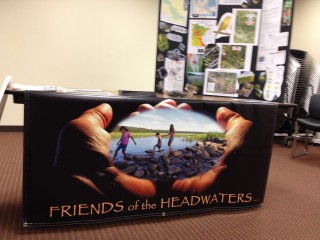 As observers of Enbridge expansion projects in the region, we’ve long admired the work the Friends are doing. Getting to know them in person only deepened that admiration, adding to it real fondness. We can’t thank them enough– for the invitation and for their efforts to protect and preserve Minnesota’s natural resources.
Best of all, their cause appears to be gaining steam, so much so that the PUC actually seems to be listening (at least a little) and Enbridge is doing what it does: lots of misleading p.r.
by Jeffrey Insko | May 7, 2014 |
We’re running a contest! Everyone is eligible. For details, please read on:
For a while now, we’ve been meaning to tell you that Enbridge has started its very own blog! Trust us when we tell you that it is every bit as good as you might imagine. In fact– no offense to all the marvelous sites we visit regularly— it’s pretty quickly becoming our favorite blog ever. It’s so good, in fact, that if we had the time, we’d write about it almost every day. Why? Well, many reasons. For example, there’s the incomprehensible corporate claptrap:
“This means we have a unique opportunity to collaborate with the various components of our value chain,” she adds, “on the role that CSR practices and market-based innovation can play in reducing carbon emissions and improving other aspects of environmental performance.”
There’s the fact that it appears to be written for an audience comprised of junior high school kids:
Energy is as essential to sustaining life today as water. Energy cooks our food, grows our crops, and provides the sustenance we need to lead active lives.
There’s the lineup of authors, which is supposed to make us believe that these Enbridge executives are typing up these blog entries themselves, as opposed to the Enbridge marketing team, which must mean that all Enbridge executives are taught to write in the same bland voice, full of corporatized, hollow slogans:
Our strength is in our people.
As North Americans, we owe our economic and social progress to fossil fuels.
We believe we need to be part of the solution to issues like climate change and we’re working hard to make a difference.
Working together, we will achieve our target of top industry performance.
There’s even the shameless attempt to exploit adorable dogs to persuade people to their point of view (seriously, who would do that?).
But by far, the best post yet comes from (is attributed to?) Leon Zupan, Enbridge’s Chief Operating Officer, Liquids Pipelines, who recently tried his hand at an extended metaphor. According to Zupan, pipelines are a lot like people and many of Enbridge’s employees are a lot like doctors. It goes like this:
First off, let me say that I am conflicted, as most of our pipelines, other than the original four lines, are older than me. I know that the regimen we follow to keep our lines in top shape definitely exceeds my personal regimen of exercise and diet.
Pipelines have some similarities to us:
- They have to have a health check;
- They may need some preventive work and the occasional professional treatment, and;
- If properly looked after, they can last a very long time, maybe an active working life longer than many of us.
We have some of the best pipeline “physicians” in the world working for Enbridge, and coupled with a team of external consultants and repair specialists, we do an industry-leading job of ensuring all of our lines are healthy and fit for purpose.
It goes on in this vein for a few more paragraphs before concluding on a sort of wistfully humanizing note, as Zupan says that he should “aspire to be as fit as the pipelines I look after.”
Now, it just so happens that we love a belabored metaphor. And we love it even more when the metaphor is terribly ill-conceived, as this one is. In fact, it got us thinking about some of the other ways that pipelines are just like people. So much so, that we thought it might be fun to make it a contest. So what do you think? How are pipelines like people?
We asked the crack Line 6B blog staff and they came up with these:
- Sometimes pipelines are mistreated and neglected by the people who say they’re taking care of them.
- Pipelines, like people, often do not fit the perfect ‘mold’ – they are not able to be inspected by the latest ILI devices, having a few too many curves or dips or divets.
- Pipelines are like people: stuff’s supposed to go in one end and out the other end. It’s bad if it comes out in the middle.
- Or, if Enbridge wants to be serious about the health care metaphor, consider this: the U.S. still does not have universal health care for all of its citizens. 14 percent of Americans remain uninsured. But that’s still a better situation than for hazardous liquid pipelines, where only about 42% of them are subject to rules that require periodic “health check” inspections. As for other 58% of them, operators aren’t required to take them in for check ups or “occasional professional treatments” ever. EVER. Until they fail, and then they have to fix them – much like the uninsured going to the ER. One would think that both ought to get some preventive care, no?
So there’s your challenge: how are pipelines like people? pipeline operators like doctors? (surely someone can cook up a good malpractice joke!). We’ll conduct the contest over at the Line 6B blog Facebook page. The winner, determined by the number of “likes” will receive bragging rights and admiration!
Submit your entry over on our Facebook page.
by Jeffrey Insko | Apr 21, 2014 |
Remember how Enbridge says they treat landowners fairly and consistently? Well, we’ve got a story for you.
This is a very important post, one we’ve had in our back pockets for a while as we’ve tried, with no success and no small amount of frustration, to gather some reliable information about the matter. As many of you know, a longstanding concern for landowners on Line 6B has been the widely disparate treatment– from land agent responsiveness to compensation– landowners have received from Enbridge, despite their claims to the contrary. The subject of this post is a perfect illustration of this inconsistent treatment.
The whole thing is hazy and complicated. But the bottom line here is this: if you are a Line 6B landowner, especially along Phase One, Enbridge might owe you some money. As with most things Enbridge-related, it’s all a little convoluted, so we’ll provide both a short version and a long version. At the end, we also have some contact information in case you’d like to contact Enbridge to inquire about this matter– which we encourage you to do.
Short Version
If you are on Phase One and were NOT taken to court in condemnation proceedings, you probably settled with Enbridge in 2012. However, there is a good chance that Enbridge should have come back to you at some point to make an additional payment based on a recalculation of the values you were originally paid. How do you know? Well, you’ll have to ask Enbridge. But one indication is this: did a land agent come back to you in 2013 and write you a check and give you a receipt? Did you receive a 1099 tax form from Enbridge this year for filing your 2013 tax forms? If not, you might be owed some money.
Long Version
Now here’s the more detailed explanation of all of this. Please bear with us while we try to explain it, also bearing in mind that we are neither accountants nor attorneys. We’ll try to be as accurate as we can and hope that we don’t make any major mistakes. Again, it is our understanding that all of this pertains primarily, perhaps only, to Phase One landowners.
When you settled with Enbridge– again, assuming you did not go to court–you most likely received compensation, in the form of a check from Enbridge, for three things: (1) use of the existing easement (what was probably called an “Additional Pipeline Receipt”), (2) for the use of Temporary Work Space and/or Additional Temporary Work Space (TWS and ATWS), and (3) compensation for damages, including the value of trees (or timber) that were removed from your property. The amounts you were paid for the first two of those items were based on fixed values determined by Enbridge. Compensation for damages was determined by your negotiations with a land agent.
Now, the way in which those fixed values (for the easement and TWS) were determined by Enbridge has been in quite a bit of flux from the beginning of this whole project. For instance, when we were first approached, the per acre value that Enbridge was using to calculate the additional pipeline receipt was $6500 per acre. Some time later, we were told that that value had been increased (as if by magic) to $30,000 per acre. Then we learned that our neighbors were receiving even more per acre than we were for virtually identical properties. We’ve heard stories along the line of different values as well, some higher, some lower (what were you paid per acre, we wonder?). These various values have always seemed to us almost completely arbitrary– and certainly not consistent. In fact, during condemnation hearings in Livingston County, Enbridge all but admitted that they had no real basis for determining those values; it’s as if they were pulling numbers out of thin air.
As for the TWS, Enbridge calculated those payments according to the same values, but paid landowners 30% of that value. So, for instance, if they used 1 acre of TWS, valued at $35k/per acre, they would have paid you $10,500 (that’s 30 percent of 35K).
Finally, Enbridge may have paid you for trees. Trees are even more complicated and arbitrary. In some cases, Enbridge simply paid “timber value” for trees. But in many other cases, the value paid for trees was a matter of negotiation– somewhere between “worthless” (to Enbridge) and “invaluable” (to the landowner).
Now, as near as we can piece this together, here is what happened next (again, we’re being as scrupulously accurate as we can be based on information provided to us by various sources): at some point during the condemnation hearings, Enbridge agreed to pay landowners more than the amounts as described above. Specifically, they agreed to pay 125% of the valuation for the additional pipeline receipt, 50% (not 30%) of the per acre value for TWS, and 150% of the timber valuation. It is our understanding that, at the point, Enbridge decided that all landowners would be similarly compensated– both those who had not yet settled and those who had already been paid.
So here’s what all of this would look like. To make things simple, we’ll use the simplest values possible. (Please note that these numbers are purely fictional and unusually high; there is probably no one with a full acre of easement or TWS.) Let’s say Enbridge had 1 acre of easement on Joe and Jane Jenkins’ property, used 1 acre of TWS, and paid them $1000 for trees (timber). Here’s what the Jenkinses would have received– say, in the summer or fall of 2012) based on those original values:
$35,000 (for additional pipeline) + $10,500 (for TWS) + $1000 (for timber)= $46,500
However, after those condemnation hearings, Enbridge should have come back to the Jenkinses to pay them for the increases stated above. That would look like this:
125% of additional pipeline= $43,750
50% of TWS= $17,500
150% of timber= $1500
Total= $62,750
Now, subtract from that the $46,500 you were already paid and the Jenkinses should have received a check from Enbridge– probably by surprise some time last year– for $19,250.
Again, based on what we were told by our land agent, ALL landowners were to be compensated according to these rates. If you are on Phase Two, these adjusted/increased rates should have been built into your original payments. Check your receipt: were you paid 50% of the per acre value for TWS? By contrast, many Phase One landowners– those who were paid BEFORE these increases– should have received a surprise visit from a land agent to pay out the difference.
However, we know for certain this has not taken place. We know that some people in our neighborhood (we’re on Phase One) have been paid this difference and some have not. Why? We have no clue whatsoever. Partly, it may be because Enbridge has been flying by the seat of its pants since the beginning of this project. More likely, it’s because Enbridge’s land agents are, by turns, overworked, uncaring, hapless, or just not very well trained or informed by Enbridge’s not-terribly-efficient-or-effective land agent supervisors.
This is a matter of basic fairness and decency. We encourage you to contact your land agent– if, that is, you have any idea who your land agent currently is– to find out whether you are due this additional compensation. If we are able to learn anything more about this– though, honestly, we don’t know who is in charge or who might be willing to respond to our inquiries– we will certainly let you know. In the meantime, if you don’t know who your land agent is currently, you can try this number listed on Enbridge’s website for Line 6B landowners:
866-410-4356
Or, if you prefer email, you can try this address:
Line6BPhase2@enbridge.com
by Jeffrey Insko | Apr 17, 2014 |
We are currently working on a very important post about a deeply troubling matter that might affect a number of Line 6B landowners. Please stay tuned for it in the next couple of days. As we await some more information– as you know, we strive to be accurate– we thought we’d begin our long overdue and ever-growing news roundup. It’s going to take a few posts.
Now that spring is here (knock on wood!) and the ground has begun to harden a little, Enbridge is getting back to work to our east, putting in the remaining section of pipeline that will run from Ortonville to Marysville, Michigan. Unsurprisingly, that means unhappy landowners. We’ve found some of the local news coverage so far quite interesting:
Over at the Macomb Daily, reporter Lara Mossa quotes our hero Brandon Township Kathy Thurman in an article about Enbridge’s return to work in that area. In her typically restrained way, Thurman recalls some of Brandon’s troubles last year (see our archives) and even talks a little tough:
“There have been a lot of concerns,” she said. “There have been some issues. We ended up shutting them down at one point, because they were in violation of a woodlands agreement.”
Oxford Township Supervisor Bill Dunn, on the other hand, neither reports nor foresees any problems. But his remarks about Enbridge are hardly a ringing endorsement:
“I know they have had problems in other townships, but, for the most part, they are going through very large parcels of land,” he said, adding that much of it is old gravel mines. “It’s not like they’re going through subdivisions. I have not had any complaints. Enbridge has been somewhat cooperative.”
In Bruce Township, according to another Macomb Daily article, residents are (understandably) unhappy with Enbridge’s planned destruction of a number of very tall trees near the Ford test track. Weirdly, Macomb County Road Commissioner Bob Hoepfner thinks that Enbridge’s offer to replant twice as many crappy little trees as the mature ones they’re cutting down is “generous”:
Hoepfner said Enbridge was more than within its rights to do the work on that designated portion of land and offered the county a “two for one” deal to replace all trees that would be removed immediately rather than do their work and see the trees die later.
“They showed us what needed to be done and we agreed with them,” said Hoepfner. “It was a generous offer. Cutting the roots would kill them and the right thing to do is to have them removed.”
But residents and Township Supervisor Richard Cory (no, not that Richard Cory!) think otherwise and say not-so-fast:
“None of us will ever live long enough to ever see those trees provide enough shade over the road like it has now,” said one resident of the proposal to replace the mature trees with new ones after completion of the project.
Cory later asked if residents wanted to fight to have the trees remain intact; the overwhelming response in unison was “we want the trees to stay.”
What the township will base its fight on is a letter Cory read aloud at the meeting from attorney Benjamin Aloia to Enbridge representative Mike Ashton.
Cory said the letter, dated March 10, 2014, was apparently in response to a proposal from Enbridge to remove the trees.
“The Road Commission did not approve or authorize any work whatsoever within the Road Commission’s 36 Mile Road statutory 66-foot full-width right-of-way under this permit,” Cory read to the residents. “The removal of trees was not expressly permitted by the Road Commission with the three-mile stretch of 36 Mile Road in question.”
Finally, from Marysville, the Times Herald reports on some landowners feeling abused by Enbridge. Despite a rather insulting headline– “People Gripe About Enbridge”– the article gives a fair hearing to the concerns of some landowners who appear to have received the same sort of treatment we’ve documented here exhaustively.
What’s the takeaway here? We imagine Enbridge and/or Enbridge apologists would dismiss all of this by saying that any large project is going to run up against some complainers (a notion that, unfortunately, the last story’s headline seems to enforce). But those so-called “gripers”– Brian St. Clair, Thomas Leen, and Judy Robertson, not to mention all those concerned Bruce Township residents– have an awful lot of company. What this says to us is that Enbridge still, after all this time, hasn’t learned anything or is simply incapable of changing its ways.
by Jeffrey Insko | Feb 20, 2014 |
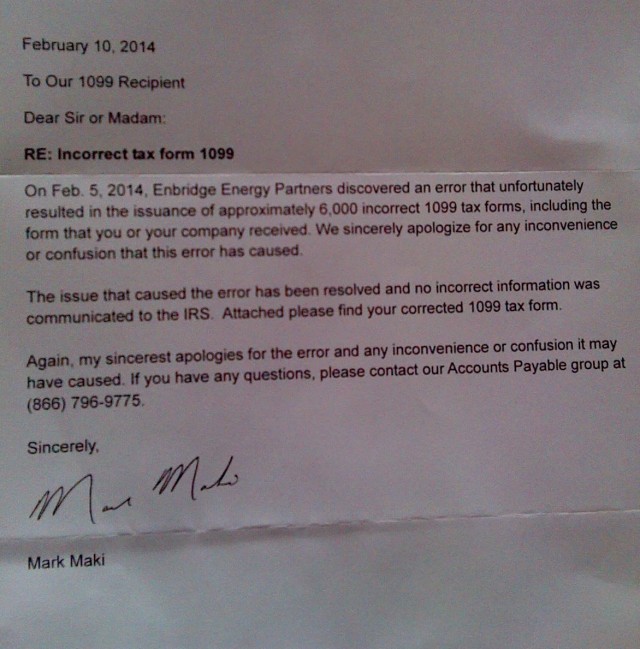
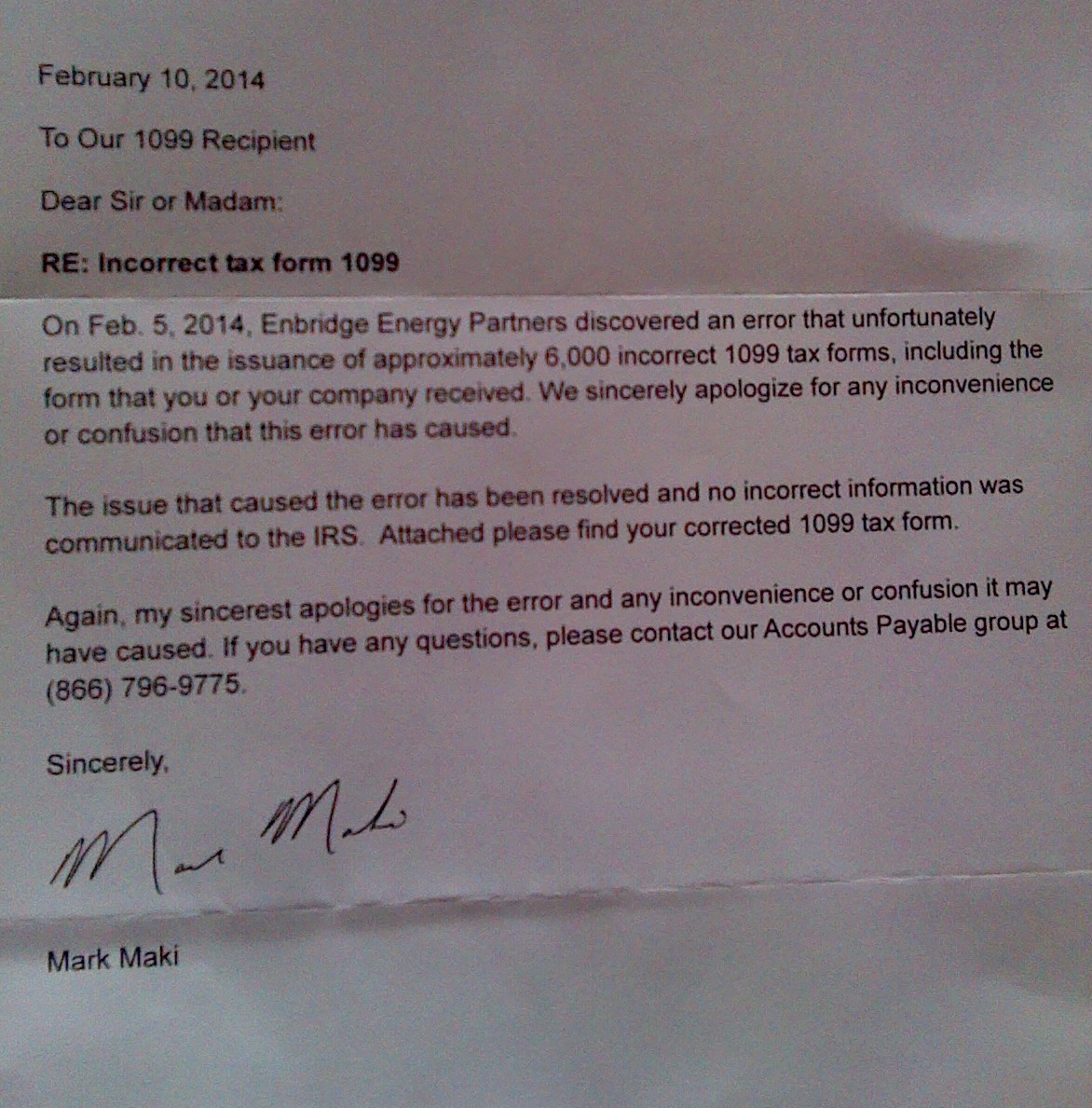
This week, we received a corrected– and accurate– 1099 tax form from Enbridge, along with an accompanying letter that says they issued SIX THOUSAND incorrect forms (frankly, we’re shocked that they would admit such a thing). So it appears Line 6B landowners aren’t the only ones affected this latest Enbridge gaffe, though it also appears that they’ve straightened it out. We’re assuming you have also received a corrected form; if not, please let us know. More importantly, you should let Enbridge know.
While we’ve got you, here are a few other quick news items worth noting:
by Jeffrey Insko | Feb 16, 2014 |
We have some good news to report on the Michigan legislative front– of a minor sort. You might recall that at the end of last month, we had ourselves pretty worked up about some seemingly minor changes proposed by state lawmakers to the Crude Oil and Petroleum Act. The bill that had us most concerned was a companion to another bill that will reduce the oil and gas severance tax in the state. HB 5254, as it was originally introduced, would have changed the word “landowner” to “owner of agricultural property,” thereby eroding the already scant protections afforded to property owners affected by eminent domain. Needless to say, this is for us a rather sensitive topic.
So we wrote to our House Representative Joseph Graves as well as the House Energy and Technology Committee, multiple times to express our concerns. Promisingly, we then saw those concerns expressed in the Committee’s deliberations on the bill. Yet we weren’t certain as to whether those discussions bore any sort of fruit. Then last week we spoke on the phone with Representative Graves, who reported to us the good news that the Committee removed the offending change from HB 5254, leaving its original language intact (here is the bill as passed by the House).
Score one for landowners!
Admittedly, this is an exceedingly small victory, but at the very least it shows that Michigan legislators do recognize the need to protect property owners and are capable of listening to their constituents. We are grateful to Rep. Graves and other members of the committee, Marilyn Lane in particular, for their responsiveness on this question. We also spoke with Rep. Graves about pursuing further discussions regarding the treatment of landowners by Enbridge. If something comes of that– and we plan to follow up– we will of course let you know.

by Jeffrey Insko | Feb 1, 2014 |
We live in polarized times. You hear all the time how sharply divided the country is, a fact that seems to be borne out by new evidence and new controversies nearly every week. The fissures run deep, splitting families, ending friendships, causing all sorts of bad behavior– dinner table fights, Facebook flareups, Twitter wars. Often this behavior, while generally the result of misdirected passion, is rather unbecoming. Yet there appears to be no cure in sight. Matters are likely to continue as they are for the foreseeable future.
Despite all of this, as long-time readers of this blog know, we try very hard to remain as nonpartisan as possible. It’s not that we don’t have strong opinions, strong leanings, or strong convictions. We most certainly do. And maybe it’s not all that hard to see where our loyalties generally lie. But we think most of what we discuss here at the Line 6B blog defies easy pigeon-holing, doesn’t fit neatly into most conventional, predictable ways of thinking about this side or that side. Frankly, we don’t see how anybody, regardless of affiliation, could condone the sort of corporate behavior we document here.
In addition to that, the unfortunate truth is that, in these divided times, the minute you announce your allegiance, you automatically risk alienating half the people you hope to persuade. We don’t want to do that, not least because we know that the landowners living along Line 6B– and along other pipelines all across North America– are generally good and decent people, despite the fact that the positions they hold or affiliations they claim might not be perfectly in line with our own. Just because you don’t agree with us on something doesn’t mean that you deserve to be exploited, abused, or taken advantage of by those with tremendous power and influence. The truth is, we wouldn’t wish the treatment so many people have received at the hands of Enbridge on our worst enemies (that is, if we had any enemies…).
However, having said all of that, there comes a time when you can no longer try to ride down the center of the road. There comes a time when trying to get along with everybody simply isn’t possible. There comes a time when compromise, crossing the aisle, bipartisanship, comity, working together, getting along, and cooperation are no longer a sign of fair-mindedness, but are a sign of cowardice, of weakness. There comes a time when you just have to stand up and pick a side, regardless of whether doing so will alienate people, create rivals, or even anger some of your friends. There just comes a time when making nice won’t do, when it’s time to put up or shut up and face that fact that what you really want is the complete destruction, the utter annihilation, the total humiliation, of your opponents.
That time has come.
So today we proclaim, clearly, forcefully, and uncompromisingly in no uncertain terms, which side we are on. And if you don’t like it, well, that’s just tough; you’ll have to find a way to deal with it. Here goes:
We stand proudly with Peyton Manning and the Denver Broncos.
So there.

by Jeffrey Insko | Jan 2, 2014 |
Welcome to 2014 everybody! In the spirit of the New Year, we’re taking a bit of time to look back by counting down our Top Ten posts of the year that just was. If you missed the bottom five, you can read about them here. But just to recap them quickly:
10. Line 6B Earns Pulitzer Prize
9. Pet Coke
8. Red Herrings
7. How Not to Write About Line 6B
6. IJNR Kalamazoo River Institute
Now on to the final five:
5. PHMSA. Last summer, we were lucky enough to be invited by the National Wildlife Federation to participate in a lobbying “fly-in” to ask some of our elected officials to support the NWF petition seeking some new rules on pipeline safety from PHMSA. We also wanted to meet with PHMSA officials themselves, but they declined. This did not please us, especially since, in our view, PHMSA is already far too insulated from the concerns and viewpoints of ordinary citizens– as opposed to the concerns and viewpoints of industry. We’ll have much more to say about PHMSA in 2014, especially once we return to writing about the PS Trust conference last November. And we are likely to once again adopt the tone of this post that we wrote upon our return from the D.C. trip.
4. Enbridge Thinks EPA is Stupid. Among the more astonishing Enbridge blunders of the last year was their hapless, thoughtless, tone-deaf, corner-cutting attempt to secure a dredge-site plan in Comstock Township so that they could complete the Kalamazoo River cleanup according to the deadline set by the Environmental Protection Agency. In addition to attempting to skirt local zoning ordinances, they also managed to agitate the owner of one of the state’s best breweries and as a result found themselves in a bit of a pickle. Then, in order to get out of the pickle they found themselves in, Enbridge Vice President Richard Adams went and crafted one of the most desperate, disingenuous, counter-factual, values-violating letters imaginable to the EPA asking for more time– as if the EPA were somehow completely unaware of the facts on the ground. Fortunately, the EPA turned out not to be as blind, gullible, and stupid as Enbridge evidently thought they were.
3. Why Enbridge Can’t Do Better. If you just went and re-visited that little episode, you might be wondering to yourself, as we have on countless occasions, why in the world Enbridge conducts itself this way, why they can’t just do things right, why they can’t act according to– not in opposition to– their professed values. This is something we’ve pondered long and hard, far too much really. In fact, it’s something we’re going to ponder some more in the next week or so as we tell you a little about Enbridge’s just-released “Corporate Social Responsibility Report” for the past year. But back in June, we pondered it somewhat systematically in a series of posts that considered a number of possible theories for why Enbridge behaves the way it does. We’re not sure we arrived at any clear conclusions– but we think our hypothesis rests on some pretty firm evidentiary and experiential ground.
2. Enbridge Re-writes Michigan Law. One would reasonably think, after a disaster like the Marshall spill and all we know about its causes, that public officials and regulatory agencies would scrutinize the company responsible for the disaster very carefully, that those same officials and agencies would be skeptical, hyper-vigilant, extra-tough. But one would be wrong– at least here in Michigan. From the governors (outgoing and incoming) on down, almost no one in a position of authority at the state level uttered a word when Enbridge launched its “replacement” project. Frankly, in our view those officials– especially the Governor– are partially responsible for the nightmare so many landowners have had to endure over the past two years. Or, if we’re being generous, perhaps it’s just that they believed the Michigan Public Service Commission, the agency responsible for approving pipeline projects and entrusted with the solemn power to bestow upon private corporations the power of eminent domain, would do its job.
But one of the biggest stories of the past year is the story of how the MPSC did NOT do its job, failing miserably to protect the public interest and playing the role of Enbridge’s flunky. This became clear during the Phase Two MPSC proceedings, which we covered and wrote about at length, mainly in this series detailing the laughable efforts of their public engineer, the MPSC staff attorney’s seeming advocacy for Enbridge’s arguments, the Administrative Law Judge’s background and Enbridge-friendly rulings, the gloating, mean-spirited, unprofessional final ruling, and more. Frankly (if you’ll forgive us for saying so), we think it’s the most important stuff we’ve written. That’s because, procedurally speaking, in Michigan the MPSC is the only line of defense for landowners and the environment. But rather than working for us, they went to bat for Enbridge. How that happened is a disturbing tale that was never really covered in any detail in the press (save for Inside Climate News). So if we had to choose just one single post that we wrote in 2013 that everyone should read, just one post that Beth Wallace’s mom should send around in one of her promotional blitzes, it would be this one. In it, we explain how Michigan public officials, along with a local Michigan law firm (Fraser Trebilcock Davis & Dunlap) worked together to sell out their fellow citizens to a Canadian corporation and its industry colleagues for years to come.
And yet, not even that vitally important story is #1 on our list. What could possibly top that? We’ll let you know in a final installment coming soon!
by Jeffrey Insko | Dec 18, 2013 |
Although there hasn’t been a whole lot of news directly related to the Line 6B replacement lately, we’ve been putting together a list of notable items worthy of your attention. We present them here, bulleted (in honor of Carl Weimer) and in no particular order:
- From Canada, Enbridge’s Line 9 reversal project– which has been somewhat contentious and has lots of landowners reasonably wary— took a step forward by earning the approval of a Quebec National Assembly committee. On the bright side, our friend Richard Kuprewicz is on hand to apply a little pressure to Enbridge’s rosy claims. Specifically, Rick suggests that Enbridge might want to do some hydrotesting on that line to ensure its safety. In response, Enbridge whines about how much that would cost them.
- Also from Canada, a Prince George paper reports this week on Enbridge vice-president of pipeline integrity Walter Kresic telling a Northern Gateway Community Advisory Board about all of the fancy new tools and gadgets (perhaps they’ll use these on Line 9) they use to check the integrity of their pipelines. Most striking about his remarks is this howler about the Marshall spill: “The [inspection] technology wasn’t as good as it should have been,” he said. “Any of the new tools would have seen [the problem]” Technically speaking, that is surely a true statement. What makes it outrageous, however, is that it implies that the older technology failed to detect problems on that line. But that, of course, is just plain untrue. The fact is, as we’ve noted many times– it’s all right there in the NTSB report– that OLD tools saw the problems on that line FIVE YEARS before it ruptured. But Enbridge chose not to act on those findings. The problem in Marshall– we all know it by now, which is why it’s astonishing to hear Enbridge executives still peddling this technology-will-save-us nonsense– wasn’t with the technology, it was with Enbridge’s callous, hapless safety culture.
- Back in the states, we were very interested in this story from South Portland, Maine. The City Council there voted to prohibit the shipment of tar sands oil through the city’s port. This is a story with all sorts of important and fascinating dimensions. For instance, it’s a pretty good illustration of how failures of leadership at the state and federal level are leaving municipalities to attend to these matters for themselves. It’s also interesting in terms of the role of local authority (there was a panel on this topic featuring the great Rebecca Craven at last month’s PS Trust conference) as these large corporations seek to expand tar sands production all over the country and beyond. Unsurprisingly, the American Petroleum Institute seems to want to limit that authority as much as possible. In response the Council’s decision, API shrieks and thumps its chest like a big gorilla putting on some threatening display.
- Over at the terrific DeSmog Blog, our new friend (we met at this year’s PS Trust conference) Julie Dermansky has an excellent report on the great landowners panel featuring our other friends Ann Jarrell, David Gallagher, and Jennifer Baker. Like those landowners did at the conference, Julie nails it.
- There’s been a little bit of Keystone XL news this week as well. Inside Climate News reports on a letter to President Obama signed by a number of U.S. and Canadian celebrities and notable figures urging the President to reject TransCanada’s permit. Our favorite names on the list? Rocker Joan Jett, whose I Love Rock ‘n Roll was the very first record album we ever bought, and Yann Martel, author of the excellent novel Life of Pi.
- And speaking of KXL and people we admire, Omaha.com has a story about a bunch of courageous, principled landowners in Nebraska who steadfastly refuse TransCanada’s ever-lucrative entreaties. Our friend Jane Kleeb of Bold Nebraska has the money quote: “Our landowners are stubborn and independent, which is good,” Jane says. Those landowners have our respect, admiration, and support.
- Closer to home, you may have seen the story this week about some large “tar balls” discovered in the Kalamazoo River (as reported on in two excellent Canadian outlets, The Tyee and the Vancouver Observer). Some concerned activists found the creepy-looking rocks in the river recently and were understandably alarmed. It turns out, however, that the rocks are actually natural formations. Of course, there are still plenty of unsettled questions about the effects of the spill and cleanup on the river and on people’s health. But it appears that there are not, in fact, giant tar balls in the river (whew!).
- Speaking of citizen activists, those tireless MICATS are urging people to turn out to support the “felonious 4” activists who were arrested earlier this year for their protests that stopped work at Enbridge construction sites. They’d like to see charges against the activists dropped. So would we. If you’d like to support them, the hearing is set for January 15 at the Ingham County Courthouse.
- Finally– and we hope you’re sitting down for this one– our friend Beth Wallace has apparently started her very own blog! Evidently, guest-blogging here just wasn’t enough for a hero like her (although she’s welcome to post here as often as she likes!), so she has struck out on her own. Her first post is a follow-up to the recent excellent news about the letter Michigan’s U.S. senators wrote to PHMSA about Enbridge’s Line 5 that runs through the Straits of Mackinac. Needless to say, what Beth has to say on the matter is crucially important and hits the bullseye.