by Jeffrey Insko | Nov 27, 2013 |
To all of the wonderful, kind, generous, interesting, honest, smart, committed, good, decent people we have met and friends we have made (and there are a great many from Michigan and all over the country; you know who you are) as a result of this crazy, painful pipeline project:
We are genuinely and earnestly thankful for you. You have made the last year and a half bearable. Thank you.

by Jeffrey Insko | Oct 22, 2013 |
This news roundup is a little dusty, we’re sorry to say, but still relevant. Here’s a barrelful of recent items of note:
Enbridge President of U.S. Operations Stephen Wuori– yes, that Stephen Wuori— was in Michigan last week. No, he wasn’t here to talk to landowners and to apologize for the shabby treatment they’ve received at the hands of Enbridge and its pack of flighty, itinerant land agents; evidently, he is unwilling to face that unpleasant truth. Instead, he was here for a nice photo-op. Enbridge has turned over three parks that they created along the Kalamazoo River to the Calhoun Conservation Club. Obviously, we think this is a very good thing. And there’s no getting around the fact that the parks are very nice–even though, as we’ve said before, they’ve also scrubbed the area clean of the history that lead to the creation of those parks. Perhaps the Calhoun Conservation Club will put up some signs that tell the truth about those parks’ creation. They certainly should. The Battle Creek Enquirer’s Jennifer Bowman has the story.
In fact, Jennifer was quite busy last week. She also covered an interesting talk— we’re sorry we weren’t there– by our friend Steven Hamilton, the scientist from MSU who probably knows more about cleaning up diluted bitumen from waterways than any other human on the planet. If you want to know how things are really going on the Kalamazoo River, you don’t look to Steven Wuori or Jason Manshum, you look to Hamilton. Here’s a little taste of what he had to say:
“Sheen is really important to the story because it actually doesn’t take a lot of oil to make sheen,” Hamilton said. “But, we see it so you have a visible sign that there’s oil in the river when sheen is produced.”
Recent reports say the sheen doesn’t present long-term harm to river users. But Hamilton said whether it’s ecologically harmful is up for debate. And tar sands continues to be a controversial energy source.
And:
Hamilton also pointed to last year’s report from the National Transportation Safety Board, in which it said organizational failures and weak federal regulations were to blame for the 2010 spill.
“To me, that says it was preventable,” Hamilton said. “If we put enough effort and money into it, it might increase the cost of oil down to the consumer level but we can make pipelines safer if we take the right measures.”
Completely unrelated: we happened to be watching an episode of the Canadian program “Dragon’s Den” the other night, when, go figure, Enbridge’s name came up. In fact, the mention of Enbridge had everything to do with matters we were ruminating upon right here on this blog not very long ago: trees. It seems that for their “Tree for a Tree” program, Enbridge works with an outfit called Carbon Farmer. We took this as an opportunity to seek a little clarification about how, precisely, that Enbridge program works. So we wrote to Carbon Farmer with a few questions. But wouldn’t you know it? They have yet to reply. Evidently, everything Enbridge touches turns un-communicative…
Closer to home, apparently there is a bit of wariness and concern on the part of residents along phase two of Line 6B about the necessary pumping station upgrades. According to (an older) news report from one of our all-time favorite local reporters Susan Bromley, Brandon Township has approved a site plan, although some conditions of that approval have yet to be met. More recently, neighbors close to the pumping station in St. Clair township have expressed their displeasure with Enbridge’s plans. The Times Herald has that story.
Beyond Michigan, you may have heard by now about the large oil spill out in North Dakota. Obviously, this should be of concern to everybody in its own right. Even more troublesome, however, is that more recent reports seem to indicate that the company responsible for that spill, Tesoro Corp., may have known about problems with that line well before the spill? Sound familiar? If not, you haven’t read the NTSB report on the Marshall spill. And the takeaway here? Don’t feel comforted when companies like Enbridge tell you about all the fancy technology they’ve got to prevent pipeline spills. Technology, as we’ve said here many times, isn’t really the problem. Humans– that is, humans shaped by specific corporate cultures– are the real problem.
And speaking of problems we’ve experienced in Michigan that are being replicated elsewhere, you might also have heard about the gigantic piles of pet coke that are piling up along the Calumet River. Like the residents of Detroit, Chicagoans are none too happy about it. Henry Henderson has more over at the NRDC’s Switchboard blog.
Finally, a little levity from all of this unhappiness, courtesy some clever people up in Canada watching closely Enbridge’s Northern Gateway PR campaign:
by Jeffrey Insko | Sep 18, 2013 |
You might recall that a couple of weeks ago, we mentioned that the Pipeline Safety Trust has had to resort to crowdfunding in order to raise enough money to send ordinary citizens to this year’s Pipeline Safety Trust conference. In our view, this is a dire situation. Having landowners, advocates, conservationists, engaged citizens, and local officials at the conference, where they get to interact with industry representatives and regulators, is arguably the most important part of the conference. There’s nothing unique about a gathering between industry representatives and regulators. They lie in bed together all the time, speaking candidly and hammering out lily-livered “rules” that masquerade as “regulations.” Those cosy meetings, to say the least, lack perspective and desperately need disruption– which is why the PS Trust conference is so tremendously vital.
Not only that, everyone seems to agree that the exchanges that take place between ordinary citizens and industry/regulators are quite fruitful. Just take a look at the testimonials from folks who have attended the conference.
And not only that, but as we pointed out a couple of weeks ago when we declared it high time that industry either put up or shut up, pipeline companies all profess to value relationships and dialogue with citizen-stakeholders. But it’s one thing to post some pleasing-sounding phrases on your corporate website; it’s quite another to take action that demonstrates unequivocally that they’re more than just pleasing-sounding phrases. What better way for the corporations to do that than to foot the bill to make sure that they’ll actually get to look a landowner or public advocate in the face, shake her hand, and have an actual conversation– at an event that is specifically designed to make such encounters possible?
In fact, we’d even go so far as to say that if it turns out that the companies are NOT willing to step up, open their (exceedingly large) wallets, and make sure those encounters happen, it will provide vivid and powerful evidence that they do NOT, in fact, mean what they say when they talk about cultivating relationships with their landowners and other citizens. It will send a clear message that all the talk is just that, talk, a lot of public relations pablum, a bunch of hot air.
Now, we’re not entirely certain about the current status of the fundraising effort. For all we know, great big checks are in the mail. But we can tell you that a few weeks into the effort, we’ve received no jubilant emails from Carl Weimer or seen any effusive announcements on the PS Trust website announcing that the travel-funding problem has been solved–even though any number of pipeline executives (say, Enbridge’s Stephen Wuori with his $6 million per year compensation package) could sneeze out the $15k the Trust is trying to raise and hardly even sully their handkerchiefs. They’d probably get a tax write-off to boot!
Of course, it’s entirely possible that the money will materialize, that industry is waiting it out a little and planning to swoop in at the last minute to save the day like some kind of comic book superhero. That’s all fine and good, we guess– better late than never. But if that is the case, we have to say that’s pretty uncool and pretty disrespectful toward the Trust and the people who would like to attend the conference. The good folks at the Trust don’t need to scramble around and worry; they’ve got better things to do. And the citizens who will attend have arrangements to make– they’ve got to ask off of work, find daycare for the kids and the dogs, polish their dress shoes. Preventing that from happening just to pull off a dramatic (and self-serving) stunt to look good is just plain cynical and, frankly, a little mean.
Instead, as we suggested before, these large, powerful, wealthy corporations should band together to establish a permanent fund designated for citizen travel for as long as the Trust holds this conference. It would take no time at all and very little expenditure (relatively speaking) to make that happen. Honestly, the fact that it hasn’t happened already strikes us as more than a little outrageous or, at the very least, worrisome.
In fact, just this morning we had a vision of how news like that would be received. Surely, media outlets all over the country would run the story. All it takes is a little press release. In fact, as our own contribution to this effort, we hereby declare that the industry is free to use, in whole or in part, the imaginary press release/news article that came to us in a vision today (and which follows). After all, as always, we are here to help.
—
Pipeline Companies Come Together to Fund Citizen Travel
By Joe Reporter, National Newspaper
Sep 18, 2013
HOUSTON, TX– In a rare show of cooperation, a number of U.S. pipeline firms are working together to make sure ordinary citizens have a voice in the development of pipeline safety initiatives. Led by Enbridge, Inc, a coalition of oil and gas industry giants will establish a permanent fund to pay for citizen travel to the annual Pipeline Safety Trust conference.
The Pipeline Safety Trust is a nonprofit public charity promoting fuel transportation safety. Its annual conference, held in New Orleans, brings together industry, government, residents, and safety advocates to work toward safer communities and a healthier environment. In the past, citizen travel to the conference has been subsidized by external grants, but those funding sources have dried up. Executive Director Carl Weimer said, “It’s heartening to see industry stepping up and demonstrating their commitment to fostering positive relationships with ordinary citizens. The Trust is grateful for their generosity.”
Weimer added that the travel fund will allow citizens from Mayflower, Arkansas, the site of a 2013 oil pipeline spill, as well as landowners who live near oil and gas pipelines from other parts of the country, from Maine to Texas and Alaska, and local officials and members of environmental groups to attend the conference and talk with regulators and industry representatives. The company responsible for the Mayflower spill, ExxonMobil is among those contributing to the fund. Other donors include Marathon, Pacific Gas & Electric, Spectra Energy, TransCanada Corp, Williams Pipelines, Sunoco, and Enbridge. While the precise amounts of each donation will not be made public, a spokesman for the American Petroleum Institute, which helped organize the coalition, said that each company agreed to a contribution “in the thousands of dollars, because, let’s face it, for companies with such vast resources and enormous profits that amount is really not a big deal.”
Stephen Wuori, President of Liquid Pipelines and Major Products for Enbridge, Inc. spearheaded the effort to get companies to work together to fund citizen travel. “Our philosophy is that you don’t compete on safety,” Wuori said. “My industry peers all jumped at the chance to participate in this effort. The Pipeline Safety Trust does important work and we all agree that ordinary citizens have a crucial role to play in pipeline safety.”
Gary Pruessing, President of ExxonMobil Pipelines said that “Continued dialogue is critical to the long-term relationship between our employees and our neighbors. Funding citizen travel is a simple and inexpensive way for us to foster that dialogue.” Other executives expressed similar sentiments.“Everything we do depends on the strength of our relationship with local residents.” said Russell Girling, President and CEO of TransCanada. “Helping to ensure that some of those residents will always be in attendance at the PS Trust conference is our way of trying to walk the walk.” Christopher Johns, President of Pacific Gas & Electric said that “It is important for us to inform and problem-solve with our diverse stakeholders. For us, this is more than just talk. Our donation to this fund is a matter of putting our money where our mouth is.”
Citizen activists and environmental groups hailed the action by industry. Beth Wallace of the National Wildlife Federation said, “While we often have serious disagreements with industry, we are all committed to doing everything we can to ensure the safe transport of oil and gas. The industry is to be commended for doing more than just paying lip service to open dialogue with citizens and advocacy groups.”
Wuori, the Enbridge executive, deflected the praise heaped upon him for leading this effort. “This is simply what it means to live our core values,” Wuori said. “The fact is that we are multi-million dollar corporations. A few thousand dollars is for us a very small investment. But it’s one that we believe will yield big rewards.” Alan Armstrong of Williams Pipelines echoed Wuori’s remarks. “Our company takes great pride in the relationship of trust and harmony we’ve developed with the many landowners and communities with whom we co-exist. Giving a few thousand dollars each year to get some of those landowners to this conference is, quite frankly, the least we can do.”
Rebecca Craven, Program Director for the Pipeline Safety Trust said that she wasn’t surprised that industry stepped in to help. “We have worked hard to develop productive relationships with industry and government through the conference,” Craven said. “Because of that, I know that companies’ statements about building safety partnerships with members of their communities are more than just rhetoric. This proves it.”
This year’s conference will take place November 21-22. More information is available at the Pipeline Safety Trust website, pstrust.org.
by Jeffrey Insko | Sep 16, 2013 |
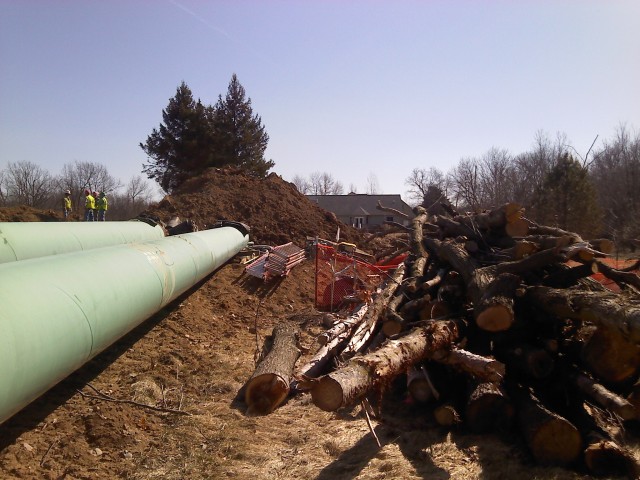
We don’t know about you, but we’ve been finding the voices of our fellow landowners moving and powerful. They reveal how and why Enbridge has generated so much ill-will with its “neighbors” in Southeast Michigan. Whether this is simply a result of “mistakes” or any number of other possible reasons the clear fact is that they have failed miserably in far too many instances (we believe) to cultivate the sorts of landowner relationships they profess to value, failed in so many cases to “make us whole.”
Today’s contribution comes from landowner Bill Aldrich of Davisburg. You may recall that Bill has appeared on this blog before. We turned to Bill when Enbridge first trotted out their mascot “Dr. Michael Milan” (we wonder if he’s still happy?), parading him around, rather offensively in our view, as someone whose credentials as a fancy doctor, a longtime resident of the state, and (judging from his rugged camo outfit), an outdoorsy hunter-type were evidently supposed to impress us all mightily and give his rosy view of Enbridge some kind of special authority. Bill is a pretty authentic Michigander himself, a lifelong resident and an auto-industry career man. So he presented his own view as a helpful counterpoint to the one served up by the Enbridge PR department.
Anyway, Bill’s experience is once again valuable. His list of “images” touch on so many of the themes we’ve discussed here before and that we’ve heard from others: the miscommunication, the broken promises, the “mistakes,” the untrustworthy land agents, the poor communication with landowners, the poor communication between Enbridge’s land agents and corporate, and all the time and energy so many of us have expended on this process and for which we have not been compensated.
By William Aldrich
When I reflect on the entire dealings with Enbridge, it is never a coherent event. Instead, it consists of many individual, fragmented images jumbled together — similar to a bad dream. The only common theme is frustration, anger and a deep resentment of Enbridge and their representatives.
- large diesel generator droning in back yard for about 4 months continuously (running water pumps)
- loss of over 200 trees, many well over 100 years old and had survived the initial pipe installation in 1969
- large portion of area clear cut by Enbridge was used to pile up the trees and roots of the clear cut trees (they clear cut trees so that they could pile up clear cut trees and roots)
- land owner agreement with Enbridge asked that they leave tree stumps in ground (so that they would resprout). The majority of stumps were bulldozed out of the ground and piled up to rot.
- Enbridge removed trees on the very edge of the area they claimed after their representative clearly marked them with “Do Not Cut” ribbons
- Enbridge’s unwillingness to modify boundaries of the work spaces to save specific trees; even when offered with a solution that provided them a larger work space
- Enbridge clearly violated their own overhead maps that defined the work space boundaries. Their surveying team marked an area larger than that defined by the overhead map which was the only definition offered to me. I pointed this out twice; both times they responded “the area is marked correctly.” Only after I documented the violations and provided the documentation to my legal counsel did they “discover their mistake” and mark the boundaries correctly. It was immediately after this event that the trees marked “Do Not Cut” were removed. I can only believe this was done as an outright malicious action as these trees in no way impeded the pipeline installation process. I carefully monitored the entire installation and at no time would these trees have impeded the process
- the incredible disconnect between the Enbridge homeowner representative and Enbridge corporate actions. Prior to the condemnation, several clauses in the legal agreement were ironed out between him and I; when the condemnation papers were served none of that language was included. Enbridge homeowner representative marks trees as “Do Not Cut”; the trees are cut. On multiple times, I was presented with papers and maps for a different property than my own. Incredibly unprofessional.
- Enbridge’s unwillingness to restore the property to its original condition by replanting the same varieties plants removed.
- the investment of my time in researching and understanding Michigan condemnation laws
- the fear that anything I now do on the work space to restore it can be undone at their will
by Jeffrey Insko | Jul 26, 2013 |
Yesterday, the three year anniversary of the spill in Marshall brought with it, as we pointed out, some excellent reports by some of our favorite reporters and writers– Dave Hasemyer, Lindsey Smith, Jacob Wheeler, and Josh Mogerman, to name a few.
By contrast, today, the day after the anniversary, has brought us some reports that are to, a greater or lesser extent. just plain maddening.
Take, for instance, the anniversary story released today by UPI, the people, you might recall, who think Beth Wallace is a “global warming advocate.” Unlike the group we mentioned above, the UPI typist couldn’t be bothered to do anything at all except quote back the hollow phrases served up to them by Jason Manshum. In fact, that’s the story’s lead:
There’s always a chance of failure when dealing with mechanical equipment and oil pipelines, Canadian pipeline company Enbridge said.
A couple of paragraphs later, the story offers up the same disingenuous load of hay about “mechanical equipment” from Jason Manshum that we discussed yesterday. Which really just raises one question: wasn’t UPI once a reputable news service?
Less maddening from a journalistic standpoint, but still a little maddening, is this item from a local paper covering Macomb County in Michigan, through which phase two of the Line 6B replacement runs. The headline of the story, oddly, is “NTSB report harshly criticizes Enbridge for oil spill in the Kalamazoo River.” This confused us a little at first, considering the fact that that report was released one year ago this month. But once we got our bearings, we realized that the story is a very good thing. The good citizens of Macomb and St. Clair counties need to know about that report, even if it’s a year old. So we commend The Voice and reporter Jim Bloch, who does a nice job of summarizing the report, for running the story. He even includes the really important stuff, like this:
The report condemned the “culture of deviance” that characterized Enbridge operators, pointing to “systemic flaws in operational decision-making.” The company’s operating culture was one “in which not adhering to approved procedures and protocols was normalized.”
Bloch also has a second story in The Voice, reporting on a meeting between some Enbridge reps and the Marysville, Michigan city council. It mainly consists of Enbridge saying, as they always do, “hey, none of this is any big deal; don’t you worry.” But at one point, Enbridge project manager Doug Reichley says this extraordinary thing:
“The original pipeline was built in the late ‘60s,” said Reichley. “We’ve had some repair issues and some maintenance issues, so we thought it best to replace the entire thing.”
That’s right. On the third anniversary of the most expensive inland oil spill in U.S. history, Reichley says they’ve “had some repair issues.”
The last two maddening items from today are of the déjà vu sort. The Minnesota Star-Tribune has a truly infuriating story about Enbridge violating the terms of some environmental permits:
Enbridge Energy said Friday it will pay a $425,000 fine to settle federal allegations that it made illegal discharges into wetlands and rivers while testing two Minnesota pipelines, including one being upgraded to carry more crude oil.
The violations pertain to the discharge of water during testing of the lines in 2009 and 2010. Sound familiar? It should. Because that’s exactly what happened in Michigan a few weeks ago when Enbridge discharged some rust-colored water into Ore Creek, violating ELEVEN conditions of its MDEQ permit. We believe this constitutes a pattern. The fact is, as our friend Beth Wallace pointed out, that Enbridge treats these matters simply as the cost of doing business. To which we would add that our regulations are so weak and the fines issued for these violations are so small that there is no disincentive for companies like Enbridge to violate these permits. So as much as we want to point out that Enbridge is a very bad actor, we also hasten to add that the systems we have in place compound the problem: they are too weak to force companies like Enbridge to behave.
We also did a double-take when we read that “Enbridge spokeswoman Terri Larson said the company didn’t admit to the violations, but decided to settle the case and avoid litigation.” It’s not just that we remember our own not-unpleasant encounter with Terri Larson at the PSTrust conference back in November (though we have a strong hunch that she was subsequently told to stop replying to our emails). It’s that this also seems to be a pattern with Enbridge. Long time readers might recall that when Enbridge finally reached a “consent agreement” with Brandon Township, they did not admit that they’d violated an ordinances or that they were required by law to seek consent. Enbridge is nothing if not recalcitrant.
Lastly, Michigan Radio’s Lindsey Smith, who’s doing great work, spent a long, late evening at the Comstock Township Planning Commission last night, as the commissioners considered whether to approve Enbridge’s dredging plan. Based on Lindsey’s fine report, it sounds like it was an interesting, if a little exhausting, meeting. But the déjà vu moment for us in the story was this:
Tracy presented the plans to the township’s planning commission after apologizing for not coming sooner. Enbridge set up a lot of equipment at the location near Morrow Lake in June, without getting township approval.
“There is a small slice of time here, that’s no excuse for not coming you to begin with,” Tracy said.
He also apologized to planning commissioners who said they were kicked off the proposed site when they attempted to see it.
This, too, is part of a pattern with Enbridge, something we have seen (and pointed out) on numerous occasions. Enbridge shoots first and aims later. They plow forward, doing whatever they want, and then later, pretending to be innocent and sincere, they issue apologies or offers to fix whatever problems they have caused. It’s a very convenient strategy– for Enbridge– and far too many regulatory and governing bodies have allowed them to get away with it for far too long. Here’s hoping Comstock Township does not do the same.
Lastly, here’s something really interesting for this anniversary. When the spill happened in Marshall 3 years ago, a lot of committed people took lots of different forms of action. This included a small local paper called the Michigan Messenger, which did a lot of vital reporting in real time and did a great job of trying to hold Enbridge’s feet to the fire. Through the magic of the internet, a great deal of that reporting lives on. So if you really want a look back upon that nightmarish summer, hop a ride on the internet wayback machine.
by Jeffrey Insko | Jul 25, 2013 |
As everyone reading this surely knows by now, today is the third anniversary of the spill in Marshall. To mark the occasion, lots of journalists and others have filed lots of fine work, looking back and assessing the current state of the Kalamazoo cleanup and Enbridge’s other ongoing operations in the state. We already posted to Pulitzer Prize winner Dave Hasemyer’s terrific piece over at Inside Climate News. If you haven’t already, be sure to checkout the accompanying slideshow.
Several other notable items have since appeared, including Lindsey Smith’s first-rate Environment Report. In fact, of everything we’ve seen so far, this is the one that has us worked up the most. That’s because Jason Manshum, apparently saved his best (by which we mean his worst) material for this special occasion. We’re used to his dissembling and his vacuities, but today, he’s outdone himself. Here’s what he told Lindsey Smith:
“You know, I would love to say that we have done the following ten items that will ensure there are no leaks again. I would love to tell you that. But I can’t. We’re dealing with mechanical equipment and any time you deal with mechanical equipment there’s a chance for some sort of failure,” says Manshum.
See what he’s doing here? He’s pretending like the Marshall spill was just a matter of some inevitable, albeit regrettable, failures of “mechanical equipment.” ‘Cuz let’s face it, sooner or later, your lawn mower is going to break down. That’s clever, we admit. But it’s also counter-factual– which is why it is so very important that everyone, every single citizen of the state of Michigan and beyond, should read the NTSB report. Because if and when they do, those citizens will learn that the spill in Marshall (how many times do we have to say this? seriously, how many?) was NOT a matter of mechanical problems, technological failures or whatever dishonest, evasive line Enbridge reps like Jason Manshum still to this day try to peddle to an under-informed public. No, the NTSB report makes it crystal clear that humans– humans working for and trained by Enbridge– failed, again and again. The fact that the Jason Manshums still try and pretend otherwise at this late date does nothing more that belie their rhetoric of taking full responsibility for what happened in Marshall on this day three years ago.
Another outstanding piece of journalism is now posted over at The Uptake. It’s a video report by Jacob Wheeler, another fellow of the IJNR Kalamazoo River Institute. Both the video and the written piece are very good, so be sure to read and watch. We’re also glad to see that it’s been picked up by a handful of outlets, as it merits a wide audience. The video features a number of our favorite people, including Beth Wallace, Susan Connolly, Deb Miller, Dave Gallagher, and Josh Mogerman. In fact, if you check out the version of the story over at the Glen Arbor Sun, there’s a downloadable picture of Josh in his adorable red cap. Oh, and if you stick around the video until about the 8:40 or so mark, you might see us saying a few words…
Speaking of Josh Mogerman, he’s got a wonderfully pithy blog post up over at the NRDC Switchboard, which includes a whole bunch of links worth clicking on.
Lastly, the Detroit News (almost always lagging behind, if we’re being honest) has a bit more on that interesting Bell’s Brewery lawsuit story.
Happy reading!
by Jeffrey Insko | Jul 19, 2013 |
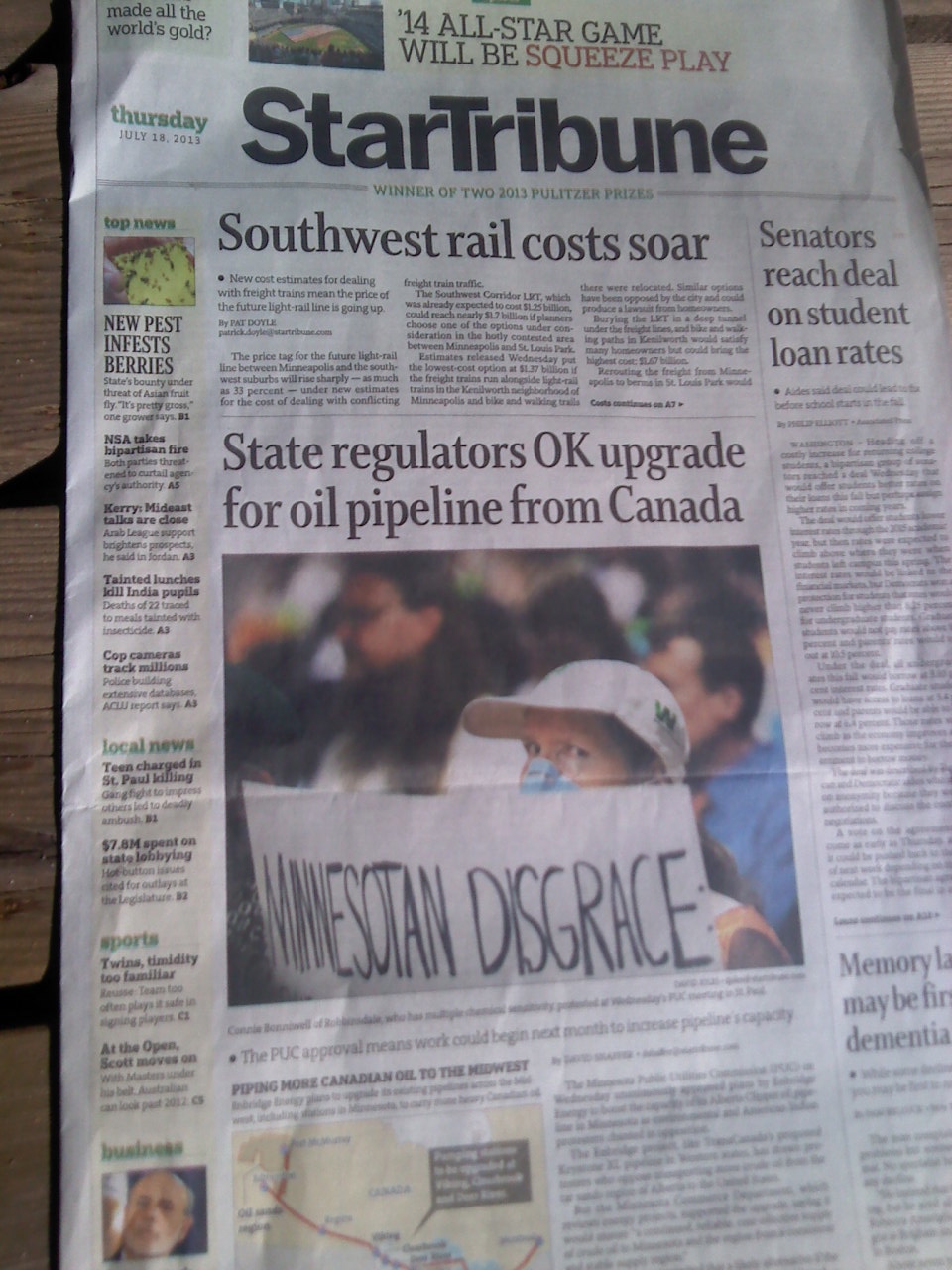
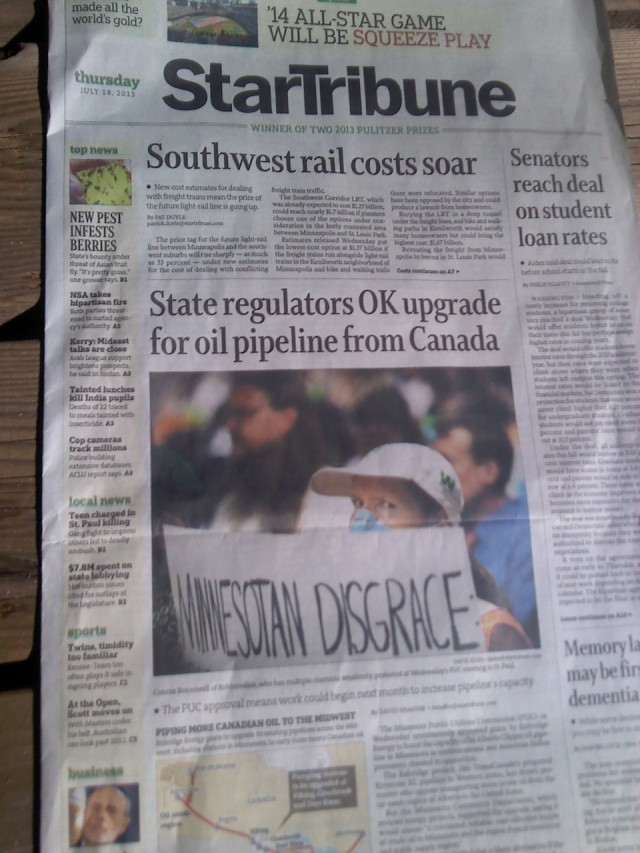
As we mentioned yesterday, we’re on our annual vacation in Minnesota. Now, you might think that would mean that we get a reprieve from Enbridge and oil pipeline related matters. But no. They evidently dog and hound us at every turn, wherever we go. For example, when we got out of bed yesterday and checked the local newspaper, this is what greeted us:
Yep, it appears that Minnesota regulators are every bit as weak and reluctant to protect the public interest as those in Michigan. Sigh. We’ve got a lot more to say about this matter — and about the Minnesota decision as one small piece of a larger Enbridge puzzle– in a separate post.
But right now, rather than looking forward, we’re doing a bit more reflection on the year that has been here at the Line 6B blog. As we said earlier this week, it’s our birthday or anniversary, one full year since we started this thing. So we’re looking back (a little sentimentally even). This morning, we’re going to kick off a series of posts on some of our “greatest hits” (if you’ll forgive us a bit of self-indulgent back-patting), some of the posts we’ve written that, in our view, merit some re-visiting. The Minnesota story reminds us one of those hits in particular– but we’re going to save that one for later.
Instead, we’ll start this year in review where it has to start, where everything Enbridge-related absolutely must begin, with the crucial context without which one can’t understand anything about what Enbridge is doing in Michigan (and beyond), with the document that anybody who thinks they have an opinion about Enbridge, critical or supportive, has to have read if they want to have any sort of credibility whatsoever, if they want to be taken seriously: The National Transportation Safety Board’s report on the Marshall spill.
The release of this report in July of last year– and our reading of it– is what changed us from frustrated landowners to critics and activists. Its parade of horrors, its litany of poor decisions, neglect, and inaction, all attributable to a dreadfully lax safety culture at Enbridge, will send chills down your spine.
So early on in the life of this blog, we did a series of posts on “Tales and Lessons” from the report, in which we not only summarized some of the more horrifying findings from the federal investigation into the Marshall disaster. We also considered how those tales appear to reveal some general truths about Enbridge that explain how they have conducted themselves during the course of the Line 6B “replacement” project– conduct and behavior we have continued to write about. In fact, looking back at this series nearly a year later, it’s extraordinary how often we have returned to the three basic problems with Enbridge that we then, via the NTSB report, identified. Here is just one example:
In the first post in that series, we told you about Enbridge’s failure to abide by its own safety protocol, known as 10-minute rule– a failure that greatly exacerbated the severity of the spill into Talmadge Creek. In disucssing this failure, we asked the question “Does Enbridge learn from its mistakes?” You can imagine what sort of answer we arrived at back then. But what is perhaps most striking to us looking back on that question now is that it turns out to be a question that we are still asking. In fact, in a pair of posts just last month, we asked what amounts to the very same question: why can’t Enbridge do better?
The fact that we’re still asking whether Enbridge learns from its mistakes nearly 12 months on suggests to us that the answer is perfectly obvious.
by Jeffrey Insko | Jul 18, 2013 |
During this birthday/anniversary week, we’re reflecting a bit. And when we reflect on this past year, we don’t just think of all the mess, stress, destruction, and inconvenience– because this experience, strangely, has not been without compensation. We’re not talking about money (frankly, there hasn’t been nearly enough of that!). No, we’re talking about some of the fascinating things we’ve learned and done, though we’ve done some pretty fascinating things. We’re talking about all of the fantastic people we’ve met, in person and cybernetically; all of the friends we’ve made.
Now, this is a dangerous thing to do, since we run the risk of leaving someone out. But we’d like to give some heartfelt shout-outs. If we forget you, we apologize in advance. Nevertheless, we want to say that we are genuinely, truly, deeply grateful that we’ve gotten the chance to meet and know:
Carl Weimer, the Big Cheese
Rebecca Craven, brainiac
Beth Wallace, hero
Kim Savage, trench warrior
Jeff Axt, Brandon brawler
Josh Mogerman, water (and beer) watchdog
Ben Gotschall & Jane Kleeb, role models
Nate Pavlovic, prodigy
Anthony Swift & Sara Gosman, legal masterminds
Susan Connolly, Deb Miller, & Michelle Barlond Smith, K-zoo pugilists
Steve Hamilton, river baron
Kathy Thurman, model public steward
Mike Holmstrom, pipeline guru
Rosemary Ahtuangaruak, whale hunter
Mike O’Leary, wild lifer
Chris Wilson, Texas tornado
Sonia Grant, scholar
Lance Enderle, winner
Gary Field, intervenor
Jake McGraw, eco-activist
Dave Hasemyer & Lisa Song & Susan Bromley & Elana Schor & Dave Spratt & Rebecca Williams & Jack Lessenberry & Adam Hinterthuer & Morgan Sherburne & Lindsey Smith & Tiffany Stecker & Tina Casagrand, journos who give us hope (seriously, having spoken with those last four, all smart and at the very start of their careers, one actually does not despair for the future of American journalism)
And most of all, all our fellow landowners, the outspoken and the silent, who have put up with far more than they ever should have: Beth D & Donna T & Dave G & Carol B & Shannon & Linda K & Patricia & Amy N and all the others too numerous to mention who stop by and occasionally comment here & all those many others whom we’ve never even met.
In all sincerity: thank you.
by Jeffrey Insko | Jul 18, 2013
Can you believe it? This week marks the one year anniversary of the Line 6B Citizens’ Blog. One full year! Can you believe it? We are finally growing up!
Well, technically, we launched the blog on June 27, but it was really the middle of July that we started blogging in earnest– even though we had no idea what we were doing and sort of floundered around unsure of what to say, clueless about blogging conventions (which we still don’t really understand that well), and shaky with the technology. It took us quite a while to find our sea legs. In fact, our early posts, like, say, this one, weren’t really posts at all.
Anyway, in our minds, we associate the launch of the blog with our annual vacation in Minnesota, where we are sitting right this very moment (in the sweltering heat, alas!). That’s when, one year ago, we made our impromptu visit to the Enbridge offices in Superior, Wisconsin. That’s when we first started reading the horror story that is the NTSB report on Marshall— the experience that changed everything for us. That’s when we had our disturbing and now-famous pseudo-correspondence with Michigan U.S. Senator Debbie Stabenow, landing our better half in the Los Angeles Times. Not once, but twice.
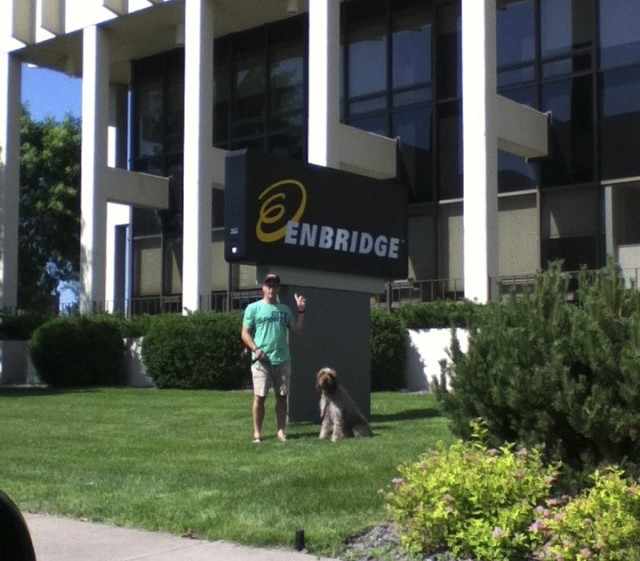
So to kick off our birthday celebration, we made a return visit to the Enbridge offices. But this time we didn’t pop in for a chat. We’re quite certain that Doug Aller and Mike Harris don’t want (or aren’t willing) to talk with us. But here we are; Sam got to get out of the car this time:
Over the next week or so, we’re going to reflect upon the past year, re-visit some of our “greatest hits” (if you’ll indulge us), and look toward some new directions for this blog (most of which will have to do with some of Enbridge’s new ventures).
So light some candles, hang some decorations, bake a cake– but no gifts, please!– and join us in celebration. We’ve decided to keep this blogging thing going for a while longer!
by Jeffrey Insko | Jun 25, 2013 |
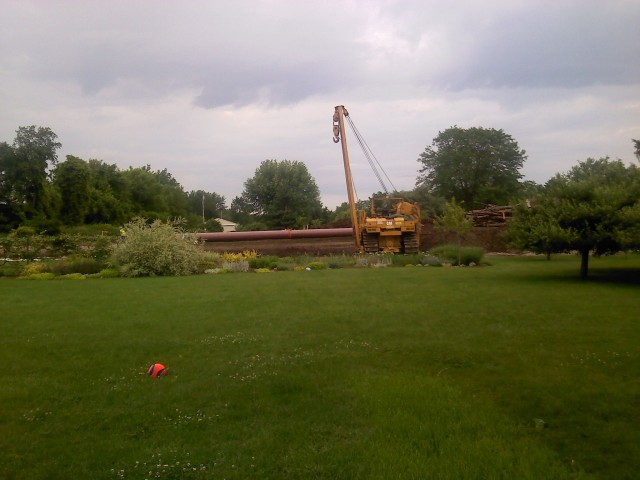
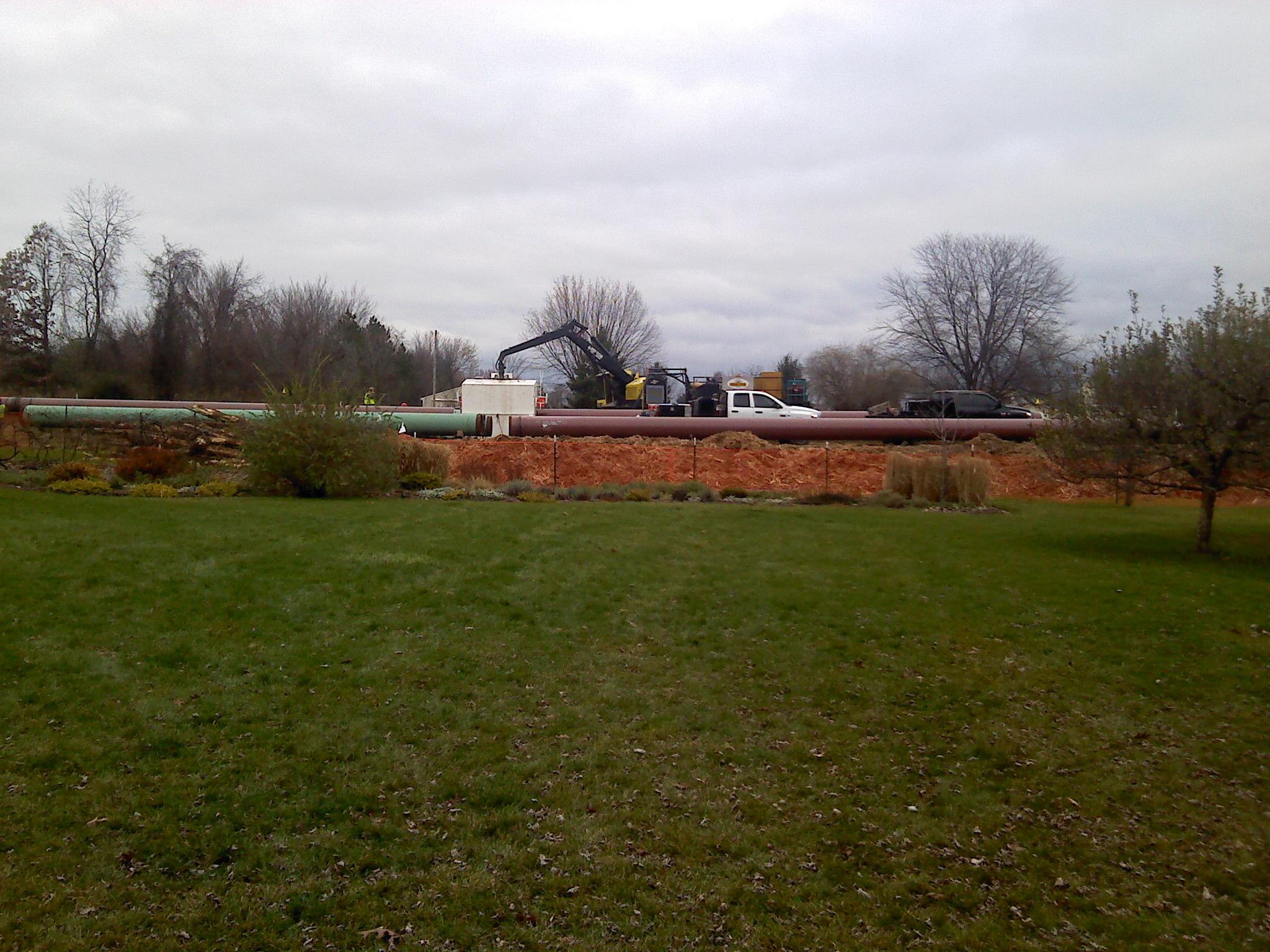
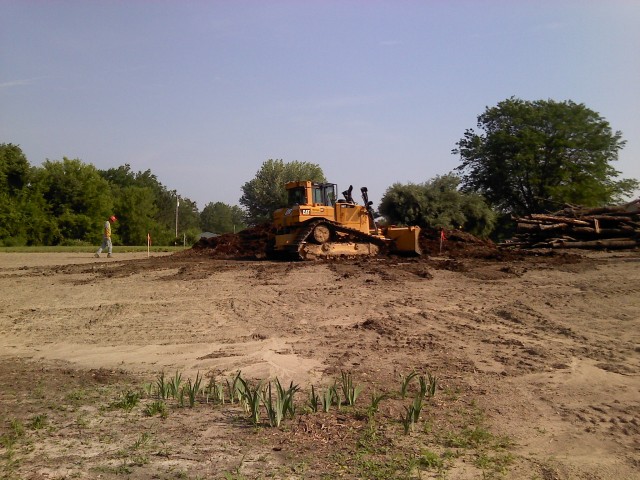
Here is a picture of our backyard taken on November 5, 2012. The picture below it was taken today–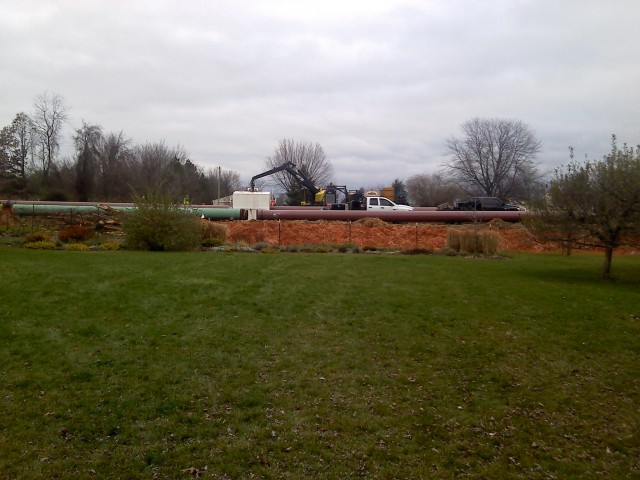 more than seven months later.