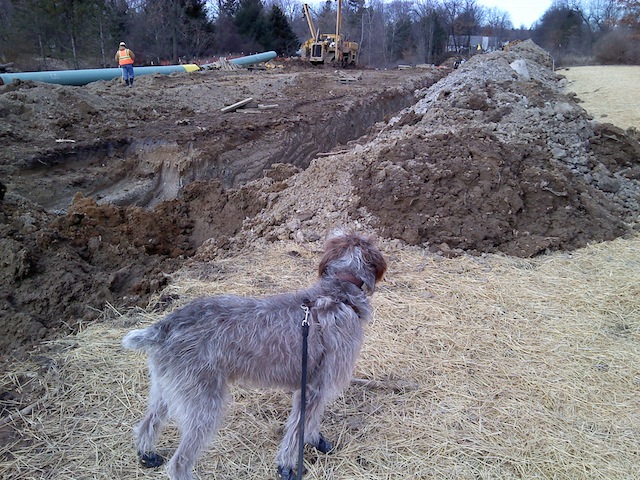
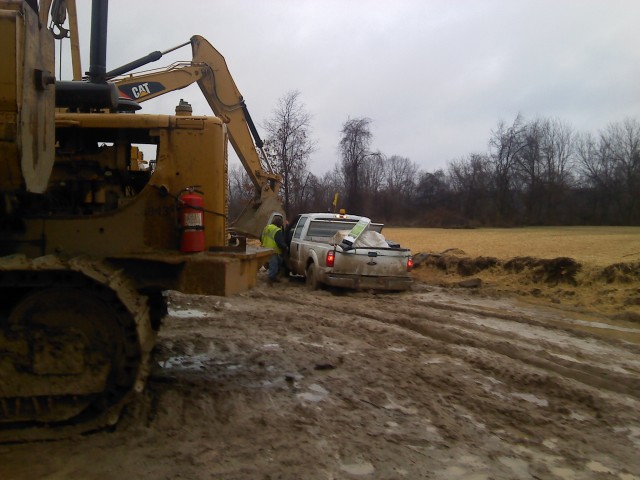
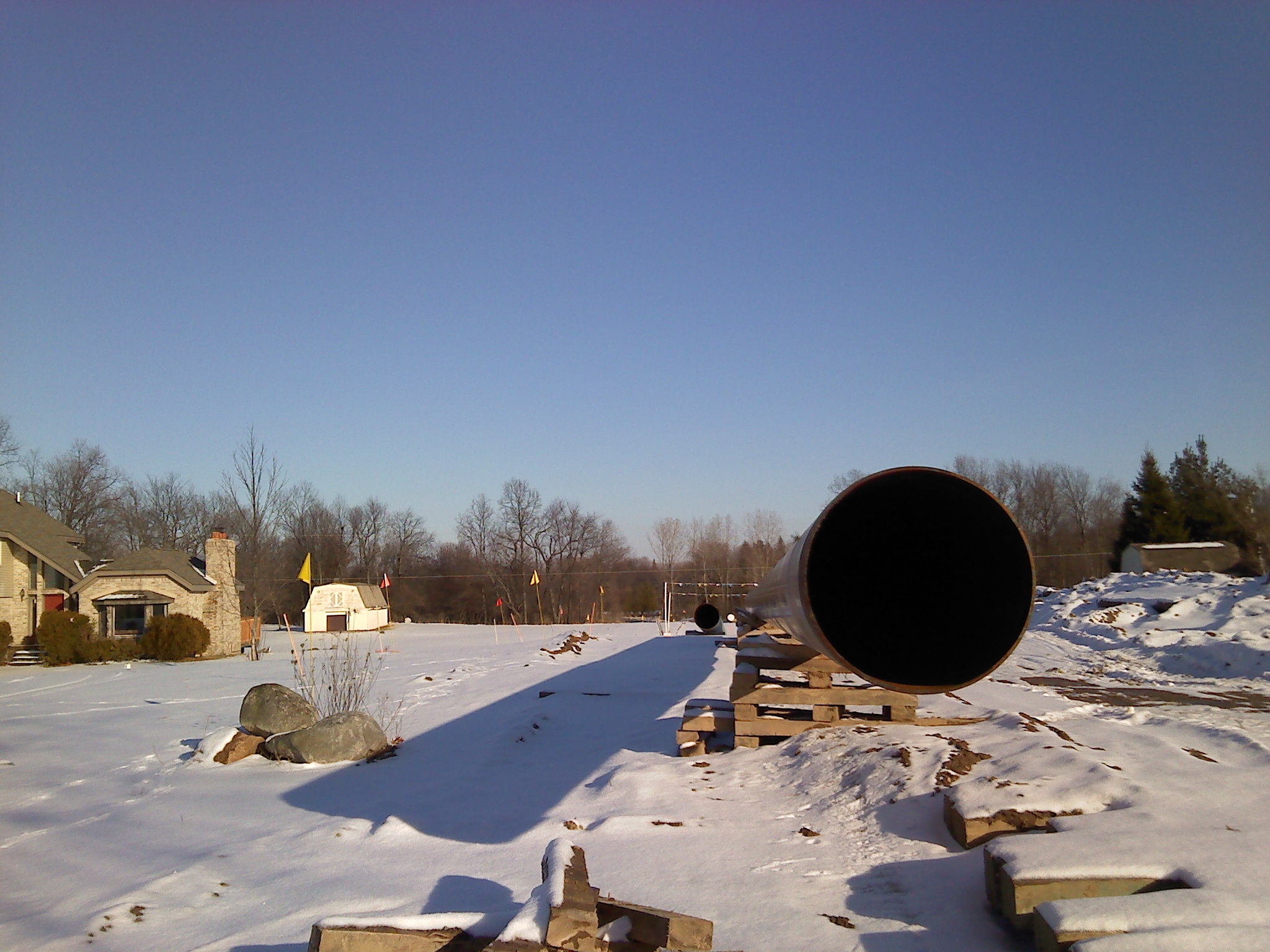
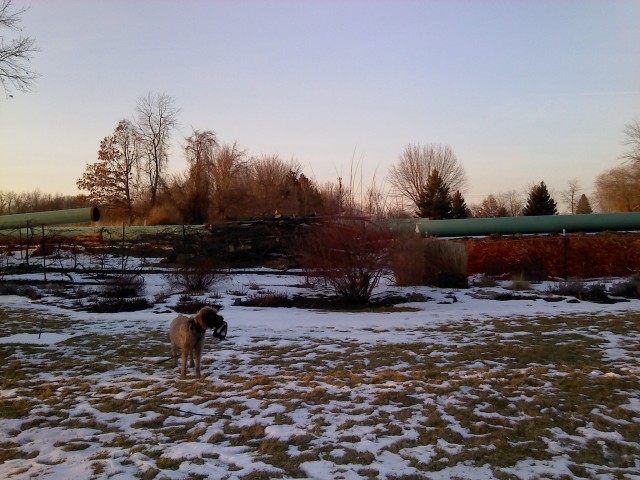
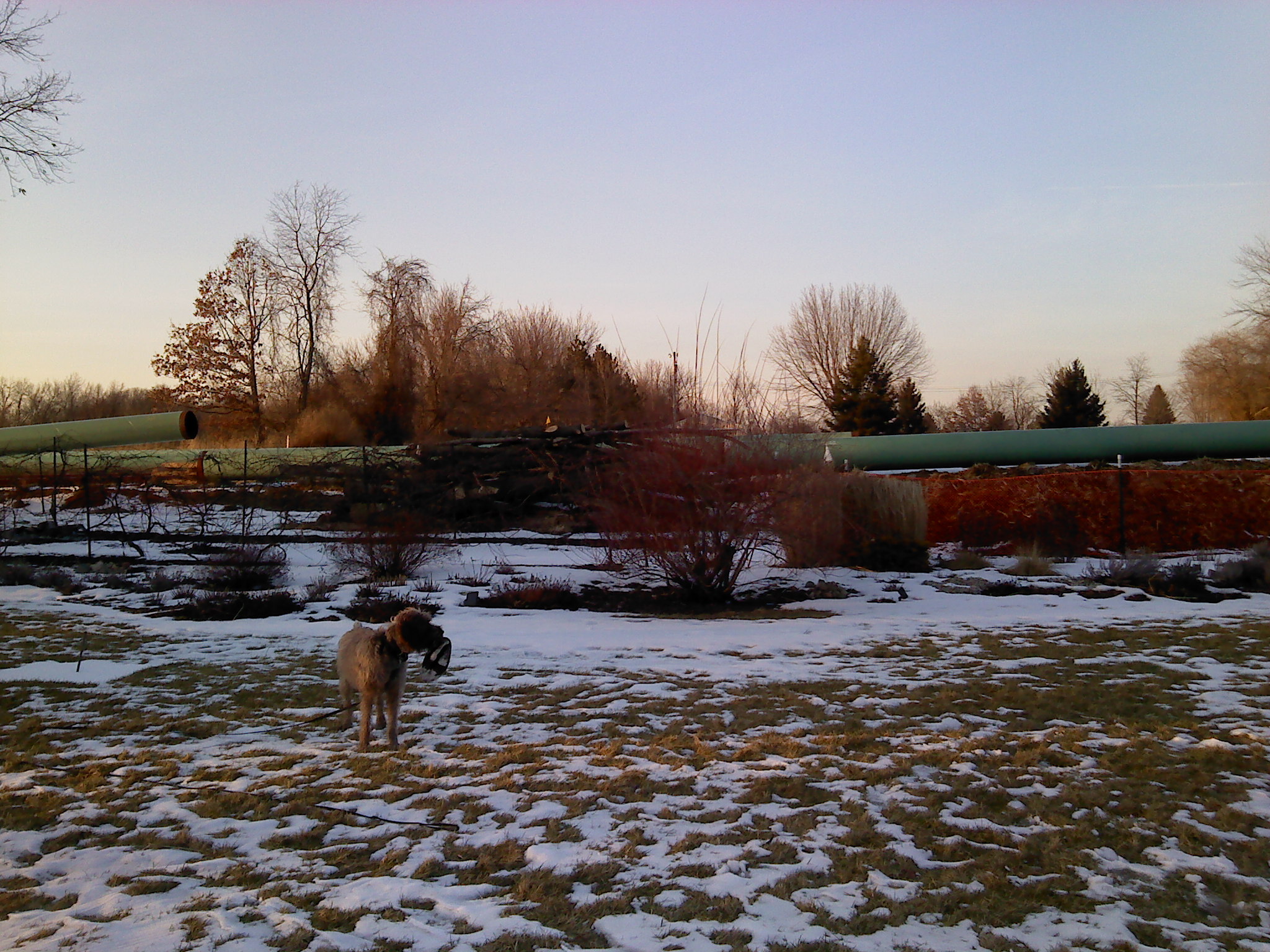
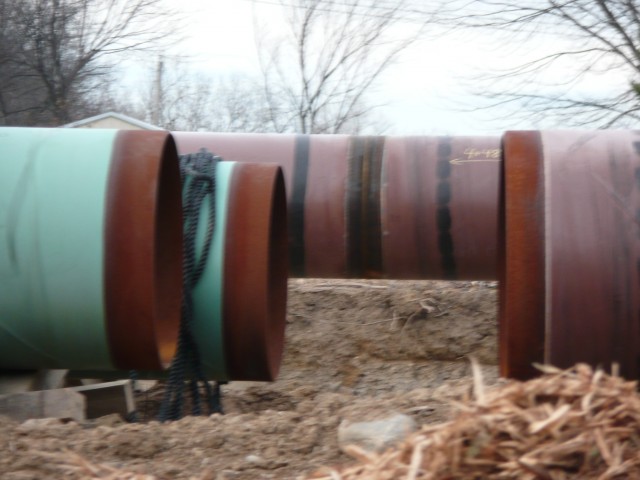
This morning we’ve fought our way to the surface from beneath a mountain of end-of-term student papers to bring you a brief tour of local news reports. Line 6B construction activity has been pretty quiet recently owing first to frost-law restrictions and, more recently, to rain, rain, rain. (We hope you’re staying dry!) But other things are happening, among them negotiations with landowners along phase two (about which we hope to bring you more very soon). In the meantime, we’ll just call your attention to some recent local news reports, some of them rather revealing (and not in a good way):
[Township Treasurer Jonathan] Hohenstein said the lines were likely breached sometime in March while Enbridge was boring underground to make room for new pipeline.
For now, the damaged portion of the sewer line has been abandoned and sewage is being hauled from a pump station to the treatment plant. The damaged portion of the water line has been plugged to halt leaking.
The article contains no statement from Enbridge on the damage, but it will be interesting to see how satisfactorily this situation is resolved. Generally, we don’t like to indulge in “I-told-you-sos,” but surely someone on the Howell Township Board of Trustees is wishing they would have enforced their pipeline ordinance months ago– an ordinance that, despite Enbridge’s and the Howell Township attorney’s claims, appears to be entirely enforceable and not pre-empted by federal law, at least according to a recent federal Circuit Court decision.
Moving westward, last week a group of demonstrators gathered outside the Enbride offices in Calhoun County to protest against tar sands oil– the stuff that spilled into the Kalamazoo River, the stuff that spilled into a suburban neighborhood in Arkansas earlier this month, the stuff that the proposed Keystone XL pipeline would transport. The stuff that will be flowing through our backyards. In response to the protests, Enbridge spokesman Jason Manshum offered this extraordinarily disingenuous comment:
“The term tar sands is a misnomer. That is a slang term. There is no tar, there’s never been tar in it,” Manshum said, “It is a normal crude oil it’s just a different type. so no it is not more environmentally damaging.”
It is true that “tar sands” is a colloquial term and it is true that there is no tar in diluted bitumen. But those facts are apropos of nothing. Nobody (that we’re aware of) is claiming, or has ever claimed, that the problem with dilbit is that there is tar in it. So Manshum appears to be responding to a phantom of his very own making. It’s part of a name game that Enbridge has been playing for a long time– as our friend Josh Mogerman at the NRDC explained about three years ago.
Even farther west, late last month the good people at The Hermitage retreat center in Three Rivers held their service of lament and hope. We couldn’t make it, but about 50 people attended. As people who know a thing or two about grieving lost trees, we were struck by one ritual in particular that the participants engaged in:
To embody their prayers of lament, the group moved meditatively toward the woods, pausing to pray at several locations. They tied strips of fabric to trees tagged for cutting. The strips came from a sliced painted mural portraying a young man grieving the loss of a cut tree. The group gathered in a circle to dance and sing their prayers of hope.
Cory said a big company like Enbridge gained approval at the state level for the pipeline so the township can’t do much about it. However, he said Enbridge has given its word to work with landowners.
“When a pipeline cuts through residential streets and people’s septics and wells, it’s huge, it’s a big concern for those people,” he said.
Even further east, according to this morning’s Detroit Free Press, Enbridge made a presentation to the Macomb County Commissioners on the Line 6B project earlier this week. The Freep article is devoid of any detail whatsoever; it doesn’t say who was there from Enbridge. Nor does it say whether the Commissioners bothered to ask any questions. It does note, however, that “Some residents in the state and environmental groups have criticized Enbridge for its plans to leave the old pipeline.”
-Part of a pipeline in Michigan will be filled with inert gas to make way for the construction of a new section of the line that leaked in 2010, Enbridge said.
-The company will fill the old section with inert place and leave it in place as per federal safety regulations, the Detroit Free Press reports.
-Line 6B was carrying Canadian crude oil, a type that sinks in water and is more difficult to clean than conventional crude oil.
Thankfully, the UPI article makes the one published earlier this month in a local Macomb County paper seem almost less bad by comparison. And while we think it’s perfectly appropriate to take a national, 100-year old news outlet to task for shoddy work, it gives us no pleasure to pick on little guys like reporter Matthew Fahr. But, as the Brandon Citizen’sSusan Bromley has amply demonstrated, there is no reason why a local reporter can’t be clear, thorough, and effective. Unfortunately, Matthew Fahr also doesn’t seem to have a strong understanding of the basics of the project, which he reports ” is currently going through the regulatory approval process in Oakland, Macomb and St. Clair counties.” We confess that we’re not really sure what that means. Even worse, though, is this:
Enbridge will be replacing 285 miles of natural gas pipeline, referred to by the company as Line 6B, that spans from Griffith, Ind., to Port Huron. The pipe delivers natural gas across the state to cross the border for use in Ontario, Canada.
And not to nitpick, but in addition to correcting such basic factual errors, the teacher in us would also like to help Fahr correct some of his awkward verb constructions: the project, he writes, “will be affecting counties.” Enbridge, he says, “will be replacing” pipeline. And then there’s our favorite, which gave us a chuckle not for its use of the passive voice, but for its unique rendering of the name of a familiar Enbridge spokesman: “Jason Mansion, from the Enbridge Public Affairs group, explained all aspects of how the company will be handling the project both locally and statewide.”
We sincerely hope that all of our readers who have dealt with Enbridge were able to figure out how to report to the IRS. Enbridge– as one might expect– did not make it easy by reporting payments on the wrong form (or so tax experts told me). But to bring a little levity to a day that’s typically not much fun for anyone, we thought we’d share this brilliantly hilarious parody. Enjoy!
There is some interesting– and promising– news out of northern Indiana this week. As you may recall, the hardworking folks at Save the Dunes have been trying to ensure that the Line 6B replacement does not harm sensitive wetlands. In that effort, they have been talking with local officials in LaPorte County. Now the LaPorte Herald-Argus reports that LaPorte County officials plan to “require a review of the project because it appears to fall within the regulations of its joint zoning ordinance.”
The wind in LaPorte County’s sails comes from a recent federal court decision. On March 25, the U.S. 4th Circuit Court issued a ruling in Maryland stating that federal law does not preempt the enforcement of local zoning laws. (Super legal nerds can read the ruling here.) Specifically, the Court upheld an earlier court ruling dismissing a complaint from Washington Gas Light Company declaring that the National Gas Pipeline Safety Act (PSA), the Natural Gas Act (NGA) and state law preempt Prince George County zoning plans. Washington Gas therefore sought an injunction preventing the county from enforcing its zoning laws.
But the Court rejected Washington Gas’s complaint, noting that the federal laws apply to matters of safety, not to siting and routing. The Court ruled:
the PSA does not preempt the County Zoning Plans because the PSA only preempts safety regulations and the County Zoning Plans are not safety regu- lations; and (3) the NGA does not preempt the County Zoning Plans because the NGA only preempts state and local laws governing interstate natural gas operations and, per the NGA, Washington Gas is a local distribution company.
In our view– and, evidently, in the view of the LaPorte County attorney– this ruling bodes very well for the efforts of local municipalities to have some input into the Line 6B project. Our regular readers might recall that, just like Washington Gas, Enbridge’s response to local governments has always been “pipelines are regulated at the federal level”– a misleading claim at best, as we’ve discussed before on more than one occasion. And had the 4th Circuit Court’s ruling been handed down some months ago, it might well have helped Brandon Township and Howell Township enforce their ordinances, which like the Zoning Ordinances of Prince George County do not attempt to regulate pipeline safety. Looking ahead to Phase Two of the Line 6B project, this ruling might yet be of some use not just to LaPorte County in Indiana, but some Michigan townships as well– if you’re on Phase Two, you might mention this to your township supervisor. The ruling might also be of some help to POLAR in its ongoing cases (about which we hope to post in detail later today).
We will keep you updated on matters in Indiana. For now, we’d just like to commend folks down there, especially Nate Pavlovic and Michael Hollcraft, and County Attorney Shaw Friedman, for their dedication to the protection of valuable ecosystems.
We are sorry for our recent silence. But rest assured we are still on the case. In fact, just today we’ve been taking pictures of the pipe that has actually made its way into the ground– a spring miracle! Oh, and we took those pictures after the telepresser this morning called by our friends at the National Wildlife Federation.
More on these things and other matters coming in the next couple of days. Please come back!
While we were toiling away all last week at our regular job, a number of interesting Enbridge-related news items appeared. The most important of which, of course, is the new EPA order telling Enbridge they need to do more dredging to remove oil from the Kalamazoo River. Enbridge has 15 days to respond to the order, although indications are– judging from what’s coming out of Jason Manshum’s mouth– that they’ll be looking for ways to resist the order:
Enbridge spokesman Jason Manshum released a statement touting the progress of the cleanup to date and suggesting that “dredging and active recovery may cause incremental damage as determined by the U.S. EPA’s own Net Environmental Benefit Assessment.”
“The weathered and degraded oil remaining in the river is in extremely small concentrations found in the bottom sediments (and) is nonhazardous upon incidental contact according to the results of a study conducted by the Michigan Department of Community Health (MDCH).
Our favorite part of this is when Manshum then adds, by way of a complete non sequitur, “Furthermore, the drinking water from private wells near the river has been and continues to (be) safe for consumption, as verified by the MDCH”– something that is evidently true, but has nothing whatsoever to do with the EPA’s order for more dredging.
But of course, as we have pointed out before, Enbridge’s style of communication does not always adhere to the ordinary rules of rational discourse. For instance, Manshum’s statement about the EPA order also says that Enbridge is “focused on cooperation with the EPA and other authorities in doing what is best for the river and the environment based on analysis and sound science.” Yet Enbridge appears to have some slightly different ideas about what constitutes “sound science” than the rest of us. Case in point, a recent study commissioned by Enbridge that claims that dilbit floats in water– a rather startling claim given the fact the dilbit they spilled into the Kalamazoo River did NOT float. It sank. Which is why the EPA wants them to do more dredging.
Samples from a county drain are being tested after a sheen was detected on the water’s surface over the weekend near the Enbridge Inc. facility in southeastern Ingham County
As of Tuesday night, no petroleum had been detected, but testing was continuing, Deputy Ingham County Drain Commissioner Carla Clos said Tuesday afternoon.
“At this point, we don’t really know what it is,” Clos said. “(The tests) are not showing anything to be worried about.”
For our part, we have our doubts that there’s anything much to this. At the same time, we also have our doubts about what’s coming out of the mouth of our old pal Larry Springer, who, by way of offering reassurances, tells us it might just be… um, decaying leaves:
Many things other than petroleum can cause a sheen on water, including decaying leaves, and there was no indication of an oil or gas leak, [Larry] Springer said.
But in both cases, we admit, we don’t really know. We hope that local and state officials continue to monitor the matter closely.
Moving north, there are a couple of interesting items out of Wisconsin. A state Court of Appeals has ruled that a family can pursue a trespass claim against Enbridge for allegedly exceeding the easement rights they have on the family’s land. The ruling means that the family could force Enbridge to remove pipelines they’ve installed on the family’s property.
Even farther north, up in Canada (unless we’re accused of being unfair!) comes this heartwarming article about what great neighbors Enbridge has been while working on Line 9.
By way of counterpoint, closer to home residents over in Rose Township, just to our west, haven’t had quite the same pleasant experience. The Tri County Times this week has the story of some construction trouble in that area. Resident Ellie Vance has some positive words to say about Enbridge’s contractor, but not so much for Enbridge and its ROW agents:
One supervisor with Precision Pipeline has picked her up personally from her door with a golf cart to take her out to her car, which is marooned on the other side of the construction. She has enjoyed dealing with the Precision Pipeline, the group carrying out the work on the pipeline that Enbridge owns. She does not, however, like working with Enbridge. She has been through two land agents, and said the recent land agent has been very brisk.
When it comes to Enbridge lately, mostly we sit around waiting for the stretches of green steel pipe that dominate our backyard vista to somehow burrow their way into the ground– so that we can finally stop looking at them. Well, that’s not totally true. We’ve been trying to get some answers as to when construction might wrap up, so we can begin devising a tree-replanting plan. But we have been waiting to hear back from Tom Hodge with an update.
We’ve also been trying to get some more information regarding the Environmental Stewardship program that we’ve been told has finally been rolled out to all townships along the route. As soon as we have that information, you can bet we’ll tell you all about– so that you can begin thinking of ways to benefit your local areas. We’ve made some inquiries on related matters, too, but again are waiting–patiently, but a bit anxiously, at this point–for some responses. Why anxiously? Well, when days (or weeks) begin to pass without any replies, we start to remember the other times we’ve been brushed off by Enbridge folks (and the other other times).
But while we wait for those things, we thought we’d point you in the direction of some other interesting, and totally unrelated (to one another) matters:
We are completely fascinated by (and filled with admiration for) the actions of the Red Lake Nation up in Northern Minnesota. They’re staging a blockade against a 60-year old Enbridge pipeline– a pipeline that was built on sovereign lands without permission. You can learn about the story here.
Closer to home, we are very interested in a request from Bruce Township (over to our east) for some help from Enbridge treating their battered roads with limestone. Enbridge, apparently, has said they would take the request “into consideration.” We hope they will. As we have said from day one– we said it to to our own Township trustees (who dismissed us out of hand)– every township should be making these sorts of requests. Not only is it a chance for Enbridge to live up to their “good neighbor” rhetoric; it’s also completely reasonable that host communities should want to gain some benefit from being good faith partners with Enbridge– because Enbridge will most certainly benefit from it, in the form of millions of dollars.
Lastly, if you missed it in our comments section, the good people over at The Hermitage retreat in Three Rivers are hosting a fascinating event later this month: “A Service of Lament and Hope along the Enbridge Pipeline” on Saturday, March 30, 2013 2-4 pm. The Hermitage is located at 11321 Dutch Settlement Road, Three Rivers, MI. They describe the event this way:
You are invited to express your sorrow, regret or disappointment over the new pipeline being laid by Enbridge. The public lament. . .will include a public confession of our complicity in the demand for oil, a prayer walk to the pipeline, public acts of mourning and despair, and conclude with a dance of hope.
Unfortunately, the drive to Three Rivers is probably a bit out of our range– but we’ll try and find some time that day ourselves for a bit of lamentation.
Sorry we’ve been out of commission the past week or so! That pesky job keeps intruding…
We’ll do some catch-up blogging this weekend. In the meantime, a semi-urgen question if anyone is able to respond quickly:
Is there any current construction happening over in Livingston County– open trenches, strings of pipe not in the ground, that sort of thing? If so, could someone please send us a quick email and let us know where?
Over at the Detroit Free Press, Eric Lawrence, one of our favorite reporters, has a follow-up piece to his article a few days ago on last week’s MPSC decision. In this one, he says that we “blasted” the MPSC. We thought our comments to Eric were rather more subdued than that. Rather, it’s in our recent post on the MPSC ruling where we really blasted them. Among the things for which we blasted them was the commission’s astonishing claim that the intervenors’ attempt to introduce the NTSB report into the proceedings was a “red herring.” How a discussion of the federal report on the incident that led to this project in the first place can be described as intentionally misleading– because to intentionally mislead is what the red herring metaphor means– is almost beyond comprehension.
Which makes the most interesting parts of today’s article (in our view)– the ones where Lawrence quotes a couple of satisfied landowners– especially illuminating. These two landowners provide perfect illustrations of real red herrings.
First up is “Chip Rascher of Oakland County’s Brandon Township.” Chip “said he is pleased the project was approved.” Chip goes on to say that:
he was compensated fairly and expressed surprise that there has been so much “fussing” from some landowners. He said they should have known about the pipeline easement on their properties.
Now, let us say clearly that we’re glad Chip Rascher thinks he was compensated fairly. We’ve never doubted that plenty of landowners have had good experiences on this project. We just wish that were the case for everyone. Chip, on the other hand, seems to think that his experience somehow does stand for everyone’s, which, we are sorry to say, makes his view slightly narrow. After all, it’s really not that hard to imagine that somebody’s experience is different from your own, is it?
But that’s not the red herring part. The red herring is when Chip says that other landowners “should have known about the pipeline easement on their properties.” With all due respect to Chip, this is a pretty silly remark. Whether or not one knew about the pipeline on one’s property (and unlinke Chip we’re assuming everyone did know!) has never been the issue. That’s what makes his statement misleading. We have never heard anyone say, “hey, stop this project! this is the first I’ve heard about a pipeline easement on my property!” Conveniently. his statement makes Chip look like he understands something all those other people do not.
But perhaps Chip Rascher has never had occasion to speak with many of the people we’ve met: people who are not unhappy because Enbridge has an easement on their property, but people who are unhappy with how Enbridge has tried to exercise (or in some cases to overstep) its easement rights. Moreover, in many, many instances Enbridge has needed to acquire new easement rights– that’s what has been a bone of contention for many landowners. More moreover, there is the sticky matter, not of easement rights, but of Enbridge’s need for and taking of “temporary workspace.” And none of this even gets to the matter of how landowners and municipalities have been treated by ROW agents, Enbridge representatives, and construction crews– that is, the way that Enbridge has conducted itself throughout this process. Over the past several months, we have documented dozens of reasons why there has been “fussing”– and not one of those reasons has to do with people not knowing about pipeline easements on their properties.
So, to pretend like all of the “fussing” has only to do with Enbridge’s existing easement rights on people’s property is profoundly misleading; it is, well, a red herring.
The second landowner Eric Lawrence quotes is Enbridge mascot, Michael Milan. You remember him: he’s the rugged fellow with the cool camouflage jacket who also just happens to be a real-life doctor— the guy Enbridge has featured in some of its ads and brochures. And what does the good doctor have to say? Well, there’s this:
“We need all the oil we can get, and the more oil delivered to refineries in the Midwest the less we pay for gasoline,” he said, noting the new pipeline will be an asset. “The quicker we get the old pipe out of commission, the less likely we are to have any more spills.”
On the first point here, Milan is just plain wrong. Neither Enbridge nor Marathon– the company with the Detroit refinery where some of Enbridge’s tar sands oil will go– make any claims that this oil will reduce gas prices. In fact, here is what Marathon says in the FAQ at their “Heavy Oil Upgrade Project” website on that very point:
Will this result in lower prices for gasoline and other petroleum products from the refinery? We cannot predict the price of gasoline or other petroleum products. Gas prices are determined by a variety of market factors. However, this project will help secure the supply of petroleum products for the state of Michigan by offering an alternate supply source (Canada) whose continuity is not impacted by the weather issues that affect the U.S. Gulf Coast.
But being wrong is not a red herring; it’s just being wrong. It’s Milan’s second statement that gets us closer to the red herring. We should note first of all that Enbridge asserts that the old pipeline is not really at risk of any more spills. If it were, one would assume that it wouldn’t currently be in use (and it is currently in use!). Rather, Enbridge just states that the new pipeline will allow them to increase capacity– a a claim we certainly do not dispute. Enbridge also says the new pipe will be safer– another point which nobody disputes. After all, compared to a 40 year old pipe, how could it not be safer? So, one point here is that Michael Milan, while he might be a good “face” for Enbridge, what with his medical degree and his hunting gear, doesn’t seem to have a terribly firm grasp of the basic facts of this project.
But what’s really misleading here is the way that Milan’s comments– he describes himself as a “supporter of the project”– imply that other people are “opponents” of the project. But as we have stated time and time and time again, we do NOT oppose the replacement of Line 6B. We don’t know anybody who is against Enbridge getting a new pipeline. To suggest otherwise in the face of repeated clear and unequivocal statements to the contrary (Beth Wallace of the NWF was crystal clear about this recently in the San Francisco Chronicle) is either just obtuse or intentionally misleading– a red herring.
This week we kicked off our new series on the MPSC hearings of Phase Two of the Line 6B project. Among other things, we’re using this series as an occasion to explore the regulatory function and performance– weak and ineffectual, in our view– of the Public Service Commission. In our first installment, we introduced you to the MPSC’s public engineer Travis Warner. In this our second installment, we will introduce you to another MPSC employee. But first, a final thought about the MPSC’s public engineer:
Our intent was not to pick on young Mr. Warner. We understand that he’s simply part of a system that appears to actively discourage the slightest skepticism or tough questioning toward companies like Enbridge. For instance, we are more than a little nonplussed by just how thin Warner’s analysis of Enbridge’s application really is. After all, the MPSC relies heavily on Warner’s testimony about such matters as whether the proposed pipeline meets or exceeds current safety and engineering standards. Yet consider this exchange during his testimony (the questioner is attorney Gary Field):
Q: For a petroleum pipeline project, what standards do you review?
A: What standards do I review?
Q: Yes.
A: Well, Michigan doesn’t have standards for petroleum pipelines. It would be the Pipeline Hazardous Materials Safety Administration Standards.
Q: Do you review those standards?
A: Very generally. I’m not extremely familiar with them.
Or consider this exchange regarding the very important matter of how the project will affect landowners:
Q: Have you, as to this project, conducted a review of the effect on landowners?
A: Yes.
Q: What did that consist of?
A: That consisted of going page by page through a series of maps in order to possibly look at a potentially different route or mainly to review the proposed route for the impact on landowners.
. . .
Q: You didn’t talk to any landowners, did you?
A: I have spoken with some landowners over the phone.
Q: But in the context of determining whether a route was disruptive to landowners or not, you haven’t spoken to any landowners specifically on that topic, have you?
A: Well, as we went over before in this case, the landowners aren’t yet aware of the specific route on their tracts. I did talk with landowners in the other case but — and they had more specific route plans. So I guess no in this case.
Similarly, consider his response to a question about whether the existing Line 6B could be sufficiently repaired: “I relied on Enbridge’s opinion on that matter.” Or a question about how much additional capacity (or petroleum) is appropriate for Line 6B: “I relied on Enbridge’s opinion on that matter.”
Yes, this is your “Public Service” agency at work. In this matter, they appear only to be serving the interests of Enbridge, not the public. Which brings us to Travis Warner’s colleague, MPSC staff counsel Assistant Attorney General Michael J. Orris. To be honest, we don’t really understand what, exactly, Orris’s role entails. What we do know, however, is that virtually everything he has said or done during the course of the proceedings has been for the direct benefit of Enbridge.
For example, on the day of cross-examinations of witnesses (November 13, 2012), all four of Enbridge’s witnesses– Mark Sitek, Tom Hodge, Enbridge Environmental Analyst Rachel Shetka, and our old pal Doug Aller— appeared for questioning by Gary Field (on behalf of the intervenors) and Steven Fischer (representing himself). One would think, in such a proceeding, that the attorney hired to advocate on behalf of the public (the MPSC is, after all, a public agency) would at least have a few questions for the applicants (Enbridge). Yet Orris had not a single question for Sitek, Shetka, or Aller. He did ask Tom Hodge a brief question, the purport of which is not altogether clear, regarding route variations. But other than that, he was idle.
But not entirely idle. Orris had plenty of objections to make during Fields’s cross-examinations. In fact, on one point, Orris was quite tenacious. You see, while questioning Tom Hodge, Field dared to mention the NTSB report on the Marshall spill. When he did, Enbridge attorney Michael Ashton immediately objected and Orris was only too happy to weigh in in support of Ashton’s position.
Now, bear with us for a moment. To understand what happened at this point in the proceedings requires a bit of context–and, we’re sorry to say, some legalistic nitpicking. You might remember that way back in July, the intervenors in Phase Two requested a delay in order to review the NTSB report. Enbridge, not surprisingly, argued that the report was not relevant to these proceedings (an extraordinary argument to make, in our view). The delay was granted (in part) in order to give the intervenors time to review the report, even though Administrative Law Judge Theresa Sheets also stated that the NTSB report “is not admissible in these hearings under federal statute.”
It’s this last statement that is the sticking point. The federal statute to which Sheets refers is federal code 49 U.S. C., section 1154, which states:
No part of a report of the Board, related to an accident or an investigation of an accident, may be admitted into evidence or used in a civil action for damages resulting from a matter mentioned in the report.
Now, on the face of it, this legal provision makes good sense. After all, if a report like the NTSB’s report on Marshall could be used in a civil lawsuit, then those who work for a company likely to be sued (like Enbridge) would be reluctant to speak freely to investigators; doing so might well cost their company a lot of money. The question, however, is whether the same sort of idea applies to other sorts of proceedings, like applications before the MPSC.
Or to put this another way, the question comes down to what, precisely, the sentence in the federal law actually says–because it’s not quite as straightforward as it at first appears. Does that sentence say (a) that a report cannot be admitted into evidence (period); nor can a report be used in a civil action? Or does it say (b) that, when it comes to a civil action for damages, a report cannot be either admitted into evidence or used? See the difference? Obviously, Enbridge argues for “a”– as Gary Field nicely puts it at the hearing, “Mr. Ashton wants to put a period after the first verb”– and the intervenors argue for “b.”
For her part, Judge Sheets says that she does “acknowledge that the language of the statute can be interpreted in two ways.” Yet she also says that she interprets the language “very similarly to the manner in which Enbridge” interprets it. “I think that the language, while it may be a little unclear, I think that that’s the intent,” she says. (Upon what basis she determines this “intent,” however, she does not bother to say.)
But here’s the thing (and this will bring us back to Michael Orris): it’s obvious why Enbridge attorneys favor interpretation A just as it’s obvious why the intervenors’ attorney favors interpretation B. Both of those parties are, by definition, partial. But what about the MPSC attorney? He represents neither the party seeking approval (Enbridge) nor the party seeking to deny approval (the intervenors)? Rather, he represents only the MPSC, whose only interest, presumably, is the collective interest of the citizens of the state of Michigan. What, therefore, would one expect his position to be?
We can think of a couple of possibilities: (1) he could take no position at all, but choose to remain neutral and leave it to the Judge to decide. That would be understandable. Or (2) he could acknowledge the ambiguity in the federal statute (and it is unquestionably ambiguous) and choose simply to err on the side of caution. In this case, erring on the side of caution would almost certainly mean allowing the report into evidence. After all, how can anyone argue that considering MORE information, rather than less– especially when it is information pertaining to the very pipeline that Enbridge is seeking to replace– is bad for the public interest? If the “replacement” of Line 6B really does satisfy the three standards upon which the MPSC must make its decision, it ought to be able to satisfy those standards even in the face of MPSC scrutiny of a factual report released by a federal agency. Right?
Well, no. Following Ashton’s objection to any discussion of the NTSB report, Judge Sheets asks, “any comment by Staff (meaning Orris)?” And here is a part of Orris’s semi-coherent reply:
This report, statute controls whether this report comes in, not what it says on the cover sheet of this report. The statute is a controlling language. I do not think that this report is evidence, can be admitted as evidence in this proceeding. The orders themselves speak for themselves of what Enbridge is going to do to operate the line. This is just background information telling the National Transportation Safety Board and telling the Pipeline Hazardous Materials Safety Administration, who formed the basis for it, but the correction, the corrective action orders are themselves what Enbridge is going to do, not the content here. What Enbridge did in the control room there has nothing to do with Public Act 16 of 1929.
Apparently, even Judge Sheets found this convoluted reply a little unclear because she then asks, “So you think there’s a relevancy issue here as well?” To which Orris responds, “Yes. Yes, I do. I think the statute quite clearly states that this is not evidence, it’s not relevant to the proceeding.” Now obviously, Michael Orris is entitled to his professional legal opinion on a matter of dispute such as this one– and that opinion does not always have to be the same as ours. But to suggest that the language of the statue “quite clearly states” anything (the lack of clarity in the language is the whole reason there is a dispute in the first place!) is just plain disingenuous. At best, it’s a judgment call.
But because of Orris’s argument, siding with Enbridge (at least in part), Sheets decides to sustain the Enbridge objection, which she says, “was essentially seconded by Staff,” and she rules that the report “will not be admissible in these proceedings.”
And this is precisely the problem– with Orris, with Warner, with the MPSC itself: “Staff” invariably “essentially seconds” the view of Enbridge. Orris neither questions nor challenges anything Enbridge witnesses say, for example, but repeatedly objects to Gary Fields’ questions during cross-examination of Travis Warner. And like his view on the admissibility of the NTSB report, those objections almost always have to do with narrowing and limiting the scope of the proceedings; they involve the exclusion, rather than the inclusion of information or comment. It’s as if Orris views his job as ensuring that the MPSC permits the hearing of as little evidence as possible, ensuring that it takes the narrowest, most limited view possible of its regulatory function.
Of course, this is exactly the strategy employed by Enbridge, both inside and outside the MPSC: the less discussion, the better; the less scrutiny, the better; the less the public knows, the better. It’s easy to understand why Enbridge would take this view: they don’t always look so good in the bright light of the facts. But why those who are supposed to work on behalf of the public interest (not Enbridge’s interest), those whose salaries we pay, would take the same view as Enbridge is more than just baffling; it’s betrayal.